 0
0
 0
0
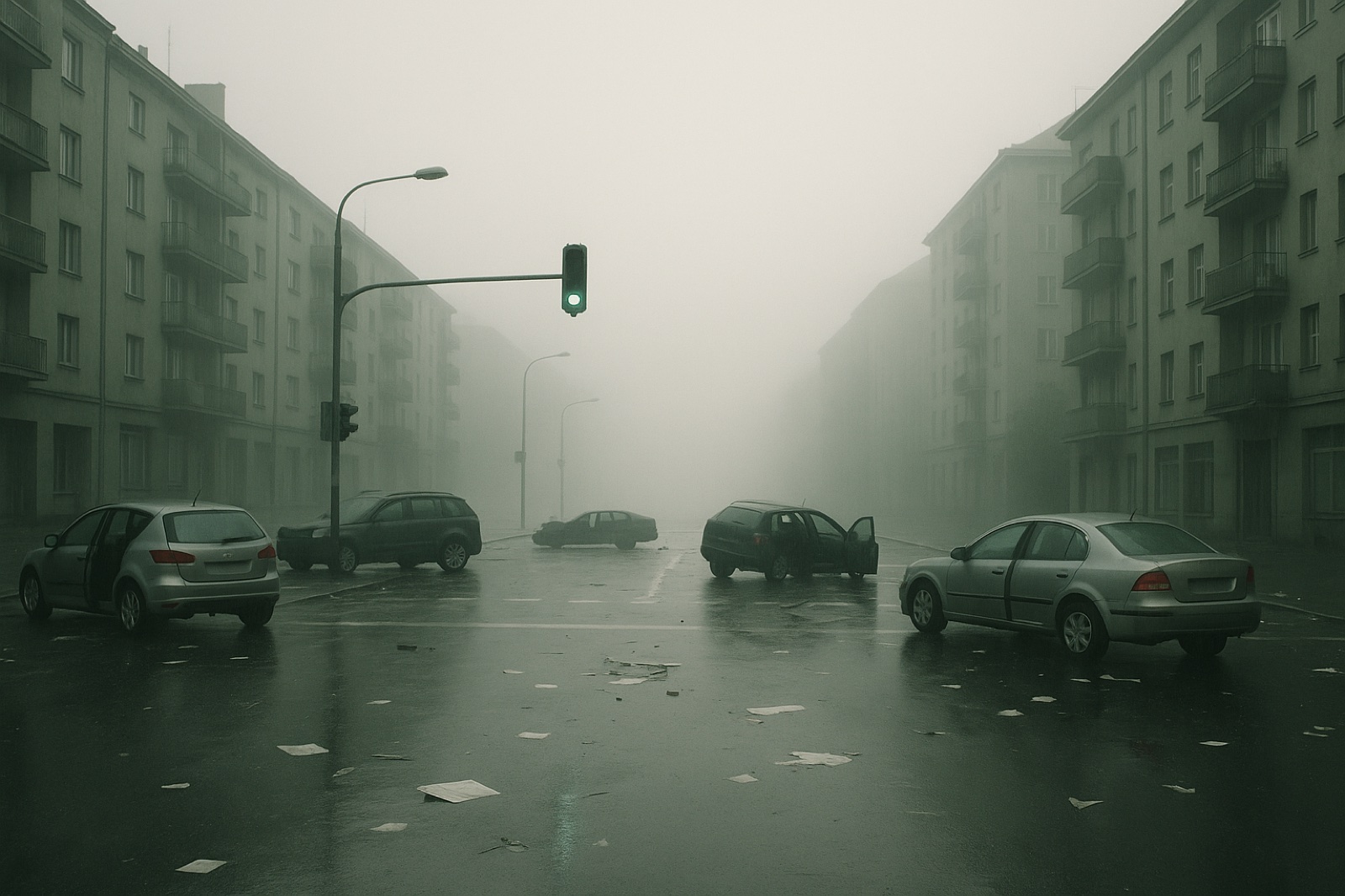
A man is stopped at a red light. The light turns green. He does not move. Behind him the horns start, then the shouting, then somebody gets out and bangs on his window. He is not asleep and he is not drunk. He has just gone blind, sitting there, in the middle of an ordinary afternoon.
Here is the part most readers do not expect. He has not gone dark. He describes it as being lost in a fog, a thick white fog, milky and bright. The blindness in this novel is white. From the first page, José Saramago takes the one thing everybody assumes about blindness and turns it inside out. These people are not plunged into night. They are drowned in light.
If you have just finished the book and you are stuck on the woman who never goes blind – why her, why she stays, what it costs her – this piece is about the meaning of Blindness by Saramago, and about the question the novel keeps circling back to: what do you owe people once you have seen them?
What Blindness by José Saramago is about
Blindness (Ensaio sobre a Cegueira, literally Essay on Blindness) is a 1995 novel by the Portuguese writer José Saramago, who won the Nobel Prize in Literature in 1998. Giovanni Pontiero’s English translation appeared in 1997. Fernando Meirelles directed a film version in 2008, and Saramago wrote a sequel, Seeing, in 2004.
The story runs like this. An unnamed man in an unnamed city goes blind at a traffic light. The stranger who kindly drives him home steals his car. The eye doctor who examines him goes blind that night, and so does everyone who sat in the waiting room. Within days the government panics and herds the blind into a disused mental hospital, guarded by soldiers with orders to shoot.
One person does not go blind: the doctor’s wife. She lies. She tells the officials her sight has gone too, so that they will not take her husband away without her. She walks into the quarantine on purpose, seeing everything.
That is the engine of the whole book. Everyone else is inside the fog. She is inside the building.
A city where everyone is named for their eyes
Nobody in this novel has a name. Not one person. They are the doctor, the doctor’s wife, the first blind man, the first blind man’s wife, the girl with the dark glasses, the old man with the black eyepatch, the boy with the squint, the car thief.
Read that list again. Almost every one of those labels is something you could only know by looking.
Dark glasses. A black eyepatch. A squint. Saramago names his people by their appearance in a world where appearance has stopped existing. The boy with the squint will be called that forever, by a book full of people who will never see his face. The girl’s dark glasses, worn out of vanity before any of this started, become pure costume, kept on for an audience that is gone.
It is a quiet, brutal joke, and it runs for three hundred pages. Every time you read one of those names you are doing the one thing none of the characters can do. You are looking at them.
The prose does the same trick. Saramago writes almost without punctuation: commas where sentences should end, no quotation marks, no “he said,” no line breaks between speakers. Dialogue arrives as a run of voices and you have to work out who is talking from what they happen to say. Which is exactly how the people in this book now live, in a room full of voices, identifying each other by sound and guesswork. The novel does not describe blindness. It hands you a small piece of it and makes you read through it.
Inside the asylum
The quarantine section is hard, and it is better said plainly than skated over. Fifteen rules are read out over a loudspeaker to people who can no longer read anything else. Leaving the building without authorisation means being shot. The internees must burn their own dead. If a fire starts, nobody is coming.
Then one ward gets hold of a gun.
The man with the gun declares himself in charge of the food. First he demands the other wards hand over their valuables. When the jewellery runs out, he demands the women. The women go, because the alternative is starving the people waiting behind them. One of them dies of what is done to her. Saramago does not dress that up and does not use it for effect. He reports it.
And then the doctor’s wife takes a pair of scissors and kills him.
She does it because she is the only person in the building who can aim.
That is the hinge of the novel, and it is not a triumph. Everything about her that could be called a gift – that she can find the food, find the door, find the man’s throat – is the same reason the job lands on her. Nobody votes for it. The ability is the assignment.
What sight actually costs the doctor’s wife
This is where Blindness stops being a disaster story and becomes something stranger.
Think about what the other characters get to not know. They do not know how filthy they are. They do not know what the corridors look like, or the courtyard, or the bodies. They live inside a white fog, and the fog is, in its way, a mercy.
She gets none of it. She sees the floors. She sees the dead. She sees what the women look like when they come back down the corridor. She has to ration, organise, bury, lie and decide, and she can never once say the thing everybody else can say honestly, which is: I did not know.
Saramago is careful to keep this a burden rather than a superpower. She gets exhausted. She gets resentful. Out in the ruined city, scavenging for people who cannot scavenge for themselves, she simply stops in the street and cries, and the only thing in the entire novel that comes to comfort her is a stray dog, which licks the tears off her face and then follows her home. The book calls it the dog of tears. Of all the humans she is keeping alive, not one of them is the one who notices.
Then there is the rain.
Later in the book the three women in the group – the doctor’s wife, the girl with the dark glasses and the first blind man’s wife – strip on a balcony during a downpour and wash themselves and their clothes in the falling water. It is the most beautiful scene in the novel, and it is also the loneliest one. Two of them are simply clean at last. The third is the only one who can see how dirty they had been, and the only one who will carry the picture of it afterwards.
The church with its eyes covered
There is a scene near the end that readers argue about, and it deserves to be described honestly rather than softened.
The doctor’s wife walks into a church packed with blind people praying. She looks up and realises that every image in the building has been blinded. The statues have white cloths tied over their eyes. The painted figures have had their eyes struck out with white paint. Somebody did it deliberately, one by one, and then left.
When she says it out loud, the congregation panics and stampedes into the street.
Saramago was, by his own long public record, a fierce critic of the church, and the scene is not a compliment. Reading it as secretly devotional would be dishonest. But look at what he actually built there. A room full of figures whose entire job is to see you, and someone has gone round covering the eyes. And notice what empties the church. It is not the blinding, which had been sitting above their heads the whole time. It is being told about it. The congregation could kneel in front of covered eyes indefinitely. What they could not survive was information.
What Blindness by Saramago really means
Near the end, the doctor and his wife have a short exchange about why any of it happened. It lands on the line that has followed the book ever since: that they did not go blind, they are blind – blind people who can see, but do not see.
Because Saramago writes dialogue without attribution, you cannot quite tell which of the two says it. That is the right way round. It is not a diagnosis one character delivers about everybody else. It is a verdict left sitting in the room with the reader.
And that distinction – between people who cannot see and people who can see and do not – is one of the oldest we have.
There is a story Jesus told about a man beaten and left at the side of a road (Luke 10). Three men come past him. All three have working eyes, and the story is careful about this: it says each of them saw him. Two looked and kept walking. The third looked, and it cost him – his oil, his wine, his animal, his time, and the money he left with an innkeeper on his way out.
The difference between those three men is not eyesight. All three had the information. What separated them was whether they let seeing make a claim on them.
And notice why the story got told at all. Somebody had asked for a definition of the word neighbour. He wanted a boundary, a manageable list of the people he was obliged to notice. What he got back was not a definition. It was one man who did not manage to look away, and a question about which of the three you would call a neighbour.
That is the doctor’s wife, without the halo. She never set out to be good. She chose her husband, told a lie at a desk, and walked into a building. The seeing did the rest.
The ending of Blindness, and why it does not thank her
The blindness lifts the way it arrived, with no reason and no warning. The first blind man gets his sight back first, mid-conversation, while she is reading aloud to the group. By the next morning the others can see too. Outside, the city goes off like a party.
And the last thing the novel does is walk her to the window.
She looks down at the wrecked street full of people shouting and singing. Then she looks up, and the sky is white. For one second she thinks her turn has come. Fear makes her drop her eyes. The city is still there.
That is the ending. No recognition, no thank you, no explanation. The book gives the woman who carried everybody a single moment of pure terror and then hands her back the view.
It is a colder close than most readers want, and it is the honest one. She is not repaid for seeing. She gets to keep seeing, which was always both the gift and the bill.
Blindness is not really a book about an epidemic, and it never was. It is a book about the small number of people in any disaster who can see exactly what is happening, and what it does to them when they will not look away.
If this novel got under your skin, you might also want our reading of The Road by Cormac McCarthy, another story about keeping people human when the structures are gone, and what Never Let Me Go is really about, which asks what happens to people who can see their situation clearly and still do not run. And if the doctor’s wife felt uncomfortably familiar to you, our free caregiver burnout check is for the people who end up being the one who notices everything.
Let’s Talk About It
Here is the question the novel leaves on the table. Was the doctor’s wife right to hide her sight when she walked into the quarantine, or did the people in that ward have a right to know that somebody in the room was watching them? Readers split hard on this one. Tell us where you land in the comments.
If the idea of actually seeing what is in front of you – and of God turning up in the ordinary, unglamorous parts of a day rather than the dramatic ones – is something you want to sit with, this free guide was written for exactly that.
Questions People Ask About Blindness by José Saramago
What is the meaning of Blindness by José Saramago?
Blindness by José Saramago (1995) is about what it costs to be the one person who can see. An epidemic of white blindness takes an entire city, but the doctor’s wife keeps her sight and hides it so she can stay with her husband in quarantine. The novel treats her sight as a burden rather than a rescue: she is the one who must bury, ration, decide and kill, and she is the only one who can never claim she did not know. Its closing idea is that most people are not sightless but blind, meaning people who can see and choose not to.
Why does the doctor’s wife not go blind in Blindness?
Saramago never explains it. In Blindness, the doctor’s wife is the only character who keeps her sight, and the novel gives no medical or moral reason for it, just as it gives no reason for the epidemic itself. She lies to the authorities and claims to be blind so that she will not be separated from her husband, an ophthalmologist, and is interned with him. Her sight functions as a structural device rather than a reward, making her the group’s eyes and its conscience.
What happens at the end of Blindness by Saramago?
At the end of Blindness, the epidemic lifts as suddenly and inexplicably as it began. The first blind man recovers his sight while the doctor’s wife is reading aloud to the group, and by the next morning the others can see again as the city celebrates. The doctor’s wife goes to the window, looks up at a blank white sky, and for a moment believes she is going blind at last. The fear makes her lower her eyes, and the city is still there. The novel gives her no thanks and no explanation.
Why is the blindness white in Saramago’s Blindness?
In Blindness, victims do not lose their sight to darkness. They describe a thick, milky whiteness, like being lost in a bright fog, which is why the illness is called the white sickness in the novel. The inversion matters: Saramago’s blind are not deprived of light but flooded with it, which makes the condition feel less like an absence than like a glare that erases everything in front of them.
Why do the characters in Blindness have no names?
No character in Blindness is ever named. They are identified by description instead: the doctor, the doctor’s wife, the girl with the dark glasses, the old man with the black eyepatch, the boy with the squint, the first blind man, the car thief. Almost every one of those labels depends on appearance, so the novel keeps naming people by details that nobody inside the story can see any more. Saramago paired this with a prose style that drops quotation marks and speaker tags, so readers must identify voices by inference, much as the blind characters do.
Social Share Posts
- Nobody in Saramago’s Blindness has a name. They’re “the girl with the dark glasses,” “the boy with the squint,” “the old man with the black eyepatch.” Every label is something you could only know by looking. The whole book is a quiet joke at your expense. #Blindness #Saramago
- The thing I missed on my first read of Blindness: the doctor’s wife isn’t lucky. She’s conscripted. She can find the food, find the door, find the man’s throat, so all of it becomes her job. The ability IS the assignment.
- Saramago’s Blindness ends without thanking the one woman who carried everyone. She just looks up, sees a white sky, gets one second of terror, and goes back to looking. Coldest, most honest ending I’ve read in years.