 0
0
 0
0
There is a kind of night that does not really end when the sun comes up. You lie there with the same thought going in circles. You have prayed about it. You have gone quiet about it. And tomorrow is going to arrive whether you have made peace with it or not.
Jacob had a night like that. The story of Jacob wrestling with God is one of the strangest few paragraphs in the whole Bible, and most people remember the same two details from it: he got a new name, and he walked away limping. What almost nobody repeats is a single line a prophet adds centuries later, which tells us exactly how Jacob won that fight.
Because the text does say he won. That part surprises people.
Jacob Wrestling With God: What the Text Actually Says
Jacob was on his way home, and home was the problem. Twenty years earlier he had taken his older brother’s blessing by deception and run for his life. Now he was walking back toward that brother. His scouts returned with a report: “We came to thy brother Esau, and also he cometh to meet thee, and four hundred men with him” (Genesis 32:6).
His reaction takes one verse and needs no explaining: “Then Jacob was greatly afraid and distressed” (Genesis 32:7). He prays, and the prayer is not polished. It is closer to panic: “Deliver me, I pray thee, from the hand of my brother, from the hand of Esau: for I fear him” (Genesis 32:11). If you have ever wondered how that brother actually felt about all this, the answer in the strange story of Esau and the word Genesis uses for him is not the one most of us were taught.
Then Jacob does something odd. He moves everyone he loves to the far side of the water — two wives, two servants, eleven sons, everything he owns — across the ford of the Jabbok (Genesis 32:22-23). He empties his own side of the river. And then:
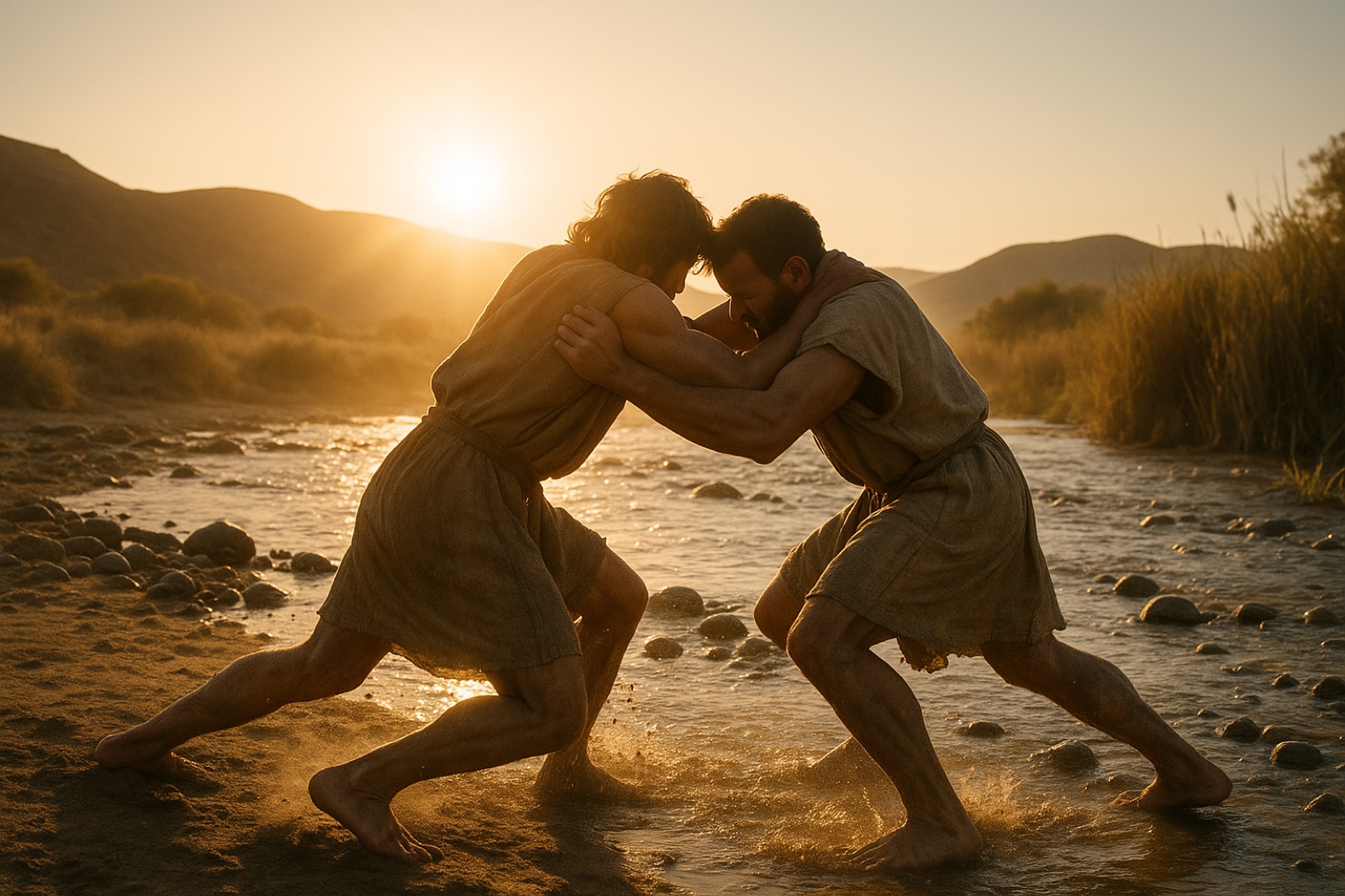
“And Jacob was left alone; and there wrestled a man with him until the breaking of the day.” — Genesis 32:24, KJV
Notice the order. Alone first. Then the fight. There are no witnesses to the most important night of his life.
The Injury Does Not Happen the Way You Think
Here is the verse that quietly reorders the whole scene:
“And when he saw that he prevailed not against him, he touched the hollow of his thigh; and the hollow of Jacob’s thigh was out of joint, as he wrestled with him.” — Genesis 32:25, KJV
Read that slowly. Jacob is not injured because he is being overpowered. He is injured after the stranger sees that Jacob is not being overpowered. And it is not a blow. It is a touch. One touch, and a grown man’s hip comes out of its socket.
Which tells you what kind of fight this was. Whoever Jacob was holding onto could have ended it at any second and did not. All night long.
And what does Jacob do with a dislocated hip? He holds on harder. “And he said, Let me go, for the day breaketh. And he said, I will not let thee go, except thou bless me” (Genesis 32:26). Jacob is the one gripping. Jacob is the one setting terms.
The Bible Says Jacob Prevailed — Twice
You will often hear that Genesis leaves the outcome open, that nobody really wins this match. Genesis does not leave it open.
“And he said, Thy name shall be called no more Jacob, but Israel: for as a prince hast thou power with God and with men, and hast prevailed” (Genesis 32:28).
Hast prevailed. And the prophet Hosea, retelling the same night generations later, repeats it: “Yea, he had power over the angel, and prevailed” (Hosea 12:4).
Twice, plainly, in two different books. Jacob won.
Hosea Says How He Won, and Almost Nobody Repeats It
Hosea 12:4 has two halves, and the second half is the gold in this entire story:
“Yea, he had power over the angel, and prevailed: he wept, and made supplication unto him…” — Hosea 12:4, KJV
He wept. He made supplication — which is an old word for begging.
So here is the full record of the only wrestling match in scripture where a human being prevails over heaven: the winner cried, and pleaded, and would not let go. That is the technique. There is not one word about strength anywhere in it. Hosea even sets it up in the verse before, reaching back to Jacob grabbing his twin’s heel in the womb (Hosea 12:3) — Jacob was always a man who grabbed things and held on.
Genesis calls it “power with God.” What that power looked like in practice was tears and a grip.
He Asked for a Name and Got a Blessing Instead
Jacob has one question left, and he asks it: “And Jacob asked him, and said, Tell me, I pray thee, thy name. And he said, Wherefore is it that thou dost ask after my name? And he blessed him there” (Genesis 32:29).
He asks who. He gets a question back. And then a blessing.
Sit with that for a second, because it is most of our prayer life. Jacob walks away from a face-to-face encounter without the one piece of information he requested. He asked for identification and was handed a blessing. Most of us ask God for information too — will this work out, is this the right choice, how long is this going to last — and what comes back is almost never the data.
He also walks away with a different name, which is what God seems to do instead of handing out labels. Scripture is full of it: new names given at the exact moment a person’s own definition of themselves has fallen apart. It is a pattern worth noticing if you have ever taken a quiz to find out who you are — the Bible never once assigns anybody a type, but it hands out new names constantly.
As for who the wrestler actually was: the text genuinely does not settle it into one label, and it is worth being precise about that rather than tidy. Genesis 32:24 says “a man.” Jacob himself concludes something much bigger — “And Jacob called the name of the place Peniel: for I have seen God face to face, and my life is preserved” (Genesis 32:30), a name that joins the Hebrew words for face and God, with the verse supplying its own meaning. Hosea says “the angel.” Jewish readings have often taken it as an angel; Christian readings have often read it as God appearing in human form. Genesis is clear about what Jacob believed happened. It simply never gives the reader the name Jacob asked for. The refusal in verse 29 is still in force for all of us.
There is even a small wrinkle most readers pass straight over: the place is Peniel in verse 30 and Penuel in verse 31. Two spellings of the same name, one verse apart.
Then Israel Built a Food Custom Around the Limp
“And as he passed over Penuel the sun rose upon him, and he halted upon his thigh” (Genesis 32:31).
The night ends. The sun comes up. And he limps out of it.
Then comes a verse that most retellings drop entirely:
“Therefore the children of Israel eat not of the sinew which shrank, which is upon the hollow of the thigh, unto this day: because he touched the hollow of Jacob’s thigh in the sinew that shrank.” — Genesis 32:32, KJV
A nation’s eating practice — still kept today, the sinew traditionally identified with the sciatic nerve and removed from the hindquarters of an animal — traces back to one man’s hip on one night by a river. Think about what that means. Israel did not build a food custom around the new name. It built one around the injury.
The wound is what got remembered.
The Turn: You Can Prevail and Still Limp
Line up everything this story calls winning. The man who prevailed ended the night crying. He ended it begging. He ended it without the answer he had asked for. And he ended it unable to walk properly again for the rest of his life.
Genesis calls that prevailing.
Which means prevailing with God was never about out-muscling God. You cannot, and the story is not pretending otherwise — one touch settled the question of who was stronger. What the text is describing is something else entirely: a person who would not let go of God, and who paid for it with a permanent change in how he walked.
He asked who God was. God blessed him instead, and let him keep the limp.
And look at what the limp actually did for him. A new name can be explained away or forgotten. A hip cannot. Every step he took for the rest of his life, his own body reminded him that he had met God and lived. The wound was not the price of the blessing. The wound was the part of the blessing he could never misplace.
Here is the last thing, and it is almost funny. The very next morning, the brother with four hundred men “ran to meet him, and embraced him, and fell on his neck, and kissed him: and they wept” (Genesis 33:4). Jacob spent a whole night fighting for a blessing to survive a battle that turned out to be a reunion. He had prepared for war and walked into an embrace.
He was not wrong to fight all night. He was just fighting about the wrong thing, and God gave him the blessing anyway.
What to Do With This Tomorrow Morning
Jacob’s two recorded lines from that night are worth copying, because neither one is religious language. In Genesis 32:11 he says, in effect, I am scared he is going to kill us. In Genesis 32:26 he says, I am not letting go until you bless me. No polish. No formula. He told God the actual truth and then made the actual ask.
Most of us pray the tidied-up version. We name the acceptable concern instead of the real one, and we make a request so vague that nothing could ever answer it. Jacob did the opposite, and scripture says he prevailed.
If you are honestly not sure where you stand with God right now — not where you feel you ought to be, but where you actually are — our free How Close Am I to God? assessment is a short, plain-spoken way to look at that without anybody watching.
Actions to Take
- Say the blunt version out loud, once. Take two minutes somewhere you will not be overheard and tell God the real thing in the words you would use with a close friend — not the polite version. Jacob’s was “I am afraid he will kill us.” Yours might be shorter than that.
- Make one ask specific enough to be answered. Write it on anything you have — the back of a receipt, a note on your phone — in one sentence, with a name, a date, or a number in it. Vague prayers are easy to pray and impossible to notice being answered.
- Name your limp. Write one sentence about what a hard season has cost you that has not gone away. Underneath it, write one thing you know now that you would not have known without it. Keep both sentences together. That pairing is the whole story of Peniel in your own handwriting.
Journaling Prompts
- What have you quietly stopped asking God for out loud? When did you stop, and what happened just before that?
- Jacob asked for a name and was given a blessing instead. What have you been given in place of the answer you actually asked for — and have you counted it yet?
- Where do you walk differently than you did five years ago? Not better or worse. Differently.
A Prayer for the Long Night
God, I am tired of praying the tidy version of this. The truth is I am afraid, and I have been afraid about it for longer than I have admitted to anyone. I am not going to pretend I have peace about it just to end this prayer politely — I am holding on until something changes in me or in it. If the answer comes with a limp, I would rather have the limp than let go. Stay in this with me until morning. Amen.
Let’s Talk About It
Do you think Jacob’s limp was the cost of the blessing, or part of the blessing itself? There is a real case for both, and the answer changes how a person reads every hard season they have been through. Leave a comment and tell us which way you land — we read every one.
Share This
- Genesis says Jacob prevailed against heaven. Hosea 12:4 says how he did it: “he wept, and made supplication.” The winning move was crying and refusing to let go.
- Jacob asked God for a name. He got a blessing instead. I have been thinking about that all week.
- Israel never built a food custom around Jacob’s new name. They built one around his limp (Genesis 32:32). The wound is what got remembered — and honestly, that is how it works for most of us too.
Questions People Ask About Jacob Wrestling With God
Who did Jacob wrestle with?
The Bible describes the opponent three different ways and never settles on one label. Genesis 32:24 calls him “a man.” Jacob himself names the place Peniel and says, “I have seen God face to face, and my life is preserved” (Genesis 32:30). Hosea 12:4, looking back on the same night, says Jacob “had power over the angel.” Jewish readings have often understood an angel; Christian readings have often understood God appearing in human form. What Genesis states plainly is what Jacob concluded — that he had met God directly and survived it. The one thing the passage refuses to give is the name Jacob actually asked for.
Did Jacob really win the wrestling match?
Yes, by the Bible’s own wording, twice. Genesis 32:25 says the stranger “prevailed not against him,” and Genesis 32:28 says directly to Jacob, “hast prevailed.” Hosea 12:4 repeats that he “prevailed.” But Hosea also records how: “he wept, and made supplication unto him.” Jacob won by crying, begging, and refusing to let go — and he left the fight with a dislocated hip and a permanent limp.
Why did Jacob end up with a limp?
During the fight, Genesis 32:25 says his opponent “touched the hollow of his thigh; and the hollow of Jacob’s thigh was out of joint.” The wording matters: the injury came from a single touch, and it came after the stranger saw that he was not overpowering Jacob — not from being beaten in a fair contest. Genesis 32:31 then reports that when the sun rose, Jacob “halted upon his thigh.” Scripture never says the limp healed.
What does Peniel mean?
Genesis 32:30 supplies its own definition: Jacob “called the name of the place Peniel: for I have seen God face to face.” The name joins the Hebrew words for “face” and “God.” One verse later, in Genesis 32:31, the same location is spelled Penuel — a variant of the identical name, sitting one line apart in the same chapter.
Why don’t Jews eat the sinew of the thigh?
Genesis 32:32 traces the practice straight back to that night: “Therefore the children of Israel eat not of the sinew which shrank, which is upon the hollow of the thigh, unto this day: because he touched the hollow of Jacob’s thigh in the sinew that shrank.” Jewish dietary practice still removes that sinew — traditionally identified with the sciatic nerve — from the hindquarters of an animal. It is a custom built to remember an injury rather than a victory.
Where is the story of Jacob wrestling with God in the Bible?
The account is in Genesis 32:22-32, at the ford of the Jabbok, on the night before Jacob met his brother Esau again after twenty years apart. Hosea 12:3-4 gives a short prophetic retelling of the same event and adds the detail that Jacob wept and made supplication. The reunion with Esau follows immediately in Genesis 33.