 0
0
 0
0
You have probably seen Luke 22:36 used as a weapon. Maybe in a comment thread, a meme, or a heated family conversation. “Jesus told His disciples to buy a sword. It’s right there in the Bible.” And it is right there. So if you have ever felt confused, you are not reading it wrong.
The same Jesus who said “Love your enemies” really did say “he that hath no sword, let him sell his garment, and buy one.” How do those two fit together? The answer is not hidden in a commentary somewhere. It is in the very next verse, and in what happened a few hours later that same night.
What Does Luke 22:36 Say?
Here are the words, with the verse just before it, because Jesus was answering His own question:
“And he said unto them, When I sent you without purse, and scrip, and shoes, lacked ye any thing? And they said, Nothing. Then said he unto them, But now, he that hath a purse, let him take it, and likewise his scrip: and he that hath no sword, let him sell his garment, and buy one.” (Luke 22:35-36, KJV)
The short answer: yes, Jesus said it. But Luke did not leave it hanging. In the next breath Jesus gives the reason, His friends show Him two swords, and He says “It is enough.” Then, a few hours later, a sword gets used, and Jesus stops it and heals the man it cut. You need the whole night to understand the one sentence.
The Night Jesus Said It
This was the Last Supper. It was the last meal Jesus ate with His friends before He was arrested. And the table was not calm.
At that same meal, “there was also a strife among them, which of them should be accounted the greatest” (Luke 22:24). Jesus told Simon Peter, “I have prayed for thee, that thy faith fail not” (Luke 22:32). Peter answered with big words: “Lord, I am ready to go with thee, both into prison, and to death” (Luke 22:33). Jesus told him that before the rooster crowed, he would deny Him three times.
So picture the room. Tired men. Arguing about rank. Promising more than they could deliver. Not quite hearing what Jesus was telling them. That is the room where the sword sentence was spoken.
And it starts with a memory. Earlier, Jesus had sent His followers out with almost nothing. “Carry neither purse, nor scrip, nor shoes” (Luke 10:4). A scrip was a traveller’s bag. They went empty-handed and depended on strangers to feed them and give them a bed. It worked. When Jesus asked if they had lacked anything, they said, “Nothing.”
“But now,” Jesus says. Things are about to change. The welcome is over. The days ahead will be hard, and the people who once opened their doors will not open them anymore.
“Sell His Garment”: The Price Jesus Named
Here is a detail most people read straight past. Jesus did not say “sell something you don’t need.” He said sell your garment.
In that world, a poor person’s outer garment was more than clothing. It was their blanket at night. The Law of Moses even protected it. If a lender took someone’s garment as a pledge for a loan, it had to be given back before sunset:
“For that is his covering only, it is his raiment for his skin: wherein shall he sleep?” (Exodus 22:27, KJV)
So “sell your garment” means “sell the thing you sleep under.” That is not a shopping list. That is emergency language. It is the kind of thing you say when you want someone to feel how serious a moment is.
And it gets stranger. The Greek word Luke uses for “garment” here is himation. It is the exact same word Luke used when Jesus taught, much earlier, “him that taketh away thy cloke forbid not to take thy coat also” (Luke 6:29). Same word, same Gospel. Earlier, Jesus said: if someone takes your cloak, let it go. Now He says: sell your cloak for a sword.
Luke’s readers would have heard that clash. It is a signal to slow down, because something bigger than a shopping instruction is going on.
Why Did Jesus Tell Them to Buy a Sword? Read Luke 22:37
The very next verse begins with the word “For.” That little word means: here is why.
“For I say unto you, that this that is written must yet be accomplished in me, And he was reckoned among the transgressors: for the things concerning me have an end.” (Luke 22:37, KJV)
Jesus is quoting Isaiah 53:12, a prophecy about God’s servant who “was numbered with the transgressors; and he bare the sin of many.” In other words, Jesus is about to be counted as a criminal. Treated like an outlaw. Put in the same group as law-breakers.
The word Luke uses for “transgressors” in this verse is anomoi, which means “lawless ones.” And think about how things looked a few hours later. When the crowd came to arrest Jesus, what did they find? A small band of men in a dark garden at night, with swords. To anyone watching, it looked exactly like a group of outlaws.
There is one more thread here. The words “be accomplished” and “have an end” in Luke 22:37 come from the same Greek root, tel-, which is about finishing something. It is the same root as the word Jesus spoke on the cross in John 19:30: “It is finished.” Jesus was not planning a fight. He was describing the finish line.
“Lord, Behold, Here Are Two Swords”
Now watch how the disciples respond.
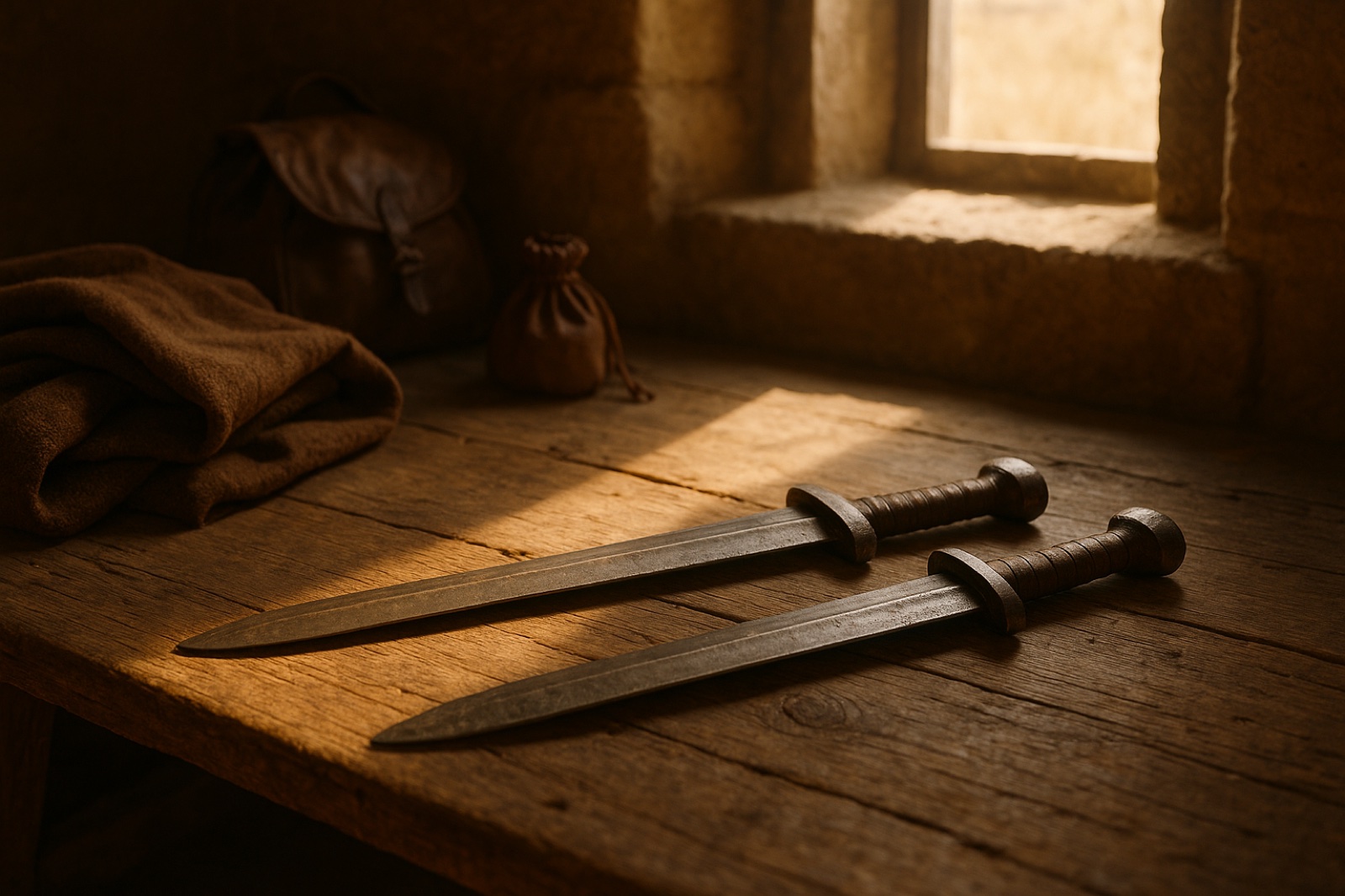
“And they said, Lord, behold, here are two swords. And he said unto them, It is enough.” (Luke 22:38, KJV)
Two swords. For a whole group of disciples about to face an armed crowd that came with the chief priests themselves (Luke 22:52). If Jesus had been organising real armed protection, two would never be “enough.”
People read “It is enough” in two ways, and it is honest to say both are possible. It might mean “two will do,” because all that was needed was for the prophecy to be fulfilled, not for anyone to win a fight. Or it might be the sound of Jesus ending a conversation His friends have misunderstood again: “Enough of this.” Either way, the result is the same. Nobody goes out to buy more. And nobody is told to use the two they have.
There is a fair question here, too. The purse and the bag in verse 36 sound quite literal. The disciples really would need money and supplies in the years ahead, when doors closed on them. So was the sword literal as well? Sincere Christians have answered that differently. What the text itself makes clear is what Jesus did when a sword actually came out.
A Few Hours Later: “Suffer Ye Thus Far”
After supper, Jesus went to the Mount of Olives to pray. He knelt “about a stone’s cast” away from His friends and prayed so hard that “his sweat was as it were great drops of blood” (Luke 22:41, 44). They fell asleep. (We looked at that night and how Jesus prayed in another article.)
Then the crowd arrived. And the swords from that supper conversation come back:
“When they which were about him saw what would follow, they said unto him, Lord, shall we smite with the sword? And one of them smote the servant of the high priest, and cut off his right ear.” (Luke 22:49-50, KJV)
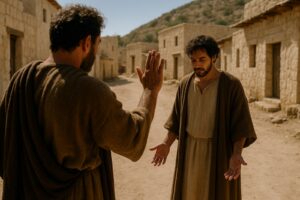
Read that slowly. They asked Jesus a question. And one of them struck before Jesus answered. John’s Gospel tells us who swung the sword and who got hurt: “Then Simon Peter having a sword drew it… The servant’s name was Malchus” (John 18:10). The same Peter who said, “I am ready to go with thee, both into prison, and to death.”
Here is Jesus’s answer:
“And Jesus answered and said, Suffer ye thus far. And he touched his ear, and healed him.” (Luke 22:51, KJV)
“Suffer ye thus far” means something like “Let it go this far, and no further.” Or simply: “No more of this.” Luke is the only Gospel writer who tells us Jesus healed the ear. Matthew adds what Jesus said to the man with the sword: “Put up again thy sword into his place: for all they that take the sword shall perish with the sword” (Matthew 26:52). John adds: “the cup which my Father hath given me, shall I not drink it?” (John 18:11).
Then Jesus turned to the crowd: “Be ye come out, as against a thief, with swords and staves?” (Luke 22:52). The word translated “thief” there really means a bandit, an armed outlaw. We unpacked that word in who the thief on the cross really was. Less than a day later, Luke says Jesus was crucified between two “malefactors, one on the right hand, and the other on the left” (Luke 23:33). “Reckoned among the transgressors” came true all the way to the end.
Count the word “sword” in Luke 22. It appears in verses 36, 38, 49 and 52. The chapter keeps circling back to it. And in the one moment a sword was actually used, Jesus undid the damage with His own hand.
So Does Luke 22:36 Mean Christians Should Carry Weapons?
This verse gets pulled into modern arguments about weapons and self-defence, in many countries. This article is not going to settle a policy debate, and it is not trying to. Christians who love Jesus and read their Bibles carefully still disagree about self-defence.
But here is what Luke 22 itself shows, whatever else you believe:
- Jesus gave His own reason for the sword saying, and the reason was a prophecy being fulfilled, not a battle plan (Luke 22:37).
- Two swords were “enough” for the whole group, which rules out real armed protection.
- No sword was used to defend Jesus with His approval. The one time it happened, He stopped it and healed the wounded man.
- Later that night Jesus said, “if my kingdom were of this world, then would my servants fight” (John 18:36).
Using Luke 22:36 on its own, cut away from the verses around it, is a lot like what Peter did in the garden. It grabs the sword and skips the answer.
The Swords We Keep Ready
Most of us will never hold a real sword. But we all keep two swords handy.
The sharp reply you have already written in your head. The screenshot you saved, just in case. The old mistake you can bring up the next time you argue with your brother, your spouse, your coworker. We carry them because they make us feel ready. Like Peter: “Lord, I am ready.”
And like Peter, we often ask God a question and swing before the answer comes. “Should I say something?” Swing. The message is sent before the prayer is finished.
Look at what Jesus did in that moment. He did not shame Peter in front of everyone. He did not give a long speech. He said, “No more of this,” and then He reached out and touched the person who got hurt. The very last healing miracle Luke records before the cross was cleaning up after His own friend’s temper.
Here is the part that may surprise you. Jesus had already prayed for Peter before any of it happened (Luke 22:32). He knew Peter would swing. He knew Peter would deny Him. And He prayed for him anyway, and told him, “when thou art converted, strengthen thy brethren.”
So if you have swung the sword this week, there are two words for you in Luke 22. The first is “Enough.” Put it down. The second is the touch on the ear. It is not too late to go back to the person who got cut.
Actions to Take
- Read the whole night in one sitting. Open Luke 22:35-53 and read it straight through. It takes about five minutes. Notice every time the word “sword” appears, and what happens next.
- Find your “two swords.” Write down one sharp thing you are holding onto, ready to use: a message draft, an old hurt you plan to bring up, a comeback. Next to it, write “It is enough.” Then delete the draft or cross it out.
- Touch the ear. Think of one person you cut with words recently. Send them a short message today that names what you did, with no excuse attached. For example: “What I said yesterday was sharp, and it wasn’t fair to you. I’m sorry.”
Journaling Prompts
- When you feel threatened or misunderstood, what is the first “sword” you reach for?
- Think of a time you asked God for direction but acted before you got an answer. What were you afraid would happen if you waited?
- Peter’s loudest promise came right before his hardest failure. Is there a promise you have made to God that you are quietly afraid you cannot keep?
A Prayer for When I Want to Swing
God, I’ll be honest. I like feeling ready. I keep my sharp words close, and sometimes I swing before I’ve even finished asking you what to do. Thank you that Jesus didn’t give up on Peter, and that Jesus prayed for him before he ever failed. Help me hear “enough” and actually put the sword down. And show me whose ear I need to go back and help heal today. Amen.
“They showed Him two swords. He showed them healing.”
Discussion Question
When Jesus said “It is enough” in Luke 22:38, do you think He meant “two swords will do” or “enough of this talk”? Tell us which way you read it, and why, in the comments.
If this night in the garden has you wanting to see the rest of Jesus’s life up close, the swords, the healing, the cross and what came after, start with Matthew. The Gospel that records “all they that take the sword shall perish with the sword” is yours free, as an immersive PDF and a 28-chapter audiobook you can listen to on a walk.
Still have questions about what Jesus meant? You can dig deeper with our free What Jesus Teaches AI assistant (it opens in ChatGPT).
Share This
- Luke 22:36: “he that hath no sword, let him sell his garment, and buy one.” Luke 22:37 starts with “For,” and gives the reason. Always read the next verse.
- The disciples showed Jesus two swords. He said, “It is enough.” A few hours later Peter used one, and Jesus touched the man’s ear and healed him. I never noticed how the whole night fits together.
- Peter asked, “Lord, shall we smite with the sword?” and swung before Jesus answered. I do that more than I want to admit.
Q&A: Luke 22:36 and the Two Swords
What does Luke 22:36 mean?
In Luke 22:36, Jesus tells His disciples at the Last Supper that anyone without a sword should sell a garment and buy one. The next verse, Luke 22:37, gives Jesus’s own reason: the prophecy of Isaiah 53:12 that “he was reckoned among the transgressors” had to be fulfilled. The saying warned that hard days were coming and that Jesus would be treated as a criminal. When the disciples produced two swords, Jesus said “It is enough,” and hours later He stopped a sword from being used and healed the man it wounded (Luke 22:49-51).
Did Jesus tell His disciples to buy a sword?
Yes. Luke 22:36 in the King James Version reads, “he that hath no sword, let him sell his garment, and buy one.” But Luke 22:37 immediately explains the purpose: fulfilling the Isaiah 53:12 prophecy that Jesus would be counted among lawbreakers. When the disciples showed Jesus two swords, Jesus said “It is enough” (Luke 22:38), and nobody was sent to buy more.
Why did Jesus say two swords were enough?
Two swords could not protect Jesus and His disciples from the armed crowd that arrested Jesus in Gethsemane, so “It is enough” in Luke 22:38 was not about winning a fight. It is read either as “two will do,” because only the fulfilment of Isaiah 53:12 was needed, or as Jesus ending a conversation the disciples had misunderstood. In both readings, Jesus did not want the swords used to defend Him, as Luke 22:51 and Matthew 26:52 show.
Who cut off the servant’s ear when Jesus was arrested?
Simon Peter cut off the right ear of Malchus, a servant of the high priest, during the arrest of Jesus in the garden. John 18:10 gives both names. Luke 22:51 is the only Gospel account that records Jesus touching the servant’s ear and healing him. Matthew 26:52 records Jesus telling Peter to put the sword away, “for all they that take the sword shall perish with the sword.”
Does Luke 22:36 support self-defence or carrying weapons?
Christians disagree about self-defence, and Luke 22:36 is often quoted in that debate. Within Luke 22 itself, Jesus explains the sword saying as the fulfilment of Isaiah 53:12, calls two swords “enough” for the whole group of disciples, and stops the only sword used on His behalf, healing the man it wounded. Jesus also said in John 18:36 that if His kingdom were of this world, His servants would fight. The passage does not present the swords as a plan for armed defence of Jesus.