 0
0
 0
0
Prodigal son repentance is usually told as a story about coming home. Read slowly, Luke 15 also holds a smaller detail that is easy to miss: on the road back, the younger son rehearses a three-part apology word for word, and he never gets to finish it. This page is the full text of the BGodInspired video on how to repent to God, set as readable prose with chapter links. It is written for anyone who has said sorry to God more than once and still is not sure it counted. Alongside Luke 15, it follows the Hebrew word shuv, the first words Mark records Jesus saying, the older brother, and Peter at two charcoal fires. For a practical, step-by-step companion, read How to Repent to God: What to Actually Say and Do.
Chapters
- 0:00 – The speech in the parked car
- 0:41 – The courtroom picture of repentance
- 1:09 – Shuv: repentance means turning around
- 1:51 – The first words Mark records Jesus saying
- 2:26 – The son in the far country
- 3:43 – The father runs and the speech goes unfinished
- 4:52 – The older brother outside
- 5:22 – Peter and the two charcoal fires
- 6:48 – So how do you repent to God?
- 7:41 – What changes the morning after
- 8:17 – A simple way to keep walking
The Speech in the Parked Car
You have probably done this. You sit in a parked car with the engine off, practicing what you are going to say before you walk inside. You try it one way, then softer, then you add one more line at the end, just in case they are still upset. The words have to be right. Don’t they?
There is a very old story about a young man who did exactly that. He wrote a speech in his head, and he practiced it the whole long walk home. And he never got to finish it. Whatever cut him off turns out to be the real answer to a question a lot of people type into a search bar late at night: how do I repent to God?
The Courtroom Picture Most of Us Carry
Most of us picture repentance like a courtroom. You stand up. You read the charges against yourself. You try to sound sorry enough. Then you wait, not sure anyone heard, not sure it counted. So you say it again the next night, and the night after that.
If that is you, you are not doing it wrong because you care too much. You have just been handed the wrong picture. The Bible’s own words for it paint a very different one, and the first one is surprisingly ordinary.
Shuv: Repentance as Turning Around
In the Old Testament, the Hebrew word behind turning to God is shuv. It is not a religious word. It means to turn around, to go back. It is what you do when you realize you have been walking the wrong way: you stop, you turn, and you head back the way you came.
The book of Lamentations says it like this: “Let us search and try our ways, and turn again to the LORD” (Lamentations 3:40). Search. Try. Turn. Not grovel. Turn.
The prophet Joel pushes it further. People in his day tore their clothes to show grief. Joel says, “rend your heart, and not your garments, and turn unto the LORD your God” (Joel 2:13). The show on the outside was never the point. The turn was.
The First Words Mark Records Jesus Saying
In the Gospel of Mark, the very first words Mark records Jesus saying are about this: “The time is fulfilled, and the kingdom of God is at hand: repent ye, and believe the gospel” (Mark 1:15).
Look at what comes right before the word repent. Not a threat. An announcement. Something good has come close, so turn around and see it. The way Jesus says it, repenting faces toward something, not only away from something.
But what does that actually look like when you are the one who blew it? For that, the story goes back to the young man on the road.
Prodigal Son Repentance Begins in the Far Country
Jesus tells his story in Luke chapter 15. A younger son asks his father for his share of the family’s wealth, leaves for a far country, and spends all of it. Then a famine hits. He ends up feeding pigs, so hungry he would have eaten what the pigs were eating.
Then comes one of the most honest lines in the whole Bible. Luke says, “he came to himself” (Luke 15:17). Before he turns toward home, he turns toward the truth. He stops pretending this is fine.
Notice what has not happened yet. Nobody has come to rescue him. Nobody has forgiven him. He is still sitting in the mud. The turn starts right there, with one honest thought. You do not have to clean yourself up before you are allowed to turn around.
So he writes his speech. Here it is, word for word: “Father, I have sinned against heaven, and before thee, And am no more worthy to be called thy son: make me as one of thy hired servants” (Luke 15:18-19).
It has three parts. I did wrong. I don’t deserve to be your son. So hire me, and let me work it off. That last line is the one we all add: the deal, the plan to earn our way back in. Keep your eye on it.
The Father Runs, and the Speech Goes Unfinished
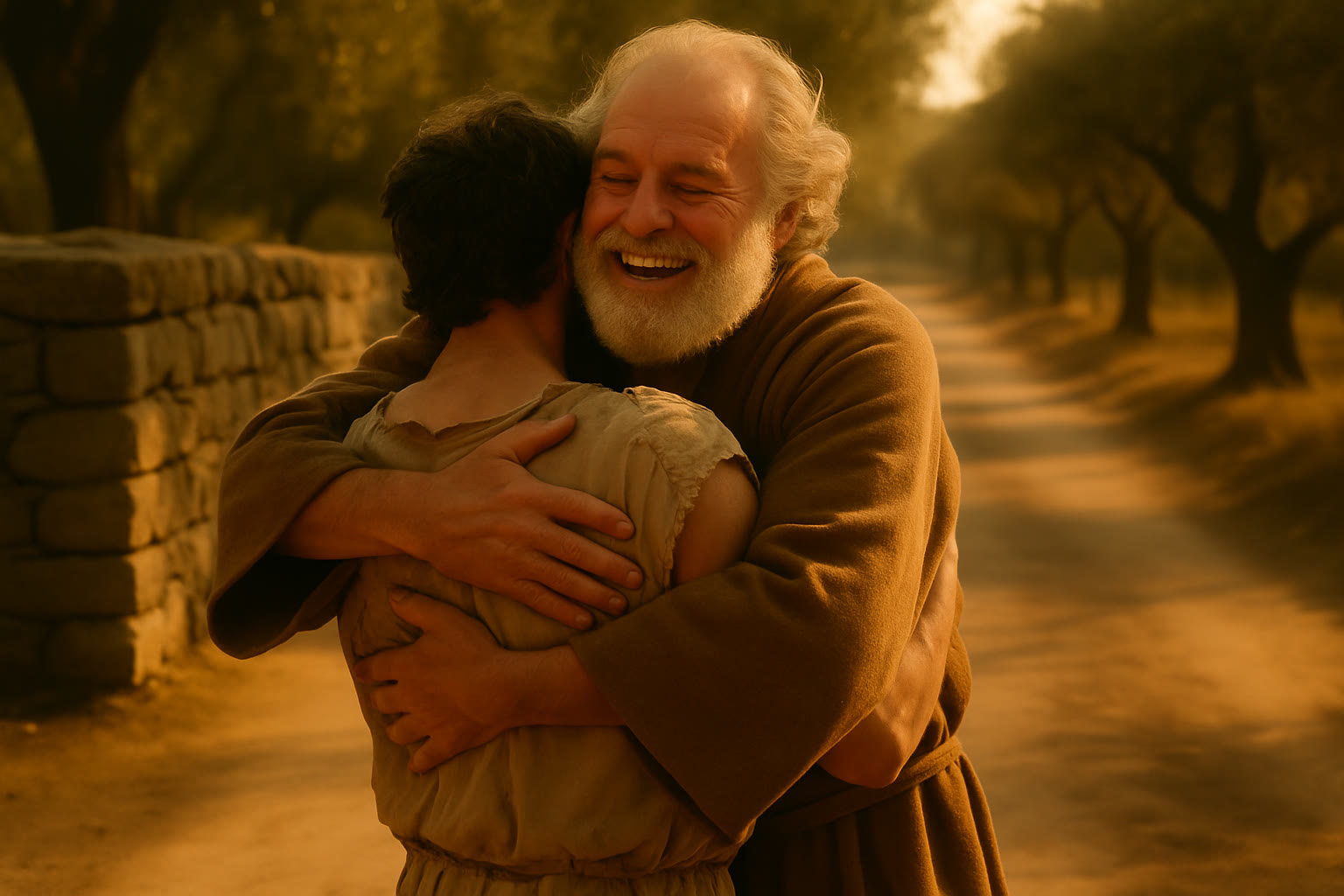
He is still a long way off when his father spots him. The father does not wait at the door with his arms crossed. Luke says, “when he was yet a great way off, his father saw him, and had compassion, and ran, and fell on his neck, and kissed him” (Luke 15:20).
Now listen to what the son says, with his face pressed into his father’s shoulder: “Father, I have sinned against heaven, and in thy sight, and am no more worthy to be called thy son” (Luke 15:21).
That is where he stops. Or really, that is where he gets stopped. Compare it with the speech he rehearsed. The line about being a hired servant, the bargain, never gets said. Luke’s very next word is “But”: “But the father said to his servants, Bring forth the best robe, and put it on him; and put a ring on his hand, and shoes on his feet” (Luke 15:22).
A robe. A ring. Shoes. Not one of them is what you hand a hired worker. That is the unfinished speech. The father heard enough to know his son had turned around, and the bargaining part was never needed. He was not coming back to be hired. He was coming back to be home.
The Older Brother Standing Outside
There is a part of this story people often skip. There is an older brother. He is out in the field, hears the music, finds out why, and he is so angry he will not go inside. Luke says, “therefore came his father out, and intreated him” (Luke 15:28).
The father runs to the son who wasted everything, and he walks out to the son who never left. So turning back is not only for the obvious runaways. Sometimes it is for the one standing outside the party, keeping score.
Peter and the Two Charcoal Fires
One more picture, and this one has a small detail that almost everyone reads right past. The night Jesus was arrested, Peter said three times that he did not know Him. Part of that happened while he stood warming himself at a charcoal fire (John 18:18). Luke adds something painful: “And the Lord turned, and looked upon Peter” (Luke 22:61). “And Peter went out, and wept bitterly” (Luke 22:62).
Weeks later, after the resurrection, Peter comes ashore at dawn, and John tells us there is “a fire of coals there, and fish laid thereon, and bread” (John 21:9).
Here is the detail. The Greek word John uses for that charcoal fire, anthrakia, shows up only twice in the entire New Testament: once at the fire where Peter denied Jesus, and once there on the beach. It is as if Peter is brought back to the worst night of his life, on purpose, so a new ending can be written in the same place.
Then Jesus asks him one question, three times: “lovest thou me?” (John 21:15-17). Three denials. Three chances to say yes. No lecture about the rooster. Just, do you love me? And then, “Feed my sheep.” Here is your work. You are still in.
Look at what Jesus does not ask for. He does not make Peter go back through the whole night, line by line. He does not ask him to prove he is sorry. He asks about love. That is the question underneath all of this.
So How Do You Repent to God?
Put these pictures side by side and it gets simpler than we make it.
First, come to yourself. Stop pretending it is fine. Name the actual thing, out loud if you can.
Second, turn. Not a mood, a direction. What will you do differently tomorrow because of tonight?
Third, say it plainly. You can borrow the son’s words, or David’s in Psalm 51: “Create in me a clean heart, O God; and renew a right spirit within me” (Psalm 51:10). And leave off the bargain. You do not have to offer to work it off. You never could.
Fourth, let yourself be met. The son was still a great way off. He did not have to make it all the way to the door first. Psalm 51 says it this way: “a broken and a contrite heart, O God, thou wilt not despise” (Psalm 51:17).
What Changes the Morning After
Here is what changes. You wake up, and the first thing you feel is not the weight. You are not rehearsing a speech any more. It has already been heard.
But look at where both stories end. The son does not get forgiven and leave. He comes home, and he lives there. And Peter does not just get pardoned. A few verses later, Jesus says to him, “Follow me” (John 21:19).
Repenting is the turn. Walking with Jesus is what you do with the road after. And for most of us, the hard part is not the one big moment. It is tomorrow morning, and the morning after that.
If guilt keeps circling even after you have turned, this look at guilt versus conviction may help. And if you have never put your turning into words at all, this walk-through of the sinner’s prayer is a gentle place to start.
Sources
- All scripture quotations are from the King James Version: Lamentations 3:40; Joel 2:13; Mark 1:15; Luke 15:17-22, 15:28; Luke 22:61-62; John 18:18; John 21:9, 21:15-17, 21:19; Psalm 51:10, 51:17.
- Hebrew shuv (Strong’s H7725), the verb translated “turn” in Lamentations 3:40 and Joel 2:13: Open Scriptures Hebrew Bible (Westminster Leningrad Codex with lemma tagging).
- Greek anthrakia (“fire of coals”), occurring in John 18:18 and John 21:9 and nowhere else in the New Testament: MorphGNT tagging of the SBL Greek New Testament.
A Simple Way to Keep Walking
If you would like a simple way to keep walking, 30 Days Walking with Jesus was made for exactly that. It walks you through the Gospels one day at a time, in under ten minutes a day, with a short video and a full chapter read aloud. It is free, with no card required, because the words of Jesus should not sit behind a paywall.
You don’t need the perfect speech. Just turn around. You may find you are being met on the road.
Questions People Are Asking
Q: Why didn’t the prodigal son finish his apology?
A: In Luke 15 the younger son rehearses a speech that ends, “make me as one of thy hired servants.” When he reaches home, his father runs to him, and the son says only the first part. Luke’s next words are “But the father said to his servants, Bring forth the best robe.” The offer to work off his debt is never spoken, because the father interrupts with a robe, a ring and shoes.
Q: What does the Hebrew word shuv mean in the Bible?
A: Shuv (Strong’s H7725) is an everyday Hebrew verb meaning to turn back or return. It is the word translated “turn” in Lamentations 3:40, “Let us search and try our ways, and turn again to the LORD,” and in Joel 2:13, “rend your heart, and not your garments, and turn unto the LORD your God.” It pictures repentance as changing direction rather than performing sorrow.
Q: What does the prodigal son story teach about repentance?
A: The prodigal son story in Luke 15 shows repentance starting with honesty (“he came to himself”) and a turn toward home, before any rescue or forgiveness arrives. The father runs to meet the son while he is still far off, and the son’s planned bargain to become a hired servant is never needed. The father also goes out to the angry older brother, so the invitation reaches both sons.
Q: Why is the charcoal fire in John 21 significant?
A: The Greek word for a charcoal fire, anthrakia, appears only twice in the New Testament: John 18:18, where Peter warms himself while denying Jesus, and John 21:9, where Peter and the other disciples come ashore to find a fire of coals already burning. There Jesus asks Peter three times, “lovest thou me?” and tells him, “Feed my sheep,” restoring him in a setting that echoes his denial.
Q: How can I keep walking with Jesus after I repent?
A: Repentance is the turn, and a daily rhythm is what keeps you walking afterward. One simple option is 30 Days Walking with Jesus, which walks through the Gospels one day at a time in under ten minutes a day, with a short devotional video and a full-chapter audio reading each day. It is free, with no card required.
How to Repent to God (Why the Prodigal Son Never Finished His Speech) on YouTube