 0
0
 0
0
Somebody says it at a funeral, or over tea about a neighbour. “She was the salt of the earth.” Everyone nods. They mean she was plain and kind. No fuss. The kind of person who shows up with soup.
That is a lovely thing to be. But it is not quite what the phrase meant when Jesus first said it. The salt of the earth meaning in the Bible is sharper, and more hopeful, than a compliment for nice people.
And if you have ever felt small, or ordinary, or quietly useless, the original meaning was said for you.
Where “Salt of the Earth” Comes From
The phrase comes from one sentence in the Sermon on the Mount:
“Ye are the salt of the earth: but if the salt have lost his savour, wherewith shall it be salted? it is thenceforth good for nothing, but to be cast out, and to be trodden under foot of men.” (Matthew 5:13, KJV)
Look at who was listening. Matthew says Jesus saw “the multitudes” and went up a mountain, and “his disciples came unto him” (Matthew 5:1). The crowd had followed Him from Galilee and the towns around it. Fishermen. Farmers. Sick people. People nobody would have called important.
Now look at the verse just before. Jesus had been talking about people who get insulted and pushed around: “Blessed are ye, when men shall revile you, and persecute you” (Matthew 5:11). The very next words are “Ye are the salt of the earth.”
So the people the world looked down on are the ones Jesus called salt.
What Does “Salt of the Earth” Mean in the Bible?
Notice the grammar. Jesus did not say “try to become salt.” He did not say “if you work hard, one day you might be salt.” He said “Ye are.” It is a plain statement. And “ye” is plural. He was talking to the whole crowd together, not handing out a prize to the best person there.
We have seen this before in the same sermon. When Jesus said “poor in spirit,” He was not describing a virtue to reach for either. (We dug into that in what “poor in spirit” actually means.) The Sermon on the Mount keeps starting with what people already are, and only then talks about how to live.
Salt mattered a lot in that world. It kept fish and meat from rotting before anyone had a fridge. It made plain food worth eating. It was even part of worship. The law said, “with all thine offerings thou shalt offer salt” (Leviticus 2:13). A lasting promise was called “a covenant of salt for ever” (Numbers 18:19). Salt meant something that does not spoil.
That is the job Jesus handed to a hillside full of ordinary people.
The Greek Word Behind “Lost His Savour”
Here is the part most people read past. The King James says the salt “have lost his savour.” But the Greek word Matthew wrote is mōranthē, from the verb mōrainō. Its plain meaning is “to become foolish.”
You can check this yourself. The same verb shows up only four times in the New Testament. Twice it is about salt (Matthew 5:13 and Luke 14:34). The other two times it is about people:
- “Professing themselves to be wise, they became fools” (Romans 1:22)
- “hath not God made foolish the wisdom of this world?” (1 Corinthians 1:20)
It comes from the Greek word mōros, which means dull or foolish. English later borrowed that same root for a harsh insult. So a very literal reading of Jesus’ warning is: “If the salt has gone foolish, how can it be made salty again?”
Why would anyone describe salt as foolish? Scholars honestly disagree.
- Some suggest Jesus spoke Aramaic, and that one Aramaic word could mean both “to lose taste” and “to be foolish.” If so, the saying carried a wordplay that the Greek tried to keep.
- Others, like the New Testament scholar Robert H. Gundry, doubt that theory. He argues “became foolish” was simply a normal way to say something had gone flat and tasteless.
Either way, Matthew chose a word that points at people as well as salt. Nobody has to settle the scholars’ debate to see that.
Can Salt Really Lose Its Saltiness?
If you have ever wondered about this, you are in good company. Pure salt (sodium chloride) is very stable. It does not stop being salty. So was Jesus describing something that cannot happen?
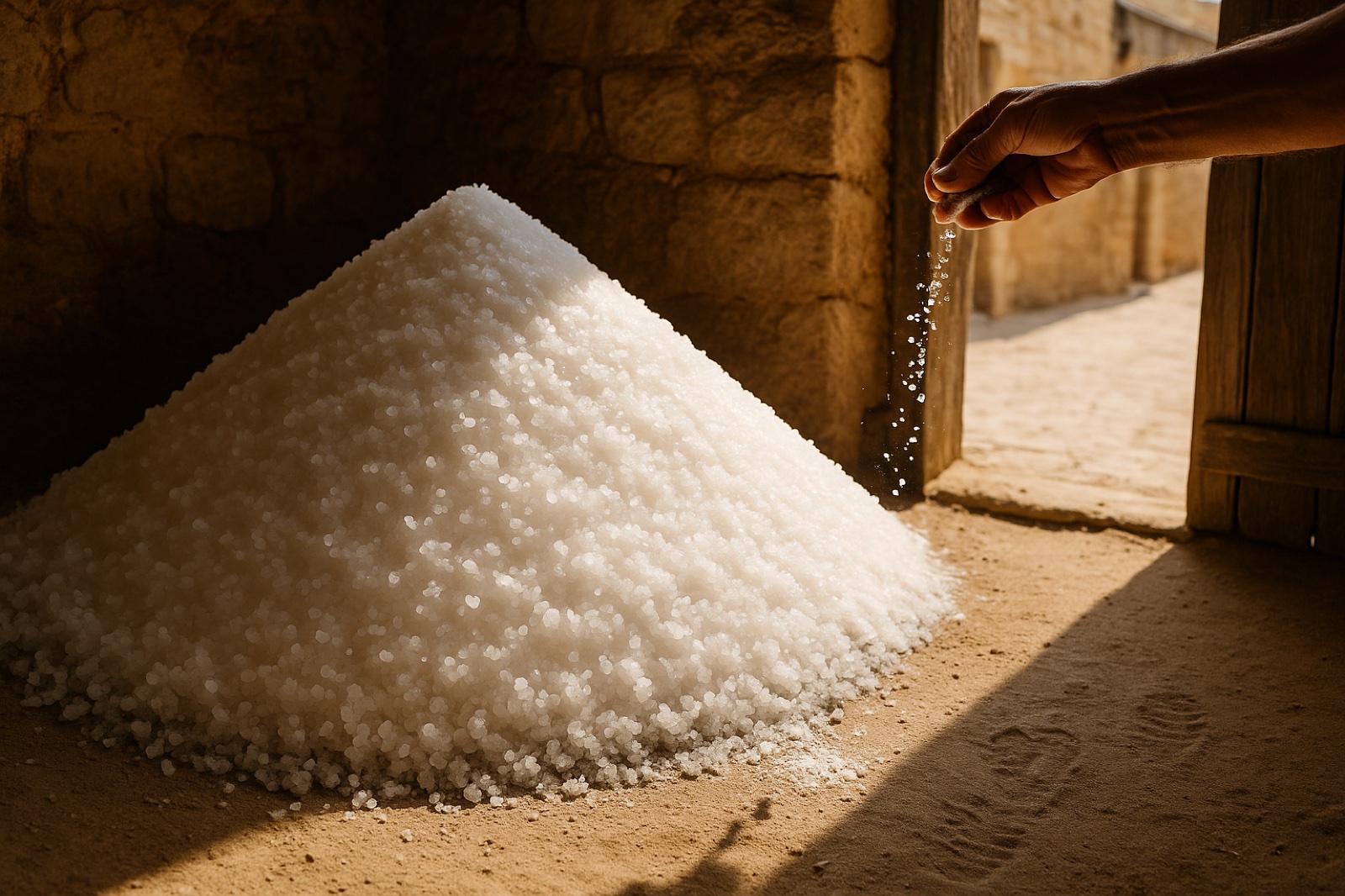
Not quite. The salt people used back then was not the clean white salt in a shaker today. Much of it was gathered from marshes and salty ground, so it came mixed with dirt and other minerals. Water could wash the real salt out and leave a pale crust behind. It still looked like salt. It just did nothing.
Two travellers from centuries ago wrote down seeing exactly this.
Henry Maundrell, an English traveller in the region, broke off a piece of salt from a rock. He wrote that the part “exposed to the rain, sun, and air, though it had the sparks and particles of salt, yet it had perfectly lost its savor.” But “the inner part, which was connected to the rock, retained its savor.”
William McClure Thomson, a missionary who lived in the region in the 1800s, described a merchant in Sidon who stored a huge load of salt in dozens of houses. The houses had dirt floors. In a few years, the salt touching the ground was ruined. Thomson saw large amounts of it “literally thrown into the street, to be trodden underfoot by people and beasts.”
Trodden under foot. The exact picture Jesus used.
Luke’s version adds one more detail. Spoiled salt “is neither fit for the land, nor yet for the dunghill” (Luke 14:35). Salt had farm uses too, so ruined salt was not even good enough for the compost heap.
Now notice what those old accounts actually say. The salt was not ruined because the pile was small. It was ruined where it sat against the dirt floor, and where rain and weather wore at it slowly. The part that stayed joined to the rock stayed salty.
Salt of the Earth Meaning for Someone Who Feels Useless
Here is where this old verse walks into your real life.
Maybe you feel like you do not matter much. You are not a leader. You do not have a platform. You look at your job, your family, your one small street, and think, “What difference could I make?”
Salt does not lose its worth by being small. Only by stopping being salt.
Think about how salt works. Nobody uses a bucket of it on a meal. A pinch changes the whole pot. Size was never the point. Contact was.
And the danger Jesus named was not “you are too small.” It was going flat. Going foolish. And look at how that happens in the old accounts: not in one big moment, but slowly. Rain. Weather. Sitting in the dirt for years until the salt is washed out and only the look of it is left.
That is how people lose their saltiness too. It is rarely one big failure. It is years of soaking in cynicism. It is slowly agreeing that nothing you do matters. It is hanging on to the look of faith after the life has quietly washed out.
But here is the hope. The salt that stayed joined to the rock kept its flavour. You do not stay salty by trying harder to be impressive. You stay salty by staying connected to the One who called you salt in the first place.
Mark’s Gospel puts the salt saying right next to how we treat each other: “Have salt in yourselves, and have peace one with another” (Mark 9:50). Being salt is not about being loud. It is about being the person who makes a room kinder, more honest, more alive, just by being there.
If you are stuck on the question of what you are even for, our free What Is My Purpose? assessment is a gentle place to start. And if you worry you are wasting what you have, the Parable of the Talents says something surprising about playing it safe.
Actions to Take Today
- Find your pinch. Write down one place where you are the only person like you: a workplace, a family chat, a queue at the market, a shared house. That is not a random spot. That is your pot of food.
- Name one slow leak. Think of one thing that is quietly washing the salt out of you. A news feed that leaves you bitter. A conversation that always turns to mocking someone. Pick one small limit you can set on it today, even for one day.
- Season one message. Paul wrote, “Let your speech be alway with grace, seasoned with salt” (Colossians 4:6). Send one short message today to someone you would normally just react to. Make it kind and true.
Journaling Prompts
- Where in my life have I started to believe that my small part does not count?
- What has slowly been washing the flavour out of my faith, not all at once, but a little at a time?
- What would it look like for me to stay “connected to the rock” this week, in a way that fits my real schedule?
A Prayer for When You Feel Useless
God, I have been feeling small and flat, like nothing I do really matters. Thank you that Jesus did not tell me to become salt, but said I already am. Show me the slow things that are washing the life out of me, and give me the courage to step away from them. Keep me close to you, so that whatever small place I stand in today tastes a little more of your kindness. Amen.
Let’s Talk
When people call someone “the salt of the earth” today, they usually mean humble and decent. Do you think that everyday meaning has lost something important from what Jesus said, or kept the heart of it? Tell us what you think in the comments.
Share This
- “Ye are the salt of the earth.” Jesus didn’t say “try to become.” He said “ye are,” to a crowd of ordinary people. I needed that today.
- The Greek word in Matthew 5:13 for salt that “lost its savour” literally means salt that has “become foolish.” Salt doesn’t lose its worth by being small. Only by stopping being salt.
- Old travellers wrote that salt went bad where it sat in the dirt and weather, but the part joined to the rock kept its flavour. I’m staying close to the Rock.
Questions and Answers (Q&A)
What does “salt of the earth” mean in the Bible?
In Matthew 5:13, Jesus told a crowd of ordinary followers, “Ye are the salt of the earth.” In that world, salt kept food from rotting, made food worth eating, and was used in worship as a sign of a lasting promise. Jesus was telling everyday people that they already had that role in the world. It was a statement about who they were, not a reward for being impressive. Today the phrase usually just means a humble, decent person, which is only part of the original meaning.
What is the Greek word for “lost his savour” in Matthew 5:13?
The Greek word in Matthew 5:13 is mōranthē, a form of the verb mōrainō, which means “to become foolish.” The King James Version translates it “have lost his savour.” The same verb appears in Romans 1:22 (“they became fools”) and 1 Corinthians 1:20 (“made foolish”). Some scholars think it reflects an Aramaic wordplay between tasteless and foolish, while others, such as Robert H. Gundry, think it was simply a normal idiom for salt going flat.
Can salt actually lose its saltiness?
Pure sodium chloride is very stable and does not stop being salty. But salt in the ancient Middle East was often collected from marshes and salty ground and was mixed with other minerals. Rain and damp could wash the real salt out, leaving a crust that looked like salt but had no flavour. Nineteenth-century missionary William McClure Thomson described salt stored on dirt floors in Sidon that spoiled and was thrown into the street to be walked on.
Why did Jesus say useless salt is “trodden under foot of men”?
Salt that had lost its flavour could not be used for food, and Luke 14:35 says it was not even fit for the land or the manure heap. People threw it out onto paths and streets, where it was walked on. Travellers in the region in later centuries still saw this happen. Jesus used that everyday picture as a warning about believers who let their faith go flat, not as a threat to people who feel small.
What does “Have salt in yourselves” mean in Mark 9:50?
In Mark 9:50, Jesus said, “Have salt in yourselves, and have peace one with another.” He tied being salty to how people treat each other. In this saying, salt is not about being loud or important. It describes a person whose presence makes the people around them kinder and more at peace, the way a small amount of salt changes a whole meal.