 0
0
 0
0
You’re nearly asleep. The room is dark and still. Then it starts: that thin whine right beside your ear. You slap at the air. You slap your own cheek. The whine stops for a moment, and then it comes back.
Somewhere around the third slap, a question shows up, half joke and half serious. Why did God make mosquitoes?
For a lot of people reading this, it isn’t a joke at all. Where you live, a mosquito bite can mean a fever. It can mean a child in a clinic. So the question deserves a real answer, not a cute one. Here is the honest version. Some of it will surprise you. And the most helpful part comes from questions God asked a suffering man, long before anyone knew what a mosquito carries.
Why Did God Make Mosquitoes? Start With the Ones That Bite
First, a fact that changes the question. Scientists have named about 3,500 species of mosquito. A 2010 feature in the journal Nature noted that only a couple of hundred of them bite or bother humans. Most mosquitoes live their whole lives without ever tasting a person.
Even in the species that do bite, only the females do it. They don’t drink blood as food. They need the protein in blood to make their eggs. The males never bite at all. They drink nectar and plant juices, and the females drink those too for everyday energy.
Some mosquitoes turn the whole picture upside down. The elephant mosquito (Toxorhynchites) is a big, shiny mosquito that never drinks blood as an adult. Its young live in water, and they hunt and eat the young of other mosquitoes. It is a mosquito that eats mosquitoes.
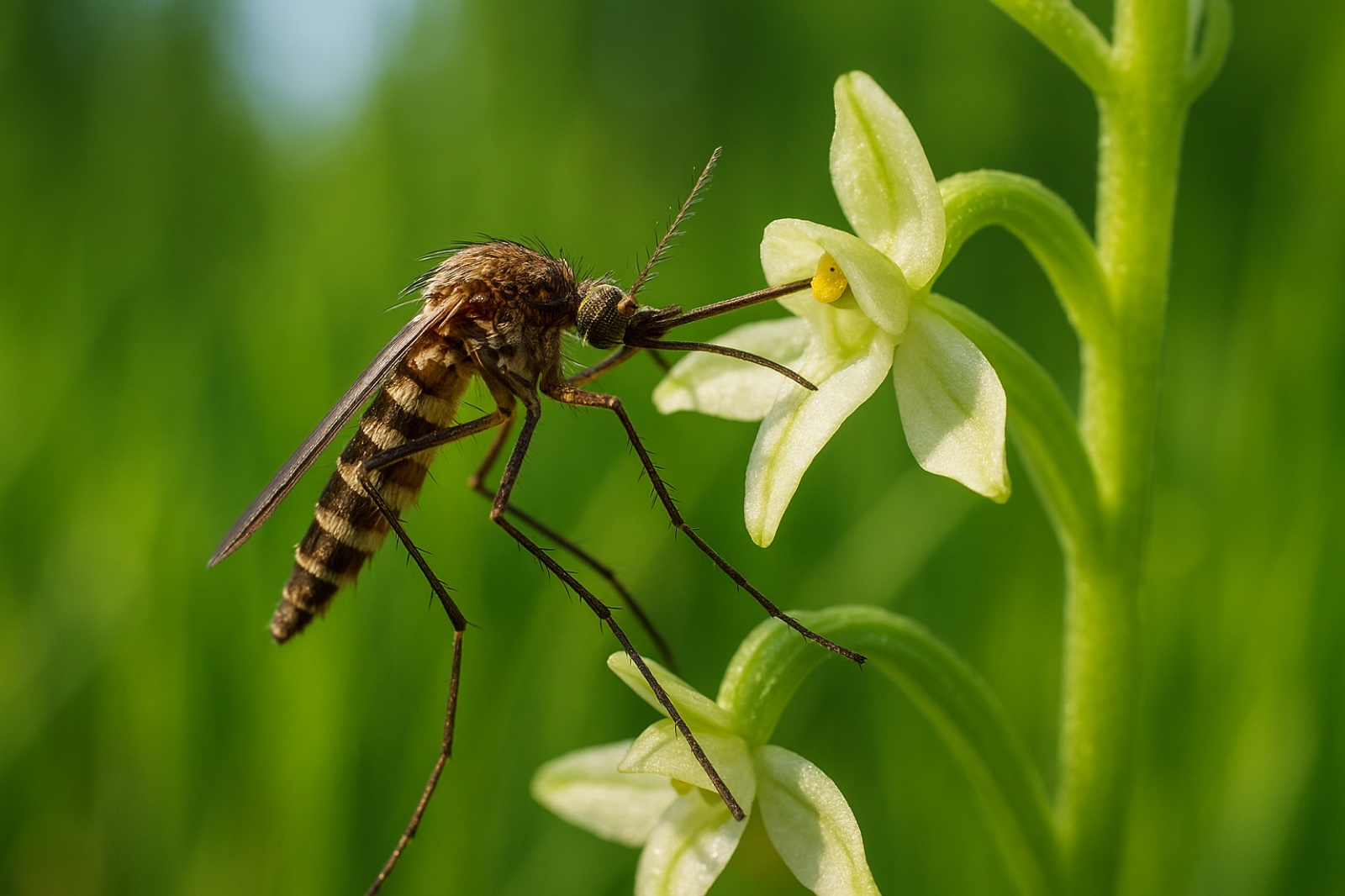
Others help flowers. In the cold forests and bogs of North America grows a small green-white flower called the blunt-leaf orchid. In 2020, researchers writing in the journal PNAS described how Aedes mosquitoes visit it for nectar. As a mosquito pushes into the flower, tiny packets of pollen stick to its eyes. It flies off wearing them, and carries them to the next flower.
And young mosquitoes are food. They wriggle in ponds, puddles and swamps, and fish, frogs, dragonflies and many other creatures eat them.
So the first honest thing to say is this. The mosquito you slapped last night belongs to a very big family. Most of that family has nothing to do with you.
If this question has you wondering where God is in the small, ordinary, itchy parts of life, we made something for exactly that: a free video guide and PDF about noticing God’s presence in real, everyday moments.
The Easy Answer, and Where It Breaks
Many of us grew up with a quick answer to this question: “Mosquitoes are food for birds and fish. Take them away and the whole food chain falls apart.”
There is some truth in that. But it isn’t the whole truth, and you deserve the whole truth.
When Nature asked mosquito scientists in 2010 what would happen if mosquitoes vanished, many of them said nature would adjust. Other insects would fill most of the gaps. Entomologist Joe Conlon of the American Mosquito Control Association put it this way: “If we eradicated them tomorrow, the ecosystems where they are active will hiccup and then get on with life.”
Not every scientist agreed on every detail. Some worried about certain birds in the far north, and about fish that feed heavily on young mosquitoes. But the big picture was clear. The mosquito is useful. It just isn’t obviously necessary.
And then there is the hard part. Mosquitoes spread malaria, dengue, yellow fever and more. The World Health Organization estimates that malaria killed about 610,000 people in 2024. Around 95 out of every 100 of those deaths were in Africa, and most of the people who died there were children under five.
So if you were hoping the answer would be “every mosquito has a job, so every bite is worth it,” the facts won’t let us say that. It’s okay to admit it. The Bible doesn’t ask you to pretend, either.
Does the Bible Mention Mosquitoes?
Not by name. The word “mosquito” doesn’t appear anywhere in the King James Bible.
The closest the Bible may come is the third plague on Egypt:
“And the LORD said unto Moses, Say unto Aaron, Stretch out thy rod, and smite the dust of the land, that it may become lice throughout all the land of Egypt.” (Exodus 8:16, KJV)
The Hebrew word behind “lice” is kinnim, and nobody is quite sure what creature it means. The King James translators chose lice. Many modern Bibles say gnats. Some older scholars argued for mosquitoes, pointing to how the ancient Greek and Latin translations handled the word. The honest answer is that it was a tiny biting insect, and we can’t be certain which one.
It also helps to know what the Bible does not say. It never says when mosquitoes first appeared. It never says what they did in Eden. People sometimes say those things with great confidence, but the Bible is quiet there. It is better to be quiet with it than to fill the silence with guesses.
The Questions God Asked Job
If the Bible doesn’t explain the mosquito, does it say anything useful at all? It does. And the most useful part is in a book about a man who was suffering.
Job lost his children, his health and everything he owned. For chapter after chapter, he asks God why. When God finally answers him out of a whirlwind, it isn’t with a list of reasons. It’s with questions. And some of those questions are about places where there are no people at all:
“To cause it to rain on the earth, where no man is; on the wilderness, wherein there is no man; To satisfy the desolate and waste ground; and to cause the bud of the tender herb to spring forth?” (Job 38:26-27, KJV)
Read that slowly. God sends rain on land where no human will ever stand. God makes small green shoots grow where nobody will ever see them. For whom? Not for Job. Not for any of us.
A few verses later comes another question: “Who provideth for the raven his food? when his young ones cry unto God, they wander for lack of meat.” (Job 38:41, KJV). Then the speech goes on to wild goats, the wild donkey, the ostrich, the hawk. Creature after creature that does nothing at all for Job.
Here is the part that’s easy to miss. God never tells Job what each animal is for. The point isn’t that everything has a use for people. The point is that the world is far bigger than people, and God cares for all of it anyway.
That changes the mosquito question. “Why did God make mosquitoes?” often hides a smaller question underneath: “What are they for, for me?” Job 38 gently answers that the world was never built only around us. A mosquito sipping nectar from an orchid in a bog no one visits belongs to Job 38, not to your bedroom.
But What About the Mosquitoes That Kill?
Job 38 helps with the “what is it for” part. It doesn’t make malaria okay. For that, we need a different passage, and it’s one of the most honest in the whole Bible.
Paul, writing to the church in Rome, says:
“For we know that the whole creation groaneth and travaileth in pain together until now.” (Romans 8:22, KJV)
“Travaileth” is the old word for a mother in labour. Paul is saying the world is in pain, but it’s the kind of pain that comes before something new is born. It isn’t how things will stay. (We looked more closely at this passage in Why Does God Allow Animals to Suffer?)
But keep reading, because Paul doesn’t stop with creation. In that one chapter, he describes three groans.
The world groans. That’s verse 22: the fever, the flood, the sick animal.
We groan. In the very next verse Paul writes, “even we ourselves groan within ourselves” (Romans 8:23, KJV), as we wait for our bodies to be made whole.
And the Spirit of God groans.
“Likewise the Spirit also helpeth our infirmities: for we know not what we should pray for as we ought: but the Spirit itself maketh intercession for us with groanings which cannot be uttered.” (Romans 8:26, KJV)
That is the detail most people read straight past. Paul doesn’t picture God standing outside the pain, handing down explanations. He pictures God’s own Spirit inside the groaning, praying for us when we’re too tired or too confused to find the words.
The Question Behind the Question
Think back to that whine in the dark.
When a parent sits up at night beside a child burning with fever and asks, “Why did God make mosquitoes?”, they aren’t asking for a lesson about orchids. They’re asking whether God sees. Whether God cares. Whether anyone is in this with them.
The Bible’s answer isn’t a neat reason for every bite. It’s better than that. It’s a God who sends rain where no one is watching, and a Spirit who groans right beside you when you’re the one sitting up in the dark.
You don’t have to find a hidden purpose in every mosquito to trust God. You’re allowed to say, “This is not how it should be.” That isn’t a lack of faith. That’s Romans 8. Paul said it first.
It also means fighting mosquitoes is not fighting God. Jesus healed Peter’s mother-in-law when she lay sick with a fever (Matthew 8:14-15). Emptying standing water, sleeping under a net if you have one, getting a sick child to help quickly: these are small ways of standing on the side of the healing that all creation is groaning toward. And if you’ve ever felt a pang about swatting one, you can let that go: we answered it in Is It a Sin to Kill Bugs?
If groaning is all you have right now, no words, just tired, here is how to pray when you don’t know what to say. Romans 8:26 says you are not praying alone. And if you’d like to keep digging into questions like this one, you can explore them with our free Bible Answers AI assistant. It opens in ChatGPT.
Actions to Take Today
- Turn the next whine into a prayer. Tonight, when you hear a mosquito, pray one sentence for a family somewhere who is sitting up with a sick child. Then swat it.
- Tip out standing water. Spend five minutes walking around your home and empty anything holding water: a bottle cap, a plant saucer, a bucket, an old tyre. Many of the mosquitoes that bite people lay their eggs in small pools just like these.
- Tell God one thing that isn’t right yet. Out loud or on paper, name one thing in your life or your world that is groaning. Don’t explain it. Don’t tie a bow on it. Just say it, and trust that the Spirit is praying with you.
Journaling Prompts
- Where have you been asking God for a reason, when what you really wanted was to know God was with you?
- Job 38 describes rain falling where no one is watching. What might God be growing in a hidden part of your life that no one else can see yet?
A Prayer
God, I don’t understand everything You made, and some of it hurts. Thank You that I don’t have to pretend that sickness is fine or that every bite has a reason. When I’m tired and have no words, let Your Spirit pray for me, and help me groan honestly instead of giving up. Show me one small way to stand on the side of healing today. Amen.
Let’s Talk
Here’s one for a friendly debate: if you could remove just one creature from the world, would you pick the mosquito, even knowing some birds and fish would lose a meal? Tell us your pick in the comments below.
Share This
- “Only female mosquitoes bite, and of about 3,500 species, only a couple of hundred bother people. The one in my ear tonight is the exception, not the rule.”
- “God sends rain ‘where no man is’ (Job 38:26). The world was never built only around us, and God cares for all of it anyway.”
- “Romans 8 has three groans: creation groans, we groan, and the Spirit of God groans with us. God isn’t watching the pain from outside.”
Questions People Ask
Why did God make mosquitoes?
The Bible never names mosquitoes or explains why they exist. Most of the roughly 3,500 mosquito species never bite people, and many mosquitoes drink nectar, pollinate plants and feed fish, frogs and birds. In Job 38:26-27, God describes sending rain on wilderness “where no man is,” which suggests creation exists for more than human use. For the suffering some mosquitoes cause, Romans 8:22 says the whole creation “groaneth and travaileth in pain” as it waits to be made new.
Does the Bible mention mosquitoes?
The word “mosquito” does not appear in the King James Bible. The closest reference may be the third plague on Egypt in Exodus 8:16, where the Hebrew word kinnim is translated “lice” in the King James Version and “gnats” in many modern Bibles. Some older scholars thought it meant mosquitoes, but the exact insect is uncertain.
Do all mosquitoes bite humans?
No. Scientists have named about 3,500 mosquito species, and a 2010 feature in the journal Nature noted that only a couple of hundred of them bite or bother humans. Only female mosquitoes bite, because they need protein from blood to make eggs. Male mosquitoes feed on nectar and plant juices, and some mosquitoes, such as the elephant mosquito, never drink blood at all.
What would happen if mosquitoes went extinct?
Many scientists interviewed by the journal Nature in 2010 believed most ecosystems would adjust without mosquitoes, with other insects filling most of the gaps. Some raised concerns about particular animals, such as certain Arctic birds and fish that feed heavily on mosquito larvae. Entomologist Joe Conlon said ecosystems would “hiccup and then get on with life.”
How many people die from malaria each year?
The World Health Organization estimates that malaria killed about 610,000 people in 2024. Around 95% of those deaths were in the WHO African Region, and most of the deaths there were children under five. Malaria is caused by a parasite that spreads to people through the bites of infected female Anopheles mosquitoes.