 0
0
 0
0
Most people have one.
One moment. One sentence you can’t take back, one choice made while you were tired and angry and done. It might be years old. But every time a door stays shut in your life, a quiet voice points back at it and says: that’s why.
If that voice sounds familiar, the story of Moses is for you. It’s the story of the most trusted leader in the Old Testament losing something he wanted badly, because of one bad afternoon. People search for it every day: why couldn’t Moses enter the Promised Land?
The answer is real, and it doesn’t get softened here. But the story doesn’t end where most people stop reading.
Why Couldn’t Moses Enter the Promised Land? What Numbers 20 Says
It happened near the end of forty years in the wilderness, at a place called Kadesh.
Read the first verse of Numbers 20 slowly, because almost everyone skips it. Moses had just lost his sister: “and Miriam died there, and was buried there” (Numbers 20:1, KJV). The very next sentence says there was no water, and the whole crowd “gathered themselves together against Moses and against Aaron” (Numbers 20:2, KJV).
A grieving old man. A thirsty, angry crowd. Nobody’s best moments happen there.
God gave Moses a clear instruction:
“Take the rod, and gather thou the assembly together, thou, and Aaron thy brother, and speak ye unto the rock before their eyes; and it shall give forth his water, and thou shalt bring forth to them water out of the rock: so thou shalt give the congregation and their beasts drink.” — Numbers 20:8, KJV
Speak to the rock. Here is what Moses did instead:
“And Moses and Aaron gathered the congregation together before the rock, and he said unto them, Hear now, ye rebels; must we fetch you water out of this rock? And Moses lifted up his hand, and with his rod he smote the rock twice: and the water came out abundantly, and the congregation drank, and their beasts also.” — Numbers 20:10-11, KJV
Notice something before the verdict comes. The water still came. Abundantly. God did not let thirsty families and animals go without because their leader got it wrong.
Then the verdict:
“And the LORD spake unto Moses and Aaron, Because ye believed me not, to sanctify me in the eyes of the children of Israel, therefore ye shall not bring this congregation into the land which I have given them.” — Numbers 20:12, KJV
That is the plain answer. Moses and Aaron both lost the crossing at a place later called Meribah, a name that means strife or quarrelling.
Almost all of what follows ends up in one book, the Gospel of Matthew. If you’d like to read or hear that whole Gospel for yourself, it’s free: an immersive PDF plus a 28-chapter audiobook.
So What Exactly Did Moses Do Wrong at the Rock?
Here’s an honest thing most quick answers skip: the Bible never sums up the failure in a single word. You can see several things go wrong in those two verses.
- He struck when he was told to speak. And he struck twice.
- He said “must we.” As if the water were his and Aaron’s to hand out.
- He called the people rebels, in anger, in public.
God’s own words point underneath all three: “ye believed me not, to sanctify me in the eyes of the children of Israel.” Later, Deuteronomy says it again: “because ye sanctified me not in the midst of the children of Israel” (Deuteronomy 32:51, KJV).
To “sanctify” means to treat as holy, to show someone as they really are. The whole nation was watching. They needed to see a God who cared about their thirst. What they saw was a leader’s temper.
There’s one more detail worth knowing. Close to forty years earlier, at a place called Horeb, God had told Moses to do the exact opposite: “thou shalt smite the rock, and there shall come water out of it” (Exodus 17:6, KJV). Scripture doesn’t tell us what was going on in his head at Kadesh. But it’s easy to imagine a worn-out man reaching for what worked last time instead of listening for what God was saying this time.
The Tension Most Answers Leave Out: “For Your Sakes”
If you only read Numbers, the fault is simple. Then you get to Deuteronomy, and Moses tells it differently. Twice.
“Also the LORD was angry with me for your sakes, saying, Thou also shalt not go in thither.” — Deuteronomy 1:37, KJV
For your sakes. Because of you. Is Moses making excuses?
Psalm 106 looks back on the same day and holds both sides in one breath. It says “it went ill with Moses for their sakes”, and then gives the reason:
“Because they provoked his spirit, so that he spake unadvisedly with his lips.” — Psalm 106:33, KJV
Both things are true. The people pushed him hard. And Moses still said and did what he did.
That is what real failure usually looks like. It rarely comes out of nowhere. There was pressure, grief, other people’s behaviour. None of that is fake, and none of it cancels the choice. Scripture refuses to pick one side, and that honesty is a kindness. You don’t have to pretend you were the only cause. You don’t have to pretend you weren’t a cause at all.
The Prayer God Said No To
This is the part that hurts to read. Moses didn’t just accept the verdict. He begged.
“I pray thee, let me go over, and see the good land that is beyond Jordan, that goodly mountain, and Lebanon. But the LORD was wroth with me for your sakes, and would not hear me: and the LORD said unto me, Let it suffice thee; speak no more unto me of this matter.” — Deuteronomy 3:25-26, KJV
Speak no more unto me of this matter. The answer was no, and it stayed no.
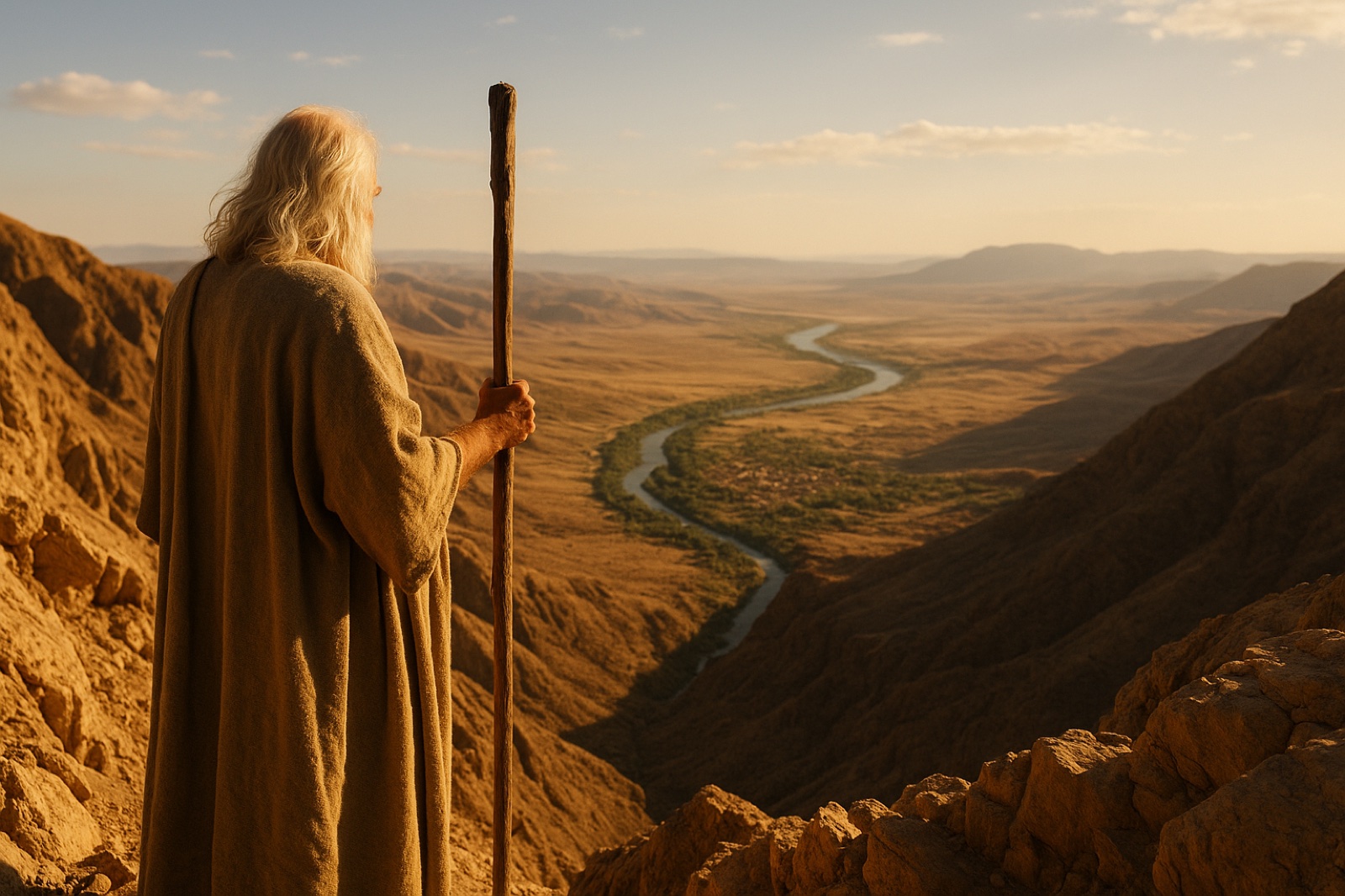
But look at what God did at the very end. God took Moses up Mount Nebo, across the Jordan from Jericho, and showed him the land, “all the land of Gilead, unto Dan, And all Naphtali, and the land of Ephraim, and Manasseh, and all the land of Judah” (Deuteronomy 34:1-2, KJV). Then:
“This is the land which I sware unto Abraham, unto Isaac, and unto Jacob, saying, I will give it unto thy seed: I have caused thee to see it with thine eyes, but thou shalt not go over thither.” — Deuteronomy 34:4, KJV
Moses died there, in Moab. He was 120, and the Bible adds that “his eye was not dim, nor his natural force abated” (Deuteronomy 34:7, KJV). He had strength left. The door closed anyway.
And yet the final word Deuteronomy gives on his life is not about the rock at all: “there arose not a prophet since in Israel like unto Moses, whom the LORD knew face to face” (Deuteronomy 34:10, KJV). The failure cost him the crossing. It never cost him the friendship.
Then, More Than a Thousand Years Later, a Mountain
Turn to the New Testament.
“And after six days Jesus taketh Peter, James, and John his brother, and bringeth them up into an high mountain apart, And was transfigured before them: and his face did shine as the sun, and his raiment was white as the light. And, behold, there appeared unto them Moses and Elias talking with him.” — Matthew 17:1-3, KJV
Moses. The man who was told “thou shalt not go over thither”, standing on a high mountain far from the plains of Moab, talking with Jesus.
Which mountain? Be careful here, because a lot of writing gets this wrong. Matthew never names it. An old tradition says Mount Tabor in Galilee. Tabor appears in Joshua as a marker on the borders of the tribes of Issachar and Naphtali (Joshua 19:22, 34), and Naphtali is one of the regions Deuteronomy says God showed Moses from Nebo. Many other readers think it was Mount Hermon, much further north, because the chapter before takes place near Caesarea Philippi. Nobody knows for certain.
But neither candidate is the plains of Moab. Wherever that mountain stood, Moses was no longer on the outside looking in.
One more honest note. The Gospels never say, “and so Moses finally entered the land.” They don’t draw that line for you. It’s something you notice when you hold the two stories side by side, not something a verse announces. We looked at a different side of this same scene, how the disciples knew who they were seeing, in Will We Know Each Other in Heaven?
If you’d like to walk back through the whole of Moses’ life, from the basket to the burning bush to Nebo, our free Bible Stories AI assistant retells it simply (it opens in ChatGPT).
What Moses and Jesus Were Talking About
Luke tells us the subject of the conversation:
“And, behold, there talked with him two men, which were Moses and Elias: Who appeared in glory, and spake of his decease which he should accomplish at Jerusalem.” — Luke 9:30-31, KJV
The word translated “decease” is, in Luke’s Greek, exodos. Exodus. The same word the Greek Old Testament used as the title of the book of Exodus.
Sit with that. The man who led the first exodus, out of slavery in Egypt, is talking with Jesus about the exodus Jesus was about to make in Jerusalem: the cross, and the rescue on the other side of it.
Then a voice comes out of a bright cloud: “This is my beloved Son, in whom I am well pleased; hear ye him” (Matthew 17:5, KJV).
Hear ye him. Long before, Moses had promised Israel that God would raise up “a Prophet from the midst of thee, of thy brethren, like unto me; unto him ye shall hearken” (Deuteronomy 18:15, KJV). On that mountain, Moses stood beside Jesus and heard his own promise echoed back.
The man who once said “must we fetch you water” was now standing beside the One the whole story had been pointing to, and the voice from the cloud told everyone to listen to Jesus, not to Moses.
The Turn: A Closed Door Is Not a Closed Story
Let’s be honest about what this story does not say.
It doesn’t say consequences are fake. Moses really didn’t lead Israel across the Jordan. He really died in Moab. God’s no was a real no, and no amount of hope-talk changes Numbers 20.
Your one moment may have cost something real too. Trust. A job. A marriage. A season you won’t get back. Some of those doors may stay closed, and pretending otherwise isn’t faith. It’s just pretending.
But look at everything that didn’t close for Moses. The water still flowed for the people. God still spoke with him face to face. God personally showed him the land. And more than a thousand years later, he was standing on a high mountain far from Moab, in glory, in conversation with Jesus about the greatest rescue there has ever been.
Meribah closed a door. It never closed the story.
When the New Testament sums up Moses, it doesn’t mention the rock. It says: “Moses verily was faithful in all his house” (Hebrews 3:5, KJV). Faithful. That’s the word that stuck.
The Book of Numbers is full of this. Even the children of the men who led a rebellion against Moses weren’t written off. We traced that in Sons of Korah: The Rebel’s Children Who Did Not Die.
The voice that says “that’s why” about your worst moment might be partly right about one door. It is wrong about you.
Actions to Take Today
- Name your rock in one sentence. Write down the moment you keep going back to. Plain words. No excuses added, and no extra punishment added either. Two minutes, on paper or in your phone.
- Draw two short lists under it. On the left: what it really cost. On the right: what it didn’t cost. The people still here. The ways God still meets you. Psalm 106 told the truth about both sides, and you can too.
- Pray the “let me go over” prayer once, honestly. Tell God plainly which door you still want open. Then, if someone else carried the cost of your moment and it’s safe to reach out, send one short message that says “I know what that cost you.” No excuses, no request attached.
Journaling Prompts
- What pressures were on you the day of your “rock” moment, and which part was still your choice? Try to write both without shrinking either one.
- Where have you been treating one closed door as proof that every door is closed?
- Moses heard “speak no more unto me of this matter” and still ended his life known “face to face.” What would it look like for you to stay close to God inside a no?
A Prayer for the Door That Stayed Shut
God, you know the moment I keep going back to, and you know I’d take it back if I could. I’m not going to pretend it cost nothing, and I’m not going to pretend it was all someone else’s fault. But I’m tired of letting that one day tell me who I am. Thank you that the water still came for Moses’ people, and that his story didn’t end outside the land. Keep me close to you inside the no, and show me the story you’re still writing. Amen.
One Question to Sit With
When God told Moses “speak no more unto me of this matter,” do you think that was mostly justice, mostly mercy, or somehow both at once? Tell us how you read it in the comments.
Share This
- Moses struck the rock when God said speak. He lost the crossing. The water still came, abundantly. God didn’t let thirsty families pay for their leader’s worst day.
- Numbers 20 closed a door on Moses. Matthew 17 has him standing on a high mountain far from Moab, talking with Jesus. A closed door isn’t a closed story.
- In Luke 9:31 Moses and Jesus talk about Jesus’ “decease.” The Greek word is exodos. The man of the Exodus, discussing the greatest exodus of all.
Questions People Ask About Moses and the Promised Land
Why couldn’t Moses enter the Promised Land?
Moses was barred from entering the Promised Land because of what happened at Meribah, recorded in Numbers 20. God told Moses to speak to a rock so it would give water, but Moses called the people rebels, said “must we fetch you water out of this rock?” and struck the rock twice. In Numbers 20:12 God gives the reason: “Because ye believed me not, to sanctify me in the eyes of the children of Israel, therefore ye shall not bring this congregation into the land which I have given them.” Aaron was barred for the same event.
What did Moses do wrong when he struck the rock?
Numbers 20 shows several failures at once: Moses struck the rock when he had been told to speak to it, he struck it twice, he spoke in anger, and he said “must we” as if he and Aaron were providing the water. God’s words in Numbers 20:12 and Deuteronomy 32:51 name the root problem as not believing God and not showing God as holy in front of the people. Psalm 106:33 adds that the people “provoked his spirit, so that he spake unadvisedly with his lips.”
Did Moses ever get to the Promised Land?
Moses did not lead Israel into the Promised Land and died on the Moab side of the Jordan River, after God showed him the land from Mount Nebo (Deuteronomy 34:1-5). However, Matthew 17:1-3, Mark 9:4 and Luke 9:30-31 record Moses appearing with Elijah on a high mountain, talking with Jesus at the Transfiguration. The Gospels do not name the mountain; tradition points to Mount Tabor in Galilee and many readers suggest Mount Hermon. The Gospels also do not describe this as Moses entering the land.
Where is Moses buried?
According to Deuteronomy 34:6, Moses was buried “in a valley in the land of Moab, over against Beth-peor: but no man knoweth of his sepulchre unto this day.” The Bible deliberately gives no known grave site. Moses died at 120 years old, and Deuteronomy 34:7 notes that his eyesight and strength had not failed.
What does Meribah mean?
Meribah is a Hebrew place name meaning strife, quarrelling or contention. The Bible uses it for places where the Israelites quarrelled with God over a lack of water. The event that kept Moses and Aaron out of the Promised Land happened at the waters of Meribah near Kadesh in the wilderness of Zin (Numbers 20:13, Deuteronomy 32:51).