 0
0
 0
0
On Tuesday, 22 September 2026, a low white building with a long curved back opens to the public in Exposition Park, Los Angeles. It runs to about 300,000 square feet. It holds more than 100,000 square feet of galleries across more than thirty rooms. And the whole enormous thing exists to win one argument that plenty of serious people still refuse to concede: that pictures which tell stories are real art.
That is the job of the Lucas Museum of Narrative Art. The museum defines narrative art plainly enough — the art of telling stories through images. Cave paintings. Illustration. Comics. Murals. Film. The permanent collection, gathered by George Lucas across five decades, runs past 40,000 works, and it deliberately puts a seventeenth-century painter in the same building as a comic book artist.
You can agree or disagree with that. What is harder to argue with is the room they chose to open with.
What the Lucas Museum of Narrative Art Is Actually Claiming
The museum’s own language is not shy. It says visual stories connect us, shape belief, and help us see ourselves in one another.
Read the middle phrase again. Shape belief. Not decorate a belief you already hold. Shape it. That is a claim about how people actually come to think what they think, and it is being made by an institution big enough that it has to mean it.
Most of us already suspect it is true. Almost nobody has ever changed their mind about anything that matters because of a chart. People change because of a face in a photograph, or one scene in a film they watched at fourteen and never quite shook off.
The Opening Room Is Made of Copies
Here is the detail that slips past most of the coverage.
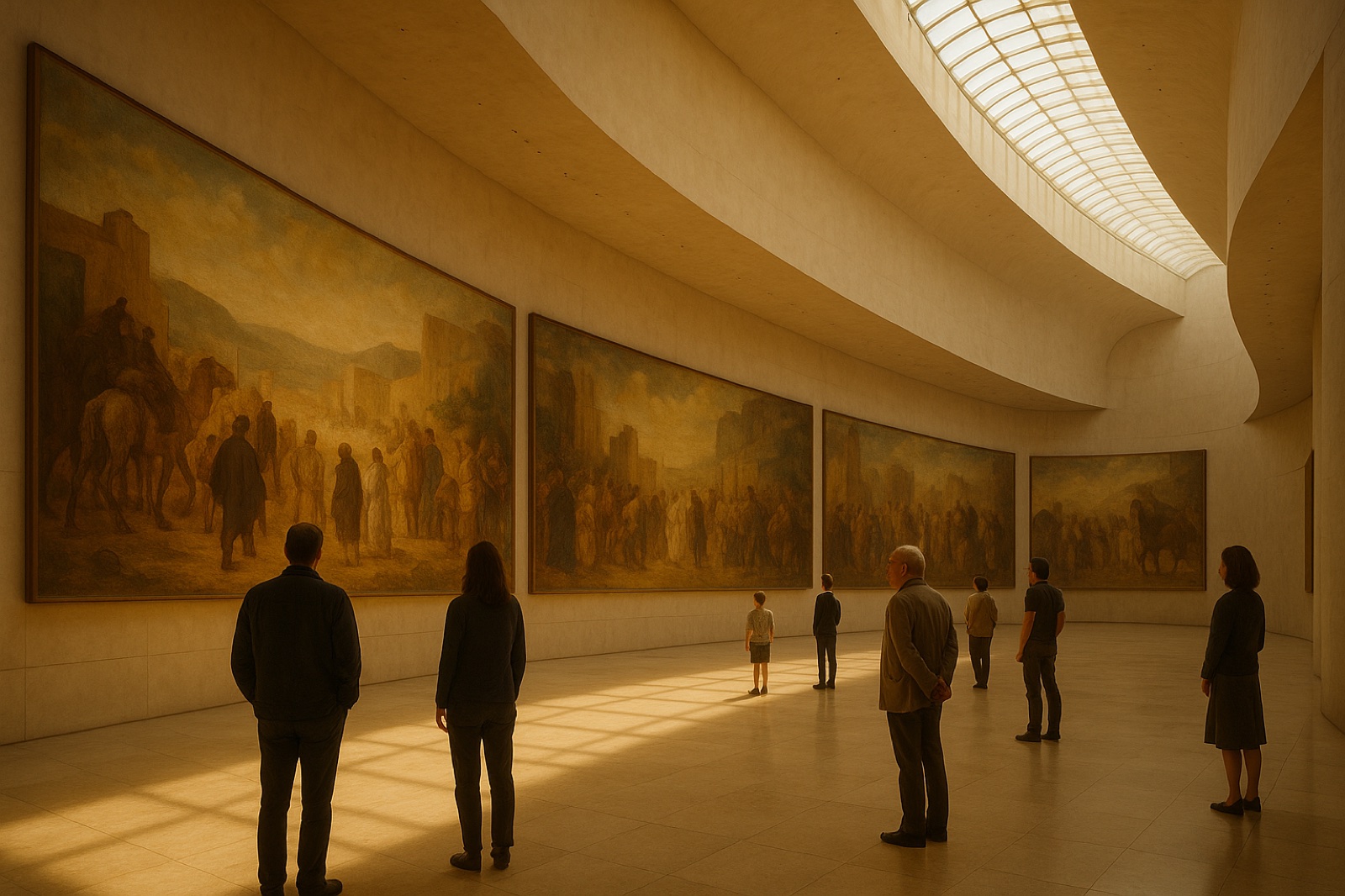
The first floor holds the introductory exhibition, and it is called The History of Narrative Art: Heroes • Myths • The Sacred. To build it, the museum did something an institution that size does not usually do. It filled the room with reproductions.
Not because it could not get originals. Because the originals cannot be moved.
- The ceiling of the Sistine Chapel, reproduced in collaboration with the Vatican Museums.
- The winged, human-headed bulls that stood guard at the palace of Sargon II, with the Louvre.
- Ancient cave paintings, with the National Museum and Research Center of Altamira in Spain.
- The Aztec Sun Stone, with Mexico’s Instituto Nacional de Antropología e Historia.
A museum that opens with copies is making a quiet, confident statement about what it thinks it is showing you. If the object were the point, a copy would be worth nothing. This museum is betting the object is not the point. The story the object carries is the point — and a story is the one thing that survives being copied.
It survives being retold in languages that did not exist when it started, by people who never met the person who first told it. That is why readers still argue about how Odysseus finally gets recognised when he comes home, roughly three thousand years after somebody first said it out loud to a room.
Heroes, Myths, and the Sacred
Look again at the three words the museum picked to organise that opening room. Heroes. Myths. The Sacred.
Then look at what it reached for to fill them. A chapel ceiling. Temple guardians from an Assyrian palace. A carved stone from a civilisation that built its calendar around the sun. Animals painted on a cave wall by hands nobody will ever name.
That is not the museum making a religious statement. It is closer to an inventory. When a modern institution went looking for the oldest and strongest evidence that images carry belief across centuries, most of what it found was sacred. There was not a great deal else on the shelf. For most of human history, the pictures people took the most trouble over were the ones about God.
Why a Story Gets Through When an Argument Doesn’t
An argument comes to the front door and announces itself. You can see it coming, so you brace.
A story comes in through a side window. You are not defending anything, because you think you are watching someone else’s life. By the time you notice it is also about you, you have already agreed with it.
This is not only a theory about art. It is why people kept paying to sit in a dark room to watch films they could have streamed at home for nothing — what they were buying was never really the film. And it is why the fastest way to change how somebody treats their own father is almost never advice. It is a story about somebody else’s father.
The Oldest Evidence Involves a Lamb
The museum is making its case with a new building. The case itself is far older than the building.
There is an account from around three thousand years ago about a king who had done something genuinely terrible and had managed not to see it. He was the most powerful man in the country. A direct accusation would have cost the accuser everything, and it would not have worked anyway — powerful people are extremely good at not hearing accusations.
So the man who had to tell him came in with a story instead. A rich man with enormous flocks. A poor man who owned one lamb — a pet, that ate from his plate and slept beside his children. A traveller arrives, and the rich man, rather than take from his own thousands, takes the poor man’s only lamb.
The king was furious. He wanted the rich man punished on the spot.
Then he was told the story was about him. That was the moment it landed. No new facts had arrived. He had simply judged the case honestly before he knew he was standing in it.
The same pattern runs through the teacher whose words are quoted more than anyone else’s in human history. Jesus had arguments available and used them rarely. Almost everything he taught arrived as a short story about ordinary things — seeds, coins, wages, a son who left home with his share and spent it. In a culture full of skilled debaters, he mostly told stories. Those stories are still moving through the world two thousand years later, in languages that did not exist when he told them.
Which is, more or less, the thesis a museum in Exposition Park has just spent years building a home for. If you ever want to pull on that thread, our free Bible Stories assistant walks through those old stories one at a time — it opens in ChatGPT and costs nothing.
What to Look For When It Opens
The Lucas Museum of Narrative Art opens to the public on Tuesday, 22 September 2026, in Exposition Park, and the inaugural galleries hold more than 1,300 works. If you get there, the first floor is the room to slow down in — not because it holds the most valuable objects, but because it holds almost none. It is a room full of careful copies, arranged to prove the copy still works.
And if you never get to Los Angeles, the argument is available to you anyway. It is in the film you keep rewatching. It is in the thing somebody told you once that you have never been able to shake. Something in us was built to be reached that way — sideways, through someone else’s life, in a story that turns out to have been about us the whole time.
That is not a modern discovery. It has just finally been given a building.
What Do You Think?
Can a faithful copy of a great work do the same job as the original — or does something real disappear the moment it is not the thing itself? Tell us in the comments. We read them.
Share This
- A museum just spent years and 300,000 square feet arguing that pictures which tell stories are real art. Then it opened with a room full of copies — because the object was never the point. https://bgodinspired.com/index.php/entertainment/lucas-museum-of-narrative-art-why-stories-change-minds/
- Nobody ever changed their mind about anything that matters because of a chart. An argument knocks on the front door. A story comes in the side window. https://bgodinspired.com/index.php/entertainment/lucas-museum-of-narrative-art-why-stories-change-minds/
- The new Lucas Museum organised its opening room around three words: heroes, myths, the sacred. Look at what it had to reach for to fill them. https://bgodinspired.com/index.php/entertainment/lucas-museum-of-narrative-art-why-stories-change-minds/
Questions People Are Asking
What is the Lucas Museum of Narrative Art?
The Lucas Museum of Narrative Art is a museum in Exposition Park, Los Angeles, founded by George Lucas and Mellody Hobson and dedicated to narrative art — the art of telling stories through images. Its permanent collection holds more than 40,000 works spanning cave painting, illustration, comics, murals, photography and film. The building, designed by Ma Yansong of MAD with Stantec, covers about 300,000 square feet and holds more than 100,000 square feet of gallery space across more than thirty galleries.
When does the Lucas Museum of Narrative Art open?
The Lucas Museum of Narrative Art opens to the public on Tuesday, 22 September 2026, in Exposition Park, Los Angeles. Its opening announcement puts more than 1,300 works in the inaugural exhibitions.
What is narrative art?
Narrative art is art that tells a story through images rather than through words. The Lucas Museum defines it as the art of telling stories through images, and traces the tradition from prehistoric cave paintings through illustration, comics, murals and film.
What is in the first exhibition at the Lucas Museum?
The first-floor inaugural exhibition is called The History of Narrative Art: Heroes, Myths, The Sacred. It includes faithful reproductions of works that cannot be moved, made in collaboration with the Vatican Museums (the Sistine Chapel ceiling), the Louvre (the winged human-headed bulls from the palace of Sargon II), the National Museum and Research Center of Altamira in Spain (cave paintings), and Mexico’s Instituto Nacional de Antropología e Historia (the Aztec Sun Stone).
Why do stories change minds when arguments don’t?
Stories work differently from arguments because they do not ask the listener to defend a position. Someone following a story judges the situation on its merits before recognising themselves inside it, so the conclusion is reached from the inside rather than accepted from outside. This is why persuasion across history has so often travelled as story — a parable, a painting, a film — rather than as a list of claims.