 0
0
 0
0
There is a number you already know without looking it up.
Maybe it sits on a loan. Maybe it is chalked on a slate at a shop where you are allowed to run a tab. You check it more often than you admit, and the strange part is not the size of it. It is the feeling that it has become permanent.
People have felt that for a very long time. Long enough that the year of jubilee in the Bible exists at all — a debt reset God wrote straight into the calendar, on a fixed date, whether anyone felt generous that year or not.
What the Year of Jubilee in the Bible Actually Was
Leviticus 25 is not a sermon about being kind to poor people. It is a scheduling instruction.
“And thou shalt number seven sabbaths of years unto thee, seven times seven years; and the space of the seven sabbaths of years shall be unto thee forty and nine years.” (Leviticus 25:8)
Count seven sets of seven. Forty-nine years. Then the fiftieth year does something the other forty-nine do not:
“And ye shall hallow the fiftieth year, and proclaim liberty throughout all the land unto all the inhabitants thereof: it shall be a jubile unto you; and ye shall return every man unto his possession, and ye shall return every man unto his family.” (Leviticus 25:10)
Read that as an economist and it is startling. Land that had been sold went back to the family that lost it. People who had sold themselves into service to survive walked out — “and shall serve thee unto the year of jubile: And then shall he depart from thee, both he and his children with him” (Leviticus 25:40-41). Every fifty years, the whole ledger went back to zero.
Not because someone in charge felt merciful. Because it was the fiftieth year.
The Detail Almost Nobody Mentions: When the Trumpet Sounded
Here is the line that gets read past, because it looks like an administrative note.
“Then shalt thou cause the trumpet of the jubile to sound on the tenth day of the seventh month, in the day of atonement shall ye make the trumpet sound throughout all your land.” (Leviticus 25:9)
The jubilee did not start on New Year’s Day. It started on the Day of Atonement — the single day in the whole year set aside for sin to be dealt with and guilt to be carried away.
So the announcement that debts were cancelled went out on the same day the nation was being forgiven. One trumpet, two kinds of release, on purpose. God did not put money in one drawer and mercy in another. The economic reset and the spiritual reset were scheduled for the same morning, and everybody in earshot heard the same horn.
Why a Field Was Never Really for Sale
Underneath the whole arrangement sits one sentence that explains it: “The land shall not be sold for ever: for the land is mine; for ye are strangers and sojourners with me.” (Leviticus 25:23)
Which means nobody in Israel was ever actually buying land. They were buying the harvests between now and the next jubilee — and the price moved accordingly. “According to the multitude of years thou shalt increase the price thereof, and according to the fewness of years thou shalt diminish the price of it” (Leviticus 25:16). Buy in year five, you pay a lot. Buy in year forty-seven, you pay very little, because you are only getting three harvests before it goes home.
Then the text names the temptation directly: “Ye shall not therefore oppress one another” (Leviticus 25:17). The jubilee was not only a mercy for the person who lost everything. It was a fence around the person doing well, so a bad decade could never harden into a permanent underclass.
That phrase, “proclaim liberty,” is the one cast onto the Liberty Bell — and the Hebrew word behind it, dror, does not simply mean freedom. It means release. Going back. The word shows up again later, and where it shows up is the whole point of this article.
It Was Not the Same Thing as the Seven-Year Release
These two get mixed up constantly, so it is worth being clear.
Deuteronomy 15 sets up a separate, more frequent provision: “At the end of every seven years thou shalt make a release. And this is the manner of the release: Every creditor that lendeth ought unto his neighbour shall release it” (Deuteronomy 15:1-2). That one ran every seventh year and dealt with loans. We have looked at that seven-year release and what it says about debt before.
The jubilee was bigger and rarer. Every fiftieth year, and it moved land and people, not just loans. Two different resets, both on a timer.
Did Israel Ever Actually Keep the Year of Jubilee?
This is where the story turns, and honesty matters more than a tidy answer.
Scripture never records a single jubilee year being carried out. Not under the judges, not under any king, not after the exile. There is no archaeological record of one either. Scholars do disagree about what that silence proves — an absence of records is not quite the same as proof of an absence — but nobody can point to a jubilee that happened.
What the Bible does give us is two moments that read like an answer.
The first is a comment on the exile. When Judah is carried off to Babylon, the writer of Chronicles explains why the land sat empty for seventy years: “until the land had enjoyed her sabbaths: for as long as she lay desolate she kept sabbath, to fulfil threescore and ten years” (2 Chronicles 36:21). Read that slowly. The rest the land was owed and never given, it finally took. The exile is described as the land collecting a debt.
The second is worse, and it is the only time we see a release actually proclaimed. King Zedekiah made a covenant “to proclaim liberty unto them” — every Hebrew servant set free. And it worked, for a moment: “then they obeyed, and let them go.” Then Jeremiah records the reversal in one flat sentence: “But afterward they turned, and caused the servants and the handmaids, whom they had let go free, to return” (Jeremiah 34:8-11).
They said the words. They opened the doors. And then they went out and brought everybody back in.
So this is where the ledger stands by the end of the Old Testament: God scheduled a release, put it on a fixed date, tied it to the day of forgiveness, and it never happened. Not once that anyone recorded. Centuries of fiftieth years came and went, and the trumpet stayed quiet.
Then Jesus Stood Up in Nazareth
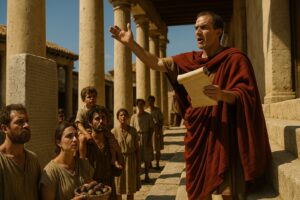
He was in His home town, at the synagogue He had grown up in, and they handed Him the scroll of Isaiah.
“The Spirit of the Lord is upon me, because he hath anointed me to preach the gospel to the poor; he hath sent me to heal the brokenhearted, to preach deliverance to the captives, and recovering of sight to the blind, to set at liberty them that are bruised, To preach the acceptable year of the Lord.” (Luke 4:18-19)
That is Isaiah 61 — and Isaiah 61 is jubilee language. Liberty to the captives. The same word, dror. The acceptable year of the Lord is the fiftieth year, the one that kept not arriving.
Now watch where He stops.
Isaiah’s sentence keeps going: “To proclaim the acceptable year of the LORD, and the day of vengeance of our God” (Isaiah 61:2). Jesus reads the first half. He does not read the second half. He closes the scroll mid-sentence.
“And he closed the book, and he gave it again to the minister, and sat down. And the eyes of all them that were in the synagogue were fastened on him. And he began to say unto them, This day is this scripture fulfilled in your ears.” (Luke 4:20-21)
He is not opening His ministry with a teaching. He is sounding a trumpet. The reset that had been on the calendar for a thousand years and had never once been kept — He announces that it has arrived, and that it has arrived as a person, in a room, on an ordinary sabbath, in front of people who had known Him since He was a boy.
The reset was never earned. It was scheduled. Then it walked in.
What That Changes on an Ordinary Tuesday
Be careful here, because there is a cheap version of this and it is not true. This is not a promise that a loan will vanish if you have enough faith. God is not a lender to be talked around, and the number you checked this morning may well be the same number tomorrow.
What changes is quieter and, honestly, bigger.
Most of us live as if release is something we have to qualify for. Pay it down far enough. Behave well enough for long enough. Get to some invisible line where we have earned the right to stop carrying it. The jubilee says something almost offensive to that instinct: release was never a reward for the debtor’s performance. It was a date. It came round because God put it on the calendar, and the only qualification for walking free was being someone who was not free.
And the reason the trumpet sounded on the Day of Atonement is that God never treated your guilt and your circumstances as two separate problems. One horn. Both.
The thing you have quietly filed under permanent — the debt, yes, but also the mistake, the year you lost, the version of yourself you assume you are stuck with now — is not filed that way by God. Israel never managed to sound the trumpet. So Jesus came and sounded it Himself.
Actions to Take Today
- Write the actual number down. Not the vague dread of it — the real figure, on paper, in one place. Most people carry a version in their head that is worse than the truth, and it costs ten minutes to find out. If it helps to see how the timeline actually shortens, run it through our free debt payoff calculator. Facing a real number is not a lack of faith. It is the first honest thing.
- Cancel one small thing somebody owes you. Not the big one. The small one — the bit of money a friend borrowed, the favour you have been keeping score of. Send the message today, in writing, so it is real: consider it done, let us not mention it again.
- Name the person you are still charging. Not money — the one you are still making pay in small ways, in tone, in distance. Write one sentence about what letting them off would actually cost you. You do not have to do it today. Just stop pretending there is no ledger.
Journaling Prompts
- What have you quietly filed under “permanent”? Write the list without arguing with any of it.
- When you picture being released from the thing you owe, what shows up first — relief, or something closer to shame? Stay with whichever one arrived, and ask where it learned to arrive first.
- Where are you still trying to earn a date that has already been set?
A Prayer for Anyone Carrying Something That Feels Permanent
God, I have been carrying this like it is permanent, and I am tired in a way that sleep does not fix. I do not know how the numbers change, and I will not pretend that is my deepest fear — my deepest fear is that I am the one thing that never gets released. Thank You that release was Your idea long before it was my need, scheduled and announced before I ever knew I would need it. Help me stop trying to earn a date that is already on Your calendar. And where I am still quietly making somebody else pay me, give me the nerve to let it go first.
One Question Worth Talking About
Why do you think God put debt release on a fixed schedule instead of leaving it to people’s generosity? Tell us what you make of that in the comments — we read them.
Share This
- Leviticus 25 put debt cancellation on a calendar — every fifty years, land back, slate wiped. Scripture never records Israel actually doing it once. Then Jesus stood up in Nazareth and said the year had arrived. I have read that chapter before and never noticed.
- The jubilee trumpet did not sound on New Year’s Day. It sounded on the Day of Atonement. Freedom was announced on the same day guilt was carried away. One horn, both problems.
- Jesus read Isaiah 61 out loud, stopped in the middle of the sentence, closed the scroll and sat down. He read the part about the acceptable year of the Lord. He left out the rest. Then He said it was happening right now.
Questions People Ask
What is the year of jubilee in the Bible?
The year of jubilee is a law given in Leviticus 25 for ancient Israel. Every fiftieth year, agricultural land that had been sold returned to the family that originally held it, and Israelites who had sold themselves into service because of poverty were released and went home. Leviticus 25:10 describes it as proclaiming liberty throughout the land to all its inhabitants.
How often was the year of jubilee supposed to happen?
Every fifty years. Leviticus 25:8 instructs Israel to count seven sabbaths of years — seven times seven, or forty-nine years — and then to hallow the fiftieth year as the jubilee.
When during the year did the jubilee begin?
On the Day of Atonement, the tenth day of the seventh month. Leviticus 25:9 commands that the trumpet be sounded throughout the land on that day, meaning the announcement of debt release fell on the same day the nation’s sin was dealt with.
Did ancient Israel ever actually observe the year of jubilee?
There is no record of a jubilee year ever being carried out. The Old Testament never describes one taking place, and no archaeological evidence of one has been found. Scholars debate whether that silence proves non-observance or simply reflects missing records. 2 Chronicles 36:21 describes the Babylonian exile as the period when the land finally “enjoyed her sabbaths,” which many read as an indication the sabbath-year and jubilee laws had gone unkept.
What is the difference between the jubilee and the sabbatical year?
They are two separate provisions. The sabbatical release in Deuteronomy 15:1-2 happened every seventh year and cancelled loans between neighbours. The jubilee in Leviticus 25 happened every fiftieth year and went further — restoring ancestral land and freeing Israelites who had entered servitude.
What did Jesus say about the year of jubilee?
In Luke 4:16-21, Jesus read from Isaiah 61 in the synagogue at Nazareth, including the phrase “to preach the acceptable year of the Lord” — jubilee language. He stopped reading mid-sentence, before Isaiah’s words about the day of vengeance, closed the scroll, sat down, and said, “This day is this scripture fulfilled in your ears.”