 0
0
 0
0
Most people who visit the Liberty Bell spend about sixty seconds on the crack.
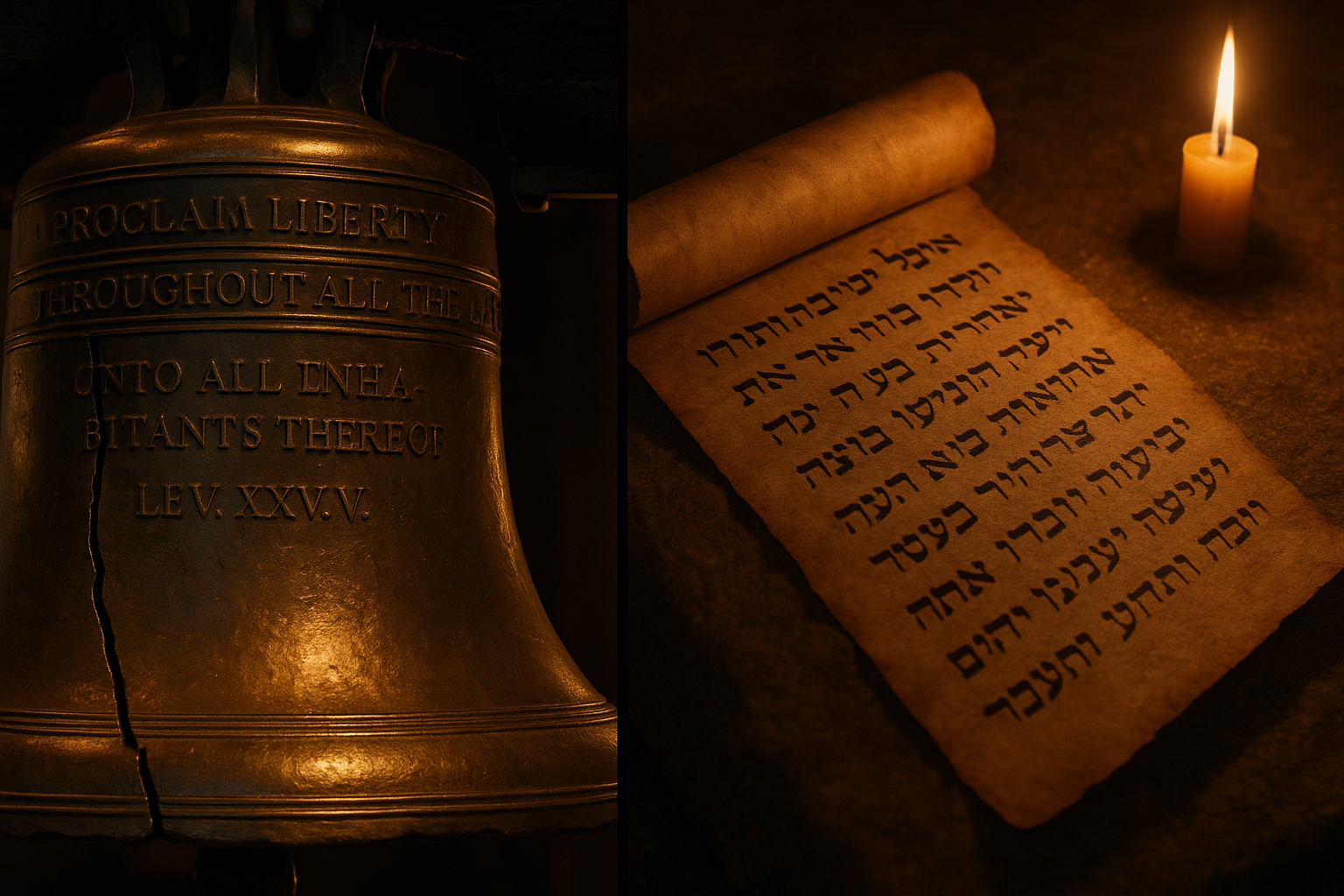
That’s the part everyone photographs. The hairline fracture that spread across the bronze sometime in the early nineteenth century — an event that silenced one of America’s most iconic objects permanently. Nobody knows exactly when it happened. The most plausible estimates place it around 1835, during or after a ceremonial ringing. By the time anyone realized the extent of the damage, it was too late. The bell never rang again.
After the crack, most visitors let their eyes drift upward to the inscription circling the top of the bell. They read it quickly — maybe recognize it from a textbook or documentary — and move on.
What they rarely notice is that the inscription is not American.
The Word the Founders Borrowed — and Where It Came From
The full text on the Liberty Bell reads: “Proclaim LIBERTY Throughout all the Land unto all the Inhabitants Thereof.”
The capitalization is original. When Isaac Norris, Speaker of the Pennsylvania Provincial Assembly, selected this inscription in 1751, the word LIBERTY was intentionally set apart. He was commissioning the bell to mark a specific anniversary — the fiftieth year of William Penn’s 1701 Charter of Privileges, the governing document that had established Pennsylvania’s particular brand of religious tolerance and self-governance. Norris wanted an inscription appropriate to the gravity of fifty years.
He reached back three thousand years to find it.
The full source text reads: “Consecrate the fiftieth year and proclaim liberty throughout the land to all its inhabitants. It shall be a jubilee for you; each of you is to return to your family property and to your own clan.”
That is Leviticus 25:10.
The word LIBERTY on the Liberty Bell is an English translation of the Hebrew word dror.
Norris was a Quaker, deeply steeped in scripture, who understood that the fiftieth-year language in Leviticus resonated with the fiftieth anniversary of Penn’s charter. Whether he grasped the full weight of the Hebrew concept he was translating is another question. The text he chose, however, knew exactly what it was saying.
Two Words That Are Not the Same: Chofesh vs. Dror
In English, “liberty” and “freedom” feel approximately synonymous. We use them interchangeably — civil liberties, freedom of speech, land of the free. The two words have blurred together through centuries of common usage, and most people don’t stop to ask whether they mean different things.
But the text Isaac Norris inscribed was not written in English.
Hebrew has two entirely different words for what English collapses into one.
The first is chofesh (חפשׁ, Strong’s H2670). This is the freedom of release — the simple lifting of a constraint, the end of an obligation, the manumission of a person from servitude. You were bound. Now you are not. That’s chofesh. It’s a negative definition: the absence of bondage. Think of it as the moment the door opens. Nothing more, nothing less.
The second is dror (דרור, Strong’s H1865). This is the word on the Liberty Bell.
Dror appears eight times in the Hebrew Bible. In every single instance, it carries specific legal and social weight. It is the word of Jubilee — the proclamation attached to the ancient reset built into Leviticus 25. Dror doesn’t merely mean “not enslaved.” It means: returned to your inheritance. Restored to your family. Brought back to the land and the belonging that were yours before the debt, before the displacement, before the loss.
With chofesh, a freed person is simply no longer bound. The door is open.
With dror, the freed person goes home.
The difference is the difference between an exit and a destination.
The Jubilee: The Most Radical Economic Proposal in the Ancient World
To understand what dror carried, you have to understand the Jubilee.
Leviticus 25 outlines a system unlike anything attempted in recorded ancient history. Every fifty years — after seven cycles of seven years — the ancient Israelite community was to observe the Year of Jubilee. The Jubilee had three defining features, each more radical than the last.
All debts were cancelled. Whatever you owed — agricultural loans taken out during drought years, debts accumulated through illness or misfortune, obligations that had compounded over decades — they were released. The slate was cleared.
All persons sold into debt servitude were freed. In the ancient Near East, people who could not pay their debts could sell themselves, and sometimes their families, into servitude to their creditors. The Jubilee ended that arrangement. Every person in servitude was released — and critically, they didn’t just walk away. They were returned to their own families and communities. The dror word, the restoration word, was specifically built into this element.
All land reverted to its original family. This is the most structurally unusual provision. In the Jubilee system, land could not be permanently sold. What you were actually selling was the number of harvests remaining until the Jubilee year. When the Jubilee arrived, the land went home. The original family’s claim was restored, regardless of what had happened in the intervening decades.
The underlying logic is striking: the starting conditions of life matter, and systems that allow those starting conditions to compound indefinitely in one direction — accumulating advantage on one end, accumulating disadvantage on the other — will eventually stop functioning as communities at all. The Jubilee was a built-in structural correction. Not charity, not redistribution in any modern political sense, but something more foundational: the recognition that displacement, left unaddressed across generations, compounds into something that eventually swallows everything.
Whether the Jubilee was ever fully practiced at scale is a matter of historical debate — the archeological record is incomplete. But the concept itself, embedded in the founding legal code of an ancient nation, is remarkable. No comparable mechanism appears in any other ancient legal tradition.
The word Isaac Norris placed on the Liberty Bell in 1751 carries all of this. He was choosing an inscription. He may not have known how much that word was carrying. But in choosing dror, he chose a word that was not content to mean merely “free from.”
The Question Every Free Society Eventually Faces
The American founders were consumed by a specific kind of freedom: the chofesh kind. Freedom from a distant crown. Freedom from taxation without representation. Freedom from the quartering of troops in private homes. These were real grievances, and the revolution they drove produced a republic that has persisted for two and a half centuries — an outcome that was far from guaranteed in 1776.
But freedom from is only the first sentence of a much longer question.
Every experiment in human liberty — from ancient Athens to the French Revolution to the American founding to the independence movements of the twentieth century — eventually runs into the same wall. Removing the constraint is achievable. The moment of liberation is real. You sign the treaty. You take down the colonial flag. You walk out the door.
And then the morning comes.
What now?
This isn’t an abstract philosophical puzzle. It’s the practical question that faces every liberated person and every liberated community the day after liberation. Freedom from something — that question has an answer. You remove the thing. Freedom for something — that question doesn’t resolve itself.
The psychological literature on major life transitions documents this same pattern at the personal scale. The retirement that was the goal for decades and then felt strangely empty. The departure from a relationship or a job that needed to end, followed by the unexpected difficulty of figuring out who you are without the thing you were escaping. Freedom from constraint is achievable. Freedom toward something meaningful — that requires a more developed understanding of who you actually are beneath the constraint.
Chofesh says: you are no longer bound. And is silent about what comes next.
Dror says: you are restored to your inheritance. You return to who you were before the loss. It has an opinion about what you were designed to be — and that opinion becomes the direction.
The Ancient Word That Was Already Pointing Somewhere
There is a moment in the same ancient tradition that produced the Jubilee that is worth sitting with.
A teacher — someone who had grown up immersed in the Leviticus text, in the Jubilee concept, in the specific weight of the word dror — stood up in his hometown and was handed a scroll. The scroll contained a prophecy written roughly five centuries before his time, by an earlier writer who had seen something coming. He read it aloud to the room:
“The Spirit of the Lord is on me, because he has anointed me to proclaim good news to the poor. He has sent me to proclaim freedom for the prisoners and recovery of sight for the blind, to set the oppressed free, to proclaim the year of the Lord’s favor.”
The phrase “the year of the Lord’s favor” was not vague. In a room full of people who knew the Leviticus text, everyone would have recognized it. It was another name for the Jubilee — the year of dror. The year when debts are cancelled, when the enslaved go free, when the displaced come home.
The teacher rolled up the scroll. He sat down. Every eye in the room was on him.
And he said: “Today this scripture is fulfilled in your hearing.”
He wasn’t making a political speech. He wasn’t proposing legislation or drafting a founding document. He was making a specific claim about what the Jubilee had always been pointing toward — and about what it now meant for anyone who had lost something that mattered. Not freedom-from-constraint as the endpoint. Freedom toward restoration. Return to inheritance. Return to who you were designed to be before the debt, the displacement, the diminishment.
The concept of a God who moves toward the displaced — not away from them — runs through this entire tradition. We explored it from a different angle when looking at what Juneteenth reveals about the God of the Bible — the same liberating thread, pulled from the Exodus account. The word dror is that same thread, encoded in a legal text, placed on a bell in Philadelphia, and still asking its question three thousand years after it was first written.
The Bell Is Silent. The Question Is Not.
The Liberty Bell sits in a glass pavilion on Market Street in Philadelphia. Millions of people visit every year. Most of them photograph the crack.
The crack is one kind of history — the evidence of an instrument that rang for decades and then went silent. The bell that proclaimed liberty on July 8, 1776, after the first public reading of the Declaration of Independence. The bell that rang through the founding years and then, somewhere in the 1830s, fell silent.
But the words above the crack are still there. Still legible in the bronze. Still carrying a question they’ve been asking since Leviticus 25 first put them together: What does liberty actually mean?
Not chofesh — the empty space where the constraint used to be. But dror: the return to inheritance. The restoration to who you were made to be. The answer to the question every liberated person eventually faces when the freedom arrives and the real work begins.
The bell may never ring again. But the word is still there.
And it was never content to mean merely not bound.
If you’re curious about what else gets lost in translation — including the Hebrew word for breath that changes the whole meaning of rest — this piece on what burnout reveals about how we were actually designed is worth the read.
The question dror was always asking — what you were made to be, before the loss and the displacement — doesn’t resolve quickly. If that question is sitting with you, the 30 Days Walking with Jesus journey is one place to begin following it somewhere. Not a quick answer. A path toward one.
A Prayer
God — I’ve been going through the motions of being free without fully knowing what I’m free for. If there’s an inheritance I’ve lost sight of, a version of who I was designed to be that’s gotten buried under the debt and the distance and the years — I’d like to find my way back to it. I don’t need a dramatic moment. Just a direction. That would be enough to start.
Something to Do This Week
- Look up the Liberty Bell inscription this week — not in a photograph, but in the actual text. Read Leviticus 25:10 alongside it. Three minutes. See if the chofesh/dror distinction changes how you read both.
- Write down one thing in your life right now that feels like chofesh — a constraint you’ve been trying to escape. Then write: what would dror look like here? Not just freedom from, but freedom toward. What would it mean to be restored to your inheritance in this area?
- Share this article with one person who’s in a transition — someone who got free from something and is now figuring out what comes next. The ‘freedom for what’ question is easier to sit with when you don’t have to sit with it alone.
Journaling Prompts
- Think of a moment in your life when you got free from something that had been holding you. What did the first few days feel like — and what did the first few months feel like? Where did the ‘what now?’ question start to show up?
- The word dror doesn’t just mean freedom from constraint — it means returned to your inheritance, to who you were before the loss. What is the version of yourself you think you were before something you’ve been through? What would it mean to go home to that?
- The Jubilee built a reset into the calendar — the assumption that advantage and disadvantage compound over time in ways that need structural correction. Where in your own life do you feel like you’re carrying something that was never supposed to be permanently yours? What would the Jubilee mean for that specific thing?
Discussion Question
When you hear the word “liberty” in an American context — July 4th, the founding documents, the Liberty Bell — do you think most people understand it as freedom from something, or freedom for something? Does the distinction matter? Drop your take in the comments.
Frequently Asked Questions
What does the Liberty Bell inscription actually say and where does it come from?
The Liberty Bell inscription reads: ‘Proclaim LIBERTY Throughout all the Land unto all the Inhabitants Thereof.’ It was chosen in 1751 by Isaac Norris, Speaker of the Pennsylvania Provincial Assembly, to mark the fiftieth anniversary of William Penn’s Charter of Privileges. The text is a direct quote from Leviticus 25:10 — an ancient Hebrew legal text predating the American republic by roughly three thousand years. The word translated as LIBERTY is the Hebrew word dror.
What is the difference between freedom and liberty in the Bible?
In Hebrew, there are two distinct words for what English collapses into one. Chofesh (H2670) means freedom from constraint — the simple absence of bondage. Dror (H1865) means something more specific: the Jubilee proclamation, the restoration of a person to their inheritance, their family, and the land that was theirs before displacement or debt. Dror doesn’t just mean ‘not enslaved’ — it means ‘returned to who you were before the loss.’ The Liberty Bell uses the dror word, not chofesh.
What was the Jubilee year in the Bible?
The Jubilee was a special year prescribed in Leviticus 25 to occur every fifty years. During the Jubilee, three things happened: all debts were cancelled, all people in debt servitude were freed and returned to their families, and all land that had been sold reverted to the original family that owned it. The Jubilee was designed as a structural reset — a built-in correction against the permanent compounding of disadvantage across generations. The Hebrew word for this proclamation of Jubilee freedom is dror.
Did the founding fathers know the Liberty Bell inscription was from the Bible?
Isaac Norris, who chose the inscription in 1751, was a Quaker deeply familiar with scripture and likely knew he was quoting Leviticus 25:10. The inscription was chosen before the Revolutionary War — the bell was originally commissioned to mark the fiftieth anniversary of Pennsylvania’s Charter of Privileges. Whether Norris or later American founders fully understood the specific weight of the Hebrew word dror — with its Jubilee connotation of restoration to inheritance, not merely release from constraint — is harder to say. The text knew what it was saying, whether or not all who rang the bell did.
What does dror mean in Hebrew?
Dror (דרור, Strong’s H1865) is a Hebrew word that appears eight times in the Hebrew Bible, always in the context of Jubilee proclamation or prophetic declarations of freedom. Unlike chofesh — which simply means freedom from constraint — dror carries the specific legal and social meaning of the Jubilee: the return of displaced people to their family property, the cancellation of debts, and the restoration of enslaved persons to their communities. It’s best translated not as ‘freedom from’ but as ‘liberty for’ — the restoration of a person to who they were before the loss.
The bell says liberty. But the word it borrowed doesn’t mean ‘not bound.’ It means ‘returned to who you were made to be.’