 0
0
 0
0
You have heard the word a thousand times. It is on church signs, in song lyrics, in the name of a whole music genre. Somebody says “the gospel” and you nod, because of course you know what it means.
Then someone asks you to say it in one sentence, and you reach for “the good news” and “the message” — both true, both explaining almost nothing. That is not your fault. It is what happens to any word used every week for two thousand years. It goes soft.
So here is a question worth asking slowly: what does gospel mean? Not what it means to us now, after centuries of hymns and sermons. What did it mean to the first people who ever read it, in the language it was written in, before the church owned it?
The answer is not gentle. It was a word about power.
What Does Gospel Mean in the Original Greek?
The Greek word is euangelion. Take it apart and it is simply eu, “good,” and angelia, “message.” Good message. Good news. Good tidings. That is where our words “evangelist” and “evangelical” come from, and by a long road through Old English it is where the word “gospel” comes from too: god-spel, good story.
But knowing what a word is built from is not the same as knowing what it did. In the Greek-speaking world of the first century, euangelion was not a religious term at all. It was a public one.
It was what you called the announcement a runner carried in from a battlefield: the fighting is finished, our side won, the war is over. It was what a city proclaimed when an emperor was born, or came of age, or took the throne. It was news that arrived from somewhere else and changed the situation of everyone who heard it, whether or not they had an opinion about it.
That is a very specific kind of statement. It is not advice. It is not a philosophy. Nobody sends a runner across a hundred kilometres of road to deliver a helpful suggestion.
If that opens something up in you and you would rather read one of these announcements end to end than hear about it secondhand, we made the complete Book of Matthew free — as an immersive PDF and a 28-chapter audiobook you can listen to while you walk or cook. It is the same news this article is about, told at full length.
The Stone in the Marketplace
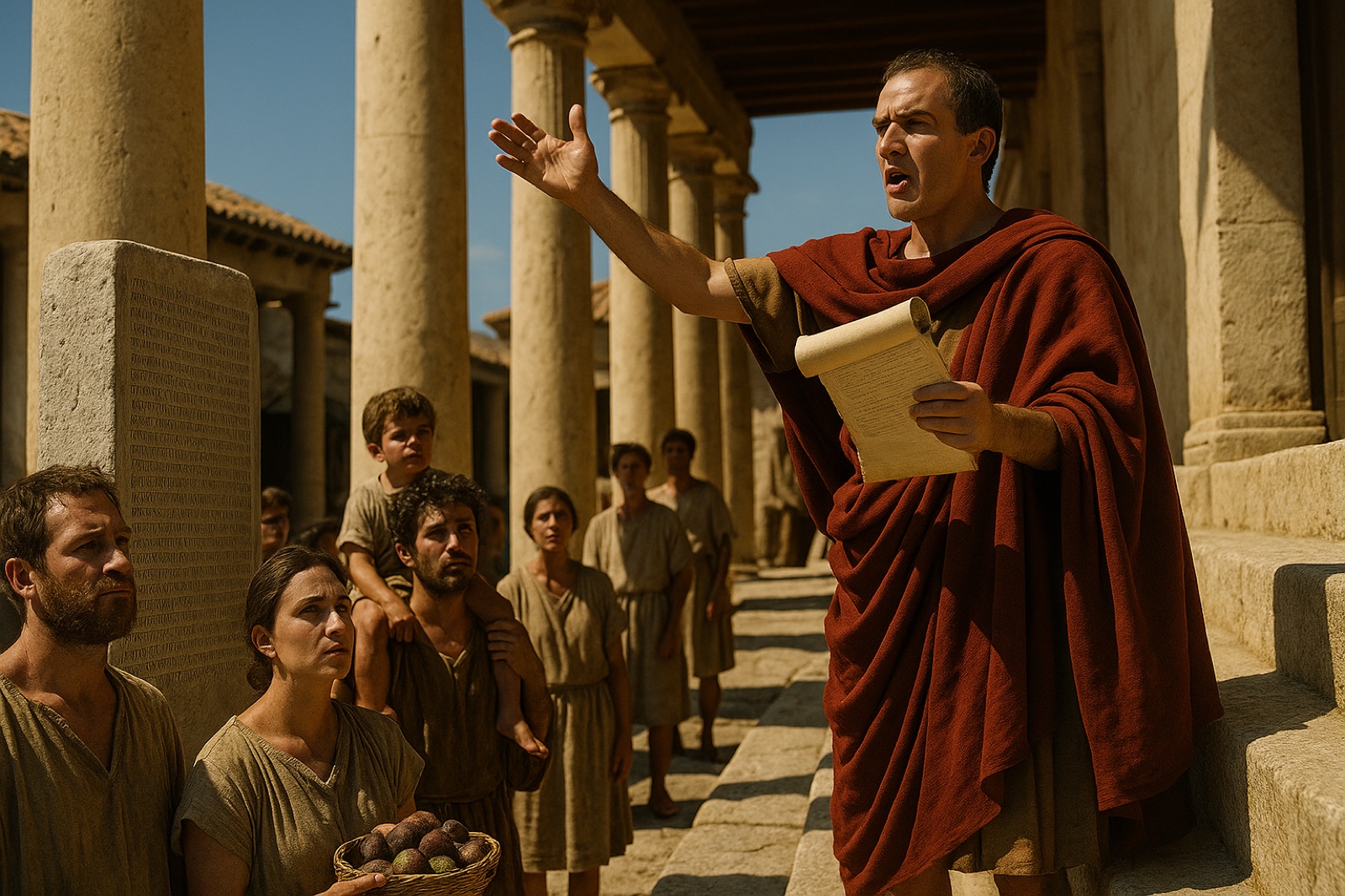
We are not guessing about any of this. There is a stone.
In the marketplace of Priene — an old Greek city on the coast of what is now western Turkey — archaeologists found an inscription carved in Greek and dated to 9 BC. It records a decision by the provincial assembly of Asia, following a proposal from the Roman governor, to throw out the old calendar and begin the year on the birthday of Caesar Augustus: the twenty-third of September.
Reorganising time itself around one man’s birthday is already a strong move. But it is the reasoning that stops you. The decree explains why the honour is deserved, and the key line reads, in the standard English translation of the text:
“since the birthday of the god Augustus was the beginning of the good tidings for the world that came by reason of him”
The word behind “good tidings” there belongs to the euangelion family. Same root. Carved on a Roman government notice, in a market square, decades before any Christian wrote anything down.
And Augustus carried a title as well — on that stone, on coins, on inscriptions and papyri all over the empire. In Greek, huios theou. In Latin, divi filius. Son of a god.
If a carved stone settling a historical question sounds far-fetched, it happens more often than you would think. A block of limestone pulled out of a theatre at Caesarea in 1961 is the reason we can say Pontius Pilate was a real Roman official rather than a character in a story — that one is worth reading too.
Then Mark Wrote His First Sentence
Now read the opening line of the earliest of the four Gospels, exactly as the King James Version has it:
“The beginning of the gospel of Jesus Christ, the Son of God;” — Mark 1:1
Gospel. Son of God. Beginning. Three pieces of the empire’s own vocabulary, stacked into one short sentence, and handed to a travelling teacher from a small town in an occupied province — a man the Roman state had already executed.
Let us be careful here, because this is exactly where it is easy to overclaim. That Mark’s vocabulary overlaps with imperial vocabulary is not in dispute. The inscriptions exist and anyone can go and read them. Whether Mark sat down and deliberately aimed that sentence at Caesar is an inference — a reasonable one, argued by serious scholars, but an inference. Nobody has a note from Mark explaining himself.
What can be said plainly is what that sentence would have done to somebody in Asia Minor who walked past a stone like the one at Priene on the way to buy bread. They would not have needed it explained.
The Detail Almost Everybody Reads Past
Here is the part that surprised me most, and it is a matter of grammar rather than drama.
Rome’s version of the word was normally plural. Euangelia. Good newses. In his study of the Priene inscription for the Journal of Greco-Roman Christianity and Judaism, the New Testament scholar Craig A. Evans notes that the inscription itself probably carries that plural form, twice — while Mark, in his opening line, uses the singular.
Sit with that for a moment, because it is small and it is not small at all.
Plural makes perfect sense for an empire. An empire produces good news the way a river produces water: continuously, and never finally. A victory this spring. An heir this winter. A birthday every September. Another emperor after this one, and another after that. Every announcement is real, every announcement is temporary, and the fact that another one is always coming is precisely what tells you none of them settled anything.
Mark wrote one. Not “here are the latest good tidings.” The gospel. Singular. Definite. Finished. A word that by its own grammar refuses to be one more item in a stream.
You do not need Greek to feel that difference. It is the difference between a company that keeps announcing exciting news and a doctor who rings once to say the test came back clear.
The Word Had an Older Home Too
There is a complication here, and leaving it out would make this article tidier and less true.
Rome was not the only place this word lived. Centuries before Augustus, the Greek translation of the Hebrew scriptures used the same word family for one very particular scene — and Mark quotes that very prophet three verses into his own Gospel. Isaiah 52:7, in the King James Version:
“How beautiful upon the mountains are the feet of him that bringeth good tidings, that publisheth peace; that bringeth good tidings of good, that publisheth salvation; that saith unto Zion, Thy God reigneth!”
Look at what the runner actually shouts at the end of that verse. Not “cheer up.” Not “here are five steps.” Thy God reigneth.
A throne announcement. The same shape as the Roman one, written down long before Rome ruled anything, and pointed in a completely different direction.
So the word reached Mark carrying two histories at once: the herald coming down off the mountains in Isaiah, and the herald coming into the market square with news of Caesar. Evans, who argues the imperial connection carefully, points at the Isaiah thread in the same breath. Both are in view. That is not a weaker answer than “it was aimed at Rome.” It is a bigger one. The word means throne, whoever happens to be sitting on it — and Mark is telling you which throne this particular news is about.
And Then Mark Closes the Loop
If you want to know whether Mark understood what he was doing with that title, read to the end of his book.
Jesus dies. And the first human being in the whole Gospel of Mark to look straight at Him and name Him correctly is not a disciple, not a priest, not a member of His family. It is a Roman army officer — a man whose job was Caesar’s, whose oath was Caesar’s, who had in all likelihood said the words “son of a god” about an emperor more than once:
“And when the centurion, which stood over against him, saw that he so cried out, and gave up the ghost, he said, Truly this man was the Son of God.” — Mark 15:39
Mark opens his book by putting the emperor’s title on Jesus. He closes it by putting the emperor’s title in the mouth of the emperor’s own soldier, standing in front of a cross. Whatever else that is, it is not accidental writing.
Why This Changes What the Gospel Is Asking of You
Here is where this stops being history.
Most of us, quietly, treat the gospel as advice. Very good advice. Holy advice. Advice with God’s name on it — but advice. A set of instructions for becoming a better person. And advice has a particular feel to it: it sits there waiting while you decide whether you have the energy for it this week. Advice makes you the main character. Everything depends on how well you follow it.
News does not work like that.
When a runner comes into the square and says the war is over, your feelings about it do not change the situation. You did not win the battle. You were not consulted. You cannot follow an announcement well or badly. There is only one question available to you — is it true? — and if it is true, you now live in a world where it is true, and you start walking home differently.
That is what Mark put in his first line. Not “here is how to be good.” A throne has changed hands. The one in charge is Jesus, and He is good, and this is not a rumour going around. It is the announcement.
Which quietly swaps out the question you have been carrying all day. It stops being am I doing enough? and becomes who is on the throne today? That second question you can actually answer — at any hour, in any mood, on your worst morning, with nothing in your hands. And the answer does not move when you do.
It also explains something that has probably confused you before. When Jesus started preaching, His first recorded words in Mark were not a moral instruction. They were a bulletin: “The time is fulfilled, and the kingdom of God is at hand: repent ye, and believe the gospel” (Mark 1:15). The word behind “kingdom” there never meant a place you go when you die — it meant a reign actually being exercised, right now. And the word behind “repent” does not mean grovel. It means think again. See it differently.
Announcement first. Response second. Never the other way round.
What to Do With This Today
- Read Mark 1:1–15 out loud, swapping one word. It is fifteen verses and takes about three minutes. Every time you hit the word “gospel,” say “announcement” instead. Notice what happens to the passage — and to your shoulders.
- Finish one sentence, in writing. On your phone or on the back of anything: “If God is genuinely on the throne today, then the thing I am most worried about is ______.” Do not try to solve it. Just look at it in that light for a minute.
- Say it out loud to one person. Pick the situation where you have been acting as if the entire outcome rests on you. Send one message today — to a friend, a sibling, anyone — that says plainly: “I am handing this one over.” Saying it to a person makes it real in a way that thinking it never does.
And if the announcement lands and you genuinely do not know what happens next, there is a short, free walk-through here: How to Become a Christian: Your First 6 Steps. No pressure, no sign-up. Just the next few steps laid out plainly.
Journaling Prompts
- Look back over the last month. Where have you been living as though the outcome depends entirely on how well you perform? Write the situation down, then write underneath it: “This one already has someone on the throne.”
- If the gospel is news rather than advice, what have you been carrying that was never yours to carry? Name one thing specifically, not in general.
- When did you last hear news that genuinely changed how you walked through a day? What did that feel like — and how is that different from the way the word “gospel” usually feels to you?
A Prayer
God, I have been treating the good news like a list of things I keep failing at. I did not realise it was an announcement — that the throne question is already settled, and that I was never the one who had to settle it. Help me stop reading it as pressure and start hearing it as a report from someone who was actually there. And when tomorrow gets loud, remind me which question I am really supposed to be asking. Amen.
One Question Worth Talking About
Do you think the church has lost more than it gained by softening euangelion into a warm, religious “good news” instead of keeping its original edge as a public announcement that power has changed hands? Tell us what you think in the comments — we read them.
Share This
- “Gospel” was Caesar’s word before it was the church’s. It meant: a throne has changed hands. Which means the gospel was never advice you could take or leave — it is news, and the only question news asks is whether it is true.
- Rome announced good news in the plural. A fresh one every emperor, every victory, forever. Mark wrote one. Singular. That is the whole difference.
- The first person in Mark’s Gospel to name Jesus correctly is a Roman soldier at the foot of a cross, using the emperor’s own title. Mark opened his book with that title and closed it with that soldier.
Questions People Ask About What the Gospel Means
What does gospel mean?
Gospel translates the Greek word euangelion, which means “good news” or “good tidings.” In the first-century Greek-speaking world it was a public and political word rather than a religious one: it named the announcement a messenger carried that a battle had been won, or that an emperor had been born or had taken the throne. Applied to Jesus, it means the gospel is a report that something has happened and that a throne has changed hands — not a set of instructions for how to live.
Where does the English word “gospel” come from?
The English word “gospel” comes from the Old English god-spel, meaning “good story” or “good news.” It was chosen to translate the Greek euangelion, which is also the root of the English words “evangelist” and “evangelical.”
What is the Priene Calendar Inscription?
The Priene Calendar Inscription is a Greek inscription dated to 9 BC, found in the marketplace of the ancient city of Priene in what is now western Turkey. It records a decision by the provincial assembly of Asia to begin the year on the birthday of Caesar Augustus, and describes that birthday as the beginning of the “good tidings” for the world — using the same Greek word family that the New Testament later uses for the gospel.
Did Mark deliberately use Roman imperial language in Mark 1:1?
Mark 1:1 in the King James Version reads: “The beginning of the gospel of Jesus Christ, the Son of God.” Both “gospel” (euangelion) and “Son of God” (huios theou, Latin divi filius) were used of Caesar Augustus in Roman inscriptions and on coinage, so the overlap in vocabulary is well documented. Whether Mark intended a deliberate challenge to Rome is a reasonable scholarly inference rather than a proven fact. The same word family also appears in the Greek translation of the Hebrew scriptures, notably in Isaiah’s picture of a herald announcing that God reigns.
Is the gospel good advice or good news?
The gospel is news, not advice. Advice describes something a person ought to do; news describes something that has already happened and is true whether or not anyone responds to it. Because euangelion was the ordinary word for announcing a victory or a change of ruler, the gospel of Jesus Christ is a report that a throne has changed hands — which is why the New Testament calls for belief in an announcement before it calls for any change in behaviour.