 0
0
 0
0
You said no on Tuesday. It was a small no. You didn’t shout, you didn’t explain yourself for ten minutes, you just said you couldn’t do it this time.
And then you felt sick about it for three days.
Not because they were angry. Half the time they aren’t even angry. The sick feeling comes from somewhere else — a quiet voice that says a real Christian would have said yes. That love means always available. That the person who draws a line is the person who has stopped loving.
If that voice is familiar, stay with me. Because the way out of it is not a better argument about self-care. It’s one ordinary Hebrew word, and it changes who the line belongs to.
What Does the Bible Say About Boundaries?
Here’s the surprising part. Most Christian writing on this subject starts with psychology and then goes looking for a verse to prop it up. But scripture has its own boundary vocabulary, and it was there thousands of years before anyone wrote a book about it.
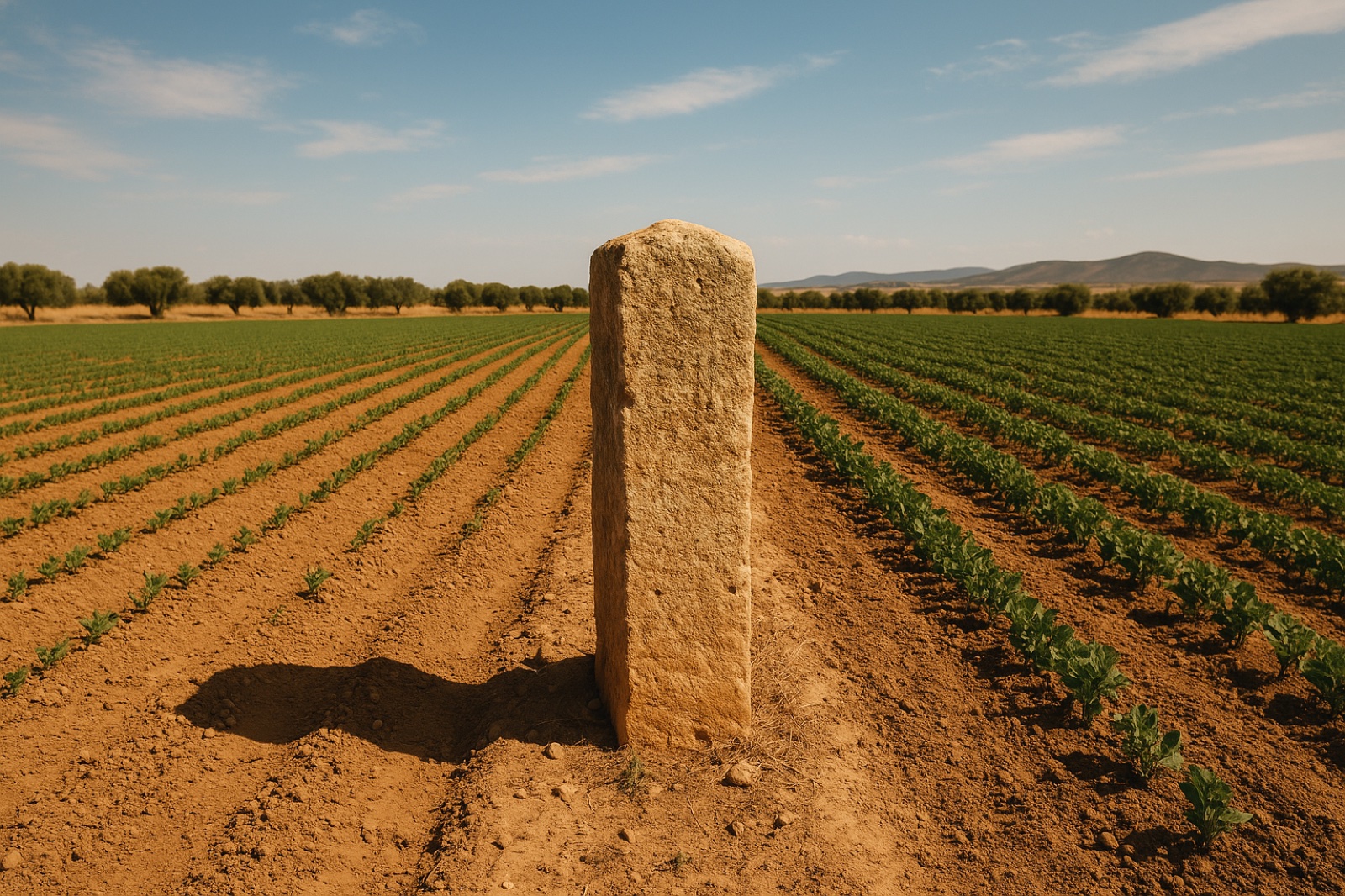
The Hebrew word is gebul. Depending on the sentence, the King James Bible renders it as border, bound, coast, limit — or landmark. It’s the same word used for the edge of an entire nation and for the stone sitting at the edge of one family’s field. A boundary, in the Bible, is not a mood or a personality trait. It is a line on the ground with a rock marking it.
And there is a law about that rock:
“Thou shalt not remove thy neighbour’s landmark, which they of old time have set in thine inheritance, which thou shalt inherit in the land that the LORD thy God giveth thee to possess it.” — Deuteronomy 19:14
Read it again slowly, because everything turns on one detail: the person who owned the field did not set the stone. “They of old time have set” it. The boundary was already standing there when the owner arrived. In the book of Joshua the land was divided by lot, cast — as the text puts it — “before the LORD our God” (Joshua 18:6). The line was assigned. The farmer simply inherited it.
So when a neighbour crept out and shifted that stone, he wasn’t disagreeing with the farmer’s preference. He was overruling an allotment he had no part in making.
The Crime You Could Never Prove
Now look at where that law is sitting, because the placement is doing work most readers walk straight past.
Deuteronomy 19 opens with the cities of refuge — safe towns for someone who killed a person by accident and would otherwise be hunted down (verses 1-13). Immediately after the landmark verse comes the law of witnesses: “One witness shall not rise up against a man for any iniquity, or for any sin, in any sin that he sinneth: at the mouth of two witnesses, or at the mouth of three witnesses, shall the matter be established” (Deuteronomy 19:15).
Refuge. Landmark. Witnesses. That is a chapter about wrongs that are hard to prove and easy to deny.
Which is exactly what moving a boundary stone is. Nobody watches it happen. It shifts a hand’s width, then another hand’s width the next season. There’s no blood, no shouting, no single moment you can point at. Accuse him and he says he never touched it — and he may half believe himself. A year later your field is smaller and you cannot explain how.
If you have ever tried to describe why a certain relationship leaves you exhausted, and heard yourself sound petty listing things that each seemed like nothing on its own, you already know this crime from the inside.
One of Only Twelve
Then Deuteronomy 27 does something startling with it.
Israel stood on two mountains while the Levites read out twelve curses, and after each one the whole nation answered “Amen” out loud. Twelve — that’s the entire list. Idol-making is on it. Dishonouring your father or mother. Taking money to kill an innocent person. Perverting justice for the stranger, the fatherless and the widow.
And third from the top:
“Cursed be he that removeth his neighbour’s landmark. And all the people shall say, Amen.” — Deuteronomy 27:17
Out of everything that could have made a list of twelve, moving a boundary line made it. An entire nation said Amen to that out loud, with their own mouths, standing on a hillside.
That is not the posture of a God who thinks limits are selfish.
A boundary isn’t you deciding you matter. It’s a stone God already set.
God Put the Line on the Weaker Person’s Side
Here’s the detail that surprised me most, and it’s the one that quietly dissolves the guilt.
Every single time scripture returns to this law, it lands beside the powerless.
Proverbs pairs it with one specific person: “Remove not the old landmark; and enter not into the fields of the fatherless: For their redeemer is mighty; he shall plead their cause with thee” (Proverbs 23:10-11). A child with no father is the easiest person in the village to steal from. There’s nobody to complain to, no one to make a scene. So God steps into that gap personally, as the one who argues the case.
Job says the same thing from the other direction, listing what the wicked actually do: “Some remove the landmarks; they violently take away flocks, and feed thereof. They drive away the ass of the fatherless, they take the widow’s ox for a pledge. They turn the needy out of the way” (Job 24:2-4).
Landmark first. Then the fatherless. Then the widow. Then the needy. It’s one list, and it is the same act performed over and over on people who cannot fight back.
Notice who scripture assumes is being protected. Not a powerful man guarding a stockpile. The person with the least leverage in the arrangement — the one everybody quietly expects to just absorb it.
That is usually the person feeling guilty. In most relationships where boundaries become an issue, the one lying awake at night asking whether they were selfish is the one with less power, not more. Scripture puts the line on their side, and then stands behind it.
Jesus Walked Away While People Still Needed Him
Which brings us to the real objection, and it was never a theological one. It’s this: but they still need me.
They do. That’s the whole difficulty. Nobody loses sleep over refusing something nobody needed.
So look at what Jesus did with precisely that situation. Luke describes crowds gathering to be healed — real people with real illnesses, right there in front of Him — and then adds a single sentence: “And he withdrew himself into the wilderness, and prayed” (Luke 5:16). Not once the queue had cleared. While it was still forming.
In Mark, He tells the disciples, “Come ye yourselves apart into a desert place, and rest a while: for there were many coming and going, and they had no leisure so much as to eat” (Mark 6:31). Read the reason He gives for leaving: the sheer volume of need. Not its absence.
And in John, when a crowd decided to make Him king by force, “he departed again into a mountain himself alone” (John 6:15).
Jesus walked away from unmet need repeatedly, and not one gospel writer treats it as a lapse in love. Whatever love is, it is evidently not the same thing as being infinitely available.
So here is the turn. The guilt you carry rests on a hidden assumption — that the line is yours. That you invented it, so you have to justify it. That’s exactly why it feels selfish: you think you’re defending a preference.
But the landmark was never the farmer’s idea. He inherited it. His whole job was to not move it, and to not let anyone else move it either. Refusing to shift a stone you didn’t place isn’t self-assertion. It’s stewardship. You are not building a wall around yourself — you are standing where you were put.
That is a completely different weight to carry. And it holds up in the conversation where someone tells you that you’ve changed.
What This Looks Like on Monday Morning
None of this costs money, and none of it requires anyone’s permission.
- Name one stone that has moved. Not the whole relationship — one specific thing. Say it out loud in the car: “I used to stop answering messages after ten at night.” Naming it takes thirty seconds and it stops the vagueness that keeps you stuck.
- Say one sentence with nothing attached to it. “I can’t this week.” Full stop. No reason, no apology paragraph. The explanation is usually where the stone gets moved, because it hands the other person something to negotiate with.
- Ask who set the line. Take the limit you feel worst about holding and ask whether it protects something God actually gave you — your sleep, your health, your family’s evening, the work in front of you. If it does, you are not defending a preference. You’re guarding an inheritance.
If step two is the one that makes your stomach drop, it may be worth knowing how you’re wired for this: our free What Is My Conflict Style? quiz takes a couple of minutes and tends to explain a lot about why the sentence gets so hard to say. And if the guilt shows up even when you rest, not just when you refuse, we looked at that separately in why you feel guilty when you rest.
Questions to Sit With
- Where did you first learn that saying no makes you a bad person? Who taught it — and did they ever say it out loud, or did you simply watch it?
- Think of one line that has quietly moved over the past year. What did you tell yourself each time it shifted? What would you have said if a friend had told you that same story?
- If you knew for certain that God had set one of your limits personally, which one would you stop apologising for tomorrow?
A Prayer for the Guilt That Comes After
God, I keep apologising for a line I did not even draw. It has moved so many times I honestly can’t remember where it started. Show me which of these limits actually came from You, and give me the nerve to leave them standing — even when someone I love is disappointed in me. Keep my heart soft while I do it, because I don’t want to become hard. Amen.
What Do You Think?
Do you think most people who set boundaries are protecting themselves, or protecting the relationship? Tell us in the comments — we read every one.
Share This
- The Bible’s word for “boundary” is the word for a border stone. And the person who owned the field never set the stone — they inherited it. Turns out I’ve been apologising for a line God drew.
- Moving a neighbour’s boundary marker was one of only twelve things the whole nation of Israel was made to curse out loud. Twelve. Limits are not a modern invention and they are not selfish.
- Jesus withdrew while the crowd was still arriving to be healed. Not after. Whatever love is, it isn’t the same thing as being endlessly available.
Common Questions
What does the Bible say about boundaries?
The Bible’s own word for a boundary is the Hebrew gebul, translated in the King James Version as border, bound, coast, limit or landmark. It refers to a physical marker stone at the edge of a field. Deuteronomy 19:14 forbids moving a neighbour’s landmark, and Deuteronomy 27:17 places a public curse on anyone who does. Crucially, the owner of the field did not set that stone — it was there when the land was inherited.
Is setting boundaries selfish according to the Bible?
Scripture does not treat limits as selfish. Every passage about landmarks sits beside the vulnerable rather than the powerful. Proverbs 23:10-11 forbids moving the old landmark in the same breath as entering the fields of the fatherless, and promises that their redeemer will plead their cause. Job 24:2-4 lists landmark-moving alongside taking a widow’s ox and turning out the needy. The boundary in scripture protects the person with the least power in the arrangement.
Did Jesus set boundaries?
Yes, repeatedly, and often while people still had unmet needs. Luke 5:15-16 describes great multitudes gathering to be healed, and then says Jesus withdrew into the wilderness to pray. In Mark 6:31 He tells the disciples to come apart and rest, giving the volume of people coming and going as the reason. In John 6:15 He departs alone into a mountain when a crowd tries to make Him king by force. No gospel writer presents any of these as a failure of love.
What is the Hebrew word for boundary in the Bible?
The word is gebul (Strong’s Hebrew 1366). It originally carried the sense of a twisted cord, and came to mean the territory enclosed by a line. The King James Version translates it as border, bound, coast, limit and landmark. The same word describes the border of an entire nation and the stone at the edge of one family’s field.
Which Bible verses talk about boundaries?
The main passages are Deuteronomy 19:14 (do not remove your neighbour’s landmark), Deuteronomy 27:17 (a public curse on anyone who does), Proverbs 22:28 (“Remove not the ancient landmark, which thy fathers have set”), Proverbs 23:10-11 (the landmark and the fields of the fatherless), Job 24:2-4 (landmark-moving as an act of the wicked) and Hosea 5:10, where the leaders of Judah are compared to people who move a border.
One more thing, if the guilt after a “no” is really about how loudly other people’s opinions land in your head, that’s a slightly different knot — and we pulled it apart in how to stop caring what people think.