 0
0
 0
0
Every language you have ever read is built from a small pile of shapes.
English gets by on twenty-six. Arabic uses twenty-eight. Korean’s Hangul has twenty-four. Every book ever written in those languages, every argument, every love letter, every set of instructions for fixing a tap — all of it is made by putting a handful of shapes in a different order.
Life is more economical than any of them. Every living thing on this planet — you, the mould on old bread, a blue whale, the bacteria in your gut — is written with exactly four. Not four hundred. Four.
In September 2026, researchers reported that a natural enzyme read eight-letter DNA — the usual four plus four that do not exist anywhere in nature. And the strangest part is not that the eight-letter version works. It is who read it.
Life Writes With Four Letters
The four are A, T, C and G. They are short for four chemicals, and honestly the names matter less than the arrangement.
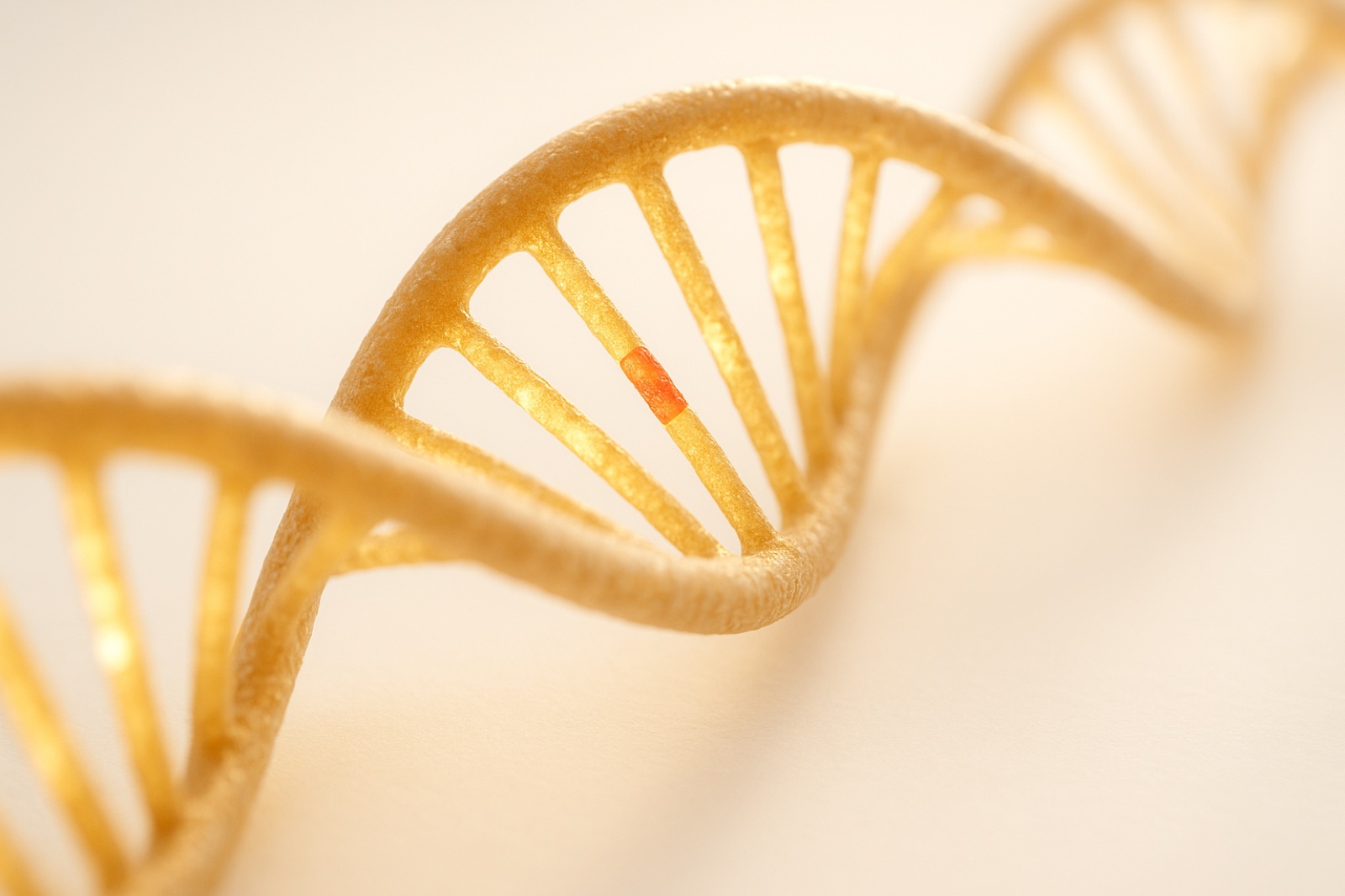
They pair up. A always holds hands with T. C always holds hands with G. That pairing is the whole trick, because it means one side of the ladder can always be used to rebuild the other side. Split the ladder down the middle and each half carries complete instructions for making a new whole.
That is the entire mechanism behind why you look a little like your grandmother.
Four letters. Two pairs. Roughly four billion years of everything alive running on it without a single upgrade.
What Is Eight-Letter DNA?
In February 2019, a team led by Steven Benner at the Foundation for Applied Molecular Evolution published work in the journal Science describing a genetic system built from eight building blocks instead of four.
They kept A, T, C and G, and added four synthetic ones, labelled B, S, P and Z. Like the originals, the new ones pair off — two more couples joining the two that life already had.
They called it hachimoji DNA. The name is Japanese, and it means “eight letters.”
Hold on to that name for a moment. We will come back to it.
Building the thing was one achievement. But a genetic alphabet that only sits there is a curiosity, not a language. For it to mean anything, something has to be able to read it.
The Enzyme Nobody Had to Teach
This is the part worth slowing down for.
Inside a cell, the job of reading DNA belongs to a molecular machine called RNA polymerase. It runs along the strand and copies what it finds into a working message the cell can act on. Biologists call that copying step transcription.
On 2 September 2026, a study in Nature Communications — led by Dong Wang, a professor at the UC San Diego Skaggs School of Pharmacy and Pharmaceutical Sciences — asked whether an ordinary RNA polymerase, taken from E. coli bacteria, could transcribe the eight-letter alphabet.
Not a redesigned enzyme. Not one engineered for the job. The standard one.
It could. Using cryo-electron microscopy, the team captured structural snapshots of the enzyme recognising and incorporating synthetic base pairs — and reported that it handled the new letters using the same biochemical and structural signals it uses for the natural ones. They also found it could recognise a further pair of synthetic letters that do not even bond in the usual way.
Sit with the oddity of that.
This enzyme has spent an unimaginable stretch of time reading a four-letter alphabet, because that was the only alphabet there was. The four new letters did not exist until people made them. And when the enzyme met them, it did not jam, and it did not need instructions. It read them.
It is a little like handing a lifelong reader a page in an alphabet invented last Tuesday — and watching them read it aloud without breaking stride.
The Name Itself Is a Word About Writing
Now go back to hachimoji. Eight letters.
Look at the vocabulary in this entire field and notice what it is made of. Letters. Alphabet. Code. Sequence. Reading. Transcription. Proofreading. Translation. Even the title of the new study calls it an alphabet.
None of that is poetry that got bolted on afterwards to make the science friendlier. It is the working vocabulary, used by the people doing the work, in the papers themselves — because it is the language that actually fits. When you find a system where discrete units are arranged in order, and the order carries meaning, and a machine runs along it and reads out that meaning, you are not looking at something that merely resembles writing. You are looking at writing.
Nature is quietly good at getting somewhere first. It was making fully biodegradable plastic long before we thought of it, and the question of how complex life began at all still turns on partnerships we are only starting to make sense of.
But the alphabet is a different order of strange. Plastic is a material. An alphabet is a decision about meaning.
The Turn
There is an old idea, far older than genetics and found in the oldest writing we have, that the world was not assembled but spoken. Said into being. Not built out of parts like a wall, but uttered, the way you utter a sentence.
For most of history that sounded like a poetic way of dodging the question. It is a curious thing that the people who went looking for the smallest working part of a living body found something that has to be described as a text — and then found that the text can be extended, and read, by machinery that never once agreed to the new terms.
You do not have to make anything of that. It is simply there, sitting in the vocabulary, refusing to be translated into any other kind of word.
What This Does Not Mean
Worth being straight about the limits, because the headlines will not be.
This is an enzyme, in controlled conditions, transcribing synthetic DNA. It is not an organism living on eight letters. Nobody has built one, and this study did not claim to. The researchers describe it as evidence that a cell’s own machinery can process expanded genetic information — which is a real and significant step toward that goal, and is not the same as arriving there.
What it does open up is engineering: if cells can be made to read letters that nature never used, biologists gain room to design systems that produce things no living thing currently makes. That is the stated ambition. It is early.
Four Letters, and Then Some
The thing that stays with you is not the technology. It is the ratio.
Four shapes. That is the whole supply. Everything that has ever crawled, swum, flowered, hunted, sung or read a sentence came out of four shapes in a different order — and apparently there was room for more the entire time, and the reader was ready for them before anyone asked.
It is a good reminder that the amount of world still unaccounted for is larger than it looks from here. If you enjoy that particular feeling, our free How Old Is the Universe? explorer is a decent way to spend ten minutes standing in it.
Four letters. Then eight. Nobody has any idea what the ceiling is.
Discussion Question
Scientists describe DNA as an alphabet, a code, a text to be read. Is that a genuinely accurate description of what DNA is — or just the most convenient metaphor we happen to have? Tell us what you think in the comments.
Share This
- “Every living thing on Earth is written with four letters. Scientists added four more, and a normal bacterial enzyme just… read them. Nobody had to teach it.”
- “The eight-letter DNA system is called hachimoji. It’s Japanese for ‘eight letters.’ Even the name of the chemistry is a word about writing.”
- “Four letters built every living thing that has ever existed. Turns out there was room for more the whole time.”
Questions People Ask
What is eight-letter DNA?
Eight-letter DNA, also called hachimoji DNA, is a synthetic genetic system that uses eight building blocks instead of the four found in nature. It keeps the natural letters A, T, C and G and adds four laboratory-made ones labelled B, S, P and Z, which pair up in the same complementary way the natural letters do. It was described by a team led by Steven Benner at the Foundation for Applied Molecular Evolution in the journal Science in February 2019. The name is Japanese for “eight letters.”
What did the 2026 RNA polymerase study actually find?
A study published in Nature Communications on 2 September 2026, led by Dong Wang of the UC San Diego Skaggs School of Pharmacy and Pharmaceutical Sciences, found that an ordinary RNA polymerase enzyme from E. coli bacteria can transcribe the eight-letter hachimoji alphabet. Using cryo-electron microscopy, the researchers captured structural images showing the enzyme recognising and incorporating synthetic base pairs using the same biochemical and structural signals it uses for natural base pairs. The enzyme was not engineered for the task.
Does this mean there are living things with eight-letter DNA?
No. The 2026 work involved an enzyme transcribing synthetic DNA under controlled laboratory conditions, not an organism living and reproducing on an eight-letter genetic code. No such organism has been built. The researchers present the result as evidence that a cell’s natural machinery is capable of processing expanded genetic information, which is a step toward that goal rather than an achievement of it.
Why do scientists call DNA a language?
Because the structure genuinely behaves like one. DNA is made of discrete units arranged in a specific order, the order carries meaning, and molecular machinery moves along the sequence and reads that meaning out. The technical vocabulary of the field reflects this directly: researchers speak of letters, alphabets, code, sequences, reading, transcription, proofreading and translation. These are the working terms used in published papers, not simplifications invented for the public.
What could eight-letter DNA be used for?
The stated ambition in synthetic biology is to expand what living systems can be instructed to do. If cells can reliably read genetic letters that do not occur in nature, researchers could in principle design biological systems that carry out functions or produce compounds no natural organism makes. This remains an early-stage research goal rather than an existing application.