 0
0
 0
0
You said yes. Maybe out loud in a church, maybe alone in a car, maybe at two in the morning when the house finally got quiet enough for you to mean it.
Then Tuesday came. You made coffee, you checked your phone, and nothing about the morning told you what to do next. You believe now. You just have no idea what a relationship with God is supposed to look like on an ordinary weekday — and asking someone out loud feels like admitting you missed a step everybody else already got.
So here is the part that usually gets skipped: the first two people who ever followed Jesus were exactly this unsure, and the record of how it started is short enough to read in about a minute.
The first thing Jesus says in John’s Gospel is a question about you
John’s Gospel opens with a poem, and then with John the Baptist telling anyone who will listen that someone is coming. Jesus himself does not say a word until verse thirty-eight. Two men start walking after him. He turns around. And the first sentence out of his mouth in the whole book is this:
“Then Jesus turned, and saw them following, and saith unto them, What seek ye?” — John 1:38, KJV
What are you looking for. That is the opening move. Not a quiz. Not a list of what they would need to clean up first. A question about what they actually wanted, asked before they had done anything at all to earn the conversation.
If you have been quietly braced for God to open with an inspection, that is worth sitting with for a second. The relationship starts with someone asking what you are after.
They didn’t ask what to do. They asked where he was staying
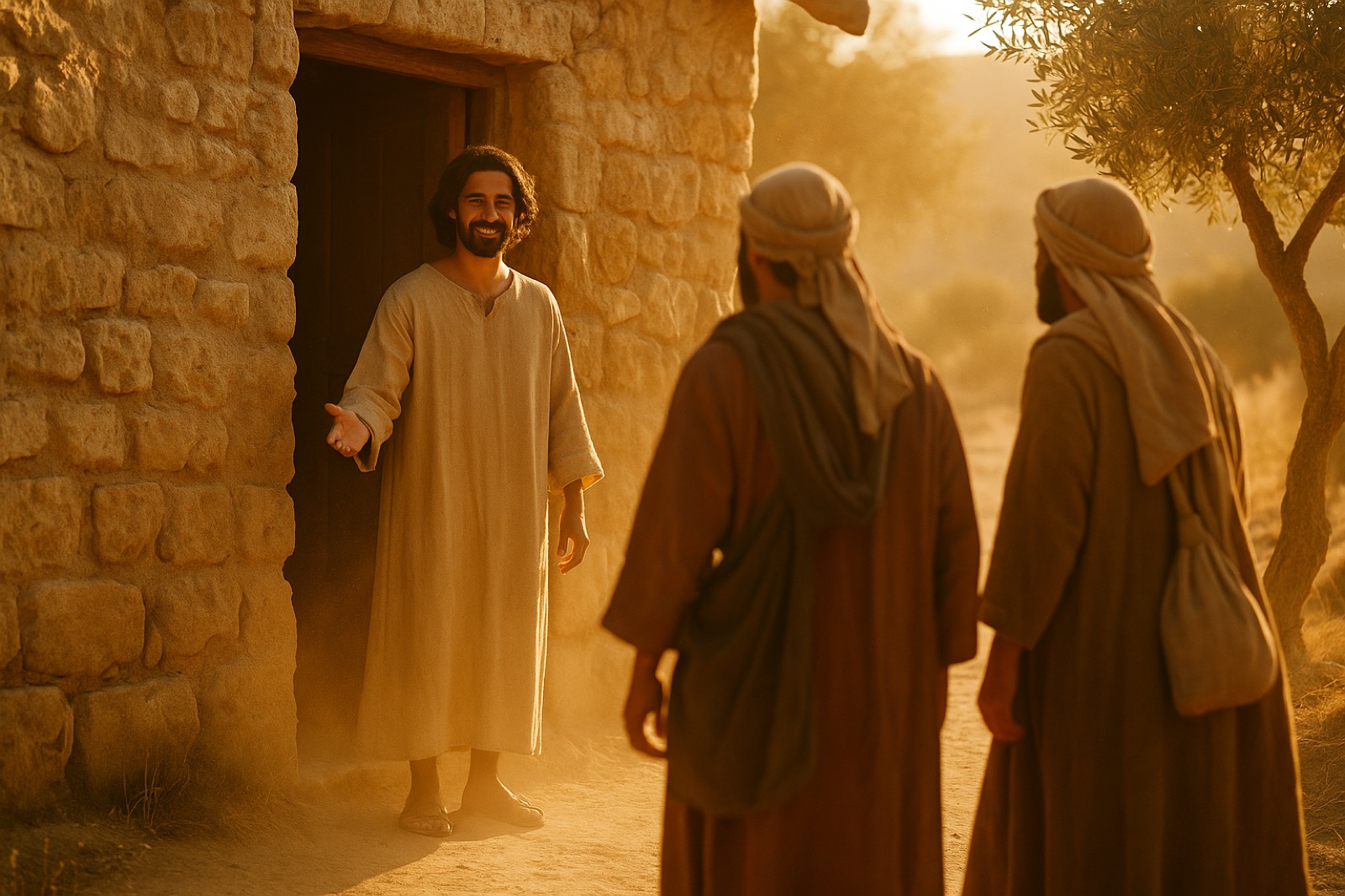
Their answer back is the strangest, most human thing in the passage. Two grown men, handed an open question by the person they had just been told to look for, and this is what they came up with:
“They said unto him, Rabbi, (which is to say, being interpreted, Master,) where dwellest thou? He saith unto them, Come and see. They came and saw where he dwelt, and abode with him that day” — John 1:38-39, KJV
Where are you staying. That is not a theological question. It is barely even a spiritual one. It is the question you ask when you want to be near somebody and you are trying to find a socially acceptable way to say so.
Notice what they did not ask. Not “what do we have to believe.” Not “what are the rules now.” Not “how do we qualify.” Their first instinct was proximity, not performance — and Jesus did not correct them or upgrade the question. He said come and see, and then they spent the rest of the day at the house.
That is the whole shape of it. A relationship with God did not begin as a decision to be understood. It began as time spent.
The detail John kept, and it tells you everything
Here is the line that most people read straight past, because it looks like a footnote:
“for it was about the tenth hour” — John 1:39, KJV
John wrote that down. Decades later, telling the story of the day it all started, he still knew roughly what time in the afternoon they walked through that door. On the usual reading of how hours were counted then — from sunrise — the tenth hour lands somewhere around four in the afternoon.
Think about what kind of memory that is. Nobody remembers the start time of a lecture. Nobody timestamps a doctrine they were taught. You remember what time it was when the day turned out to be the one that changed your life — the way people remember exactly where they were standing during the phone call that split their life into before and after.
That is the tell. Whatever happened in that house was not information transfer. It was an afternoon with a person, and it marked him permanently. And one of those two men, John tells us in the next verse, was Andrew — who did not go write a book about it. He went and found his brother Simon.
So what does that actually look like on a Tuesday morning?
Strip it down and the pattern is embarrassingly simple. Three moves, none of them requiring you to know anything first.
Show up at the same time. Not a long time. The same time. Ten minutes before the house wakes up, or in the parked car before you walk into work. Consistency is what turns an event into a relationship, and it is the only part of this that is genuinely up to you.
Read what Jesus actually did, not what people say about him. Start in the Gospels — Matthew, Mark, Luke and John — where you get him in rooms, on roads, with people. If you have tried before and stalled out somewhere in the Old Testament genealogies, that is not a character flaw; it is a route problem. A beginner Bible reading plan built for your worst morning rather than your best one is what survives contact with a real week.
Talk to God like a person, in your own words. No formula, no vocabulary you would not use with a friend. And when it goes quiet on you — which it will — understand that silence is a normal part of this and not evidence that you did it wrong. The Bible has entire songs about the silence; we walked through one of them in why God can feel silent when you pray.
What actually changes
Not your circumstances on a schedule. Anyone promising you that is selling something, and it is not what the Gospels describe.
What changes is closer in and more useful. The Bible stops feeling like a locked building — you open it and you know who you are reading about, so the sentences land. The panic in the middle of a hard week has somewhere to go besides your own head at 3am. You stop restarting your faith every January, because it is no longer a project you keep failing; it is just a person you keep meeting. And there is a real difference, one that shows up in the research on this, between believing God exists and actually feeling loved by God. The second one is what proximity builds.
That is the honest answer to the question. You have a relationship with God the same way those two men did: you go where Jesus is, on purpose, repeatedly, starting today rather than starting once you feel ready. Nobody has ever felt ready.
Where to start when you have thirty days and ten minutes
The catch is that “spend time with Jesus” is easy to agree with and hard to actually schedule. Most people who drift do not drift because they stopped believing. They drift because tomorrow morning had no plan in it.
That is exactly what 30 Days Walking with Jesus is for. It walks you through the life of Jesus one day at a time — thirty short devotional videos, thirty full-chapter audio readings you can play while you drive, a PDF study guide with journal prompts, and five quick-reference scripture guides for when you want to find something fast. It takes under ten minutes a day, and every day already knows what it is doing so you do not have to.
It is free. No payment, no card, no upsell, and it stays yours. The words of Jesus should not sit behind a paywall — so they do not.
Questions People Are Asking
Q: How can I have a relationship with God if I don’t know anything about the Bible?
A: The first two people who followed Jesus knew almost nothing either — their opening question to him was simply where he was staying, and he answered by inviting them to come and see. Start in one of the four Gospels (Matthew, Mark, Luke or John) rather than at page one of the Bible, give it ten unhurried minutes at a consistent time of day, and talk to God afterward in ordinary words. Knowledge comes from the time spent; it is not a prerequisite for starting.
Q: What’s the difference between believing in God and having a relationship with God?
A: Belief is a conclusion you hold. A relationship is time you spend. In John 1, Jesus does not ask the two men what they believe — he asks “What seek ye?” and then lets them spend the afternoon with him. The practical difference shows up in your week: belief alone can sit unused for months, while a relationship has a rhythm to it — regular reading, honest prayer, and a place to take things when life gets heavy.
Q: How long does it take to feel close to God?
A: There is no schedule, and anyone quoting you one is guessing. What is reliable is the pattern rather than the timeline: closeness grows out of repeated, unhurried time, the same way it does with a person. Dry stretches are normal and are not proof that something has gone wrong — the Bible itself contains prayers that end without an answer. Keep showing up through the quiet parts and the relationship keeps forming.
Q: I’ve drifted away from God before. How do I start again without failing again?
A: Make the daily commitment small enough to survive your worst week rather than your best one. Most people do not drift because their faith collapsed; they drift because the morning had no plan in it and the effort of deciding what to read fell on them every single day. Something under ten minutes, at a fixed time, with the day’s reading already chosen for you, is far more likely to still be running in week four than an ambitious plan you build yourself in week one.
Q: Do I have to go to church to have a relationship with God?
A: The relationship itself begins the way it began on that road in John 1 — personally, in time spent with Jesus, and you can start that tomorrow morning on your own. Other believers matter, though, and it is worth noticing what Andrew did the moment he had spent one afternoon with Jesus: he went and found his brother. Start where you are, alone if that is where you are, and expect it to move outward toward other people over time.