 0
0
 0
0
You know the feeling. The money lands, the church gives its number, and somewhere between the two a small calculation starts running that has nothing to do with maths. Am I short this month? Will anyone notice? Is God counting?
Most of us learned giving as a rule first. A percentage, a duty, a line item with a slight ache attached to it.
So it is worth knowing that the first tithe in the Bible arrives with no rule anywhere near it. Nobody asked for it. Nobody had commanded it. There was no law yet to break and no promise attached to keeping it. A man simply did it, once, on his way home from something terrible — and then did something with the rest of the goods that almost nobody ever mentions.
What actually happened before the first tithe in the Bible
We usually meet this moment as a verse on a slide. In Genesis it is the end of a war story.
Abram’s nephew Lot had been carried off when four kings sacked the city he was living in. Abram went after them with the men of his own household:
“And when Abram heard that his brother was taken captive, he armed his trained servants, born in his own house, three hundred and eighteen, and pursued them unto Dan.” — Genesis 14:14, KJV
He caught them, fought at night, and got everything back — Lot, the people, the women, and all the goods the kings had taken.
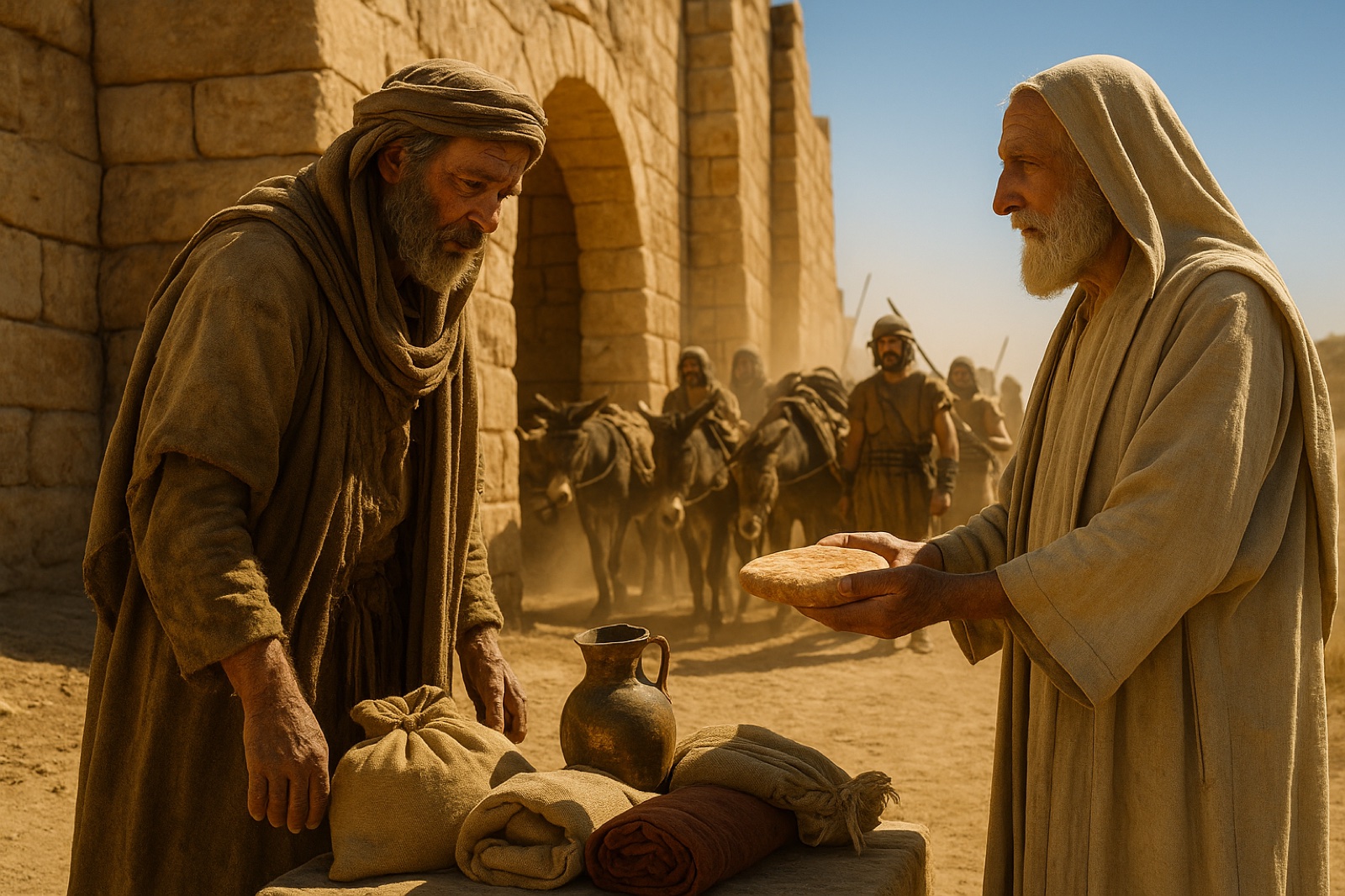
So picture the scene properly. This is not a man at a service with a card in his hand. This is a man walking home exhausted, dusty, with his nephew alive beside him and a long train of recovered property behind him. He has just risked everything he owns and everyone he has.
Two kings come out to meet him. One is the king of Sodom, who wants to talk business. The other is a figure who appears from nowhere:
“And Melchizedek king of Salem brought forth bread and wine: and he was the priest of the most high God.” — Genesis 14:18, KJV
He blesses Abram. And then comes the sentence:
“And blessed be the most high God, which hath delivered thine enemies into thy hand. And he gave him tithes of all.” — Genesis 14:20, KJV
That is it. Ten words at the end of a battle report. No instruction beforehand, no reward promised afterwards, no explanation of why. If you are looking for the command that produced it, there isn’t one — the tithe simply happens, and the story moves on.
The part almost nobody mentions: a tenth of what?
Here is where the familiar version quietly breaks.
When people tell this story, they usually hear “a tenth of everything Abram owned.” Read the sentence again. It does not say that. It says “tithes of all” — and the “all” sitting right there in the story is the pile of goods he has just recovered from four defeated kings.
The New Testament reads it exactly that way, and says so plainly:
“Now consider how great this man was, unto whom even the patriarch Abraham gave the tenth of the spoils.” — Hebrews 7:4, KJV
The spoils. Plunder. Not his herds, not his household, not his income — the recovered property of a war he had just fought.
Which means the most quoted example of giving in the Bible was not a percentage of a wage at all. It was a one-off, from a windfall, on a day that will never repeat. Whatever Abram was doing, he was not paying a bill.
Worth noticing too: the Genesis sentence never actually names which man handed over the tenth. “He gave him tithes of all” leaves both men in the room. Hebrews 7 is what settles it as Abram giving to Melchizedek, and that is how it has been read ever since — but it is a good reminder of how thin the original text is here, and how much weight later teaching has piled onto it. If the mysterious priest himself interests you, we followed that thread in Who Was Melchizedek?
Then he refused to keep the rest
This is the detail that changes the whole picture, and it is in the very next breath.
The king of Sodom offers Abram a deal: give me back the people, and keep all the goods for yourself. It is a fortune, freely offered, with no strings. Abram says no:
“That I will not take from a thread even to a shoelatchet, and that I will not take any thing that is thine, lest thou shouldest say, I have made Abram rich:” — Genesis 14:23, KJV
Not a thread. Not a bootlace.
So line the two moments up. Abram gives away a tenth of the plunder — and then refuses to keep a single thread of the other nine tenths for himself. He does not walk away with ninety percent. He walks away with nothing.
He is careful and fair about it, mind you. The men who fought beside him get their share, and the food already eaten on the march is not clawed back. He is not making anyone else go without. He is only refusing to be enriched by it himself.
That is the actual shape of the first tithe in the Bible. It was never “give ten and keep ninety.” It was a man refusing to let a night of violence become the reason he got rich, and marking the one part he did hand over as belonging to God.
The second tithe in the Bible was a bargain
If the story stopped there, giving would be easy to romanticise. It doesn’t stop there.
The next tithe in scripture belongs to Abram’s grandson, and it could hardly be more different. Jacob is running for his life, sleeping outdoors with a stone for a pillow, and he makes a deal:
“And Jacob vowed a vow, saying, If God will be with me, and will keep me in this way that I go, and will give me bread to eat, and raiment to put on, So that I come again to my father’s house in peace; then shall the LORD be my God: And this stone, which I have set for a pillar, shall be God’s house: and of all that thou shalt give me I will surely give the tenth unto thee.” — Genesis 28:20-22, KJV
Read it slowly. If God does this. Then I will give the tenth.
That is not Abram’s quiet response to a blessing already received. That is a frightened young man negotiating — offering God a percentage in advance, in exchange for bread, clothing, and a road home.
Two tithes in the whole of Genesis. One given freely by a man who had just been blessed. One promised nervously by a man who was terrified and wanted a guarantee. Neither was commanded by anybody.
When the tithe finally became a law, it was food
Generations pass before the tithe turns into an instruction. When it does, it arrives in the law given to Israel, and it is not currency:
“And all the tithe of the land, whether of the seed of the land, or of the fruit of the tree, is the LORD’S: it is holy unto the LORD.” — Leviticus 27:30, KJV
Seed and fruit. Grain, oil, wine, animals. Things that grow, in a farming nation where almost nobody earned a wage.
And even then the law’s tithe was not one flat payment to one place — parts of it went to the Levites, parts of it fed widows and foreigners, and one part the giver was told to eat themselves, in celebration. We walked through all of that in What Does the Bible Say About Tithing? Not a Flat 10%.
The point for now is only the order of events. Giving showed up in scripture long before the rule did. The rule came later, to organise something people were already doing.
Two men, two tithes, and no rule in sight
Here is what struck me, and I did not expect it.
I came into this assuming the lesson was going to be tidy: the first tithe was pure, free, unforced — so be like Abram. Then Jacob turns up four chapters later, bargaining with God on a cold hillside, and the tidy version falls apart.
Because Jacob is most of us, most months.
And notice what God does with that. Jacob’s grubby, frightened, transactional vow is not deleted from scripture. It is not corrected in the text, or held up as the bad example. It sits there in the record, right alongside Abram’s, as the second tithe in the Bible.
God let both of them stay.
Giving started as a response, not a rule — and God kept the frightened version too.
That is a far kinder picture than the one most of us carry. We tend to think there is a correct posture for giving, and that anything less disqualifies us — that if we give with a knot in our stomach, or while quietly hoping it helps, it somehow doesn’t count. The first two chapters of this story say otherwise. One man gave out of gratitude. One gave out of fear. Scripture kept both, and God went on to keep every promise made to the frightened one.
So the question shifts. Not “have I paid the right amount,” and not even “is my heart pure enough to give.” Just: what am I actually responding to?
What to do with this before the next payday
Ancient truth is not much use at the shop counter, so here is the bridge.
Abram gave after something happened to him. The blessing came first; the tenth was his answer to it. If your giving has become a number you calculate before you have noticed anything God has done, it has quietly turned back into a bill — and a bill is the one thing this story never was.
And if you are giving from fear right now, out of a real worry about what happens if you stop, you are in Genesis too. You are just in chapter 28 instead of chapter 14. That is not a disqualification. It is a starting point with a very good track record.
If money fear is the reason you are reading this at all, start with Tithing While in Debt: What the Bible Actually Says — it deals with the guilt directly.
Actions to Take
- Name one thing first. Before you give anything this week, take two minutes and write down one specific thing that has gone right recently — a body that healed, work that came, a child who is safe, a debt that got smaller. Just one. Abram’s tenth came after a rescue he could name.
- Give something small the same day something good happens. Not on a schedule. On the day. Pay for someone’s fare, buy a neighbour’s bread, send a small amount to someone you know is short. Let it be a response to a real event, so your body learns the order: blessing first, then giving.
- Decide the amount in advance, out loud. Sit down before the next money arrives and say what you are setting aside and why, in one sentence you could say to God without flinching. If you want help seeing what is actually there to work with, our free budget calculator will lay it out in a couple of minutes.
Journaling Prompts
- Are you closer to Abram or to Jacob this month — giving because something good happened, or giving because you are hoping something good will? Write down which, without judging it.
- Abram refused to be made rich by that night. What is one thing you have quietly refused to profit from, and what did that cost you? What did it protect?
- If nobody ever saw what you gave, and no number was ever named, what would you actually do? Sit with the first answer that came, and ask where it came from.
A Prayer
God, I have been treating giving like something I owe, and I am tired in a way that has nothing to do with the money. I think I have been closer to Jacob than to Abram — giving to feel safe, hoping it buys something. Thank You that You kept his story in the Bible anyway. Help me notice what You have actually done for me before I calculate anything, so that what I give is an answer and not a payment. Amen.
Your Turn
Do you think it helps or hurts when a church names a specific percentage — does a clear number free people to give, or does it turn giving into an invoice? Share your view in the comments; we read them.
Share This
- Just learned the first tithe in the Bible was a tenth of war plunder — and Abraham then refused to keep a single thread of the other nine tenths. Nobody ever taught it that way.
- Two tithes in the whole of Genesis. One man gave out of gratitude. One gave out of fear and bargained with God about it. Scripture kept both. That is far kinder than what I was taught.
- Giving started as a response, not a rule — and God kept the frightened version too.
Questions People Ask About the First Tithe in the Bible
Where is the first tithe in the Bible?
The first tithe in the Bible appears in Genesis 14:20, at the end of a war story. Abram had pursued four kings who captured his nephew Lot, recovered the people and the goods, and was met on his return by Melchizedek, king of Salem and “the priest of the most high God” (Genesis 14:18, KJV). Melchizedek brought out bread and wine and blessed him, and the chapter records: “And he gave him tithes of all.” No command to tithe appears anywhere before this moment, and no reward is promised after it.
What was Abraham’s tithe a tenth of?
It was a tenth of the spoils recovered from the battle, not a tenth of his income or his household wealth. Hebrews 7:4 states it directly: “the patriarch Abraham gave the tenth of the spoils” (KJV). This makes the best-known example of tithing in scripture a single gift from a one-off windfall, rather than a regular percentage of earnings.
Did Abraham keep the other ninety percent?
No. Immediately after the tithe, the king of Sodom offered Abram all the recovered goods for himself. Abram refused: “That I will not take from a thread even to a shoelatchet, and that I will not take any thing that is thine, lest thou shouldest say, I have made Abram rich” (Genesis 14:23, KJV). He did allow the men who fought alongside him to take their share, and did not reclaim food already eaten on the march, but he took nothing for himself.
Was tithing commanded before the law of Moses?
No command to tithe appears in scripture before the law given to Israel. Genesis records two tithes, both individual acts: Abram’s gift to Melchizedek in Genesis 14, and Jacob’s vow in Genesis 28:20-22, where Jacob promises a tenth on the condition that God protects and provides for him. The tithe becomes a legal requirement later, in the law, where it is described as produce rather than money: “And all the tithe of the land, whether of the seed of the land, or of the fruit of the tree, is the LORD’S” (Leviticus 27:30, KJV).
Was Jacob’s tithe the same kind of giving as Abraham’s?
No, and the difference is stark. Abram gave after a rescue had already happened, with nothing requested in return. Jacob’s tithe was conditional, offered while he was fleeing for his life: “If God will be with me… then shall the LORD be my God: and of all that thou shalt give me I will surely give the tenth unto thee” (Genesis 28:20-22, KJV). One is a response to blessing received; the other is a negotiation for blessing hoped for. Scripture records both without condemning either.