 0
0
 0
0
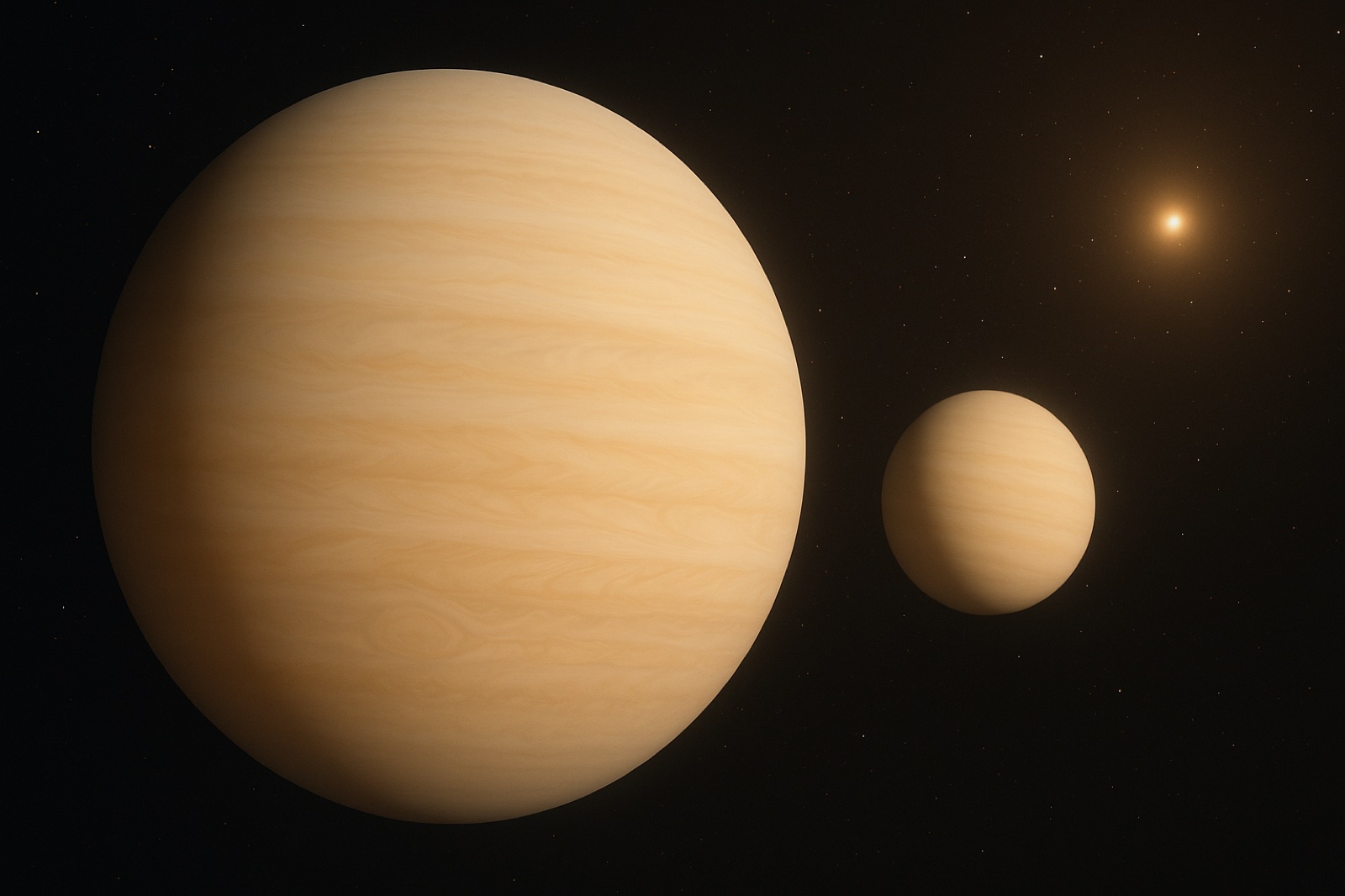
Somewhere around 1,113 light-years from here, there is a planet almost exactly the size of Jupiter.
Park it beside Jupiter and you would struggle to tell them apart. Same width. Same round shoulder against the dark.
Then you weigh it, and the whole picture comes apart. It carries about three percent of Jupiter’s mass.
Astronomers call worlds like this super-puff planets, and in June 2026 a team announced they had found two of them circling the same star. They are the least dense planets anyone has ever measured.
The strange part is not how big they are. It is how anyone noticed the emptiness at all.
What a Super-Puff Planet Actually Is
The two new worlds are called TOI-791 b and TOI-791 c. They orbit a sun-like star roughly 1,113 light-years away, and NASA’s TESS telescope found them the ordinary way — by watching the star dim slightly, over and over, as each planet crossed in front of it.
Their sizes came out almost boringly familiar. TOI-791 b measures about 0.99 times the radius of Jupiter. TOI-791 c is a little wider, about 1.16 times Jupiter’s radius.
Their masses did not match at all. The inner planet works out to roughly 9.5 times the mass of Earth. The outer one, roughly 18.6. Jupiter, for scale, is about 318 Earth masses.
Push those two numbers together and you get density: about 0.038 grams per cubic centimetre for the inner planet, about 0.047 for the outer one. Water is 1. Cotton candy — candy floss — sits somewhere near 0.05, which is the comparison nearly every write-up reached for, and George Dransfield of the University of Oxford, who led the study, has described the planets as being like candy floss or shaving foam.
Which means these two worlds are, on average, a shade less dense than the candy.
That is not a poetic flourish. That is the measurement.
A Telescope in Antarctica Watched for Eleven Hours Straight
Here is a detail almost nobody mentions, and without it this discovery does not happen.
These planets sit a long way out from their star. TOI-791 b takes about 139 days to go around once. TOI-791 c takes about 232 days. Wide orbits mean slow crossings, and each transit runs longer than eleven hours.
To measure one properly you have to watch the whole thing, start to finish, without the sun coming up in the middle of it. From most of the world, that is simply not possible.
So the confirmation came from ASTEP — the Antarctic Search for Transiting ExoPlanets — a telescope parked in the one place on Earth where night does not end for months at a time. The team recorded multiple complete crossings of both planets, and describe them as the longest-duration transits ever observed in their entirety from the ground.
Antarctica has a habit of this. It is also where researchers recently pulled hundreds of earthquakes nobody had ever catalogued out of the ice — not because the quakes were new, but because it was finally quiet enough to hear them.
The Only Way to Weigh Them Was to Watch Them Shove Each Other
Now the part that changes the story.
A transit tells you one thing and one thing only: size. The planet blocks a slice of starlight, you measure the slice, you get a width. Nothing in that measurement says a word about what is inside.
Mass is a completely separate reading, and it normally comes from the star. A heavy planet tugs on its star, the star wobbles a little, and you catch the wobble.
These two were far too light for that. Whatever pull they had, the star barely felt it. By the usual method, their emptiness was invisible.
What gave them away was each other.
The two orbits sit close to a five-to-three rhythm — roughly five laps of the inner planet against three of the outer — which means the pair keep coming back around to the same relative positions and tugging. Not much. Just enough to run each other slightly late, or slightly early. The team measured timing shifts reaching fifty minutes.
Fifty minutes, inside a 139-day orbit. That was the entire signal. “We were able to measure the masses of the planets by how much they kick each other’s orbits,” Dransfield told Science News.
Read that again, because it is the whole thing. The emptiness of these worlds was not detectable from the star they spend their lives circling. It was detectable only from the one object close enough to be knocked off schedule by them.
Nobody Is Sure How They Got Like This
The leading idea is that planets like this are born much further out, where it is cold, and then drift inward. As they close in on the star, the outer atmosphere warms and swells, and the planet inflates — bread proving in a warm kitchen, on a planetary scale.
Another possibility raised around the discovery is that an enormous ring system could make a planet look wider than it really is, inflating the size reading rather than the planet. That is generally considered unlikely here, largely because it would have to be happening twice, to two separate planets, at the same star.
Nobody has settled it. The study itself, published in Monthly Notices of the Royal Astronomical Society in June 2026, says plainly that more follow-up is needed to fully characterise the timing signal and the architecture of the system. The James Webb Space Telescope is expected to examine what the atmospheres are actually made of, which should narrow things down.
For now they are simply a problem: two enormous, nearly weightless things that the current models did not expect to find at all.
The opposite case is worth knowing about too. Mars reads as cold, finished, geologically over — and a re-examination of decades-old gravity data suggests the planet is still hot inside. Different direction, same awkward fact: the outside reading and the inside reading are not the same number.
Size and Substance Are Two Different Readings
What stays with you about super-puff planets is not really the numbers. It is the shape of the problem.
How much room something takes up and how much is actually in it are two separate measurements. They are taken different ways. One of them is easy from a distance. The other is not available from a distance at all.
Which means it is entirely possible for something to be read as full by everyone far away, and measured as almost hollow by the only instrument close enough to take that reading.
People know this one from the inside. A life can look full from every angle anybody else has access to — busy, expanding, clearly taking up space — while the person living it knows exactly what the density reading would say. And it is rarely the audience that notices first. It is usually whoever is close enough to be pulled a little off course.
There is an old idea sitting underneath that, much older than telescopes: that God is not reading the size of a life. Something bigger has always been taking the other measurement — the one nobody at a distance can get to — and has never once confused the two.
And then the planets are still out there, still enormous, still almost nothing.
What Happens Next
Webb will point at them. The atmospheres will give up their chemistry. Somebody will publish a better model of how a world gets that big on that little, and the answer will probably be stranger than either theory on the table now.
In the meantime, there is something worth sitting with in the fact that the two largest planets in that system are also the emptiest — and that it took a neighbour to prove it.
If this is your kind of thing, you can play with the bigger picture in our free How Old Is the Universe? explorer. It walks through how astronomers arrive at the age of everything, with no maths required on your part.
What Do You Think?
If you could only ever take one measurement of a person — the size of their life, or what is actually in it — which one would tell you more about them? And is the second one even gettable about somebody you are not close to?
Leave your answer in the comments. Genuinely curious where people land on this one.
Share This
“Two planets out there are the size of Jupiter and less dense than candy floss. The wild part: their own star could not detect how empty they were. Only the planet next door could.” — Super-Puff Planets: As Big as Jupiter, Almost Empty
“Astronomers just measured the two least dense planets ever found. They only got the masses because the two planets keep knocking each other slightly off schedule — fifty minutes late, and that was the whole clue.” — read it here
“Size and mass are two completely different readings, and only one of them is available from far away. That is a real fact about planets and it is doing a lot of work on me today.” — Super-Puff Planets
Questions People Are Asking
What are super-puff planets?
Super-puff planets are exoplanets that are physically very large — often around the size of Jupiter — while containing only a tiny fraction of the mass you would expect for that size. Their average density is extremely low, typically under a tenth of a gram per cubic centimetre, compared with water at 1 gram per cubic centimetre. Only a small number are known, and astronomers do not yet agree on how they form.
What are TOI-791 b and TOI-791 c?
TOI-791 b and TOI-791 c are two super-puff planets announced in June 2026, orbiting a sun-like star about 1,113 light-years from Earth. TOI-791 b is about 0.99 times the radius of Jupiter with roughly 9.5 Earth masses, and TOI-791 c is about 1.16 times the radius of Jupiter with roughly 18.6 Earth masses. Their orbital periods are about 139 days and 232 days. Their measured densities, about 0.038 and 0.047 grams per cubic centimetre, make them the lowest-density planets measured so far.
How do astronomers measure the mass of a planet they cannot see directly?
The usual method is to watch the host star wobble as the planet’s gravity tugs on it. That does not work for very lightweight planets, because the tug is too small for the star to show it. For TOI-791 b and c, astronomers used transit timing variations instead: the two planets pull on each other as they orbit, making each one cross in front of the star slightly earlier or later than a fixed schedule would predict. Those timing shifts reached fifty minutes, and the size of the shifts reveals the masses.
Are super-puff planets less dense than cotton candy?
By average density, yes. Cotton candy, also known as candy floss, sits at roughly 0.05 grams per cubic centimetre. TOI-791 b and TOI-791 c were measured at about 0.038 and 0.047 grams per cubic centimetre, so both come in at or below that figure. The comparison describes average density across the whole planet, not the texture of anything you could touch — these worlds are gas, not solid.
Why does a telescope in Antarctica matter for finding planets?
Planets on wide orbits take a long time to cross in front of their star. The transits of TOI-791 b and TOI-791 c each last more than eleven hours, and measuring one properly requires watching the entire crossing without daylight interrupting it. During the Antarctic winter the night runs continuously for months, so a telescope there can observe a very long transit from start to finish. The ASTEP telescope in Antarctica recorded multiple complete transits of both planets — described by the team as the longest-duration transits ever observed in their entirety from the ground.