 0
0
 0
0
Someone has probably said it to you. In a hospital corridor. On a phone call that started badly. Don’t be afraid.
And if you grew up anywhere near a Bible, you have heard it there too, again and again. Fear not.
Then you turn a few pages and the same book tells you to fear God. So Scripture asks you to fear not and fear God, and most of us just walk past the problem without stopping.
Most explanations solve it in one quick move: the second kind of fear “just means respect.” And if you have ever heard that answer and felt slightly cheated, you were paying attention. The Bible’s own language is stronger than respect. People in these stories shake. They fall down. They beg for the voice to stop.
There is one verse where Moses says both things. In the same sentence. About the same moment. And he clearly does not think he is contradicting himself.
Fear Not and Fear God — In the Same Sentence
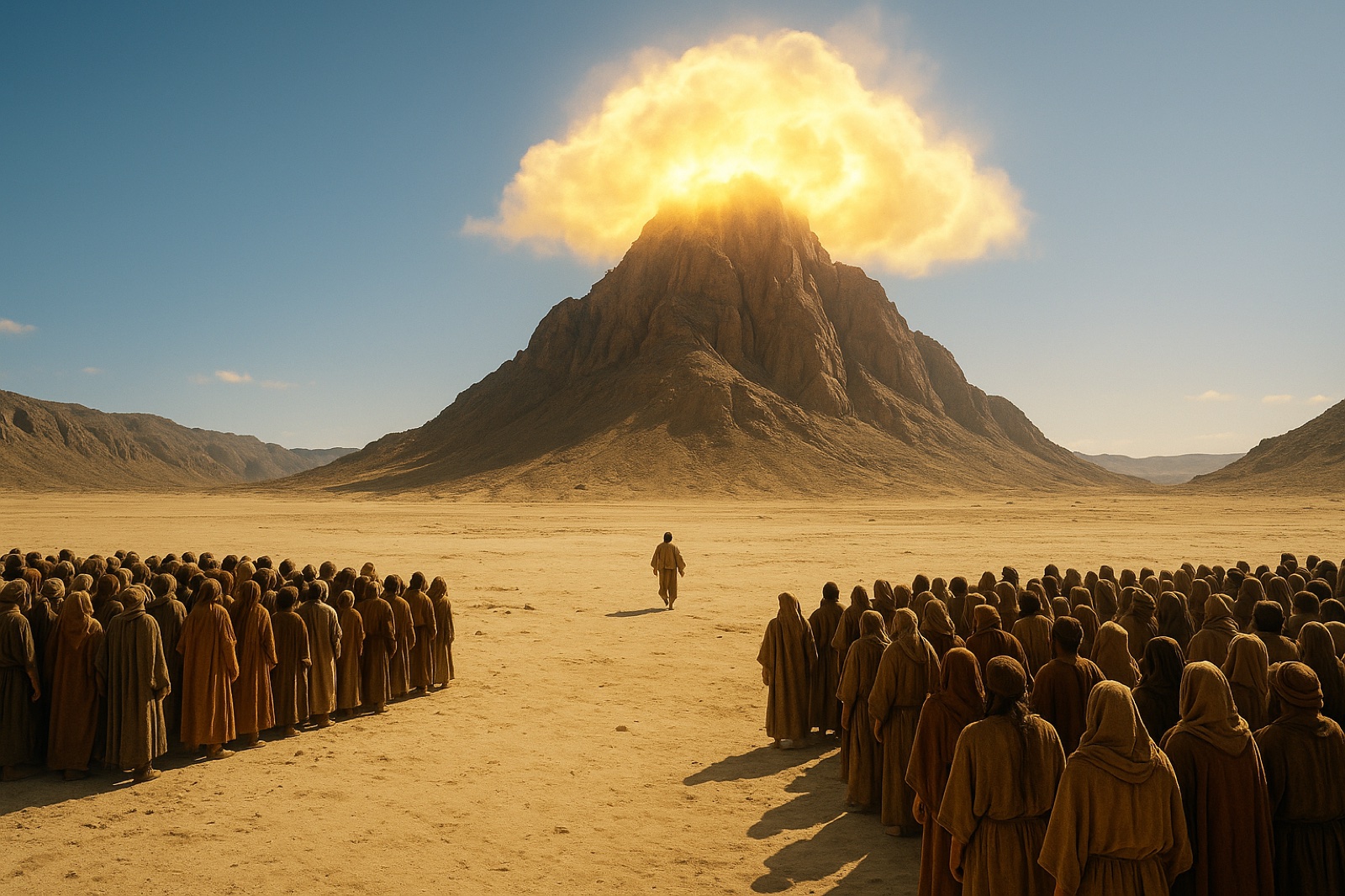
The scene is Mount Sinai. The nation has just heard God speak the commandments out loud, and it did not go how anyone hoped.
Here is what they saw: “And all the people saw the thunderings, and the lightnings, and the noise of the trumpet, and the mountain smoking” (Exodus 20:18).
They had asked for this. They got it. And it broke them.
So they made a request: “And they said unto Moses, Speak thou with us, and we will hear: but let not God speak with us, lest we die” (Exodus 20:19).
Read that slowly. It is one of the saddest sentences in the Bible. You go. We will listen to you. Just don’t let God talk to us directly. They were standing closer to the voice of God than almost anyone in history, and they asked for a middleman.
Then Moses answers. This is the verse:
“And Moses said unto the people, Fear not: for God is come to prove you, and that his fear may be before your faces, that ye sin not.” — Exodus 20:20
Count the fears. Fear not — and, ten words later, a fear he wants them to keep. Not later. Not in a different chapter written by a different person in a different century. Right there, in one breath, about one terrified crowd on one afternoon.
Whatever these two fears are, Moses does not think they cancel each other out.
First, About That “Fear Not 365 Times” Claim
Before going further, one piece of housekeeping — because you have almost certainly heard this line, and it is worth knowing where it stands.
You have been told the Bible says “fear not” 365 times, once for every day of the year.
It does not hold up. Not because someone counted and got a different number, but because there is no agreed way to count at all. Do you count only the exact two words? Every version of “do not be afraid”? “Be strong and courageous”? Every promise where God says there is no reason to be afraid? Each of those choices gives a different total, and people who have gone looking report very different figures depending on which rule they used.
The honest answer is that it appears many, many times, and nobody can hand you a verified number with a straight face.
That matters more than it sounds. The 365 line turns “fear not” into a daily vitamin — one dose a day, take with water. But that is not how it works in the text. In Exodus 20:20 it is not a devotional thought. It is a man shouting reassurance at a crowd that is physically backing away from a mountain. It is said to someone, in a moment, about something specific. Which is exactly how it will need to be said to you.
The Same Hebrew Root, Twice, Ten Words Apart
Here is the detail that changed how I read the verse.
In the Hebrew, Moses does not switch vocabulary halfway through. “Fear not” is a verb from the root yare’ (Strong’s H3372). “The fear of God” is the noun yir’ah (Strong’s H3374) — the noun built from that same root.
Same root. Verb, then noun. Ten words apart.
That kills the easy escape hatch. If Moses had used two completely unrelated words, we could say the English translation just picked “fear” twice by accident and the tension is a translation problem. It is not. The wordplay is deliberate. Moses is holding up the same word and saying: not this one — but yes, this one.
Hebrew does this a lot, and it rewards slowing down. If you have ever seen how much sits inside a single Hebrew word, you will recognise the feeling from what “be strong and courageous” actually means in Hebrew — the word is doing far more work than the English lets on.
What we can say with confidence is narrow and it is enough: one root, used two ways, on purpose. So the difference between the two fears is not in the vocabulary. It has to be somewhere else.
The Part Most People Skip: God Was Not Angry About It
This is the piece I did not expect to find, and it complicates the tidy version of this article.
You would assume God was disappointed. The people just asked not to be spoken to. Surely that gets a rebuke.
It does not. Moses retells this exact moment in Deuteronomy, and he reports what God said about their request:
“And the LORD heard the voice of your words, when ye spake unto me; and the LORD said unto me, I have heard the voice of the words of this people, which they have spoken unto thee: they have well said all that they have spoken.” — Deuteronomy 5:28
They have well said. God’s verdict on their terror is that they were right.
And then, in the very next breath:
“O that there were such an heart in them, that they would fear me, and keep all my commandments always, that it might be well with them, and with their children for ever!” — Deuteronomy 5:29
Read those two verses together and something quietly falls apart. God does not scold them for being afraid — God agrees they spoke well. And in the same moment God wishes the fear had gone deeper and stayed.
So this is not a story about a bad fear and a good fear, with one to be ashamed of. Their terror was appropriate. It just did not last, and it did not hold them there. It got them through one afternoon and then wore off.
That is a far more uncomfortable idea than “one fear is wrong.” Because the fear that wore off is the one most of us have.
Two Fears, Two Directions
Now look at what happens one verse later. Everyone is still standing in the same place, under the same sky, in front of the same God:
“And the people stood afar off, and Moses drew near unto the thick darkness where God was.” — Exodus 20:21
There it is.
Same mountain. Same thunder. Same God. Two fears pointing in opposite directions. The crowd’s fear moved them back. Moses’ fear moved him in.
That is the difference. Not intensity — Moses was not braver because he felt less. The difference is direction of travel.
The people stood afar off. Moses drew near. Same mountain, different fear.
And look at what Moses says the fear of God is for: “that ye sin not.” Not that ye stay away. The fear God wants is aimed at your behaviour, not at your proximity. It is a fear that keeps you from wrecking your life. It was never meant to keep you out of the room.
The other fear — the one Moses tells them to drop — does exactly one thing. It creates distance and then calls the distance reverence.
What This Looks Like on an Ordinary Day
Almost nobody reading this is standing in front of a smoking mountain. But nearly everybody knows the feeling of standing afar off.
It is the week you stop praying — not because you stopped believing, but because of what you did on Tuesday, and praying now feels like walking into a room where everyone knows.
It is the Bible app you have not opened in a month, because opening it feels like being handed a bill.
It is the way some people can talk about God warmly for an hour and never once talk to God, and cannot explain why.
Every one of those is Exodus 20:19 in modern clothes: you go, we will listen to you, just don’t let God speak to us directly. It looks like humility. It is usually just distance.
The tell is simple. Ask what your fear is doing to your feet. A fear that makes you careful about how you live is doing its job. A fear that makes you avoid God is doing the opposite of its job — and it is the exact fear Moses stood in front of a nation and told them to put down.
This is why so many people quietly carry a question like whether they could lose their salvation without ever asking it out loud. The question usually is not theological. It is a fear of getting closer and finding out.
If you genuinely are not sure which way your own fear has been pointing lately, our free How Close Am I to God? assessment is a short, honest way to find out where you have actually been standing — not where you think you should be.
Actions to Take Today
- Name the room you have been standing outside of. Finish this sentence, out loud or on paper: “I have been keeping my distance from God about ______.” One sentence. Do not fix it yet. Naming it is the whole task.
- Read Exodus 20:18-21 twice. It is four verses and takes under two minutes. Read it once watching the crowd. Read it again watching Moses. Notice that nothing about the mountain changed between them.
- Do the one small thing your fear has been talking you out of. The three-sentence prayer. The apology message you have drafted and never sent. The Bible you have not opened. Set a timer for five minutes and do it before the fear gets you back out of the room.
Journaling Prompts
- When you picture God noticing you today — right now, as you actually are — does something in you lean in, or lean back? Sit with which one it is before you decide what it means.
- Think of the last time you pulled away from God. Was it fear of doing wrong, or fear of being seen? Those are not the same, and only one of them is the fear Moses told the people to keep.
- What would tomorrow look like if taking God seriously did not require staying at a safe distance?
A Prayer for Standing Closer
God, I have been standing at a distance and calling it respect. The truth is I have been afraid of what You would say if I came closer, so I stayed where it was safe and told myself that was reverence. Help me tell the difference between the fear that makes me take You seriously and the fear that makes me leave the room. I want to be one of the ones who stays. Keep me near, even when the ground is shaking. Amen.
A Question Worth Sitting With
Do you think people today are more likely to take God too lightly, or to keep a careful distance from God out of fear? Tell us what you think in the comments — we read every one.
Share This
- Exodus 20:20 has Moses saying “Fear not” and “the fear of God” in one sentence, about the same terrified crowd. Turns out they were never the same fear. One moves you back. One lets you stand still.
- The people stood afar off. Moses drew near. Same mountain. Same thunder. Same God. The only difference was which fear they were carrying.
- Nobody can actually verify that “fear not” appears in the Bible 365 times — there is no agreed way to count it. Which is fine, because it was never meant to be a daily vitamin. It is something someone says to you, in a specific moment, when you are backing away.
Questions People Ask About Fear Not and Fear God
What does Exodus 20:20 mean?
In Exodus 20:20, Moses speaks to the Israelites immediately after they heard God give the Ten Commandments at Mount Sinai and were terrified by the thunder, lightning, trumpet and smoking mountain. The verse reads: “And Moses said unto the people, Fear not: for God is come to prove you, and that his fear may be before your faces, that ye sin not.” Moses tells them to stop being terrified, and in the same sentence says the fear of God is meant to remain with them so they will not sin. The two statements are not a contradiction: the terror Moses tells them to drop was driving them away from God, while the fear he tells them to keep is aimed at how they live.
Does the Bible say “fear not” 365 times, once for each day of the year?
There is no verified count that supports the 365 figure, and it is best treated as a popular saying rather than a fact. The difficulty is that there is no agreed standard for what to count — the exact phrase “fear not,” every variation such as “be not afraid,” commands like “be strong and courageous,” and general promises that there is no reason to fear all produce very different totals. People who have attempted counts report widely differing numbers depending on which rule they applied. What can be said accurately is that commands and reassurances not to be afraid appear many times throughout the Bible.
What is the difference between the fear of God and being afraid of God?
The clearest difference is what each one does to a person’s behaviour. In Exodus 20:20-21, both kinds of fear are present in the same crowd at the same moment: the Israelites “stood afar off” while Moses “drew near unto the thick darkness where God was.” Being afraid of God creates distance and avoidance. The fear of God, as Moses describes it, has a stated purpose — “that ye sin not” — meaning it shapes how a person lives rather than how far away they stand.
Does “the fear of God” just mean respect?
Respect is part of it, but it is a weaker word than the Bible’s own language supports. In the Sinai account the people tremble, back away, and ask that God not speak to them directly, which is more than politeness. In the Hebrew of Exodus 20:20 the same root stands behind both halves of the sentence: the verb yare’ (Strong’s H3372) in “fear not,” and the noun yir’ah (Strong’s H3374) in the fear of God. Because it is one root used two ways deliberately, the difference between the two fears is not that one is real fear and the other is mere respect.
Was God angry that the Israelites asked Moses to speak instead?
No. Moses recounts the same event in Deuteronomy 5:28-29, and reports that God said of their request, “they have well said all that they have spoken.” God affirms their response as right rather than rebuking it. In the next verse God adds, “O that there were such an heart in them, that they would fear me, and keep all my commandments always.” The concern expressed is not that the people were afraid, but that the fear would not last.