 0
0
 0
0
Maybe it started with a small child who said something strange, as if they remembered a life before this one. Maybe it was a funeral, and someone whispered, “Maybe they’ll come back.” Or maybe it is the plain unfairness of it all. Why is one baby born sick and another born strong? If there were more than one life, it might all even out.
So you typed the question: what does the Bible say about reincarnation? It is a fair question. It is not a silly one. The idea of rebirth sits at the heart of Hinduism, Buddhism, Sikhism and other traditions, and it has comforted a huge share of the world for thousands of years. It offers two things every human heart wants: fairness, and another try.
Here is what surprised me when I went looking. The Bible does not ignore this idea. The Gospels brush right up against it, more than once. And every time, Jesus turns it toward something else.
What Does the Bible Say About Reincarnation? The Short Answer
The short answer is that the Bible does not teach reincarnation. The clearest single line is in the letter to the Hebrews:
“And as it is appointed unto men once to die, but after this the judgment.” (Hebrews 9:27, KJV)
Once. Not many times. One life, one death, and then you stand before God.
But a one-verse answer can feel cold, and it skips the best part. Three stories in the Gospels come very close to the idea of a past life or a person coming back as someone else. If you watch what Jesus does in each one, you get a much fuller answer than “no.” You get a picture of what God offers instead.
The Blind Man and a Question About Sin Before Birth
In John 9, Jesus and His friends walk past a man who has been blind his whole life. The disciples ask a question that sounds odd to our ears:
“Master, who did sin, this man, or his parents, that he was born blind?” (John 9:2, KJV)
Stop and look at that. How could a man sin before he was born? Some readers hear a past life in that question. Others point out that the Old Testament already pictured babies acting before birth. Jacob and Esau “struggled together” inside their mother (Genesis 25:22). The text does not tell us which idea the disciples had in mind. Honestly, nobody can say for sure.
What the text does tell us is Jesus’s answer:
“Neither hath this man sinned, nor his parents: but that the works of God should be made manifest in him.” (John 9:3, KJV)
Neither. Jesus refuses the whole idea that this man’s blindness was a bill being paid for something done earlier. Then He heals him. He sends him to wash in the pool of Siloam, and the man comes back seeing.
Here is a small detail that is easy to miss. The name Siloam turns up in another place where Jesus says the same thing. In Luke 13, people bring up eighteen who died when a tower in Siloam fell on them. Jesus asks:
“Think ye that they were sinners above all men that dwelt in Jerusalem? I tell you, Nay.” (Luke 13:4-5, KJV)
Twice, Jesus meets the idea that suffering is payback. Twice, He says no. That is the core of karma, the belief that what you did before shapes what you get now, and Jesus does not accept it as the explanation for pain.
Was John the Baptist Elijah Reincarnated?
This is the passage people quote most when they say the Bible hints at reincarnation. And it is worth taking slowly.
First, some background. The last book of the Old Testament ends with a promise: “Behold, I will send you Elijah the prophet before the coming of the great and dreadful day of the Lord” (Malachi 4:5). So people in Jesus’s day were watching for Elijah. (In the King James Version, the New Testament spells his name “Elias.” It is the same man.)
When Jesus asks what people are saying about Him, the disciples report: “Some say that thou art John the Baptist: some, Elias; and others, Jeremias, or one of the prophets” (Matthew 16:14). The crowds were guessing that someone had come back.
Then Jesus says this about John the Baptist:
“And if ye will receive it, this is Elias, which was for to come.” (Matthew 11:14, KJV)
That sounds like a yes. But notice the words Jesus puts in front of it: “if ye will receive it.” That is how you talk about a meaning you have to see, not a plain fact about someone’s identity.
And John himself was asked straight out:
“Art thou Elias? And he saith, I am not.” (John 1:21, KJV)
So which is it? Luke answers that before John is even born. The angel tells John’s father that his son “shall go before him in the spirit and power of Elias” (Luke 1:17). Not as Elijah. In the spirit and power of Elijah. John was a new man, doing Elijah’s kind of work.
The Detail That Settles It: Elijah on the Mountain
This is the part that is easy to read past, and it is the strongest piece of all.
Start with how Elijah left. The Bible never records him dying. A chariot of fire appeared, “and Elijah went up by a whirlwind into heaven” (2 Kings 2:11).
Now jump to Matthew 14. King Herod has John the Baptist killed in prison: “And he sent, and beheaded John in the prison” (Matthew 14:10). John is dead.
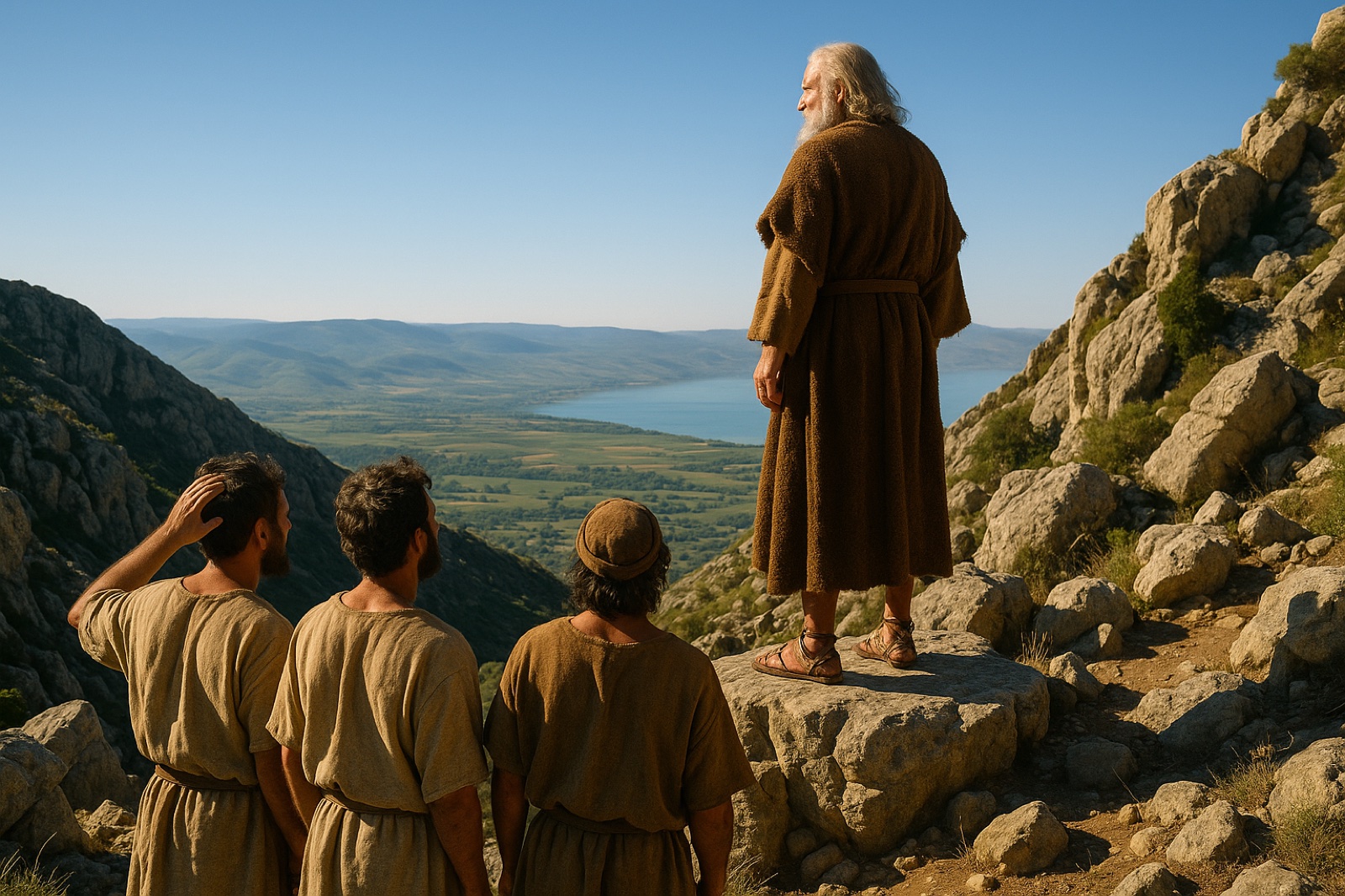
Three chapters later, Jesus takes Peter, James and John up a high mountain. His face shines like the sun. And then:
“And, behold, there appeared unto them Moses and Elias talking with him.” (Matthew 17:3, KJV)
Think about what that means. If John the Baptist really were Elijah born again, then after John’s death, the man on that mountain should have been John. He was not. Elijah appeared as Elijah. His own name, his own self, standing next to Moses. Luke adds that the two of them talked with Jesus about what He was about to go through in Jerusalem (Luke 9:30-31).
And in that very same chapter, on the way back down, Jesus tells the disciples that “Elias is come already,” and “the disciples understood that he spake unto them of John the Baptist” (Matthew 17:12-13). So Jesus can call John “Elias” and show His friends the real Elijah within a few verses of each other. There is no contradiction there. John came in Elijah’s spirit. Elijah stayed Elijah.
That same mountain is also where three men recognized people they had never met, which is a whole question of its own. We looked at it in Will We Know Each Other in Heaven? Three Men Watched It Happen.
What the Bible Offers Instead of Reincarnation
So if not reincarnation, then what? This is where it gets good.
Reincarnation offers another try, but it comes at a cost. You come back as someone else. The person who loved your mother, who laughed at that one joke, who carried that particular scar, is gone. Something continues, but not quite you.
The Bible offers something bolder. Not a second life as a stranger. The same person, raised.
Listen to how Jesus talks after He rises from the dead. His friends think He is a ghost. He says:
“Behold my hands and my feet, that it is I myself: handle me, and see; for a spirit hath not flesh and bones, as ye see me have.” (Luke 24:39, KJV)
It is I myself. And later He tells Thomas to touch the wounds in His hands and side (John 20:27). The scars came with Him. Resurrection does not erase the life you lived. It keeps you, and makes you new.
Job said it long before that, sitting in the dust after losing almost everything: “Whom I shall see for myself, and mine eyes shall behold, and not another” (Job 19:27). Not another. Me.
Paul describes the change like this: “It is sown in corruption; it is raised in incorruption” (1 Corinthians 15:42). Like a seed and the plant that grows from it. Different, and yet the same life.
And there is one more “second birth” in the Gospels. When Jesus tells Nicodemus that a person must be “born again,” Nicodemus asks the obvious question: “Can he enter the second time into his mother’s womb, and be born?” (John 3:4). Jesus is not talking about a second trip through the womb. The second birth He offers does not need a second womb or a second body. It happens in this life, in the person you already are.
That is the turn in all of this. We long for reincarnation because we want another chance and we don’t want to lose anyone. God answers both longings, just not the way we guessed. The new start comes now, not in a next life. And God keeps what belongs to God. Nobody is swapped out. Nobody is lost along the way.
Think of the blind man again. When people pushed him to explain what happened, he did not give a theory about past lives. He said, “One thing I know, that, whereas I was blind, now I see” (John 9:25). His fresh start happened on an ordinary day, in his own body, in his own name.
If you are wondering about the moment right after death, Jesus spoke to that too, to a dying man hanging next to Him. We traced it in What Happens the Moment After You Die? Jesus Told a Dying Man Exactly. And if you have a follow-up question this article didn’t cover, you can ask our free Bible Answers AI assistant (it opens in ChatGPT).
What This Means for Your Life Today
If you have been carrying a quiet fear that your pain is a punishment for something you did before, even something you can’t remember, you can put that down. Jesus looked straight at that idea and said “neither.”
If you have been hoping for a second chance, you don’t have to wait for another life. The fresh start Jesus offers begins in this one.
And if you are grieving someone, the hope is not that they will return as a stranger you might pass on the street. The hope is that God keeps them, fully themselves.
Actions to Take
- Read John 9 in one sitting. It only takes a few minutes. Watch how many people try to explain the man’s blindness, and how Jesus simply heals him.
- Name one thing you have treated as payback. A health problem, a hard childhood, a loss. Write it down, then write Jesus’s word next to it: “Neither.”
- Tell one person the Elijah detail. Next time reincarnation comes up with a friend, share it kindly, as a discovery, not a debate: Elijah showed up on the mountain as himself.
Journaling Prompts
- Where in your life have you quietly believed you are paying for something, and what would change if that were not true?
- If a fresh start is possible in this life, not the next, what is the first small part of your life you would want it to touch?
- Who are you afraid of losing, and what does it mean to you that God keeps people as themselves?
You don’t need another life. You need this one, held by God.
A Prayer
God, I’ll be honest, part of me wanted another chance in another life, because this one has been hard. I’ve wondered if some of my pain was a bill I was paying. Thank you that Jesus said “neither.” Please give me the fresh start I need right here, in the life I actually have, and help me trust that you keep the people I love, just as they are. Amen.
Discussion Question
Why do you think the idea of reincarnation feels so comforting to so many people around the world? Share your thoughts in the comments below. We’d love to hear from you.
Share This
- “I always assumed John the Baptist was Elijah reborn. Then I noticed Elijah shows up on the mountain in Matthew 17, as himself, after John was already dead. Mind blown.”
- “Jesus was asked if a man’s blindness was punishment for sin before he was born. His answer: ‘Neither.’ I needed to hear that today.”
- “I don’t need another life to start over. The fresh start Jesus offers begins in this one.”
Questions People Ask About Reincarnation and the Bible
Does the Bible teach reincarnation?
No, the Bible does not teach reincarnation. Hebrews 9:27 says “it is appointed unto men once to die, but after this the judgment,” describing one life and one death for each person. Instead of rebirth into a new body, the Bible teaches resurrection, in which the same person is raised to new life.
Was John the Baptist Elijah reincarnated?
No. When asked directly, John the Baptist said “I am not” Elijah (John 1:21). Luke 1:17 explains that John came “in the spirit and power of Elias,” meaning he did Elijah’s kind of work rather than being Elijah reborn. In Matthew 17:3, after John had already been beheaded, Elijah appeared at the Transfiguration as himself, alongside Moses.
Why did the disciples ask if the blind man sinned before he was born?
In John 9:2, the disciples asked whether a man born blind had sinned or his parents had. The Bible does not say which belief lay behind the question. Some readers see an idea of a past life, while others note that the Old Testament pictured babies acting in the womb, as with Jacob and Esau in Genesis 25:22. Jesus rejected the premise entirely, saying “Neither hath this man sinned, nor his parents” (John 9:3).
What is the difference between reincarnation and resurrection?
Reincarnation is the belief that something of a person is reborn into a new body and a new life, often shaped by karma. Resurrection, as taught in the Bible, is the raising of the same person to new, lasting life. After rising from the dead, Jesus said “it is I myself” (Luke 24:39) and still carried the wounds in His hands and side (John 20:27), showing that resurrection keeps the person rather than replacing them.
Does “born again” in the Bible mean reincarnation?
No. When Jesus told Nicodemus that a person must be “born again” (John 3:3), Nicodemus asked if someone could enter a mother’s womb a second time. Jesus explained a spiritual new birth that happens during a person’s present life, not a physical rebirth into a different body.