 0
0
 0
0
Most of us were taught the parable of the mustard seed as a simple promise: start small, and God will make it big. A tiny seed. A huge plant. Keep going.
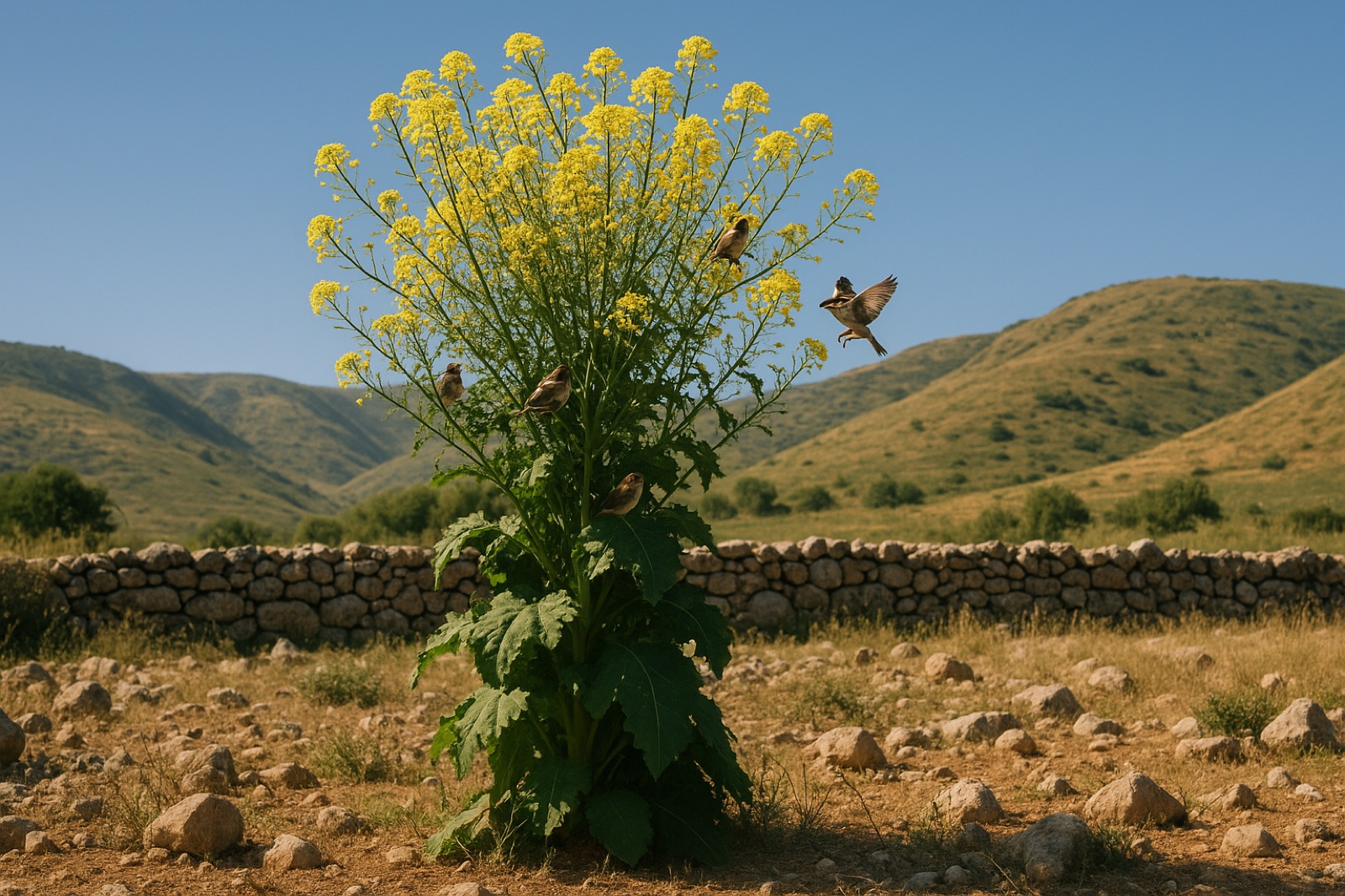
That is true, as far as it goes. But it is not where Jesus stops. Jesus does not end the story with the size of the plant. Jesus ends it with birds. Small, ordinary birds, flying in and settling down in the branches.
If you have ever felt like your life is too small to matter, or like you are still waiting to “grow into” your purpose, that last line was written with you in mind. Let’s look at it slowly.
What the Parable of the Mustard Seed Actually Says
The story shows up in three Gospels. Here is how Matthew tells it:
“The kingdom of heaven is like to a grain of mustard seed, which a man took, and sowed in his field: Which indeed is the least of all seeds: but when it is grown, it is the greatest among herbs, and becometh a tree, so that the birds of the air come and lodge in the branches thereof.”
— Matthew 13:31-32 (KJV)
Mark’s version opens with Jesus thinking out loud: “Whereunto shall we liken the kingdom of God? or with what comparison shall we compare it?” (Mark 4:30). It is a lovely moment. Jesus is searching for the right picture. And the picture Jesus lands on is a garden plant, not a palace or an army.
Mark ends a little differently, too. The plant “shooteth out great branches; so that the fowls of the air may lodge under the shadow of it” (Mark 4:32). Not only in the branches. Under the shadow. Shade, in a hot land, is rest.
Count where each version spends its words. The seed gets a phrase. The growing gets a phrase. The final words, every time, go to the birds.
Is the Mustard Seed Really the Smallest Seed?
People sometimes stumble here. Botanists know of seeds far smaller than mustard. Some orchid seeds are as fine as dust. So was Jesus wrong?
No. Jesus was talking to farmers in Galilee about the seeds they actually sowed. Among the seeds a farmer there would hold in his hand, the mustard seed was the tiny one. It was the everyday picture of “very small,” the way we might say “a grain of sand.” Jesus spoke the language of the field, not a science textbook.
One more note. Jesus also uses the mustard seed in a different saying, about faith that can move a mountain. That is a separate teaching with a separate point. This parable is not about how much faith you have. It is about what God’s kingdom is like.
Why Jesus Picked a Plant Farmers Had to Watch
Here is something most of us never hear in Sunday school. Mustard was not a tidy plant.
The Roman writer Pliny the Elder, writing in the first century, described mustard this way: “it is extremely difficult to rid the soil of it when once sown there, the seed when it falls germinating immediately” (Natural History, Book 19, chapter 54, Bostock and Riley translation). In plain words: once mustard is in your ground, good luck getting it out. It spreads.
Jewish farming rules, written down in the Mishnah about a century and a half after Jesus, point the same way. They say a farmer “may not sow mustard or safflower close to a field of grain” (Mishnah Kilayim 2:8). Mustard was treated as a crop you had to keep in its own place, so it would not crowd the main harvest.
Those rules come later than Jesus, so we should not press them too hard. But together with Pliny they paint a clear picture. Mustard was useful. It was also a little wild. It did not stay in neat rows.
So when Jesus says a man “sowed in his field” a mustard seed, the listeners may well have smiled. Who does that on purpose? Someone who wants something that will spread past the edges.
The Detail Everyone Reads Past: Jesus Chose an Herb, Not a Cedar
Jesus’ first listeners knew their Scriptures well. And “birds nesting in the branches of a great tree” was already a famous picture.
The prophet Ezekiel used it for the coming kingdom of God. God takes a tender twig from the top of a tall cedar and plants it on a high mountain:
“In the mountain of the height of Israel will I plant it: and it shall bring forth boughs, and bear fruit, and be a goodly cedar: and under it shall dwell all fowl of every wing; in the shadow of the branches thereof shall they dwell.”
— Ezekiel 17:23 (KJV)
Daniel used the same picture for the empire of King Nebuchadnezzar, a vast tree where “the fowls of the heaven dwelt in the boughs thereof, and all flesh was fed of it” (Daniel 4:12).
A cedar of Lebanon is a mighty tree. Kings built palaces with it. That was the image everyone expected for a great kingdom.
Jesus keeps the birds. Jesus keeps the shade. But Jesus swaps the towering cedar for a backyard herb. A plant that “becometh a tree,” yes, but still a mustard plant. Big for a garden. Small next to a cedar.
It is almost as if Jesus is saying: “You know that old promise of a great tree where all the birds find a home? It is coming true. It just won’t look like a king’s cedar. It will look like something humble, a little unruly, growing in an ordinary field.”
And Ezekiel had already hinted at this. In the very next verse, God says, “I the LORD have brought down the high tree, have exalted the low tree” (Ezekiel 17:24).
Luke Shows Us the First Bird
Luke places the parable somewhere surprising. Just before it, Jesus is in a synagogue on the Sabbath, and there is a woman there who “had a spirit of infirmity eighteen years, and was bowed together, and could in no wise lift up herself” (Luke 13:11).
Eighteen years bent over. Jesus calls her over and says, “Woman, thou art loosed from thine infirmity.” She stands up straight and praises God (Luke 13:12-13). The leader of the synagogue is upset that this happened on the Sabbath, and Jesus answers him.
And then Luke writes: “Then said he, Unto what is the kingdom of God like?” (Luke 13:18). The mustard seed story comes right after.
Luke does not explain the connection. But it is hard to miss. A tired, bent-over woman had just found rest in the shade of God’s kingdom. She was a bird landing in the branches.
If you want more on why Jesus taught this way, through short stories instead of lectures, see why Jesus spoke in parables.
A good place to start:
The Book of Matthew — Immersive Storytelling Format
Walk through the life of Jesus, parables and all, as if you were standing in the crowd, in a retelling that stays true to Scripture.
Get the free guide · Free.
The Turn: The Kingdom Is Measured by Who Finds Rest in It
Here is the shift. We usually read this parable and ask, “How big will it get?” Jesus seems to be asking a different question: “Who will find a home in it?”
That changes how you look at your own life.
Maybe you have been waiting to become something big before you count. A bigger ministry. A bigger platform. A more impressive version of yourself. But a mustard plant is not judged by how it compares to a cedar. It is judged by whether the birds can land.
Your purpose may not be to be the tallest tree in the forest. It may be to be shade for someone tired. A kitchen table where a lonely neighbor can sit. A phone call that lets a worn-out friend breathe. A home where a teenager feels safe.
And notice who the birds are. They are not invited because they earned it. They just come. They lodge there. In Jesus’ kingdom, the measure of growth is how many ordinary, tired creatures find rest. That includes you.
Jesus said it plainly in Matthew’s Gospel: “Come unto me, all ye that labour and are heavy laden, and I will give you rest” (Matthew 11:28). Before you are ever the branches, you are allowed to be the bird.
Mark’s Gospel tells another small seed story just before this one, about seed that grows while the farmer sleeps. We wrote about it in what Jesus said happens to spiritual growth while you sleep. Read together, the two stories say: the growing is God’s work, and the shade is for everyone.
If you want to keep exploring parables like this one, you can ask questions any time with our free What Jesus Teaches AI assistant (it opens in ChatGPT).
“God’s kingdom isn’t measured by how tall it grows. It’s measured by who finds rest in it.”
Actions to Take Today
- Read it in Luke’s order (5 minutes). Open Luke 13:10-19 and read the healing and the parable together, out loud if you can. Notice the woman, then the birds.
- Name one bird (2 minutes). Think of one person in your life right now who looks tired, bent over, or alone. Write their first name on a piece of paper or in your phone.
- Offer one patch of shade (10 minutes). Send that person a simple message today: “I was thinking of you. How are you really doing?” Then listen. No fixing required. Shade does not talk much.
Journaling Prompts
- Where in your life have you been measuring yourself against a “cedar” instead of asking whether anyone can rest near you?
- When was the last time you let yourself be the bird, simply landing and resting in God’s care, instead of trying to be the tree?
- What small, slightly “unruly” thing has God planted in you that keeps spreading past the edges you tried to set for it?
A Prayer for Today
God, I have spent a lot of time wishing my life were bigger. I wanted to be a cedar, and I felt like a small seed in a stony field. Thank you that your kingdom grows in humble places and that the birds are welcome there. Today, let me rest in your shade first, and then show me one tired person I can make room for. Amen.
Let’s Talk
Why do you think Jesus chose a garden plant like mustard, and not a mighty tree like a cedar, to describe God’s kingdom? Share your thoughts in the comments below. We’d love to hear from you.
Share This
- I always thought the mustard seed parable was about small things getting big. Turns out Jesus ends it with birds finding rest. The point is who finds a home in it. 🌱🐦
- Jesus could have compared God’s kingdom to a mighty cedar. Instead Jesus picked a mustard plant, the kind farmers had to keep an eye on because it spread everywhere. I love that.
- Today I’m not trying to be the tallest tree. I’m trying to be a little shade for someone tired. (Matthew 13:31-32)
Questions and Answers (FAQ)
What is the meaning of the parable of the mustard seed?
The parable of the mustard seed, found in Matthew 13:31-32, Mark 4:30-32 and Luke 13:18-19, teaches that God’s kingdom starts small and grows large. Jesus ends the story with birds coming to rest in the branches, which shows that the kingdom’s growth is measured by the shelter and rest it gives to others, not only by its size.
Is the mustard seed really the smallest of all seeds?
The mustard seed is not the smallest seed in the world; some orchid seeds are much smaller. When Jesus called the mustard seed “the least of all seeds” (Matthew 13:32, KJV), Jesus was speaking to Galilean farmers about the seeds they commonly sowed, and among those, mustard was the familiar picture of something very small.
Why did Jesus use a mustard plant instead of a big tree?
Jewish listeners knew the Old Testament picture of birds nesting in a great cedar (Ezekiel 17:23) or a mighty tree (Daniel 4:12) as an image of a great kingdom. Jesus kept the birds but replaced the cedar with a mustard plant, a humble garden herb. This suggests that God’s kingdom grows in humble, ordinary places rather than in the grand way people expected.
Was mustard considered a weed in Bible times?
Mustard was a useful plant, but it spread easily. The first-century Roman writer Pliny the Elder said it was extremely difficult to clear from soil once sown, because fallen seeds sprouted immediately (Natural History, Book 19, chapter 54). Later Jewish farming rules in the Mishnah (Kilayim 2:8) said mustard should not be sown close to a field of grain.
Is the parable of the mustard seed the same as having faith like a mustard seed?
No. The parable of the mustard seed (Matthew 13:31-32) describes how God’s kingdom grows and gives rest to others. The separate saying about faith as small as a mustard seed moving a mountain is a different teaching about faith. Both use the mustard seed as a picture of something small, but they make different points.