 0
0
 0
0
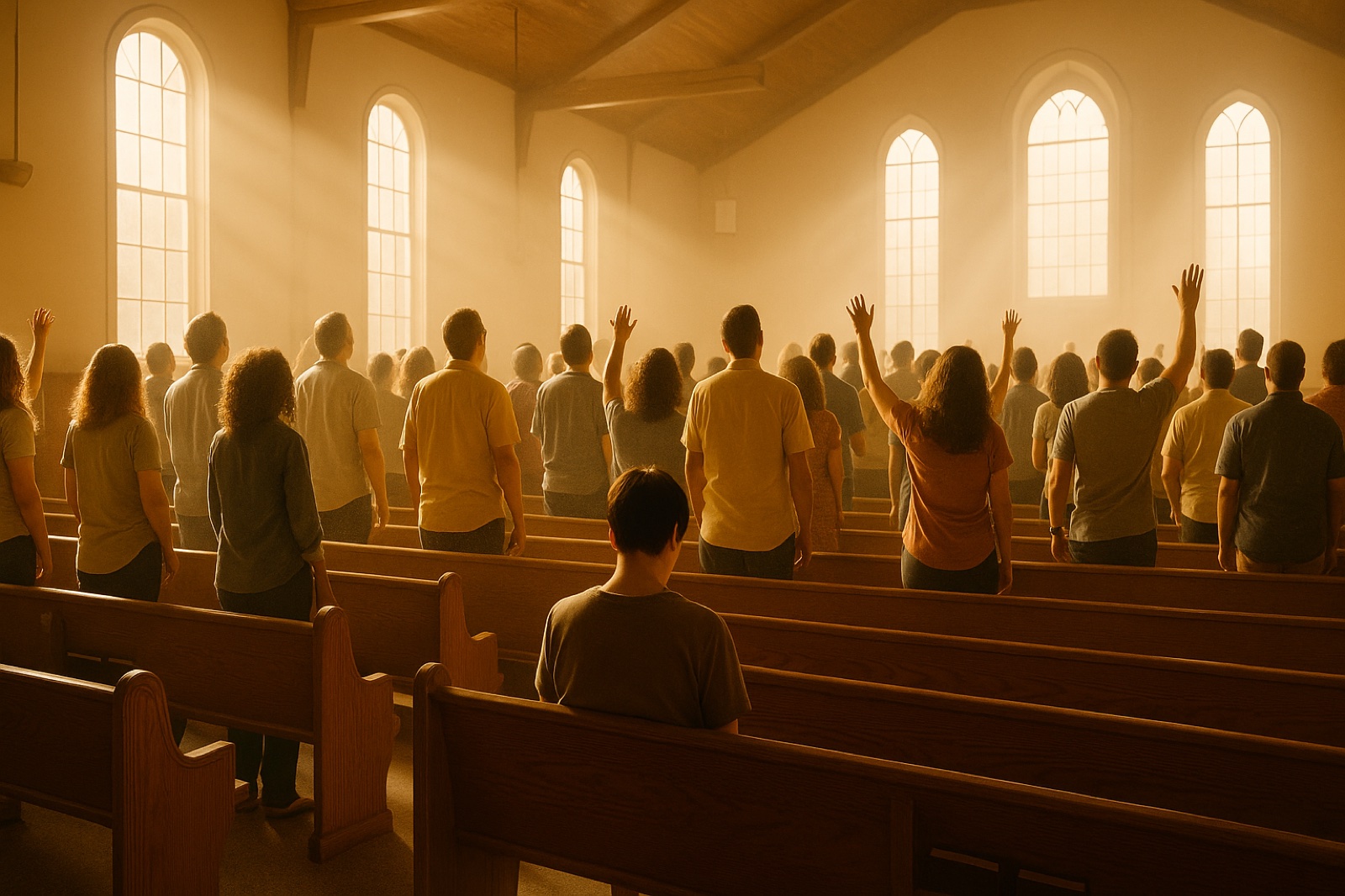
You slide into the same pew you always sit in. The music starts. A couple hundred voices rise around you, hands lifted, eyes closed — a whole room that clearly believes something together. And you stand there mouthing the words, feeling like the only person in the building who is completely, achingly alone.
If that sounds familiar, you are not broken, and you’re not as alone in feeling alone as it seems. Feeling lonely at church might be one of the most common unspoken experiences among people who show up faithfully every single week. It isn’t a sign your faith is weak. It’s a signal. And 1 Corinthians 12 already named exactly what that signal means — and exactly what to do about it.
The Loneliest Room You’ll Ever Sit In
Here’s what makes church loneliness so disorienting: it doesn’t look like loneliness. Loneliness is supposed to look like an empty apartment, a phone that never rings, a Friday night with nowhere to be. It isn’t supposed to look like a packed sanctuary, a potluck table, a small group text thread you’re technically part of.
But researchers who study loneliness keep finding the same uncomfortable pattern. A massive study across 180,000 people in 22 countries found that the thing that actually predicts loneliness isn’t how many people are physically around you — it’s whether you feel truly known by any of them. You can be surrounded by two hundred believers every Sunday and still feel like a stranger who wandered into the wrong building.
That gap — between being present and being known — is exactly where church loneliness lives. And it’s exactly where Paul, writing to one of the most fractured, comparison-obsessed churches in the New Testament, decided to spend an entire chapter.
Why Paul Wrote to a Church Full of Strangers
The church at Corinth was not a peaceful place. People had split into camps — “I follow Paul,” “I follow Apollos,” “I follow Peter” — ranking themselves by whose teacher they liked best (1 Corinthians 1:12). Some members were showing off spiritual gifts like trophies. Others were quietly convinced they didn’t have anything worth contributing at all. It was a room full of people who were technically in the same church and functionally strangers to each other.
Paul’s answer wasn’t a pep talk about trying harder to be friendly. He reached for an image his readers already understood — the human body — and used it to describe what a church is actually supposed to be:
“For as the body is one, and hath many members, and all the members of that one body, being many, are one body: so also is Christ.” — 1 Corinthians 12:12 (KJV)
He kept going. Not every part of a body does the same job, and no part is less “in” the body because its job looks different:
“But now hath God set the members every one of them in the body, as it hath pleased him.” — 1 Corinthians 12:18 (KJV)
Then he named the ache directly — the isolation some members felt even while sitting in the same room as everyone else:
“That there should be no schism in the body; but that the members should have the same care one for another.” — 1 Corinthians 12:25 (KJV)
And he closes the thought with the line that matters most for anyone sitting in a pew feeling like an outsider:
“Now ye are the body of Christ, and members in particular.” — 1 Corinthians 12:27 (KJV)
Members in particular. Not a crowd. Not an audience. Particular parts, placed on purpose, each one needed for something specific. This is the same chapter Paul uses to introduce the idea of spiritual gifts — and if you’ve never actually sat with what that means for you personally, this piece on what your spiritual gifts actually are walks through Paul’s fuller argument in a way that connects directly back to this ache.
You Were Never Meant to Function Alone
Here’s the turn most people miss when they read this passage: the ache of feeling disconnected inside a church isn’t evidence that you don’t belong to the body. It’s evidence you haven’t yet found — or been shown — which part you are.
You were never meant to function as a lone part.
A hand that’s never been asked to hold anything doesn’t stop being a hand. But it will feel useless, disconnected, out of place — right up until it’s given something to do that only a hand can do. That’s not a flaw in the hand. That’s a body that hasn’t finished connecting its own parts yet.
The same is true for you in that pew. God didn’t set you in that particular body, in that particular season, by accident — “as it hath pleased him,” Paul says, on purpose. The loneliness you feel isn’t proof the placement was a mistake. It’s often just proof that the connection between you and the rest of the body hasn’t been made yet — and that connection is something you can actually go build this week, not something you have to wait to be handed.
What To Actually Do About It
Knowing you’re “a member in particular” doesn’t fix Sunday morning by itself. Here’s how to actually close the gap between being present and being known — starting today, not someday.
Actions to Take
- Send one honest text today. Not “great sermon!” — something true. Try: “Hey — today was harder than it probably looked from the outside. Any chance we could grab coffee this week?” It takes five minutes and it’s the fastest way to turn a stranger back into a friend.
- Find one small, recurring room. Not a whole ministry commitment — just one repeating gathering where the same 8-10 faces show up weekly: a class, a small group, a serving team. Loneliness shrinks in rooms you return to, not rooms you visit once.
- Discover the specific way you’re built to connect. Paul’s whole point in this chapter is that you have a particular part to play — not a generic one. This free Spiritual Gifts Assessment takes a few minutes and gives you a real, specific starting point instead of a vague “just get involved” — then pick one small way to use it this month.
Something to Sit With
- When did I last feel truly known — not just seen — by someone at my church? What made that moment different from every other Sunday?
- What’s one thing I notice, care about, or am quietly good at that I’ve assumed “isn’t needed here”?
- If I pictured myself as one specific part of a body inside my church — a hand, an eye, an ear — which one would I be? Am I actually being used that way right now?
A Prayer for When the Pew Feels Empty
God, I’m tired of feeling like a stranger in a room full of people who love You. I don’t want to fake connection anymore — I want the real thing. Show me the one person I’m supposed to reach out to this week, and give me the courage to actually send that text. Help me stop waiting to be noticed and start believing I was placed here on purpose, for a reason only I can fill. Amen.
What do you think — does most church loneliness come from churches doing something wrong, or from people staying one layer too guarded to actually be known? We’d love to hear how you’d answer that in the comments.
Share This
- “I used to think feeling lonely at church meant something was wrong with my faith. Then I read 1 Corinthians 12 differently. The ache was never proof I didn’t belong — it was proof I hadn’t found my place in the body yet.”
- “You can sit in a packed sanctuary and still feel invisible. 1 Corinthians 12 says you were never meant to function alone — and that changes everything about what to do next.”
- “Being surrounded by people isn’t the same as being known. 1 Corinthians 12 already named the difference — and the fix.”
Questions People Ask
Is it normal to feel lonely even when I go to church every week?
Yes — it’s far more common than most people admit out loud. Being physically present in a service doesn’t automatically mean you feel known by the people around you, and that gap between presence and connection is where most church loneliness actually lives.
What does 1 Corinthians 12 actually say about loneliness?
Paul compares the church to a human body with many different parts, each placed by God on purpose and needed for something specific (1 Corinthians 12:12-27). The passage doesn’t promise you’ll never feel disconnected — it reframes that ache as a sign you haven’t yet found your particular place in the body, not proof you don’t belong to it.
Does feeling lonely at church mean I’m distant from God?
No — feeling disconnected from the people around you and feeling distant from God are two different things. You can feel completely alone in a pew and still be exactly as close to God as ever. This kind of loneliness is about human connection, not about where you stand with God.
How do I make real friends at church without it feeling forced?
Start smaller than you think you need to. One honest text to one person, and one small recurring group you return to weekly, will do more than trying to “get involved” broadly. Real connection tends to grow in rooms you keep showing up to, not rooms you visit once.
What if I’ve already tried getting involved and I still feel like an outsider?
That’s worth naming honestly rather than pushing through quietly. Sometimes it means you haven’t yet found the specific role that fits how you’re wired — which is exactly what a spiritual gifts assessment can help surface. And sometimes it’s worth having one honest conversation with a pastor or small group leader about what you’re experiencing. Naming it out loud is often the first real step toward it changing.