 0
0
 0
0
There is a list in your head. You have never written it down, but you know every line.
The guitar on top of the cupboard. The call to your aunt you keep meaning to make. The walk up the hill outside town that you have driven past a hundred times. The small business idea. The course. The letter. The trip to see your old friend before the kids get any bigger.
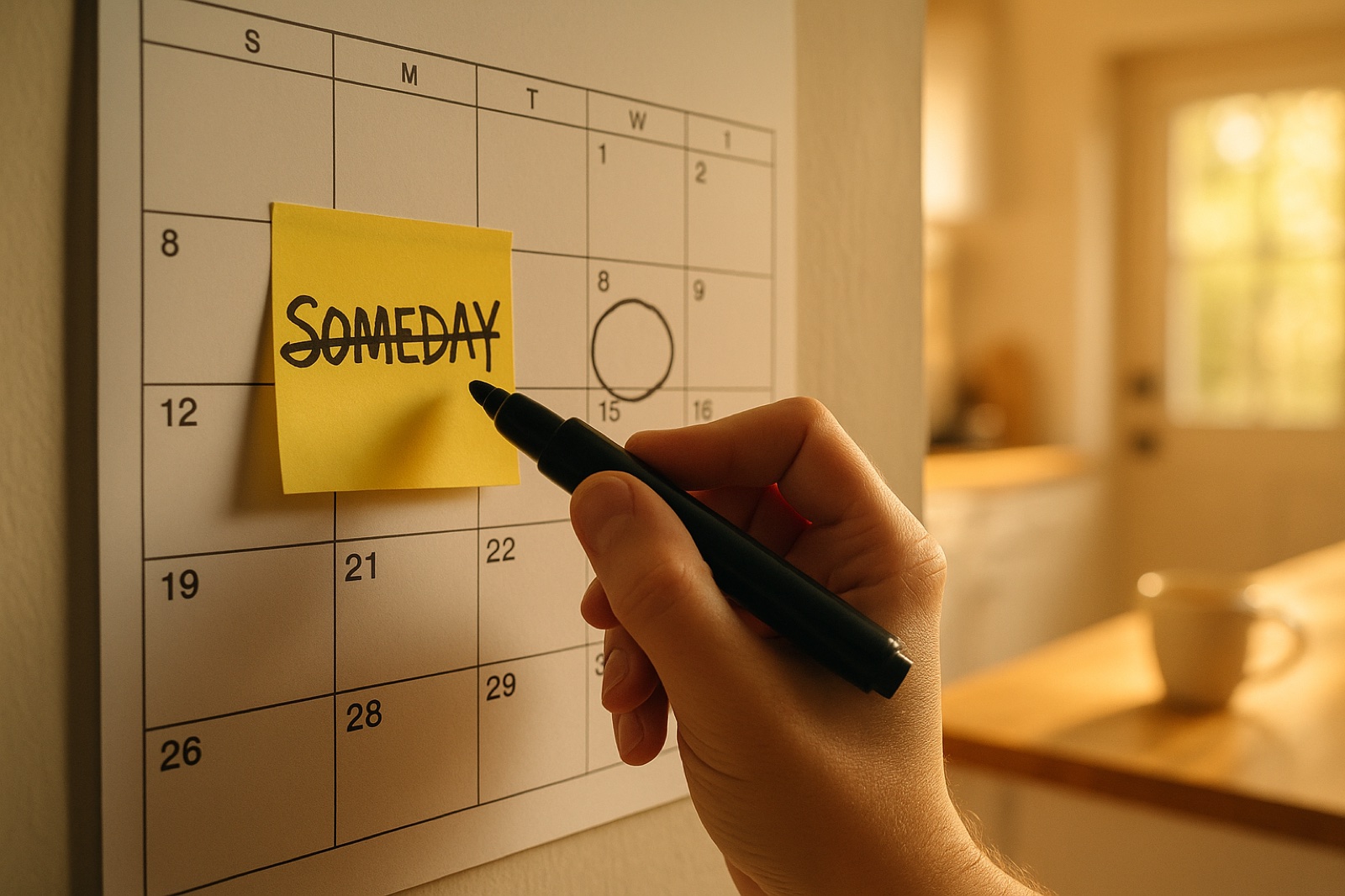
None of it is urgent. That is the problem. Every one of those things is filed under the same word: someday. And someday never shows up on the calendar.
If you want to stop living for someday, you are not alone, and you are not lazy. You get a lot done. The bills get paid. The dishes get washed. Other people get what they need from you. It is only the things you actually want that keep sliding to next month, next year, after things calm down.
Why You Keep Living for Someday
The usual advice says you need better time management. A planner. An app. A morning routine. But you already manage your time well enough to keep your whole life running. Time management is not what is missing.
Here is what is going on underneath.
The things you want have no deadline. Work has a boss. Rent has a due date. A crying child has a very loud deadline. But nobody is going to phone you and ask why you still have not picked up the guitar. So every single day, the things with a deadline win, and the things you love lose. Not because they matter less. Because they are quieter.
Someday keeps the dream safe. As long as it stays in someday, the dream is perfect. The trip is wonderful. The business works. The song sounds great. The moment you start, it gets real, and real things can go badly. Part of you knows that. So someday is not only a delay. It is a storage box that keeps the dream from being tested.
And someday feels free. This is the deepest one, and it is the one nobody says out loud. Putting something off only feels safe because of a quiet guess running in the background: there will be plenty of later. You never decided to believe that. You just never checked it. And as long as later feels endless, waiting costs nothing. So you wait.
That last guess is doing almost all the work. Take it away, and the other two lose most of their grip.
Later Is a Guess, Not Something You Own
Most of us treat “later” like money sitting in a drawer. We have not counted it, but we assume it is there, so we spend today on other things and plan to draw from the drawer when life calms down.
But later is not in a drawer. Nobody actually holds it. It is a guess about the future, and it is a guess we make without noticing. You do not know what next year looks like. Your aunt does not know. The friend you keep meaning to visit does not know. This is not a scary thought. It is just true, the way weather is true.
And here is the turn: once you see that later is a guess, today changes shape. Today is the only part of your life you are actually holding. It is not a waiting room for the real thing. It is the real thing. That is good news, not bad news. It means the thing you want is not stuck behind some future door. It is available right now, in a smaller size than you pictured.
That idea is much older than it sounds. It turns up in a short letter in the Bible, written by James, and the surprise is who it was written to. Not to lazy people. It was written to busy, confident planners who said they would go to a city, stay a year, trade and make money. The answer they got was this: “Whereas ye know not what shall be on the morrow. For what is your life? It is even a vapour, that appeareth for a little time, and then vanisheth away.” You do not need a religious framework for that to be true. It is plain good sense that happens to have very old roots, and it cuts both ways: it catches the person who plans too confidently, and the person who waits too confidently. Both are leaning on a tomorrow they do not actually hold.
Bronnie Ware, an Australian palliative care worker, wrote about the regrets her patients shared with her near the end of their lives. The one she said she heard most often was wishing they had had the courage to live a life true to themselves, not the life others expected of them. You do not have to be near the end of anything to take that seriously. You just have to be willing to spend one small piece of this week on purpose.
How to Stop Living for Someday: Five Moves for This Week
Name one thing, out loud, in one sentence. Not “travel more” or “be creative.” Those are clouds. Pick one real thing, like “I want to play one song on the guitar all the way through” or “I want to see my cousin in the next town.” Say it out loud or write it on a scrap of paper. A vague wish can wait forever. A named thing starts to feel strange sitting on a shelf.
Ask what later is actually costing you. Someday feels free, so give it a price. What is the waiting costing? Maybe your aunt is getting older. Maybe your skill is still at zero, a year after you first wanted it. Maybe it is the small, heavy feeling you carry every time you walk past the guitar. Write one line: “Waiting is costing me ___.” You are not trying to feel guilty. You are just reading the price tag you have been ignoring.
Shrink it to a this-week size. Most someday things are stuck because we picture the big version: the whole trip, the whole business, the finished song. Find the version you could do this week with no money and not much time. Instead of the visit, the phone call. Instead of the full hike, the first two kilometres. Instead of the business, one conversation with someone who has done it. Instead of learning guitar, ten minutes tuning it and trying one chord. Small is not a lesser version. It is the version that actually happens.
Give it a day, not a someday. “Someday” is a word with no square on the calendar. So give it a square. Pick an actual day this week, and a rough time, like “Thursday after dinner.” Put it where you will see it: on the fridge, as a phone alarm, on the back of your hand if you have to. The thing you love finally gets a deadline, even if you are the only one who set it.
Let the first try be bad. Remember the storage box that keeps the dream perfect? The only way out is to let it be imperfect. The first chord will sound rough. The phone call might be awkward for the first minute. The walk might end halfway because it rained. That is fine. You are not trying to do it well. You are trying to do it at all, so it moves from someday into your actual life. Once it is there, it can get better.
If you want a small, honest nudge before you start, try counting how many days you have been alive. It is not meant to scare you. Most people find it strangely encouraging to see how many ordinary days they have already had, and to notice that today is one more of them, still wide open.
And if you are not sure which someday thing matters most, it can help to get clear on what your core values actually are. The thing that lines up with them is usually the one worth doing first. If what you are putting off is less “wanted” and more “important but hard,” this piece on why we put off what matters most looks at that side of it.
What Would You Do This Week?
You do not need to fix your whole life. You do not need a plan for next year. You just need to take one thing out of the someday box and give it a real day.
So here is the question to sit with: if you stopped assuming you had endless later, which one thing would you move to this week, and what is the smallest version of it you could do by Sunday?
I would love to hear what yours is. What is the someday thing you have been carrying around the longest, and what would the first small step look like for you?
Questions People Ask About Living for Someday
Why do I keep putting off things I actually want to do?
People usually put off the things they want because those things have no outside deadline, so tasks with deadlines always win. Wanted things also feel safer as dreams, because starting them makes them real and open to failure. Underneath both is a quiet assumption that there will be plenty of time later, which makes waiting feel free.
How do I stop living for someday?
To stop living for someday, pick one specific thing you want, name what waiting is costing you, and shrink it to a version you can do this week with no money and little time. Then give it an actual day and time, and let the first attempt be rough. Moving one thing from “someday” to a real day breaks the habit faster than planning everything at once.
Is it bad to always wait for the right time?
Waiting for the right time is sometimes wise, for example when you need to save money or recover from illness. It becomes a problem when “the right time” has no clear conditions and keeps moving. A useful test is to ask what exactly would need to change for the time to be right. If there is no clear answer, the waiting is probably fear or habit rather than good timing.
What is the smallest way to start something I have been putting off?
The smallest start is usually a version that takes under half an hour and needs no money: one phone call instead of a visit, ten minutes with an instrument instead of lessons, walking the first part of a route instead of the whole trip, or one conversation with someone who has done what you want to do. A small start that happens is more useful than a big plan that does not.
Share This
“I kept telling myself I’d do it someday. Turns out someday isn’t on any calendar. So I gave it Thursday.”
“Putting things off only feels safe because we assume there’s endless later. There isn’t. Not a scary thought, just a true one. This helped me pick one thing and do a small version of it this week.”
“The things I actually want never have a deadline, so they always lose to the things that do. This was the first thing I’ve read that explained why, and what to do about it.”