 0
0
 0
0
You get a good month. The paycheck covers everything, maybe there’s even a little left over, and for a minute things feel steady. So what do you do with that breathing room? If you’re like most people, you spend it — not recklessly, just normally. Dinner out. A little catch-up on things you’d been putting off. And then the good month ends, the way good months do, and the next unexpected bill lands exactly like it always does: a car repair, a medical copay, a slow week at work. And you’re right back where you started, except now you’re also tired of starting over.
There’s a man in Genesis who had the exact opposite instinct during his own version of a good season — and it’s easy to read his story as ancient history with nothing to say to your bank account. It isn’t. Joseph’s plan during Egypt’s seven years of plenty is one of the oldest financial strategies on record, and it still exposes something most of us do backwards.
The Dream Nobody Else Could Read
Pharaoh had a dream that shook him — seven healthy, fat cows coming up out of the Nile, followed by seven starving, sickly cows that devoured them. Then a second dream, same message: seven full, healthy heads of grain, swallowed up by seven thin, blighted ones. None of Egypt’s wise men or magicians could tell him what it meant. Joseph, still years away from freedom and pulled straight out of prison to stand in front of the most powerful man in the ancient world, told him plainly: God was showing Pharaoh what was coming. Seven years of abundance across Egypt, followed by seven years of famine so severe it would erase all memory of the good years that came before it.
That part of the story gets told often. What gets skipped is what happened right after Joseph finished interpreting — because a warning by itself doesn’t save anyone. Joseph didn’t stop at “here’s what’s coming.” He gave Pharaoh a plan.
The Plan Was Specific, Not Vague
“And let them gather all the food of those good years that come, and lay up corn under the hand of Pharaoh, and let them keep food in the cities. And that food shall be for store to the land against the seven years of famine, which shall be in the land of Egypt; that the land perish not through the famine” (Genesis 41:35–36, KJV).
Notice what Joseph didn’t say. He didn’t say hoard everything. He recommended setting aside a fifth — one-fifth of the harvest, every one of the seven good years, collected under organized oversight and stored city by city so it would be there when it was needed (Genesis 41:34). That’s a 20% plan, not a panic plan. Egypt kept living, eating, working, and building during those seven years. They just didn’t spend down to zero while it was easy not to.
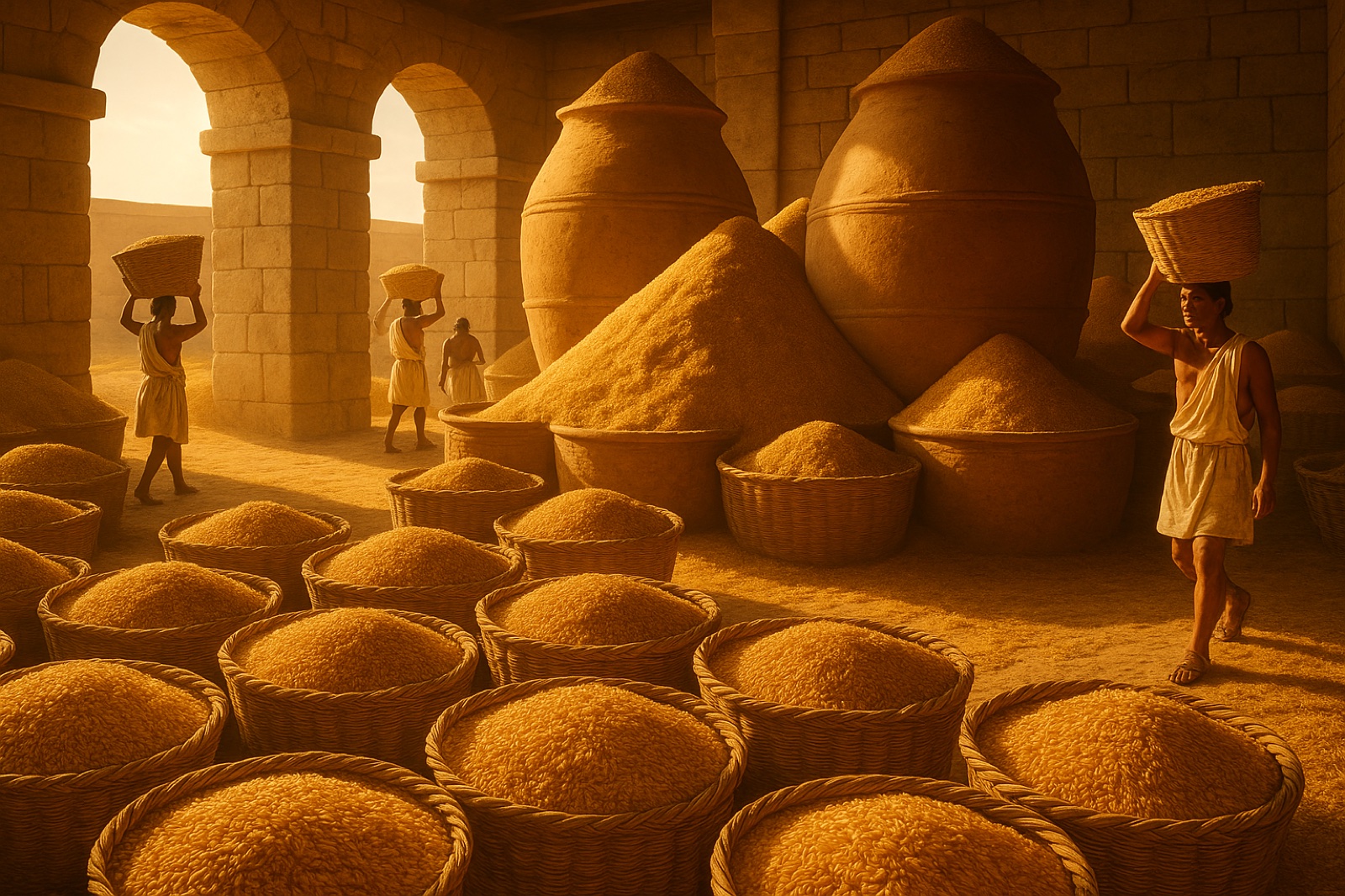
Pharaoh put Joseph in charge of the whole operation, and Joseph did exactly what he’d proposed. Scripture says that during the seven plenteous years, “the earth brought forth by handfuls,” and Joseph gathered up all the food of those years and laid it up in the cities — so much grain that he stopped keeping count, because it was beyond counting (Genesis 41:47–49). Then the famine came, “according as Joseph had said” (Genesis 41:54), and it wasn’t just severe in Egypt — it stretched across the region. Egypt was the only nation with anything left to sell, because Egypt was the only nation that had planned for the lean years while everyone else was living inside the good ones.
The Part That Changes How You Read This
Here’s where it’s tempting to close the book on this story: “Well, Joseph had a dream. I don’t get a seven-year forecast for my own life, so this doesn’t really apply to me.” That’s a fair objection — and it misses what scripture actually holds up as the model here.
Because Joseph’s foresight wasn’t the only place this principle shows up. Proverbs points to an animal with no dream, no vision, no forecast at all: “Go to the ant, thou sluggard; consider her ways, and be wise: which having no guide, overseer, or ruler, provideth her meat in the summer, and gathereth her food in the harvest” (Proverbs 6:6–8, KJV). The ant doesn’t know a specific famine is coming on a specific date. It just knows, without needing to know the details, that the season it’s in right now will not be the season it’s always in. So it acts accordingly, every single season, as a settled discipline rather than a one-time emergency response.
That’s the Turn buried in Joseph’s story. The miracle was the dream. The discipline was ordinary, repeatable, and available to anyone — then and now. You don’t need a vision from God to know that a lean season is coming eventually. You already know that. You’ve lived through at least one already. The only real question Joseph’s story puts in front of you is whether you’re going to treat the good month like it’s permanent, or treat it like Egypt’s seven years of plenty — a window, not a guarantee, and the only time you actually get to prepare for what’s next.
The miracle was the dream. The discipline was ordinary — and repeatable.
What This Looks Like on a Tuesday
You’re not Pharaoh, and you don’t have officers to appoint over the land of Egypt. But the same shape still fits an ordinary paycheck. When money is steady this month, that’s not the moment to spend down to zero because it’s easy not to notice. That’s the moment to set something aside — on purpose, before the month has a chance to absorb it — so that when the harder month comes, and it will, you’re not starting from nothing. It’s the same question stewarding your money wisely always comes down to: not how much you have, but whether you’re paying attention to it before you need to.
It’s also not a new problem. Nearly 78% of NFL players face serious financial distress within two years of retiring — not because the money wasn’t there, but because a season of abundance was treated like it would never end. Joseph’s Egypt is the other ending to that same story.
This isn’t about fear, and it isn’t about hoarding out of a lack of trust in God’s provision. It’s the opposite. It’s stewardship offered in advance, the same way God gave manna one day at a time in the wilderness and still expected the Israelites to gather it wisely rather than waste it. Provision and planning were never at odds in scripture. They were always meant to work together.
Actions to Take This Week
- Open one separate savings account today, even if you fund it with $20. Give it a name that means something to you — “the seven years” works fine. The goal isn’t the amount yet. It’s separating “spend” money from “store” money so they stop looking identical in your checking account.
- Pick your own “fifth.” Joseph didn’t store everything — he stored 20% of the good years. Look at this month’s income and set one automatic transfer, even 5%, into that account before you pay for anything else. Automatic beats willpower every time.
- Write down the last surprise expense that hit you hard — the repair, the bill, the slow month — and put a real number next to it. That number is your actual target, not a guess. It’s the famine you already lived through once, which means you already know its size.
Journal With This
- Where in my life have I been living entirely inside “the seven good years” without preparing for a leaner one?
- What’s one place where I’ve trusted my own timeline — assuming the good month would just keep going — instead of building any margin?
- If Joseph looked at how I currently treat unexpected money, what would he say?
A Prayer for the Good Months
God, thank You for this season, even the ordinary, steady parts of it I don’t always notice. I confess I’ve spent down to zero more times than I’ve planned ahead, and called it living in the moment when it was really just not paying attention. Teach me to hold what You’ve given me with open, wise hands — not gripped tight out of fear, and not carelessly, like it’ll always be this easy. Help me build something today that will still be standing when the harder season comes. Amen.
Let’s Talk About It
Is setting money aside during the good times an act of faith, or does it risk becoming a sign you don’t fully trust God to provide when the hard season actually arrives? Where do you draw that line? Tell us in the comments.
Share This
- “Joseph didn’t wait for the famine to start saving. He started during the years everything was already going right. I needed that reminder today.”
- “The miracle in Joseph’s story was the dream. The part I can actually copy is the discipline — store a fifth during the good years, so the lean ones don’t wipe you out. #BGodInspired”
- “Provision and planning were never opposites in scripture. Manna came daily. Joseph’s grain was stored for seven years. God provides both ways — the question is whether I’m paying attention to which season I’m in.”
Questions People Ask
Why did Joseph store grain for seven years?
Joseph interpreted Pharaoh’s dreams as a warning of seven years of great abundance in Egypt followed by seven years of severe famine. He proposed storing a fifth of the harvest during the abundant years so Egypt would have food when the famine hit, and Pharaoh put him in charge of carrying out the plan (Genesis 41:25–36).
How much grain did Joseph actually store?
Scripture doesn’t give an exact figure — it says Joseph gathered “as the sand of the sea, very much, until he left numbering; for it was without number” (Genesis 41:49). The specific plan behind it, though, was to collect one-fifth of each year’s harvest during the seven plenteous years.
Is saving money biblical, or does it show a lack of trust in God?
Scripture presents both provision and planning as part of the same picture. God provided manna daily in the wilderness, and Joseph stored grain for years in advance — both were acts of trust, not opposites. Proverbs 6:6–8 even points to the ant as an example of wise, ordinary preparation. The line scripture draws isn’t between saving and trusting God; it’s between wise stewardship and hoarding out of fear.
What happened when the famine actually came?
The famine hit Egypt and the surrounding region exactly as Joseph had said. Because Egypt had stored grain during the plenty, it was the one place with food to sell — not just for Egyptians, but for people from other countries who came because the famine was severe everywhere else (Genesis 41:54–57).
What’s the modern application of Joseph’s grain-storage plan?
You don’t need a prophetic dream to know a harder season is coming eventually — everyone eventually faces one. The application is the discipline itself: setting aside a portion of income during a stable season, on purpose and automatically, rather than spending down to zero simply because the good month made it easy not to notice.