 0
0
 0
0
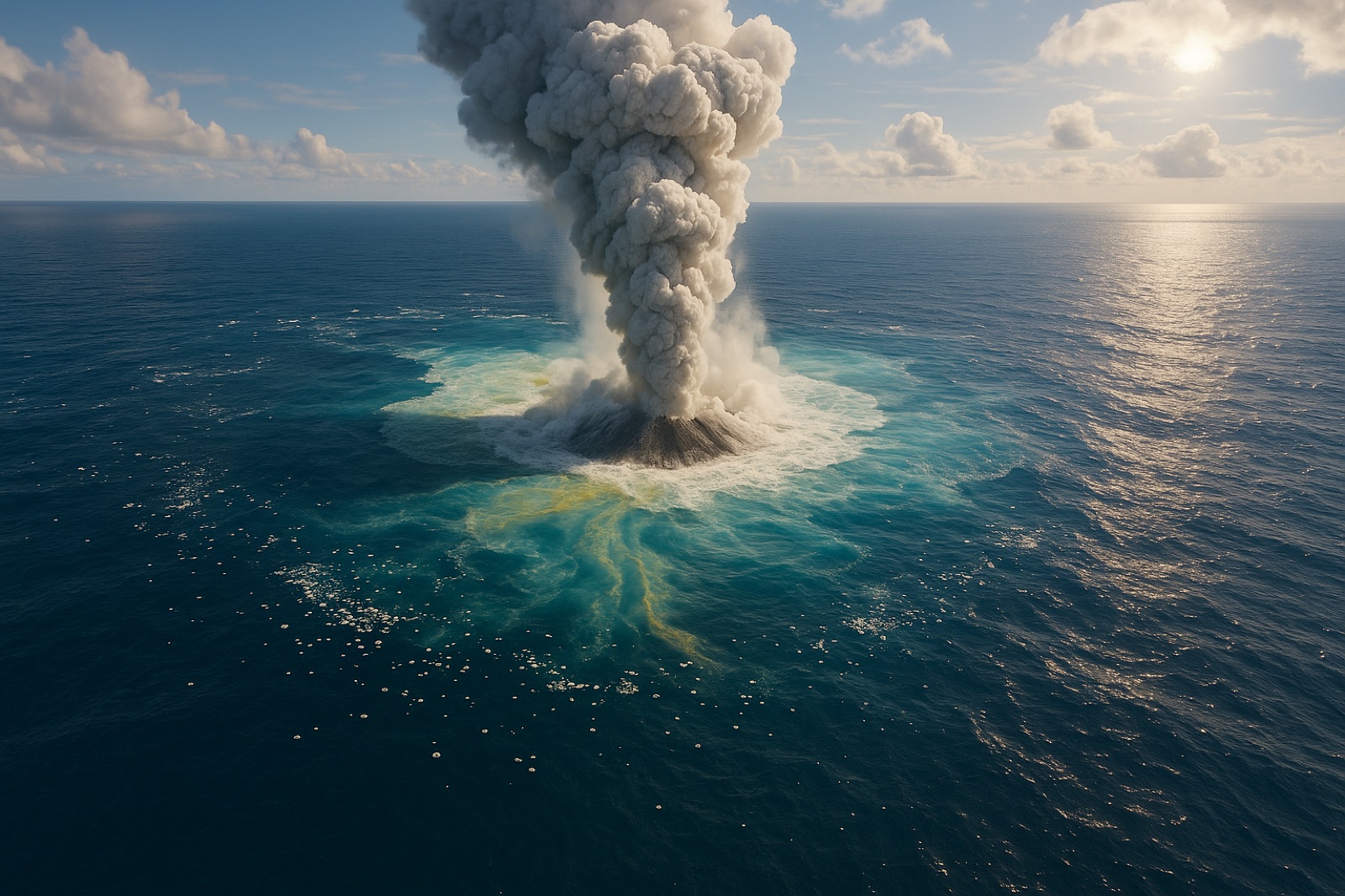
Somewhere in the Bismarck Sea, north of Papua New Guinea, the ocean has been acting strange for almost three months. Satellite images keep catching the same thing: pale plumes of steam and ash rising off open water, and patches of the sea turning a strange, milky turquoise where there should just be blue. NASA has had eyes on the spot since early May, and even now, nobody watching it knows exactly how the story ends.
What’s actually happening down there is one of the rarer things a planet does in full view of us. It might be building a new island. Live. Right now.
An Underwater Volcano Is Trying to Break the Surface
The eruption sits in shallow water in the Bismarck Sea, part of a stretch of the Pacific known for exactly this kind of activity — plates grinding against each other just under the seafloor, feeding chains of volcanoes that spend most of their lives completely submerged and unnoticed. This one didn’t stay unnoticed. NASA Earth Observatory first flagged it on May 8, 2026, and as of this month it’s still active enough to keep showing up in satellite passes.
From orbit, the signs are unmistakable once you know what you’re looking at. Steam and ash columns rise where magma meets seawater in what’s called a phreatomagmatic eruption — violent enough to punch material up through the surface, but still happening close enough to shore that satellites can track it without a research ship anywhere nearby. The water itself has turned a chalky, sulfur-tinted turquoise for miles around the vent. And scattered across the waves are rafts of pumice — chunks of volcanic rock so full of trapped gas they float, sometimes drifting for months and washing up on beaches an ocean away from where they were born.
None of that alone means an island is guaranteed. It means the process that builds one is currently underway — and it’s not the first time this year NASA’s instruments have caught a slow, patient process aimed at a very specific destination, playing out exactly on schedule the same way a years-long detour to a distant metal world turned out to be the plan all along.
How an Island Actually Gets Built
New islands don’t appear all at once. They’re built the same way anything gets built from nothing — one layer at a time, through repetition, with plenty of setbacks along the way. A submarine volcano erupts, cools, and adds a little material to a pile on the seafloor. It erupts again. Eventually, if it erupts often enough and the pile gets tall enough, that mound breaks the surface and starts hardening into actual land instead of just a hazard for passing ships.
Sometimes it works. Surtsey, off the coast of Iceland, formed this exact way between 1963 and 1967 and is still there today, now a protected nature reserve scientists use to study how life colonizes brand-new ground. Other times it doesn’t hold. Islands have popped up near Tonga in recent years, drawn crowds of curious satellite-watchers, and then quietly eroded back under the waves within months once the wave action outpaced the rock.
Nobody currently knows which version this becomes. That’s not a gap in the reporting — it’s a genuinely open question that only time, and more eruptions, can answer. The ocean keeps turning out to hold more than we expect, too — even an entire hidden ocean sealed under eighteen miles of ice on a moon of Jupiter was confirmed real only recently, after decades of guessing.
Watching Land Take Shape Is an Old, Old Story
There’s a reason this keeps grabbing attention beyond the geology of it. Long before anyone had a satellite, someone was already describing this exact shape of event — water pulling back, and dry ground appearing where there wasn’t any a moment before. It’s one of the oldest scenes in the opening pages of the Bible: land being separated out from the sea, order emerging from something formless and unfinished. People have told that story for thousands of years without ever getting to watch it unfold. For a few months this year, courtesy of a satellite orbiting a few hundred miles up, we do.
Maybe that’s what makes an unremarkable patch of the Pacific feel bigger than it is. It’s not really about the island. It’s about getting a front-row seat to a process — something bigger than any one eruption, quietly finishing what it started, on its own timeline, whether or not anyone’s watching closely enough to notice. It’s the kind of coincidence that keeps showing up once you start looking for it — even the U.S. government’s newest AI initiative ended up named, almost too fittingly, the Genesis Mission.
What Happens If You Just Have to Wait and See
The honest answer to “will this become a real island” is: check back later. Scientists will keep watching the plumes, the pumice, and the water color for as long as the eruption keeps producing them, and at some point — weeks, months, maybe longer — it’ll either have added enough rock to stay above the waterline, or it won’t.
There’s something almost relieving about a story that refuses to resolve on command. Most of what we actually wait on in our own lives works the same way — slowly, invisibly, with no announcement for when the waiting officially ends. The island in the Bismarck Sea is either forming right now or it isn’t, and no one gets to find out early. It just keeps happening, one steam plume at a time, until one day it’s simply there — or it isn’t, and the sea goes back to looking like it always has.
Discussion Question
If the eruption does finish the job and a real island shows up on the map, do you think it should get an official name of its own — or just stay another dot nobody’s heard of? What would you call it?
Share This
- NASA has been watching an underwater volcano try to build a brand-new island for almost three months. We might actually get to see it happen.
- Wild: there’s a spot in the Bismarck Sea right now where the ocean might be turning into land, live, and nobody knows if it’ll finish.
- Steam plumes, floating pumice, turquoise water for miles — NASA satellites have been tracking a possible new island forming since May. Wild to watch in real time.
Questions People Are Asking
Is a new island really forming in the ocean right now?
An underwater volcano in the Bismarck Sea, north of Papua New Guinea, has been erupting since at least May 8, 2026, and NASA satellites are still tracking it as of this month. The eruption is producing the steam plumes, ash, and floating pumice that would eventually build a new island — but it hasn’t broken the surface into permanent land yet, and scientists don’t know if or when it will.
Where exactly is this happening?
It’s in the Bismarck Sea, a part of the western Pacific Ocean near Papua New Guinea known for frequent underwater volcanic activity along its tectonic plate boundaries.
How do new islands actually form from volcanoes?
A submarine volcano erupts repeatedly, and each eruption adds a layer of cooled material to a pile on the seafloor. If enough eruptions happen, the pile eventually grows tall enough to break the ocean’s surface and harden into land. It can take years, and the process can also fail partway, eroding back underwater before it ever becomes permanent.
Do islands formed this way ever last?
Sometimes. Surtsey, off Iceland, formed this way in the 1960s and is still standing today as a protected nature reserve. Other times, islands formed by eruptions near places like Tonga have eroded back below the waves within months of appearing.
Why are pumice rafts part of this story?
Pumice is volcanic rock so full of trapped gas bubbles that it floats. Eruptions like this one can produce huge rafts of it that drift across open ocean for months, sometimes washing ashore on beaches far from where the eruption happened.