 0
0
 0
0
You have probably seen the headline by now. Something like: kimchi may help flush microplastics out of your body.
It is a lovely idea. A cheap, old, ordinary food quietly doing what no pill can. And after years of scary news about plastic turning up in blood, in lungs, even in brains, a lot of people want it to be true.
So what did the kimchi microplastics study actually find? Something real, and genuinely interesting. It is also narrower than the headlines, and it is not new. The research first came out in March 2026. It just went round again this week.
Here is the honest version, step by step.
What the Kimchi Microplastics Study Actually Tested
The work came from the World Institute of Kimchi, a government research institute in South Korea. The team was led by Dr. Se Hee Lee and Dr. Tae Woong Whon, and the paper was published in the journal Bioresource Technology.
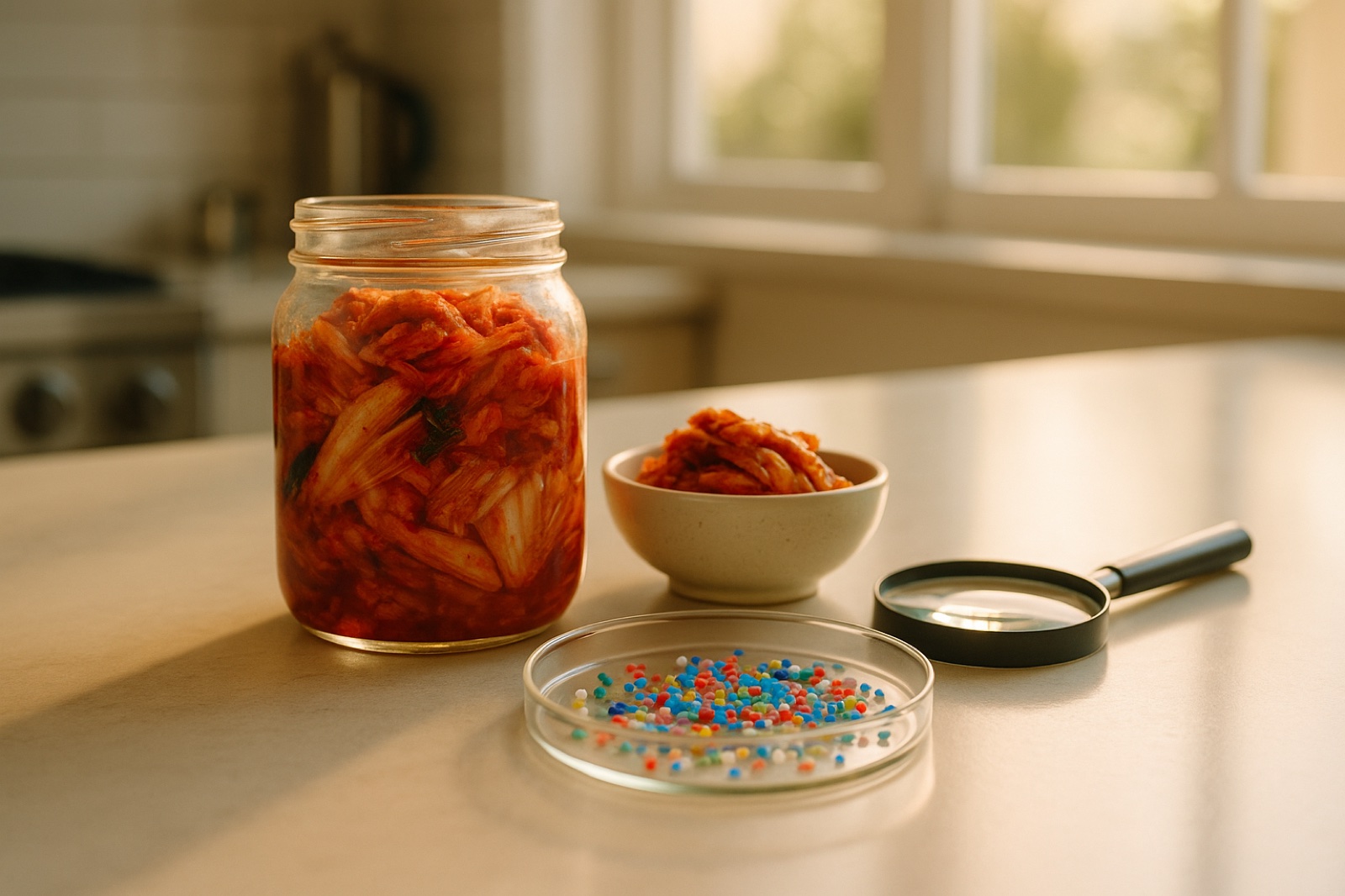
They did not feed anyone kimchi. They took one single strain of bacteria that had been isolated from kimchi. Its name is Leuconostoc mesenteroides CBA3656. Then they tested whether it would grab onto tiny bits of plastic.
Two details matter here, and most headlines skipped both:
- It was nanoplastics, not microplastics. The particles were polystyrene, smaller than one micrometre. That is far smaller than the specks most people picture when they hear “microplastic.”
- It was one strain, not the food. Kimchi holds many different microbes. This study tested one of them, on its own.
In a dish under normal lab conditions, the strain soaked up about 87% of the nanoplastics. A comparison strain the team used did almost as well, at about 85%. So far, nothing special.
If stories like this one keep you up at night, running through everything you can’t control, that free guide is for you. It explains why the mind won’t slow down after dark, and the simple order that helps it settle.
The Number That Actually Matters: 57% vs 3%
Then the researchers made the test harder. They copied the conditions inside a gut: acid, bile, the rough chemical world your food passes through.
The comparison strain almost completely gave up. Its grip on the plastic fell from about 85% to about 3%.
The kimchi strain held on. It still bound about 57%.
That is the real finding. Lots of bacteria can stick to plastic in a calm lab dish. Very few keep holding on in the place where it would actually count.
Next came mice. Mice given the kimchi strain passed more than twice as much nanoplastic in their droppings as mice that were not given it. In other words, the plastic didn’t just get grabbed. It got carried out.
“Plastic pollution is increasingly recognized not only as an environmental issue but also as a public health concern,” Dr. Lee said when the research was released. The team described it as a possible new biological approach, a first step and not a finished cure.
What This Study Does Not Show
This is where it’s worth slowing down, because this is exactly where the headlines ran ahead.
- No humans were tested. Everything happened in a lab dish, in simulated gut conditions, and in mice. The findings were reported as needing further study before anyone knows if they apply to people.
- The mice were germ-free. They were raised with no gut bacteria of their own. A real human gut is crowded with trillions of microbes, all competing. Nobody knows yet how one added strain would do in that crowd.
- There’s no evidence your kimchi contains this strain in useful amounts. The strain was isolated from kimchi. That’s not the same as saying every jar in the shop delivers it.
- It tested one kind of plastic. Polystyrene nanoplastics only. The plastic in our lives comes in many types and sizes.
We’ve seen this pattern before. The “sea squirt anti-aging” story went the same way, and what that study actually found was much smaller than the buzz, too. It’s not that the science is bad. It’s that a careful first step gets retold as a finished answer.
So eat kimchi if you like it. It’s a good food. Just don’t eat it thinking you’ve cleaned your blood.
Why a “Flush It Out” Story Hits So Hard
Why did this story travel so far, twice?
Part of the answer is that the fear underneath it is real. In 2025, researchers at the University of New Mexico reported in Nature Medicine that they had found micro- and nanoplastics in human brain samples, and that samples from 2024 held more than samples from 2016. Other scientists pointed out that the study showed an association, not proof of harm, and that measuring plastic in body tissue is still hard to do precisely. Both things are true at once: we don’t fully know what it does, and it’s clearly there.
And that is a very particular kind of worry. You didn’t choose it. You can’t see it. You can’t scrub it out. No amount of trying harder fixes it.
The kimchi study’s answer is interesting because of its shape. It doesn’t ask you to clean yourself. Something living comes alongside, holds onto what doesn’t belong, and carries it away. It’s also careful to say it hasn’t proven that for people yet.
People have understood that shape for a very long time, and not only about plastic. One of the oldest prayers still prayed today was written by someone who knew there was something in him he could not get out on his own. It doesn’t promise to try harder or clean up. It simply asks to be washed. There’s a quiet freedom in that. Some things we carry were never ours to scrub out alone, and a lot of people have found that God doesn’t wait for us to be clean before coming close.
What You Can Actually Do About Microplastics Today
No special food or pricey product required. These are small, free habits that cut down how much plastic ends up in what you eat and drink:
- Don’t heat food in plastic. A 2023 University of Nebraska study of plastic baby-food containers found microwaving released the most particles of any condition they tested. Move food to a glass or ceramic dish first, even just a plate.
- Let hot drinks cool in something else. Hot liquid and plastic are a poor mix. Any mug works better than a plastic cup for tea or coffee.
- Wipe dust with a damp cloth. Household dust carries fibres from fabrics and plastics. Damp wiping traps it instead of spreading it into the air.
- Swap one thing at a time. You don’t need to replace everything. Reuse a glass jar you already have. Small is still real.
- Don’t let the worry run your life. Doing a few sensible things and then putting it down is healthier than checking every label in fear. If worry has started to take over more than this one topic, the free How Anxious Am I? check can help you see where you are.
It’s also worth knowing that nature was dealing with waste long before we invented plastic. Bacteria have been making their own zero-waste, biodegradable plastic for millions of years. A lot of the most hopeful plastic research is really just people learning from living things.
Questions People Ask About Kimchi and Microplastics
Does eating kimchi remove microplastics from your body?
There is no evidence yet that eating kimchi removes microplastics from the human body. A 2026 study from South Korea’s World Institute of Kimchi found that one bacterial strain isolated from kimchi, Leuconostoc mesenteroides CBA3656, bound polystyrene nanoplastics in lab tests and helped germ-free mice pass more than twice as many nanoplastics in their droppings. No human trial has been done, and ordinary kimchi has not been shown to contain this strain in useful amounts.
What did the kimchi nanoplastics study find?
The kimchi nanoplastics study, published in Bioresource Technology in 2026, found that the bacterial strain Leuconostoc mesenteroides CBA3656 bound about 87% of polystyrene nanoplastics in standard lab conditions and about 57% in simulated gut conditions. A comparison strain dropped from about 85% to about 3% under the same gut conditions. In germ-free mice, the kimchi strain more than doubled the nanoplastics found in faeces.
What is the difference between microplastics and nanoplastics?
Microplastics are small plastic pieces generally under 5 millimetres across, while nanoplastics are far smaller, usually defined as under 1 micrometre. Nanoplastics are small enough that researchers study whether they can cross into body tissues. The 2026 kimchi bacteria study tested polystyrene nanoplastics specifically, even though many news headlines described it as a microplastics study.
How can I reduce microplastics in my body for free?
Simple, free ways to reduce exposure to microplastics include not heating food in plastic containers, letting hot drinks cool in glass or ceramic instead of plastic, wiping household dust with a damp cloth, and reusing glass jars for food storage. A 2023 University of Nebraska study of plastic baby-food containers found that microwaving released more plastic particles than any other condition tested, including refrigerated and room-temperature storage.
What Do You Think?
When a hopeful health headline turns out to be smaller than it looked, does it make you trust science less, or does it make you trust the careful scientists more? Tell us in the comments. We read every one.
Share This
Post 1: Saw the “kimchi flushes microplastics” headline? The real study used one bacterial strain, in germ-free mice. Still really interesting, just not a cure. The honest version is worth two minutes.
Post 2: The part of the kimchi plastic study nobody mentioned: in gut-like conditions the comparison bacteria’s grip on plastic fell from 85% to 3%. The kimchi strain held at 57%. Worth a read if you’ve been worrying about plastic in your body.
Post 3: Some things we carry were never ours to scrub out alone. A surprisingly gentle read about kimchi, plastic, and what we can and can’t clean up ourselves.