 0
0
 0
0
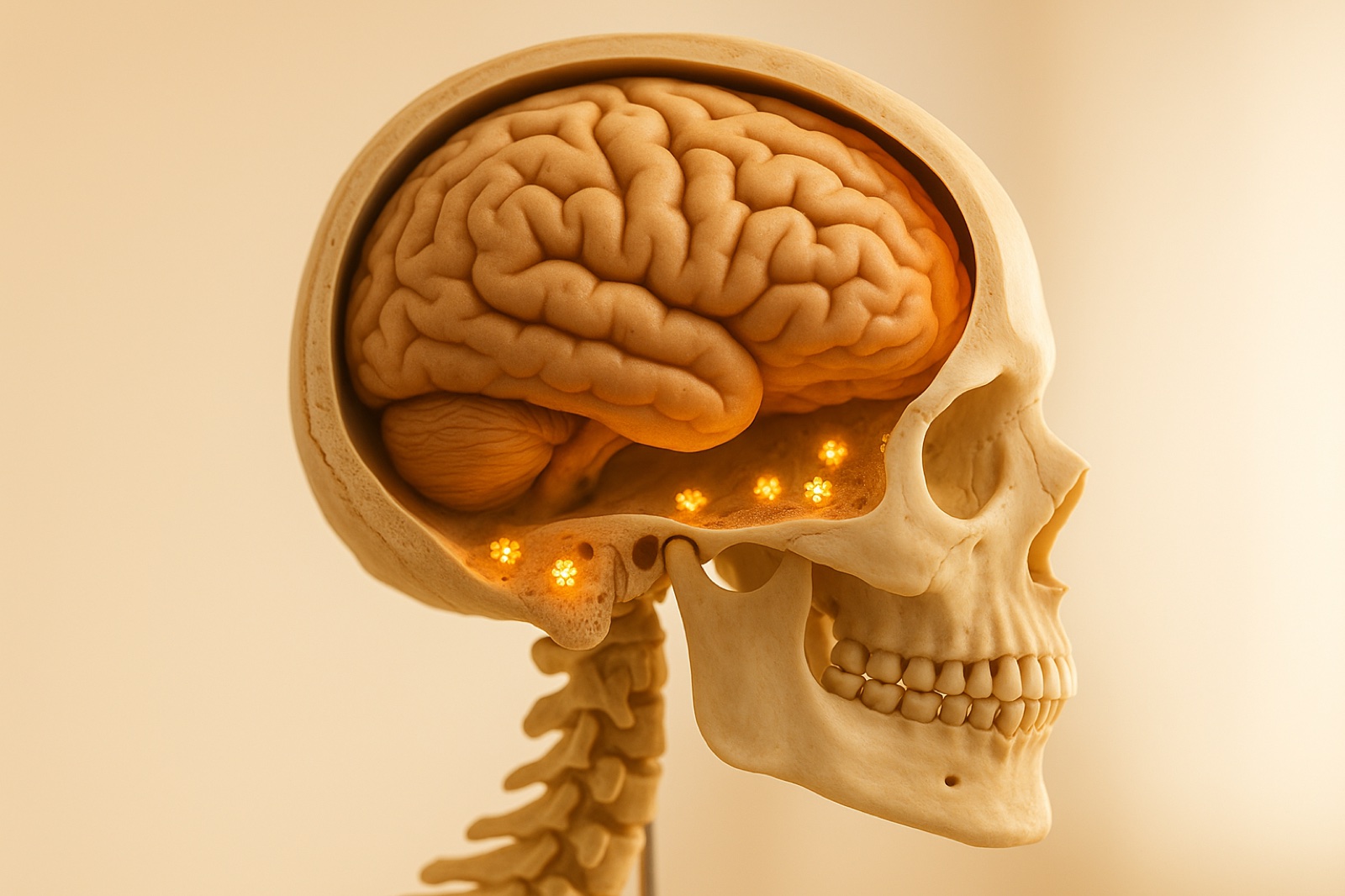
Your brain sits inside a hard box of bone. For most of the last century, that box was treated like a wall, and not much more. Scientists now say part of it works like a guard post. A team at Washington University School of Medicine in St. Louis has found what they call an immune organ in the skull: small, lymph-node-like hubs tucked inside the skull’s bone marrow, right next to the brain.
In mice with brain cancer, those hubs reacted first. They got moving before the body’s regular lymph nodes, farther away, had even picked up the signal that something was wrong.
The study was published in Nature on August 19, 2026. Here is what was actually found, what it does not prove yet, and why the most interesting part may be where the defenders were sitting.
What Is the Immune Organ in the Skull?
Bone marrow is the soft tissue inside your bones. It is where new blood cells are made. That part is not news.
What is new is what the researchers saw inside the marrow of the skull. They found clusters that look and act like small lymph nodes. Lymph nodes are the body’s meeting rooms for the immune system. They are the places where immune cells gather, compare notes on a threat and plan the attack. You have hundreds of them, in places like your neck, armpits and belly.
These new clusters hold a kind of helper cell, called a T follicular helper cell, whose job is to coach other immune cells (B cells) into making antibodies. In plain words: the skull hubs are not just storage. They are places where a defense gets organized.
“We have never seen such structures in healthy bone marrow before,” said Jang Hyun Park, the study’s first author. The senior author, Jonathan Kipnis, put it this way: the skull bone marrow “is far more than just a structural framework.”
How the Scientists Knew the Hubs Mattered
Finding something is one thing. Showing it does a job is another. The team did two tests in mice with glioblastoma, a fast-growing brain cancer.
- They switched the hubs off. When the researchers used drugs to disrupt the skull hubs, tumors grew faster and the mice did not live as long. So the hubs were doing real protective work.
- They turned the hubs up. The team put a gel under the scalp, holding a mix of three immune-boosting proteins. A wave of tumor-fighting activity started in the skull hubs first, then showed up later in lymph nodes outside the skull. Mice given the gel rejected tumors better and lived longer than mice that did not get it.
That order matters. The response began near the brain and spread outward, not the other way around.
Why Being Close Changes Everything
Earlier research had already found tiny channels that link the skull’s marrow to the tough covering around the brain, and to the brain tissue itself. Those channels act like a private hallway. Immune cells and cell waste can pass between the brain and the skull marrow without going the long way around through the body.
Put that hallway together with a guard post at the end of it, and you get what the researchers describe as security stations placed closer to the brain than the body places them for other organs.
There is a practical reason this is exciting. Kipnis said future treatments “could access these immune hubs directly through the skull, without major peripheral side effects.” In other words, doctors might one day be able to tune the brain’s defenses without stirring up the immune system everywhere else. He named Alzheimer’s disease, Parkinson’s disease, schizophrenia and long COVID as conditions with an immune side where this could matter.
If you have read about the body’s alarm doing more damage than the injury in some aging diseases, you can see why a local, aimed response is so appealing. A defense that is close and precise can do less harm than one that floods the whole body.
The Same Lab Has Done This Before
Here is the detail that is easy to miss. This is not the first time Kipnis’s group has poked a hole in the idea that the brain is sealed off.
For a long time, textbooks taught that the brain was “immune privileged,” kept mostly apart from the body’s defense system. In 2015, Kipnis’s lab, then at the University of Virginia, reported lymphatic vessels in the membranes that wrap the brain, vessels many experts had assumed were not there. It was a big shift in how scientists pictured the brain.
The skull hubs push the same story one step further. First, a drain that nobody expected. Now, a guard post that nobody expected, sitting in the bone. The brain, it turns out, was never as alone as we thought.
What This Study Does Not Show Yet
It is important to be exact here, because headlines about cancer can run ahead of the science.
- The main results are in mice. The tumor tests, the switching-off test and the gel treatment were all done in mice.
- The human evidence is early. The team found signs of similar immune cells in human skull bone marrow. That is a promising clue, not proof that the hubs work the same way in people.
- There is no new human treatment yet. The scalp gel is a research tool in animals. Nobody should read this as a cure for brain cancer.
What it does show is a new place to look, and a new way to think about how the brain is protected.
Help That Was Already There
There is something quietly moving in the picture this study paints. We tend to imagine help as something that has to be called. Something far off that must be sent for, and that arrives late. The brain’s regular lymph nodes work a bit like that. The message has to travel. The response takes time.
The skull hubs are different. They were not sent for. They were already stationed right beside the thing they guard, in the bone we thought was only a wall.
People of faith have described God in that same shape for thousands of years. Not a rescuer on the way. A help that is already present, close enough to move first, in the very places we assumed were just walls around us.
You do not have to believe that to find the science beautiful. But it is worth noticing how often the closer we look, the less alone anything turns out to be. Even the part of you that thinks, sealed in bone, has company.
If this kind of hidden design interests you, you might also like the story of the body’s switch for turning inflammation off, another case where the body turned out to be doing more on its own than anyone guessed.
Discussion Question
The brain’s nearest defenders were hiding in plain sight, inside bone scientists had studied for centuries. What do you think is the next “just structure” part of the body that will turn out to be doing a job? Share your guess in the comments.
Share This
Post 1: I always thought the skull was just a helmet. Turns out its bone marrow holds tiny immune “guard posts” that respond to brain cancer before the rest of the body even knows (in mice, so far). Wild. https://bgodinspired.com/?p=115887
Post 2: The detail that got me: the help wasn’t sent for. It was already sitting right next to the brain. A new Nature study on the immune organ in the skull, explained simply: https://bgodinspired.com/?p=115887
Post 3: Ten years ago this lab found drainage vessels around the brain that textbooks said didn’t exist. Now they found defenders living in the skull bone. The brain keeps turning out to be less alone than we thought. https://bgodinspired.com/?p=115887
Questions People Ask
What is the immune organ found in the skull?
Researchers at Washington University School of Medicine in St. Louis found lymph-node-like structures inside the bone marrow of the skull in mice, reported in Nature in August 2026. The structures contain T follicular helper cells, which help B cells make antibodies. They sit right next to the brain and act as a nearby hub where immune responses to brain threats get organized.
Does the skull’s bone marrow help fight brain cancer?
In mice, yes. In mice with glioblastoma, immune responses began in the skull’s bone marrow hubs before they appeared in lymph nodes farther away. When the researchers disrupted the hubs with drugs, tumors grew faster and survival dropped. This has not yet been shown in people.
Have these skull immune hubs been found in humans?
The Washington University team reported evidence of similar immune cells in human skull bone marrow. That suggests people may have something comparable, but the research has not yet shown that these hubs function in humans the way they do in mice.
Is there a new brain cancer treatment from this skull study?
Not for people yet. In mice, a gel placed under the scalp containing three immune-boosting proteins triggered a tumor-fighting response that started in the skull hubs, and treated mice rejected tumors better and lived longer. The researchers hope the skull could one day offer a route to treat brain diseases with fewer side effects elsewhere in the body, but that remains future work.
How does skull bone marrow connect to the brain?
Earlier studies found tiny physical channels that link the skull’s bone marrow to the dura, the tough membrane around the brain, and to brain tissue. These channels let immune cells and cellular waste move between the brain and the skull marrow directly, which is part of why a defense hub in the skull can respond to the brain so quickly.
Source: Washington University School of Medicine in St. Louis, “Newly found ‘immune organ’ inside skull directs brain defense,” on the Nature study “Functional role of skull lymphoid structures in CNS immunosurveillance” (Park, Kipnis et al., 2026). Read the university’s release.