 0
0
 0
0
You already know this verse. That is the strange thing about it.
Psalm 23 is the one people say out loud at funerals, in hospital corridors, at gravesides, in rooms where nobody knows what else to say. Plenty of people who have never opened a Bible can still get through the first line from memory. It has been read over soldiers, over grandmothers, and over babies who did not come home.
And because we know it that well, most of us have never actually read it slowly.
Especially the first verse. Psalm 23:1 is nine English words, and then a full stop.
“The LORD is my shepherd; I shall not want.” — Psalm 23:1
In Hebrew, after the short line that says it is a psalm of David, it is only four words. And two of those four are “not” and “lack.”
That is worth slowing down for, because the promise hiding in there is smaller than the one most of us have been hanging on it. Smaller, and much harder to break.
What “I Shall Not Want” Actually Means
Start with the word that trips everybody, because it has quietly changed meaning since 1611.
When the King James translators wrote “want,” they did not mean desire. They meant lack. To be “in want” was to be short of something you needed. You can still hear that older sense in phrases like “a want of food,” or in saying someone was “found wanting.”
So the verse is not promising that you will stop wanting things. It is not saying desire goes quiet. It is saying something much plainer: I will not go short.
The Hebrew points the same way. The verb here comes from a root that simply means to lack, or to be without. A standard Jewish English translation renders the whole line: “God is my shepherd; I lack nothing.”
That is a narrower claim than the one this verse usually gets asked to carry. People reach for it expecting a guarantee of abundance, and then feel quietly betrayed when life does not hand it over. But abundance was never the word. The word was lack.
And as it turns out, the man who wrote it knew exactly how narrow he was being.
David Had Actually Done the Job
Here is the part that usually gets skipped, and it changes everything underneath the verse.
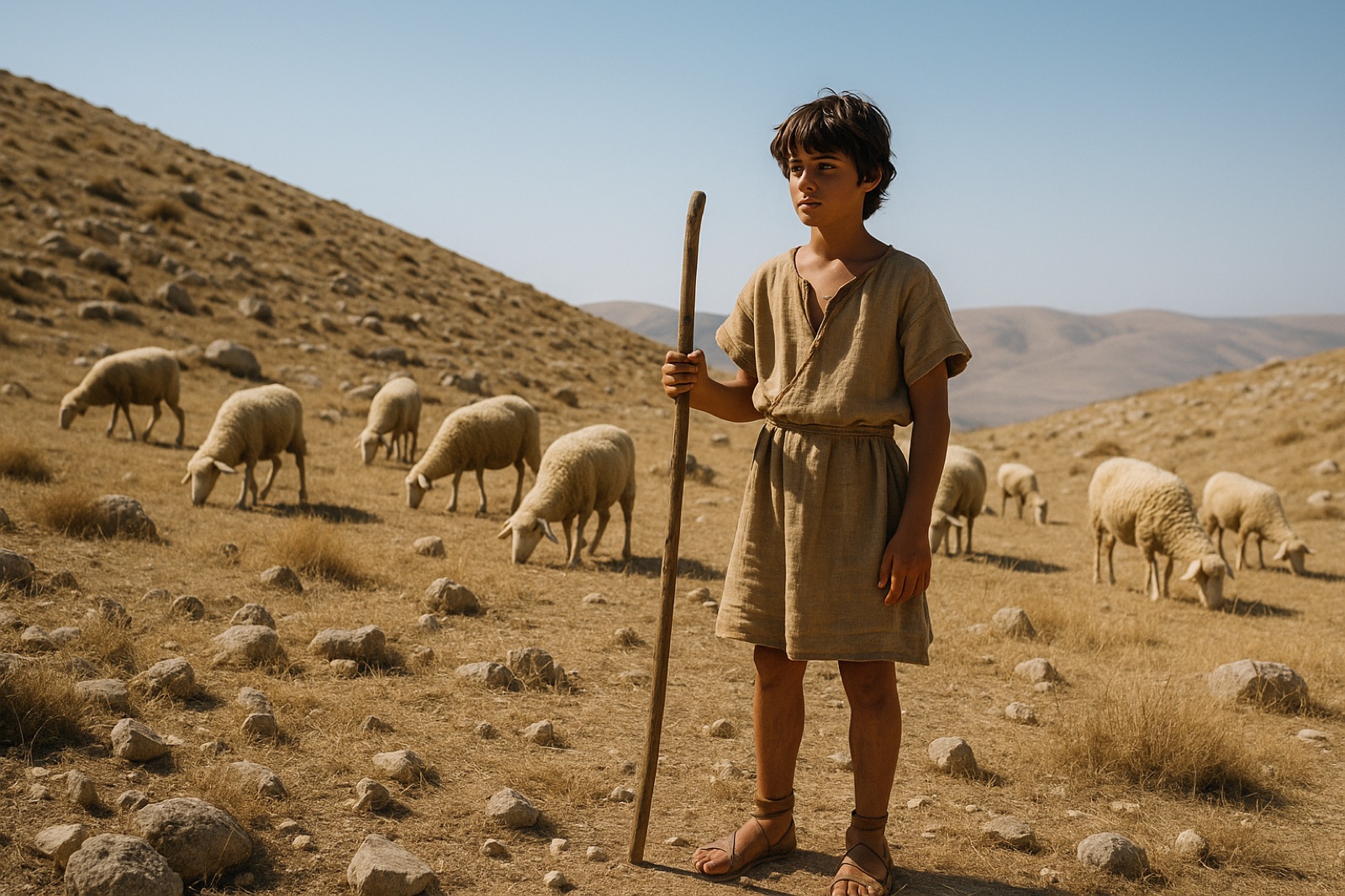
David was not writing about shepherds from a distance. He had been one.
When the prophet Samuel came to Bethlehem looking for a king, David was not even in the house. His father had to send for him.
“And Samuel said unto Jesse, Are here all thy children? And he said, There remaineth yet the youngest, and, behold, he keepeth the sheep.” — 1 Samuel 16:11
The youngest. Out with the animals. Not important enough to call in for the meeting.
And the work was not gentle. Years later, standing in front of King Saul and arguing that he was fit to fight Goliath, David described the job in his own words:
“Thy servant kept his father’s sheep, and there came a lion, and a bear, and took a lamb out of the flock: And I went out after him, and smote him, and delivered it out of his mouth.” — 1 Samuel 17:34-35
Read that again slowly. A lion took one lamb, and the boy went into the lion’s mouth after it.
That is David’s own picture of a shepherd. Not someone dozing under a tree while the sheep sort themselves out. Someone who goes after one animal, into the teeth of the thing that took it, and carries it back.
It is the same shape Jesus reached for centuries later in the parable of the lost sheep, where the sheep never finds its own way home and has to be carried.
Then God Gave Him the Same Job, With People
David did not stay in the field. He became king of Israel. And the Bible describes that promotion using the very same word.
“And the LORD said to thee, Thou shalt feed my people Israel, and thou shalt be a captain over Israel.” — 2 Samuel 5:2
“Feed” there is shepherd language. Psalm 78 says it without leaving any room for doubt:
“He chose David also his servant, and took him from the sheepfolds: From following the ewes great with young he brought him to feed Jacob his people, and Israel his inheritance.” — Psalm 78:70-71
From the sheepfolds to the throne. Same job description. Much bigger flock.
That was not a poetic flourish in the ancient world. Shepherd was simply what rulers were called. When God later brings charges against the leaders of Israel through the prophet Ezekiel, the word used for them is shepherds:
“Son of man, prophesy against the shepherds of Israel … Woe be to the shepherds of Israel that do feed themselves! should not the shepherds feed the flocks?” — Ezekiel 34:2
Kings were shepherds. Bad kings were bad shepherds. Everyone hearing it understood exactly what was meant.
The Turn: The King Wrote Himself Down as a Sheep
Now put the two halves together and read that first line one more time.
David is the one person in Scripture who held both ends of that word. He had done it with actual animals, in the dark, against a lion. And then he had done it with a nation, which is harder and far less forgiving.
He knew exactly what a shepherd owes. He also knew exactly what a sheep gets.
And what he writes is: The LORD is my shepherd.
The king puts himself back on the other side of it. Not as a polite gesture of humility. As a conclusion. This is the one man qualified to audit the job, and after working it twice, he hands the title upward and takes the place of the animal.
Which tells you what kind of promise the second half is.
A shepherd cannot promise a flock a feast. Grass is seasonal, water moves, and some days the walk is long and dusty and there is nothing much at the end of it. What a shepherd can promise is narrower and far more useful: there will be enough, I will be the one who goes and finds it, and I am not leaving.
That is why the line is written in the negative. David does not say “I shall have everything.” He says “I shall not lack.” He is naming a floor, not a ceiling.
“I shall not want” is a floor, not a ceiling. It promises a bottom you cannot fall through.
And a floor is the thing you can actually stand on when life is hard. A ceiling is only good news when things are already going well.
Look at where the rest of the psalm goes and you can see it was built that way on purpose. The green pastures in verse 2 are somewhere the shepherd leads you, which quietly admits you were not there yet. And by verse 4 the road runs straight through the worst place in the poem.
“Yea, though I walk through the valley of the shadow of death, I will fear no evil: for thou art with me.” — Psalm 23:4
The psalm never claims you will be spared the valley. It claims you will not be alone in it. That is the same promise as verse 1, said a second way.
A good place to start: The Beginner’s Guide to Feeling God’s Presence Every Day. It walks you through a simple daily rhythm for noticing God in ordinary moments, the kind this psalm is actually describing. Get the free guide. Free.
What This Changes on an Ordinary Day
Most of us test this verse against the wrong question. We ask: did I get what I wanted? And when the answer is no, the verse feels like it quietly failed.
But that was never the claim. The claim is about lack, not longing.
Which means the honest way to read your own life against Psalm 23:1 is not “do I have everything I hoped for” but “have I been left short.” Those are different questions, and they very often have different answers. Most of us have gone without plenty of things we wanted. Far fewer of us can point to a day when nothing at all was provided.
This is the same rhythm Jesus built into the prayer He taught, where the request is for bread for today rather than supplies for the year. Enough, arriving on time, is the pattern. It is not a lesser promise. It is just a daily one.
And if the way this shows up for you is lying awake trying to carry a whole week at once, there is a slower look at that worth sitting with on a bad evening.
Three Things to Do With This Today
Not a programme. Three things you could genuinely do in the next ten minutes, easiest first.
- Say it with the word swapped. Read the verse out loud as “The LORD is my shepherd; I shall not lack.” Thirty seconds. Hearing it in today’s English once is usually enough to stop your ear sliding past it forever.
- Write two short lists. On one side, what you want right now. On the other, what you actually lack right now, today. Look at how different the lists are. That gap is the whole verse.
- Name one thing you have not gone short of. Something from today, not from your whole life. Food, water, a roof tonight, one person who picked up. Say thank you out loud for that one thing, by name. Out loud matters more than it sounds like it should.
To Sit With Later
- When you say this verse, who do you picture yourself as in it — the sheep, or someone standing beside the shepherd watching? Be honest about which one, and about why.
- What is one thing you have wanted for a long time and not received? And separately: in that same stretch of time, what did arrive?
- David had done the shepherd’s job before he trusted one. What would it take for you to trust someone with something you normally handle yourself?
A Prayer
God, I have said this verse a hundred times without ever really hearing it. I think I have been asking You for a ceiling when You were offering me a floor, and then feeling let down when the ceiling never came. Help me see the difference today. Help me notice what has actually been provided instead of only what is still missing, and help me believe that enough, arriving on time, is not a smaller kind of care. I am taking the sheep’s place here, because I am tired of pretending I can find the grass myself. Amen.
A Question Worth Sitting With
Do you think “I shall not want” was meant as a statement of fact about David’s life, or as a decision he was making about how to read it — and does that change how much weight the verse can carry? Leave a comment and tell us where you land.
Share This
- “I shall not want” doesn’t mean you’ll stop wanting things. In 1611 “want” meant lack. The verse promises a floor, not a ceiling — and a floor is what you can stand on when life is hard.
- David had been a shepherd with real sheep, and then God made him shepherd of a nation. He knew exactly what the job cost. And in Psalm 23 the king writes himself down as the sheep.
- In Hebrew, Psalm 23:1 is four words. Two of them are “not” and “lack.” The most quoted promise about God’s care is stated in the negative, and that is exactly why it holds.
Questions People Ask About Psalm 23:1
What does “I shall not want” mean in Psalm 23:1?
In the English of 1611, when the King James Version was translated, “want” meant to lack or to be short of something needed, not to desire. Psalm 23:1 is therefore saying “I will not go short,” rather than “I will stop wanting things.” The Hebrew verb comes from a root meaning to lack or be without, and a standard Jewish English translation renders the line “I lack nothing.”
Who wrote Psalm 23 and was he really a shepherd?
Psalm 23 is attributed to David. He had genuinely worked as a shepherd before becoming king: 1 Samuel 16:11 places him out keeping the sheep when the prophet Samuel arrives at his family’s house, and in 1 Samuel 17:34-35 David describes rescuing a lamb from a lion and a bear while doing that job.
Why is “shepherd” used for God in the Bible?
In the ancient Near East, shepherd was a standard title for a ruler, not only a description of someone who kept animals. The Bible uses it that way directly: 2 Samuel 5:2 describes David being made king with the words “Thou shalt feed my people Israel,” and Ezekiel 34:2 addresses the leaders of Israel as “the shepherds of Israel.” Calling God a shepherd was a claim about authority and responsibility, not only about gentleness.
Does Psalm 23:1 promise that Christians will be wealthy?
No. The verse makes a claim about not lacking, which is a different and much narrower claim than having abundance. The psalm itself does not promise an easy life: Psalm 23:4 describes walking “through the valley of the shadow of death,” and the comfort offered there is companionship rather than escape.
How many words is Psalm 23:1 in Hebrew?
After the opening superscription identifying it as a psalm of David, the verse itself is four Hebrew words. Two of those words make up the phrase translated “I shall not want,” which is expressed in the negative — a statement about what will not happen rather than a promise of what will be given.