 0
0
 0
0
You can be standing in the middle of a packed room — a family reunion, a church lobby after the service, a break room at work — and still feel completely unseen. Feeling invisible in a room full of people isn’t about being alone. It’s about being surrounded and still somehow overlooked, like everyone else got a name tag and you didn’t. If that feeling has a familiar weight to it, there’s a man in the Bible who knew it better than almost anyone — and what happened to him is the whole reason this feeling doesn’t get the last word.
The Man Nobody Wanted to Look At
His name was Zacchaeus, and he lived in Jericho, and everybody in that town had a reason to avoid making eye contact with him. He wasn’t just a tax collector — he was the chief tax collector, which meant he didn’t just take money from his own neighbors on behalf of Rome, he oversaw other men who did the same. He got rich doing it. Under that system, skimming extra off the top wasn’t just tolerated, it was basically the business model. So when Luke 19 introduces him, it does it with a loaded word: he was “chief among the publicans, and he was rich” (Luke 19:2). To everyone standing around him, that sentence wasn’t a compliment. It was a verdict.
Add to that one more detail Luke doesn’t skip over: Zacchaeus “was little of stature” (Luke 19:3). He was short. In a culture with no microphones and no elevated stages, that meant something very practical — when a crowd gathered, he was physically stuck behind it, unable to see over the shoulders in front of him. He was excluded twice over. Morally, by a town that had already decided who he was. Physically, by his own body, in a crowd that wasn’t going to make room for a man like him.
He Climbed a Tree Just to Get a Glimpse
Jesus was passing through Jericho, and word of him had clearly reached Zacchaeus, because Luke says he “sought to see Jesus who he was” (Luke 19:3). Not to be seen — just to see. He wasn’t angling for an encounter. He wanted a look, from a safe distance, the way you might watch someone you admire from across a room without ever expecting them to notice you’re there.
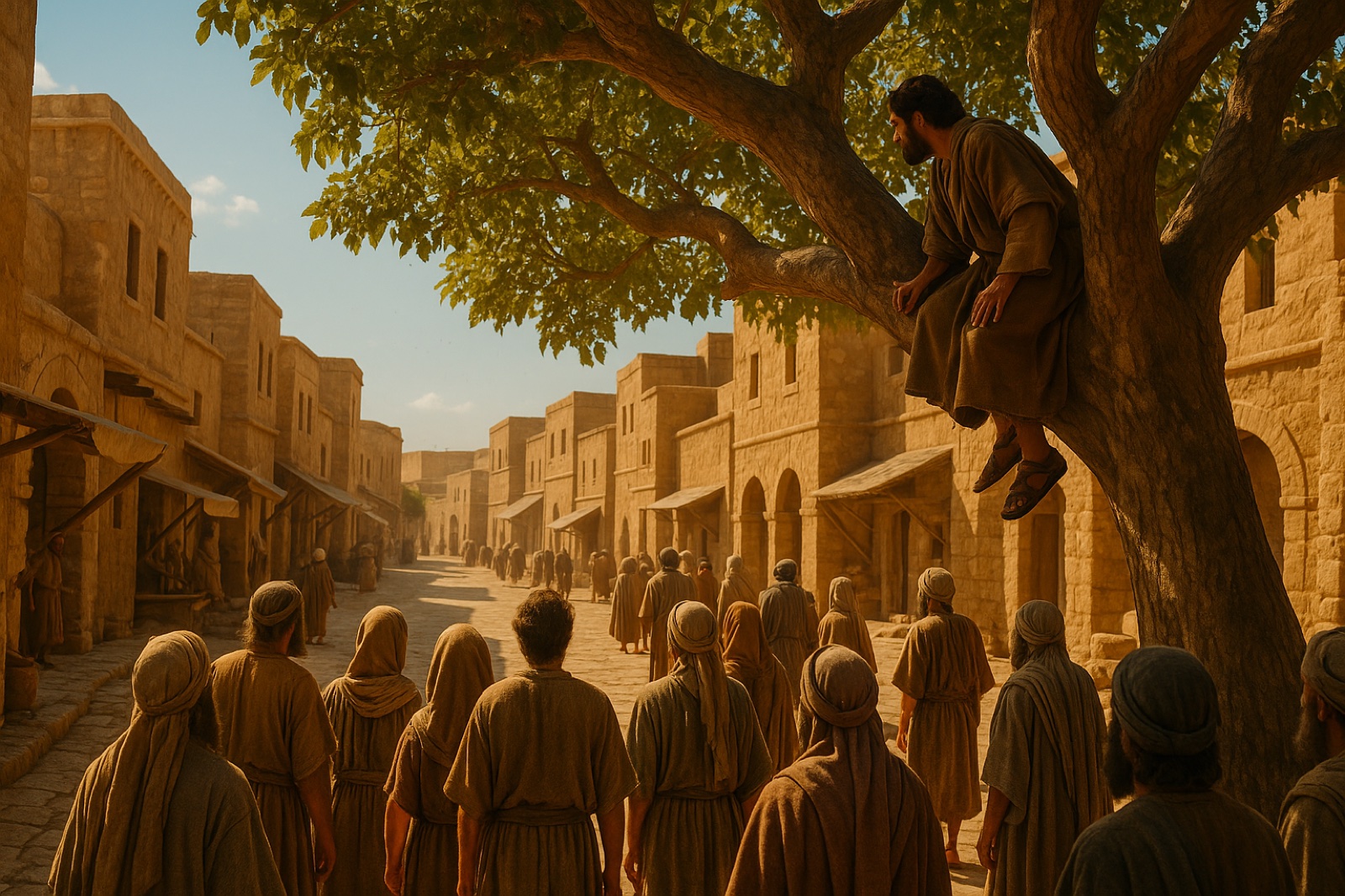
So he ran ahead of the crowd and climbed a sycamore tree along the road Jesus was going to walk (Luke 19:4). Picture that for a second: a wealthy, powerful, grown man, hiking up his robes to scramble into a tree like a kid, in front of the very town that already looked down on him. That’s not dignified. That’s desperate. It’s the kind of thing you only do when the ache to be near something real outweighs your fear of looking foolish trying to get there.
Then Jesus Stopped — and Said His Name
This is the moment the whole story turns on. Luke writes: “And when Jesus came to the place, he looked up, and saw him, and said unto him, Zacchaeus, make haste, and come down; for to day I must abide at thy house” (Luke 19:5).
Stop there. Jesus didn’t just glance up and notice a man in a tree. He said a name — his name. Nobody had told Jesus who this man was. There was no introduction, no whispered explanation from a disciple. Jesus stopped a moving crowd, in the middle of a busy road, to speak directly to the one person everyone else had already filed under “not worth my time.” And he didn’t just acknowledge him. He invited himself into his house — the single greatest social honor you could extend to someone in that culture, offered to the one man in town nobody else wanted at their table.
The crowd’s reaction tells you everything about how surprising this was. Luke says “they all murmured, saying, That he was gone to be guest with a man that sinneth” (Luke 19:7). The crowd wasn’t confused about who Zacchaeus was. They knew exactly who he was. That’s precisely why Jesus stopping for him didn’t make sense to them — and precisely why it mattered.
Being Overlooked and Being Unseen Are Not the Same Thing
Here’s the part that’s easy to miss on a fast read: Zacchaeus climbed that tree expecting to watch, not to be watched. He’d made peace with being background scenery in his own town. And then the one person whose opinion he never dared to hope for stopped everything, looked directly up into the branches, and called him by name in front of everyone.
That’s the thing about feeling invisible in a crowd — it convinces you that being unnoticed by people means being unknown by God. It doesn’t. This story, like the one about Hagar in the wilderness discovering God as “the One who sees me”, keeps showing up in Scripture for a reason: the God who made you has never once lost track of you, even in the moments a crowded room makes you feel like furniture.
You don’t have to be visibly rejected to feel this way. Plenty of people who feel invisible aren’t outcasts like Zacchaeus was — they’re simply tired, or quiet, or new, or grieving, or just standing in a room where everyone already seems to know each other. If you’ve ever read through what the Bible actually says about loneliness, you already know this ache isn’t rare and it isn’t shameful. It’s just human. And it’s exactly the kind of moment Jesus keeps interrupting.
What This Means for You Today
Notice what Jesus didn’t do. He didn’t wait for Zacchaeus to climb down and introduce himself. He didn’t require him to clean up his reputation first, or prove he deserved the attention. Jesus moved first — “for to day I must abide at thy house” isn’t a request, it’s a decision Jesus had already made before Zacchaeus said a word. That’s the pattern: God pursues, and the invitation lands before you’ve earned it.
And the ending matters just as much as the middle. Zacchaeus didn’t just get noticed — he got changed. He stood up and told the Lord, “the half of my goods I give to the poor; and if I have taken any thing from any man by false accusation, I restore him fourfold” (Luke 19:8). Being seen and named by Jesus didn’t just make him feel better. It made him a different man. Jesus summed up exactly why he’d stopped that day: “For the Son of man is come to seek and to save that which was lost” (Luke 19:10). Not “the visibly repentant.” Not “the socially acceptable.” The lost — which, on any given day, includes anyone sitting in a crowd feeling like nobody would notice if they slipped out the back.
If part of what makes you feel invisible is a quieter question underneath it — not just “does anyone see me” but “am I even worth seeing” — that’s worth sitting with too. It’s the same question behind what the Bible says about self-worth, and Zacchaeus’s tree is one more piece of the same answer: your worth was never up for a vote from the crowd around you.
Three Things You Can Do Right Now
- Say the sentence out loud, alone, in the next five minutes: “God knows my name, even here.” Not as a performance — just to yourself, in whatever room you’re in right now. Let it interrupt the feeling the way Jesus interrupted the road.
- Text one person today and use their actual name in the first line. “Hey [name], you crossed my mind today.” It takes thirty seconds, and it’s a small way of doing for someone else exactly what Jesus did for Zacchaeus — stopping long enough to notice a specific person, not a general crowd.
- Before you go to sleep tonight, name one specific moment from today when you felt unseen — and hand that exact moment to God in a single honest sentence. Not a vague prayer. The real moment. He already saw it happen.
God, I don’t always know how to say this out loud, but there are rooms I walk into and feel like I disappear. You know the exact moments I mean. Thank you that you’re not waiting for me to prove I’m worth noticing before you notice me. Like you did for Zacchaeus, call me by name today — I want to believe you actually see me, not just the crowd I’m standing in. Amen.
A Question Worth Sitting With
If Jesus stopped a moving crowd just to speak one name out loud, what does that tell you about how He sees the people the rest of us tend to walk past? Who in your own life might be up in a tree right now, hoping somebody stops?
Share This
- “I climbed the tree just to watch. He stopped and called me by name instead.” — Luke 19, and every quiet room I’ve ever stood in.
- Feeling invisible in a crowd doesn’t mean you’re unknown to God. Zacchaeus thought the same thing — right up until Jesus looked up and said his name.
- You don’t have to earn being seen by God. He said the name before you climbed down. #FeelingInvisible #Zacchaeus
Questions People Ask About This Story
Why did Zacchaeus climb a tree to see Jesus?
Zacchaeus was “little of stature” (Luke 19:3) and couldn’t see over the crowd gathered to watch Jesus pass through Jericho, so he ran ahead and climbed a sycamore tree along the road to get a clear view.
Why did the crowd get upset that Jesus went to Zacchaeus’s house?
Zacchaeus was a chief tax collector who had grown wealthy collecting Roman taxes from his own neighbors, a job widely associated with extortion. The crowd murmured because Jesus, a respected teacher, chose to be the guest of someone they considered a sinner (Luke 19:7).
What does it mean that Jesus called Zacchaeus by name?
Nobody introduced Zacchaeus to Jesus before that moment. Jesus speaking his actual name shows a personal, specific knowledge of exactly who was in that tree — not a general awareness of a crowd, but a direct, individual recognition of one overlooked man.
What is the main lesson of the Zacchaeus story?
That Jesus pursues people before they clean themselves up or prove they deserve attention — and that being truly seen by Him tends to change a person from the inside, the way it moved Zacchaeus to repay what he’d taken (Luke 19:8-10).
Is feeling invisible in a crowd a sign something is wrong with me?
No. It’s an extremely common experience, not a character flaw or a sign of spiritual failure. Scripture treats it as real and worth naming rather than something to feel ashamed of.