 0
0
 0
0
Four Men, One Mat, and a Roof That Belonged to Somebody
There is a person you have been carrying. Not for a season — for years. You have prayed the same prayer so many times it has worn smooth, nothing about them has moved, and somewhere in there you quietly started wondering whether any of it registers anywhere.
Mark 2 has a line in it for exactly that. When Jesus saw their faith, Mark writes — and the small word in the middle of that phrase is doing far more work than most people notice.
When Jesus Saw Their Faith, the Greek Word Was Plural
The setting is Capernaum, in a house. Mark had last placed Jesus in the home of Simon and Andrew (Mark 1:29), and the house in this scene is generally taken to be the same one. By the time the four men arrive, it is sealed: “And straightway many were gathered together, insomuch that there was no room to receive them, no, not so much as about the door” (Mark 2:2).
Then the detail Mark drops in and walks straight past: “And they come unto him, bringing one sick of the palsy, which was borne of four” (Mark 2:3).
Four men. Named by number, never by name.
What comes after the digging is the verse everyone quotes: “When Jesus saw their faith, he said unto the sick of the palsy, Son, thy sins be forgiven thee” (Mark 2:5). In the Greek, that “their” is autōn, a genitive plural. Faith with more than one owner.
It is worth being careful here, because the point gets pushed too far. The plural does not shut the paralysed man out; he was part of the group that came, and the word covers him too. What the plural refuses to do is leave the four out. Whatever the Greek word pistis actually carries, Jesus looked at a group of people and saw it spread across them rather than measured out one at a time.
And then the part that stings a little. They came for a pair of legs. The first words spoken over the man were about something else entirely. Their carrying got him into the room; it did not set the agenda once he was in it. He is healed eventually — “Arise, and take up thy bed, and go thy way into thine house” (Mark 2:11) — but not first, and not on their timetable.
What They Had to Break to Get Him In
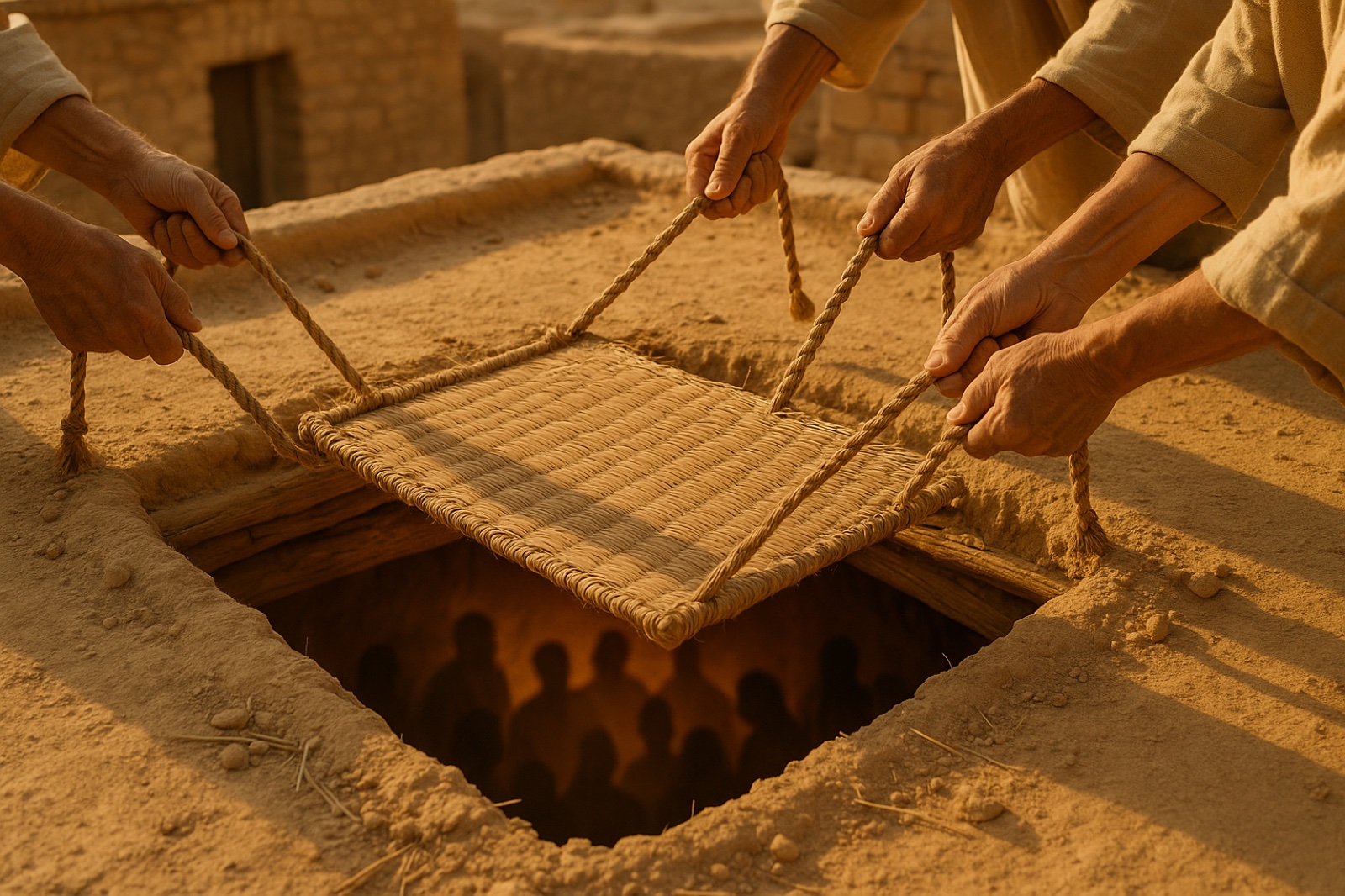
Mark uses two verbs for the roof and both are physical labour. They “uncovered the roof” — apestegasan, literally un-roofed it — and then, in the phrase the King James renders “when they had broken it up,” a participle of exorussō: to dig out, to gouge out (Mark 2:4).
That second verb appears only twice in the entire New Testament. The other time is Paul, reminding the Galatians what their love for him had once looked like: “ye would have plucked out your own eyes, and have given them to me” (Galatians 4:15). Same word. Both times it describes people tearing something out at real cost, for somebody who is not themselves.
A Galilean village roof was not a lid you lifted off. Houses excavated at Capernaum had walls of black basalt carrying wooden beams, with branches, straw and packed earth laid across and rolled flat to shed the winter rain. Diggable, yes. But it had to be dug, and dry earth was falling on the heads of everyone below while a teacher was mid-sentence.
Here is what the passage never mentions: it was somebody’s roof. Mark records no objection, no bill, no apology. Someone had to repair it afterwards, and the account is not interested enough in that to tell us who.
Luke tells the same scene and says they let him down “through the tiling” (Luke 5:19). The two accounts sit a little differently — Mark describes digging, Luke pictures tiles — and it has been read more than one way: some take Luke to be rendering the scene for readers who lived under tiled Greco-Roman roofs, others point out that the Greek word for tile can cover baked clay more generally. It has not been settled, and it does not need to be. Both writers keep the same fact: the way in was closed, and these men made one.
Set out plainly, this is everything the four actually do in the story:
- They carry him, while the crowd is already too thick to walk through (Mark 2:3).
- They fail to get near him “for the press” — and do not turn around (Mark 2:4).
- They go up and dig out the roof above the room where Jesus is.
- They lower the mat, with him still on it, into the middle of a crowded room in front of everybody.
- Then they stop. Nothing else in the passage belongs to them.
That last line is the one to sit with. The four are enormously busy for two verses and then completely absent for eight. They do not answer the scribes who start reasoning in their hearts about blasphemy. They do not tell Jesus which problem to fix. They got a man in front of Jesus and then they had no further say in what happened to him, and the story treats that as the whole of their job.
If you have been carrying someone a long time, that division of labour is either the most freeing thing in this passage or the hardest. Probably both. You are holding ropes. You were never holding the outcome. And the exhaustion that builds up in the person doing the carrying is real enough that it deserves naming out loud rather than treated as a lapse in your faith.
Actions to Take This Week
Write the name of the person you have been carrying on a scrap of paper and keep it in your pocket today, so the prayer has somewhere to land every time your hand finds it.
Ask one other person to carry them alongside you this week, by name, because the faith Mark 2:5 records had more than one owner.
Do one physical thing for them before the week is out — a meal left at the door, a lift given, a bill quietly paid — since what got that man to Jesus was four sets of arms, not four good intentions.
A Prayer for the Person You Keep Carrying
God, I have carried this person so long that I have run out of words for them. I do not know what to ask any more. So I am doing what those four men did — bringing them as close to You as I can get them, and then letting go of the ropes. I do not get to decide what happens in the room. Help me trust that You saw us arrive. Keep me carrying. Amen.
If tonight is one of those nights, there is a longer prayer for healing for someone you love you can borrow when your own words have run out.
Journal Prompts
- Who is the person you keep bringing, and when did you first start carrying them?
- What outcome have you quietly assumed you were carrying them toward — and what would it cost you to stop naming it?
- Who once carried you into a room you could not have reached on your own, and have you ever told them?
- What is the roof in your situation — the thing you would have to break to keep going?
Share This
Mark says Jesus saw their faith. Plural. If you have carried someone for years with nothing to show for it, you are inside that word.
#Mark2 #PrayingForSomeone #FaithThatCarries #BibleStudy #BGodInspired
Q&A: They Dug Through a Roof. Jesus Saw Their Faith.
What does “when Jesus saw their faith” mean in Mark 2:5?
It means Jesus responded to the faith of a group rather than one individual. The Greek word behind “their” is a genitive plural, so the faith Jesus saw belonged to the men who carried the paralysed man as well as to the man himself.
Who carried the paralysed man to Jesus?
Four unnamed men. Mark 2:3 says he “was borne of four,” and that is the only description they are given — no names, no professions, no relationship to the man stated anywhere in the account.
Was the paralysed man’s own faith included in Mark 2:5?
Most likely yes. A plural pronoun covers the whole party that arrived, and he arrived with them. The plural is not there to exclude him; it is there to include the people who did the carrying.
Why does Luke say tiles when Mark says they dug through the roof?
Mark 2:4 uses a verb meaning to dig out, matching the packed-earth roofs of Galilean village houses, while Luke 5:19 says they lowered him “through the tiling.” Readers have explained this either as Luke picturing the scene for an audience used to tiled roofs, or as the Greek word for tile covering baked clay more broadly. The question is not settled.
Does praying for someone else actually change anything for them?
Mark 2:5 shows other people’s faith bringing a man into contact with Jesus, so intercession clearly does something. What the passage does not promise is control over the result — the four decided that he would be in the room, and nothing about what happened once he was there.
You Are Holding the Ropes, Not the Room
The person you have been carrying still has not changed. That was true before you read this and it is true now. What Mark 2 quietly moves is the question — from whether your prayers are working to whether you are still carrying, because the only thing the four men were ever responsible for was getting him close and letting go.
They dug through someone’s roof to do it. Nobody remembers their names. Jesus saw their faith anyway.
Who is the person you have been carrying? Tell us their first name in the comments if you are willing, and someone reading this will carry them with you.
Watch the short version: They Dug Through a Roof. Jesus Saw Their Faith. on YouTube.