 0
0
 0
0
Maybe you typed it late at night. Maybe you only said it inside your head, on the bus, at the sink, lying awake. I don’t know what to do with my life.
Everyone has advice for that sentence. Make a list. Take a personality test. Follow your passion. Gather more information and the answer will come.
But here is something most people have never been told. That sentence is already in the Bible, almost word for word. A king prayed it out loud, in front of everyone he was responsible for. And the Bible does not treat it as a failure of faith. It treats it as the moment everything starts to turn.
A King Who Didn’t Know What to Do
The king’s name was Jehoshaphat. He ruled Judah, a small kingdom, and he was by most measures a good king. Then one day a messenger ran in with news.
“There cometh a great multitude against thee from beyond the sea on this side Syria” (2 Chronicles 20:2, KJV). Moab, Ammon and others with them were already on the march. They were not far away anymore. They were at En-gedi, a spring on the shore of the Dead Sea.
Now look at how the Bible describes the king’s first reaction. It does not say he was calm. It does not say he had a plan. It says this:
“And Jehoshaphat feared, and set himself to seek the LORD, and proclaimed a fast throughout all Judah.” (2 Chronicles 20:3, KJV)
Jehoshaphat feared. Three words, stated plainly. The Bible lets a good king be afraid, and does not stop to scold him for it. If fear is where you are starting today, you are in good company.
Notice what he did with the fear, though. He did not hide it and he did not let it make the decision. He turned toward God, and he called everyone else to do the same.
The Prayer That Said “I Don’t Know”
The people gathered at the temple in Jerusalem, and the king stood up in front of them all and prayed. Most of his prayer is not about the problem at all. He starts somewhere else.
“O LORD God of our fathers, art not thou God in heaven? and rulest not thou over all the kingdoms of the heathen? and in thine hand is there not power and might, so that none is able to withstand thee?” (2 Chronicles 20:6, KJV)
He keeps going like that. He remembers what God had already done for them. He reminds himself of a promise: when trouble comes, “we stand before this house, and in thy presence… and cry unto thee in our affliction, then thou wilt hear and help” (2 Chronicles 20:9, KJV).
Only after all of that does he get to the most honest line in the whole chapter:
“O our God, wilt thou not judge them? for we have no might against this great company that cometh against us; neither know we what to do: but our eyes are upon thee.” (2 Chronicles 20:12, KJV)
Neither know we what to do. A king, in public, with the whole nation listening, said: I have no plan.
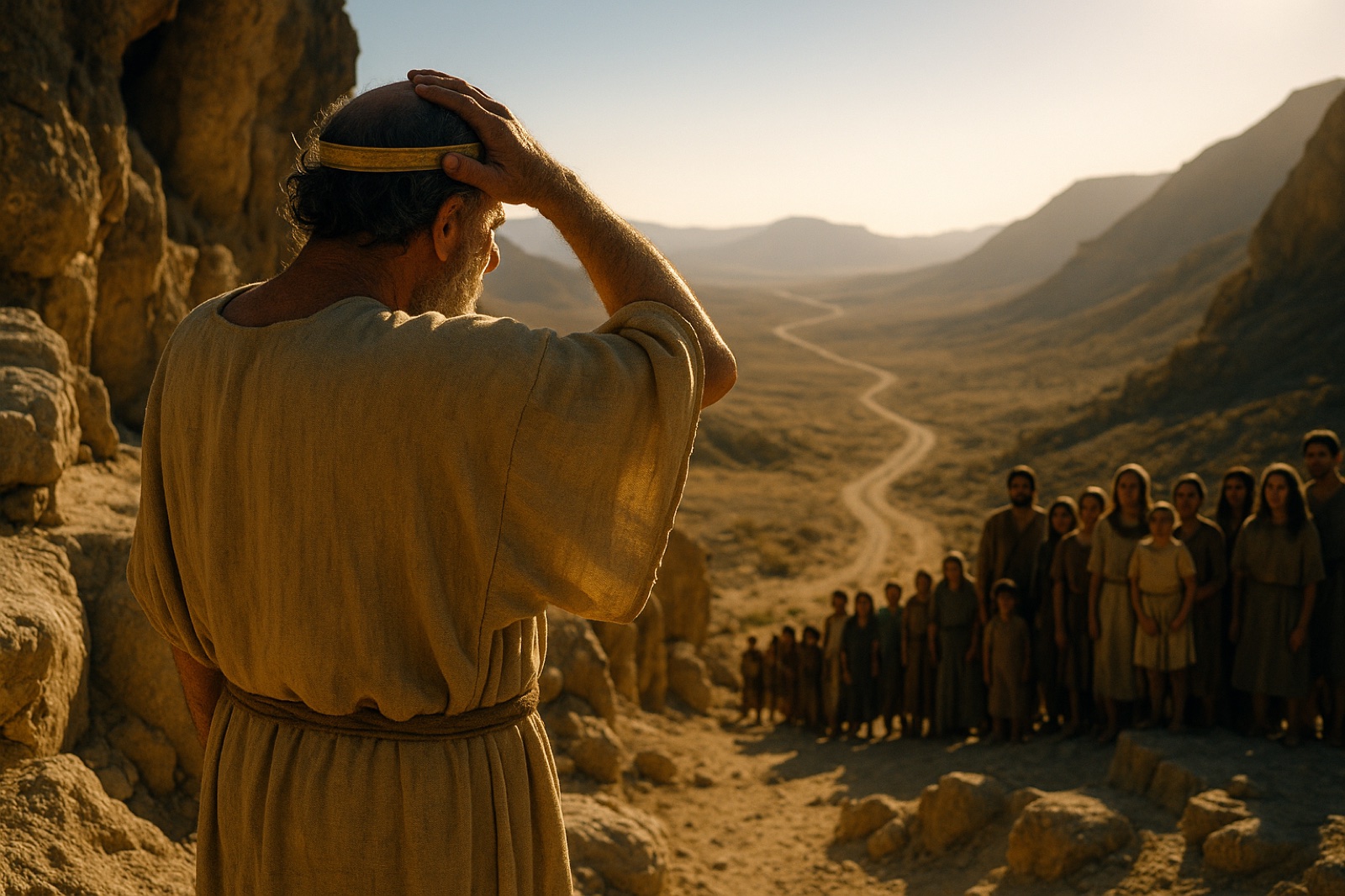
Then the Bible adds a detail that is easy to read past. “And all Judah stood before the LORD, with their little ones, their wives, and their children” (2 Chronicles 20:13, KJV). Whole families. Kids too. Nobody in that crowd had the answer. They just stood there, together, waiting.
What Came Back Wasn’t a Life Plan
Here is where many people remember the story a little wrong. The famous line is “stand still,” so it is easy to think God’s answer was simply: do nothing, and it will all work out.
Read what actually came back. A Levite named Jahaziel, right there “in the midst of the congregation” (2 Chronicles 20:14, KJV), began to speak. First, comfort: “Be not afraid nor dismayed by reason of this great multitude; for the battle is not yours, but God’s” (2 Chronicles 20:15, KJV).
Then, directions. Very specific ones:
“To morrow go ye down against them: behold, they come up by the cliff of Ziz; and ye shall find them at the end of the brook, before the wilderness of Jeruel.” (2 Chronicles 20:16, KJV)
Tomorrow. Go down. By the cliff. At the end of the brook. That is not a five-year plan. It is not even a battle plan. It is one day’s road, with landmarks.
And the famous “stand still”? Look at where it was supposed to happen: “set yourselves, stand ye still, and see the salvation of the LORD with you… to morrow go out against them” (2 Chronicles 20:17, KJV). They had to walk out into the wilderness to stand still there. Standing still was something they did on the road, not instead of it.
So they did. “They rose early in the morning, and went forth into the wilderness of Tekoa” (2 Chronicles 20:20, KJV). The king even “consulted with the people” before they set out (2 Chronicles 20:21, KJV). Not knowing did not mean he stopped asking other people. It just meant he stopped pretending he had the whole answer on his own.
The ending is almost hard to believe. They sent singers out in front, and “when they began to sing and to praise,” the invading armies were defeated before Judah ever lifted a sword (2 Chronicles 20:22, KJV). Afterward the people were three days gathering up what was left behind, “it was so much” (2 Chronicles 20:25, KJV).
What to Do When You Don’t Know What to Do With Your Life
This is the part I never noticed until I slowed down on this chapter. The king did not know what to do. But he was not empty-handed. He knew some things, and he said them first.
He knew who God was. He knew what God had done before. He knew where to look: “our eyes are upon thee.” What he did not know was the plan.
That is a very different kind of not knowing. It is not “I know nothing.” It is “I know who I’m trusting, I just don’t know the steps yet.”
And look at what the answer was when it came. Not the whole map. Just tomorrow. A cliff, a brook, a direction to walk.
Maybe that is what “I don’t know what to do with my life” is really asking for, and why it feels so heavy. We want the whole life. The whole path. The job, the person, the city, the ten years ahead, all settled before we move.
The Bible’s answer in this chapter is gentler than that. You do not have to know what to do with your whole life. You may only need to know what to do with tomorrow morning. And you are allowed to say out loud, to God and to people you trust, that you do not know the rest yet.
If this question keeps you up at night, you might also find it helpful to read why “I feel like I wasted my life” shows up at 18, 25 and 35 alike. And if you want a gentle place to start sorting out what matters to you, our free What Is My Purpose? assessment takes a few minutes and ends with a real next step, not a label.
When the question is “which way?”, it also helps to know what the Bible means by discernment. Solomon, famously, asked God for a hearing heart, not a sharper mind.
Or as James puts it: “If any of you lack wisdom, let him ask of God, that giveth to all men liberally, and upbraideth not; and it shall be given him” (James 1:5, KJV). Upbraideth not means God does not scold you for asking. Not knowing is not a sin. It is an invitation to ask.
Actions to Take Today
- Say the sentence out loud, once. Try the king’s words in your own voice: “I don’t know what to do, but my eyes are on You.” It takes ten seconds. Saying it plainly often loosens the knot of pretending you should already know.
- Write down three things you DO know. Before you worry about the plan, do what the king did first. On paper or your phone, write three things you are sure of. Something true about God. Something God has already brought you through. One person who is on your side.
- Name tomorrow’s “cliff of Ziz.” Not your whole life. Just one small, real step for tomorrow morning. Send one message. Ask one person for advice. Look up one course, one job, one church, one conversation. Write it down, and let that be enough for now.
Journaling Prompts
- When you say “I don’t know what to do with my life,” which part of your life are you really thinking about? Name it as specifically as you can.
- What are you afraid will happen if you take a step before you are sure? Where did that fear come from?
- Who is standing in the crowd with you right now, even if they don’t have the answer either?
“You don’t need the map for your whole life. You need tomorrow’s road.”
A Prayer for When You Don’t Know What to Do
God, I don’t know what to do. I’ve been trying to act like I do, and I’m tired. I don’t have the plan, but I know You are still God, and You have carried me before. My eyes are on You. Please show me just tomorrow’s step, and give me enough courage to take it.
Discussion Question
Why do you think it is so hard for people, even people of faith, to admit out loud that they don’t know what to do? Tell us what you think in the comments. We read every one.
Share This
- “Neither know we what to do: but our eyes are upon thee.” A king prayed that with three armies coming. Turns out not knowing is allowed. #faith #2Chronicles20
- I keep asking God for my whole life plan. Jehoshaphat asked, and got one day’s road: a cliff, a brook, a direction. Maybe tomorrow is enough.
- The Bible says plainly: “Jehoshaphat feared.” A good king was afraid, admitted he didn’t know what to do, and that honest prayer is where the story turns.
Questions People Ask
What does the Bible say when you don’t know what to do?
The Bible records a prayer for exactly that moment in 2 Chronicles 20:12, where King Jehoshaphat of Judah, facing a large invading army, prayed: “neither know we what to do: but our eyes are upon thee” (KJV). James 1:5 adds that anyone who lacks wisdom can ask God, who gives generously and does not scold the person asking.
Is it wrong for a Christian to say “I don’t know what to do with my life”?
No. In 2 Chronicles 20, a king described as seeking God openly admitted in front of the whole nation that he did not know what to do, and the chapter treats that honest prayer as the turning point of the story. Admitting uncertainty to God is a form of trust, not a failure of faith.
What does “stand still” mean in 2 Chronicles 20:17?
In 2 Chronicles 20:17 the people of Judah were told to “stand ye still, and see the salvation of the LORD” but in the same verse they were also told “to morrow go out against them.” The day before, they had been given a specific route, by the cliff of Ziz. Standing still meant trusting God on location after walking out, not staying at home and doing nothing.
How do I figure out what to do with my life as a Christian?
A practical pattern from 2 Chronicles 20 is to start with what is already known about God, say honestly what is not known, ask trusted people for counsel, and then take the next single step rather than waiting for a complete life plan. In that chapter, the answer Judah received covered only the next day’s journey.
Who was Jehoshaphat in the Bible?
Jehoshaphat was a king of Judah whose reign is described in 1 Kings 22 and 2 Chronicles 17 to 20. He is best known for the prayer in 2 Chronicles 20, when Moab, Ammon and their allies marched against Judah and he led the nation in a fast and in prayer at the temple in Jerusalem.