 0
0
 0
0
Every year, about 1 in 100 babies is born with some form of congenital heart disease — the most common birth defect there is. Doctors have known for decades that certain genes were involved. What they never quite understood was how losing just one copy of a single gene could throw off something as intricate as a working heart.
A study published this summer in the journal Science just answered that question. And the answer has almost nothing to do with a broken part. It has to do with folding.
The Gene Doctors Have Watched for Decades
The gene is called TBX5, and cardiologists have known it mattered since the 1990s — mutations in it cause Holt-Oram syndrome, a condition marked by heart and limb defects. What nobody could explain was the mechanism. How does one gene, doing its quiet work inside a heart cell’s nucleus, end up controlling whether the heart forms correctly at all?
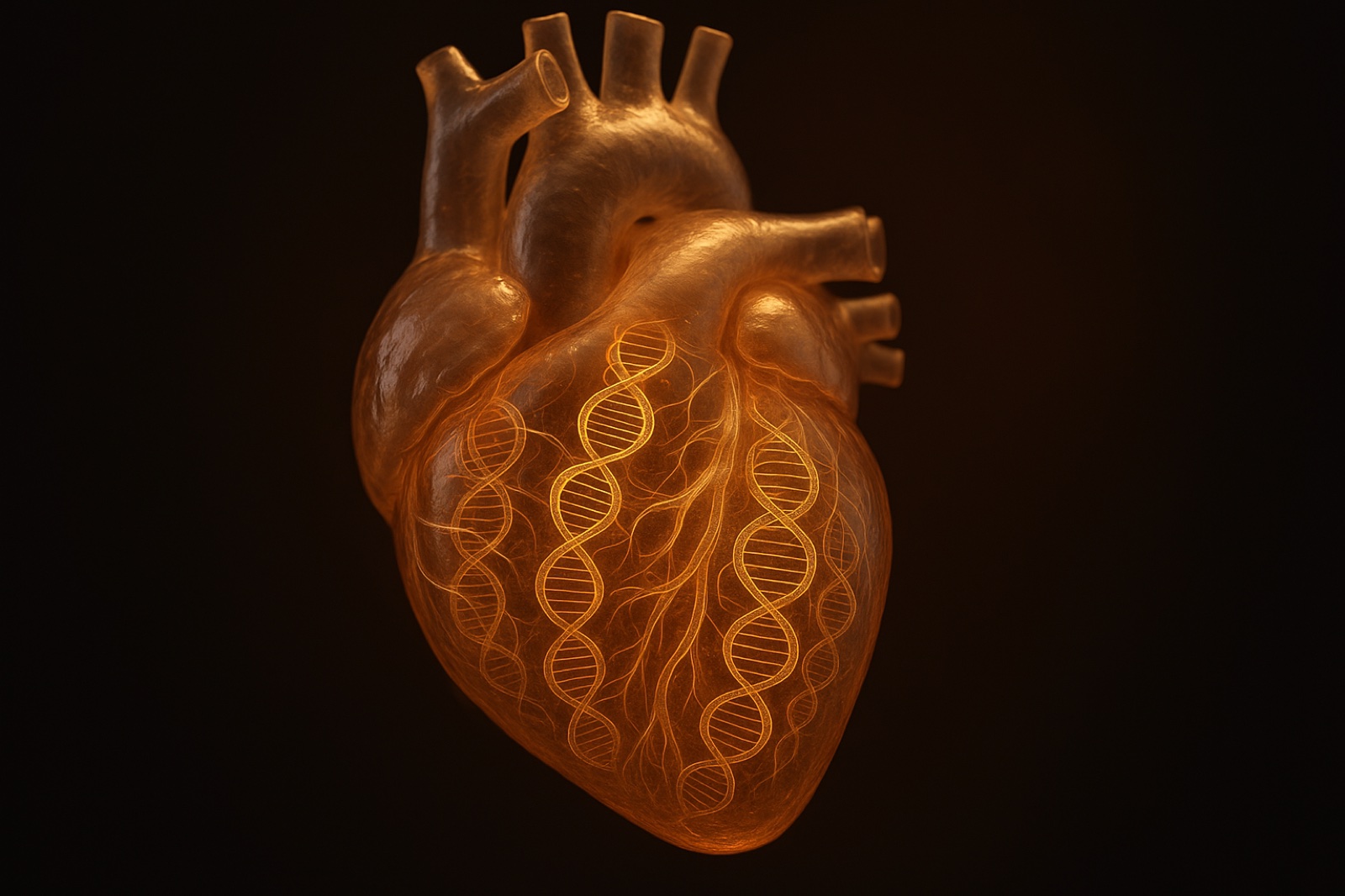
Researchers at Gladstone Institutes decided to look somewhere almost nobody had looked before: not at the genes themselves, but at how the DNA carrying them is folded. Inside every cell, roughly six feet of DNA gets packed into a nucleus smaller than a speck of dust. It doesn’t just get crumpled in — it’s folded with astonishing precision, so that genes end up looped next to the exact switches, called enhancers, that turn them on at the right time and place.
What the team found is that TBX5 is one of the architects of that folding — at least inside heart cells.
A GPS for Your Genome
Here’s the part that reads like something out of an engineering manual, not a biology lab. Cells rely on a molecular motor called cohesin to physically drag loops of DNA into shape, connecting genes to their enhancers across long stretches of genetic material. But cohesin doesn’t know where to stop on its own. It needs directions.
TBX5 gives it those directions. Researchers describe it as acting like a GPS, telling cohesin exactly where to land so it builds the correct loops in the correct places. Get enough TBX5 in the cell, and the genome folds into the shape a heart cell needs. Lose it, and the loops don’t form where they’re supposed to.
It’s not the first time scientists have found this kind of exactness hiding inside biology. A separate team studying how a single fertilized cell builds a brain with 170 billion precisely organized neurons ran into the same kind of astonishment — not roughly right, but exactly right, down to the connection.
Why Losing Just One Copy Breaks Everything
Most of us carry two copies of every gene, one from each parent. You might assume losing one copy of TBX5 would cause, at most, half the trouble. That’s not what happened.
“What was striking was how the amount of TBX5 matters immensely,” said Zoe Grant, PhD, a postdoctoral researcher in the Gladstone lab and first author on the study. “The more TBX5 you removed, the worse the disruption across every level of genome organization we looked at.”
The collapse wasn’t limited to one or two loops going missing. It happened at every scale researchers measured — the broad compartments DNA organizes itself into, the domains within those compartments, and the individual loops connecting genes to their switches. Reduce the gene’s dose, and the entire architecture of that stretch of genome starts to come undone, like pulling one support beam out of a building and watching the floors above it shift out of alignment.
It’s a theme researchers keep running into in biology’s quieter corners — even the exact brain rhythm that makes Parkinson’s treatment work turned out to be precise, learnable order hiding inside a disease that looks like pure chaos from the outside.
The Answer to a 30-Year Mystery
Here’s the detail that may matter most for families: people who carry the exact same TBX5 mutation don’t always end up with the exact same heart defect. Some have mild issues. Others have severe ones. Doctors have never fully understood why identical genetic mutations produce such different outcomes.
This study offers a real clue. TBX5’s effects turned out to vary not just from person to person, but from cell to cell within the same developing heart — because the exact amount of available TBX5 can differ slightly from one cell to the next. A gene dose that isn’t quite a simple on/off switch, but something closer to a dimmer, may be enough to explain why the same broken instruction manual builds a different heart in different people.
That’s not a small finding. Congenital heart disease affects roughly 1 in 100 babies worldwide, and for thirty years, the “why do outcomes vary so much” question has mostly gone unanswered. A folding problem, measured cell by cell, is the first mechanism that actually accounts for it.
There’s something quietly remarkable sitting underneath all of this. Long before anyone could see a single strand of DNA, ancient wisdom already described a person being knit together with intention, formed in secret with a kind of care no accident could account for. Scientists spent decades looking for the mechanism behind that intention — and what they found wasn’t randomness holding the blueprint together. It was architecture. A gene acting as an architect, giving directions, keeping the structure from unraveling. Call it what you want. It’s hard to look at a system this precise and still call it luck.
If that kind of precision makes you want to keep pulling the thread, our How Old Is the Universe? Explorer is a fun rabbit hole built around the same sense of wonder.
None of this makes congenital heart disease less real, and it won’t change a diagnosis a family is living with today. But it does mean scientists now understand, cell by cell, exactly where the structure came from — and exactly where it breaks. That’s not nothing. Sometimes understanding how something was built is the first real step toward learning how to fix it.
Discussion Question
Do you think discoveries like this — finding hidden order and precision inside something as basic as a single heart cell — change how people think about where we come from? Tell us in the comments.
Share This
- Scientists just found the exact gene that folds your heart cell’s DNA into shape — and losing even one copy unravels the whole structure. Wild.
- There’s a gene called TBX5 that acts like an architect, telling a molecular “GPS” exactly where to fold your DNA so your heart works right. One missing copy and the whole blueprint collapses.
- The most common birth defect in the world might come down to a single gene losing its grip on how DNA folds. Scientists just mapped it, cell by cell, for the first time.
Questions People Are Asking
What is the TBX5 gene and what does it do in the heart?
TBX5 is a gene that acts like an architect for heart cells. It tells a molecular motor called cohesin exactly where to land on a cell’s DNA to build the folded 3D loops that connect genes to the switches, called enhancers, that turn them on. Without enough TBX5, those loops collapse, and the genes needed to build a healthy heart can’t be read correctly.
Why does losing just one copy of a gene cause a birth defect?
Most people have two copies of every gene, one from each parent. Researchers found that TBX5 is “dose-dependent,” meaning the amount of the gene present directly controls how well DNA folds. Losing even one of the two copies reduces TBX5 levels enough to unravel the genome’s structure at every level, from broad compartments down to individual chromatin loops.
How common is congenital heart disease?
Congenital heart disease is the most common birth defect in the world, affecting about 1 in 100 babies born each year.
Why do people with the same genetic mutation sometimes have different heart defects?
The study found that TBX5’s effects vary from cell to cell, not just from person to person, because the exact amount of available TBX5 can differ within the same body. That cell-by-cell variation in a single gene’s dosage may explain why identical mutations produce a range of different heart defects in different people.
What study and journal is this research from?
The study, “Dose-dependent sensitivity of human three-dimensional chromatin to a heart disease-linked transcription factor,” was published in the journal Science on July 23, 2026, by researchers at Gladstone Institutes and collaborating institutions.