 0
0
 0
0
Every laptop, phone, and server on Earth shares the same basic design flaw. The chip that thinks — the processor — sits in one place. The chip that remembers — the memory — sits somewhere else. Every calculation means shuttling data back and forth between the two, and that shuttling is where most of a computer’s power actually gets burned. Engineers have known about this bottleneck for eighty years. They just never had a way around it.
Until now — and the fix didn’t come from better silicon. It came from DNA.
The Chip That Remembers and Thinks in the Same Place
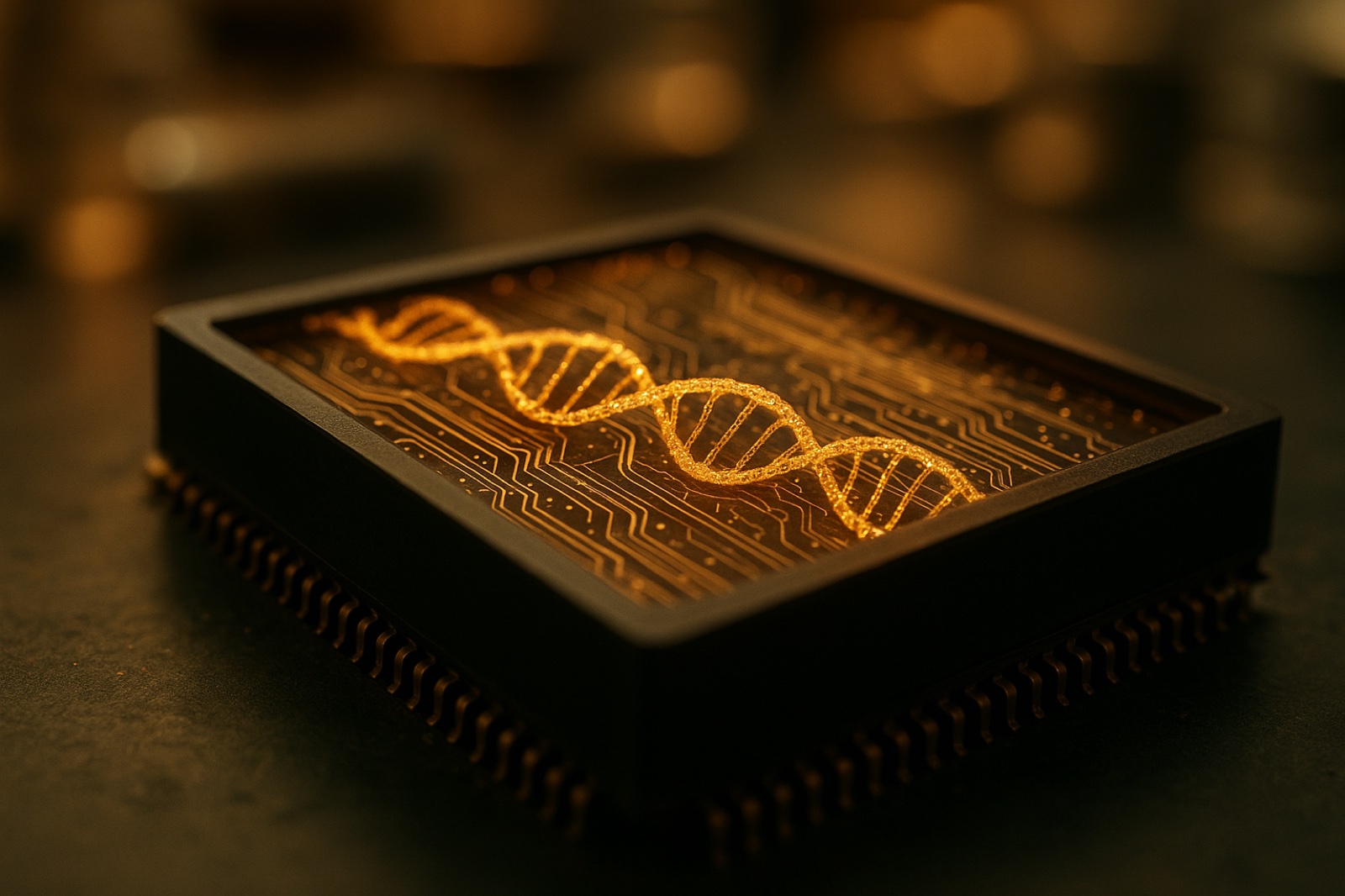
A team of researchers at Penn State, working with collaborators at the University of Minnesota, just built a working memory device — the technical term is a memristor — that fuses synthetic DNA with a crystalline semiconductor material called perovskite. They engineered custom DNA strands, “doped” them with silver nanoparticles so the DNA itself could conduct electricity, and wove them into thin perovskite films.
The result is a single component that can store information and process it, right there, in the same physical spot — no shuttling required.
The numbers are the kind that make hardware engineers sit up straighter. The device runs reliably at less than 0.1 volts and uses roughly 100 times less power than a conventional memory chip, while holding more data per square inch than standard flash storage. It stays stable at temperatures approaching 250°F and holds its data for six weeks or more at room temperature — no power source required to keep the memory intact.
“Usually, it takes more power to store more information,” one of the Penn State researchers explained. “Our device, however, consumes 100 times less power and the storage capacity is higher than traditional storage devices.”
Why “Remembering and Thinking in the Same Place” Is Such a Big Deal
Here’s what makes this more than just a smaller, cheaper chip. Every computer since the 1940s has run on what’s called the von Neumann architecture — a design so old it predates the transistor, named for the mathematician who first sketched it out. Data lives in one part of the machine. Calculations happen in another. It works, but it’s inherently wasteful: the busiest highway in your device isn’t the processor itself, it’s the road connecting the processor to the memory.
Engineers have wanted to break out of that design for decades, especially now that AI systems are hungry for exactly this kind of efficiency. A device that remembers and computes in one physical location doesn’t need that highway at all. That’s why researchers keep reaching for the same comparison to describe what they’re chasing: the human brain.
A neuron doesn’t file a memory in one drawer and run its calculations in a room down the hall. Storage and processing happen in the same tissue, often the same synapse, sometimes the same signal. Neuroscientists have pointed to that fact for years as the reason biological brains do so much with so little — a brain runs on roughly 20 watts, about what it takes to power a dim light bulb, and still outperforms supercomputers that need entire buildings and industrial cooling systems to do far less. It’s the same kind of hidden efficiency researchers keep finding in other corners of the brain — they recently traced the exact rhythm hidden inside a disease of chaos, a reminder that order keeps turning up in systems we assumed were just noise.
What Comes Next
This is still a lab result, not a chip you’ll find in next year’s phone. But bio-hybrid memory like this is exactly the kind of breakthrough that tends to reshape a field quietly over a decade rather than loudly overnight — the way early transistor research did in the 1950s. Silicon itself has a strange origin story worth remembering here: the same material inside every microchip ever made traces back to ordinary beach sand, purified and reshaped into something that can compute. DNA is simply the newest material added to that list.
If this scales, the appeal is obvious: AI systems and data centers that currently draw enormous amounts of electricity could someday run on a fraction of the power, using a material blueprint borrowed from biology instead of built from scratch by trial and error.
And that’s the part worth sitting with for a second. A team of skilled scientists spent years trying to design something that already existed, quietly, inside every human skull. The brain wasn’t playing catch-up to the chip. It was the design the chip was trying to catch up to — running the same principle, more efficiently, long before anyone had a word for “memristor.” Some kind of intention got there first, long before we had the tools to notice it.
Wonder Doesn’t Need an Explanation to Be Real
You don’t have to understand perovskite thin films or silver-nanoparticle doping to feel the strange pull of a story like this one. It’s the same pull you get looking up at a night sky you can’t fully explain, or realizing your own hand catches a ball before your conscious mind finishes deciding to move. Some designs are so good that reverse-engineering them takes our smartest people, working in teams, for years — and they still only get partway there.
If wondering about how everything got built in the first place is your kind of rabbit hole, our free How Old Is the Universe? Explorer is worth a few minutes.
Maybe it’s not a coincidence that the most advanced thing humans can build is, at best, a rough copy of something we were simply given. Maybe that’s worth noticing — not as a mystery to solve, but as a gift to receive.
Discussion Question: If the most efficient computer we’ve ever built is still just a rough copy of the human brain, does that change how you think about your own mind? Tell us in the comments — we’d love to hear your take.
Share This
- Scientists just built a computer chip out of DNA that stores AND processes memory in the same place — 100x less power than what’s in your phone right now. And it works exactly like your brain already does.
- The most advanced computer chip we’ve ever built is basically a rough copy of a human brain. Wild to think about.
- Scientists spent decades trying to build a chip that stores and processes data in one place. Turns out your brain’s been doing that for free the whole time.
Questions People Are Asking
What did Penn State scientists actually build?
A team at Penn State, working with the University of Minnesota, built a memristor — a memory device — that combines synthetic DNA with a perovskite semiconductor. It can store and process information in the same physical location, using about 100 times less power than a traditional memory chip.
How is this DNA chip different from a normal computer chip?
Normal chips separate memory and processing into two different components, so data has to travel back and forth between them, which wastes power. This new device stores and computes in the same spot, the same way a brain’s neurons do, which is why it needs far less energy to work.
Why does mimicking the brain matter for computers?
The human brain runs on about 20 watts — roughly a dim light bulb — and still outperforms supercomputers that need whole buildings and industrial cooling to do far less. Storing and processing in the same place is a big part of why the brain is so efficient, and it’s exactly what engineers have wanted to copy for decades.
Is this DNA memory chip available in real products yet?
Not yet. It’s a working lab device, not something in phones or laptops today. Breakthroughs like this typically take years to move from a research paper to real hardware, similar to how early transistor research in the 1950s eventually reshaped every computer built afterward.
What can this breakthrough teach us beyond computer science?
It’s a reminder that some of our most advanced engineering is really just a rough attempt to copy something that already existed. The brain was solving this exact efficiency problem long before anyone had the tools to study it — which is worth pausing on, whatever you make of where that kind of design comes from.