 0
0
 0
0
In August 1983, a huge crowd filled the streets of Manila for a funeral. Time magazine later put the number at about two million people.
The next day, according to that same Time report, the top headline in a leading Manila daily read: TWO KILLED BY LIGHTNING.
One editor looked at that and decided she could not stay quiet. Her name was Eugenia Apostol. Friends called her Eggie. She was 57 years old, and for most of her working life she had edited the part of the paper that serious newsmen didn’t take seriously: the women’s pages.
Eugenia Apostol died on Sunday, 13 September 2026, at the age of 100. She is remembered as the founder of the Philippine Daily Inquirer. But the most interesting part of her story is where she came from, and when her biggest work finally began.
Who Was Eugenia Apostol?
She was born in Sorsogon, in the Philippines, in 1925. Her family later moved to Manila, where her father served in the National Assembly. She studied Philosophy and Letters at the University of Santo Tomas, where she also wrote for the student paper, The Varsitarian.
According to the Ramon Magsaysay Award Foundation, she started out writing for Catholic magazines. Then, for twenty years, she edited the women’s pages of The Manila Times and The Manila Chronicle.
Back then, people called that kind of work the “lipstick beat.” Recipes. Fashion. Society news. It was the section many readers skipped on the way to the “real” news.
But the Foundation notes something easy to miss. She brought a fresh approach to those pages by writing for “intelligent, civic-minded women readers.” She didn’t treat her readers as silly. She treated them as people who cared about their country.
When martial law began in 1972 and independent newspapers were shut down, she found work on a women’s magazine. Later, she and her husband launched a glossy lifestyle magazine with a playful name: Mr. & Ms.
It did not look like the kind of magazine that would change a nation’s history. That’s what makes the next part so remarkable.
The Lightning Headline and the Mr. & Ms. Special Edition
On 21 August 1983, opposition leader Benigno “Ninoy” Aquino Jr. was shot dead at the Manila airport as he came home from exile. The crowds that came to see his body, and then to walk with his funeral, were enormous.
The big newspapers of the day barely showed it. That’s where the lightning headline comes in.
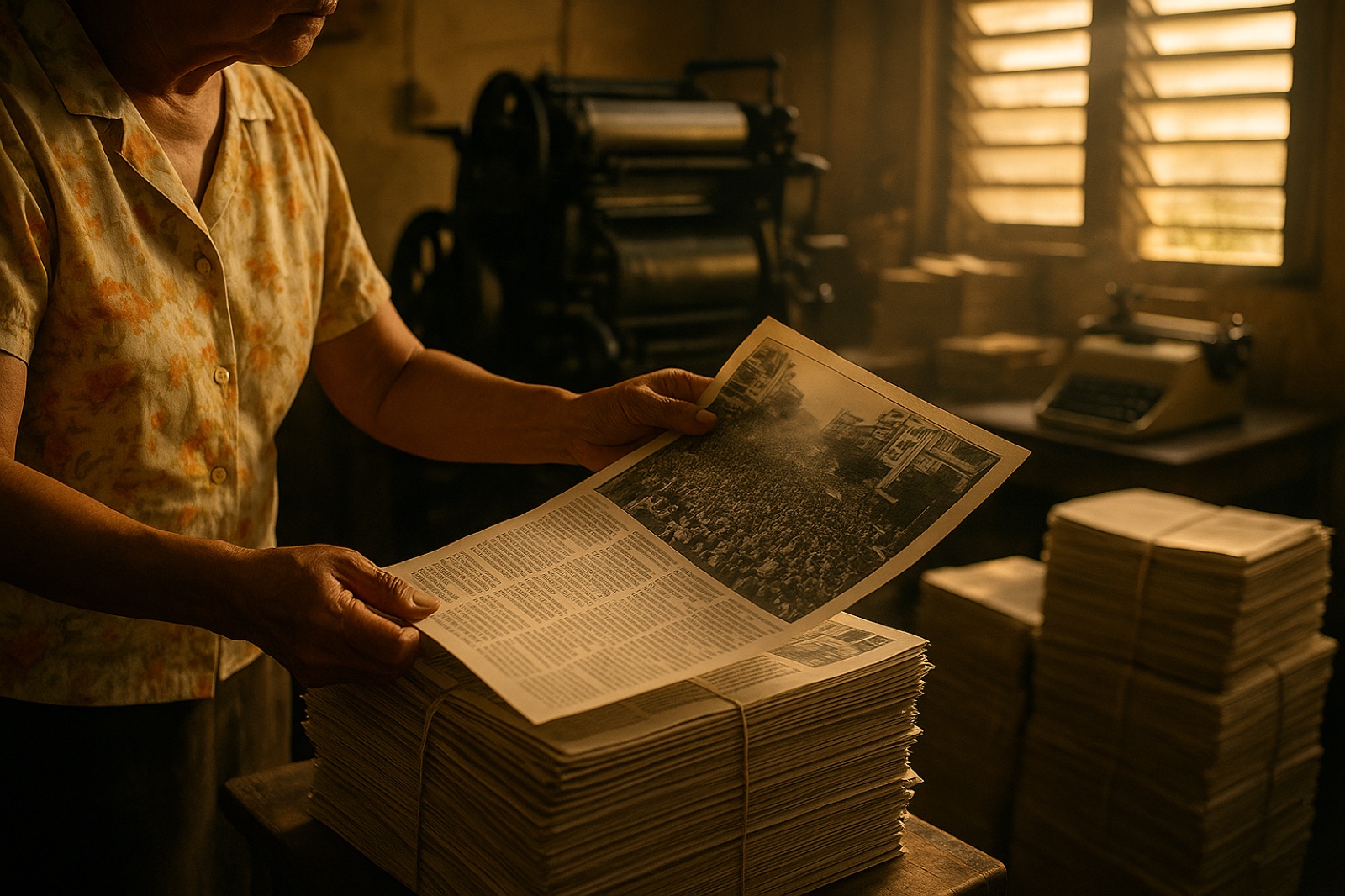
Eugenia Apostol’s answer was fast. Within days, she was printing a tabloid version of her lifestyle magazine called the Mr. & Ms. Special Edition. It was 16 pages of photographs: Aquino’s body, the people who came to see it, and the funeral procession that wound through Manila for almost 12 hours.
“From then on there was no stopping,” she later said.
The special editions kept coming, week after week. Readers bought them by the hundreds of thousands, and passed them from hand to hand. A magazine that had been known for style became the place where many Filipinos saw what the front pages had left out.
Here’s the detail that is easy to read past. For twenty years, her job had been to notice what ordinary readers actually cared about. The women’s pages had trained her to look at the people, not just at the people in charge. When two million of those people walked through the streets, she saw them. The front page that week saw lightning.
Starting a National Newspaper at 60
Most people start slowing down around 60. Eugenia Apostol started a daily newspaper.
In early 1985, she launched a small weekly called the Philippine Inquirer. Then, on 9 December 1985, she and a group of fellow journalists launched the Philippine Daily Inquirer. She had just turned 60.
It was not a comfortable start. In a foreword she wrote for a book marking the paper’s 30th anniversary, she described how she pawned her engagement ring to help the “very beleaguered” young newspaper survive until it could stand on its own.
People who worked there in the early days remember that payday came whenever the money from street sales came in, often in bundles of worn two-peso bills. Some of those bills, one colleague recalled, smelled of the fish market.
The paper grew into one of the most widely read in the country. She stepped down in 1994. And then, in her seventies, she did it again, starting another paper, a tabloid written in Filipino.
In 2006 she received the Ramon Magsaysay Award, often called Asia’s Nobel Prize, for “placing the truth-telling press at the center of the struggle for democratic rights and better government in the Philippines.” Time magazine named her one of its Asian Heroes that same year.
Asked about her part in that history, she kept it simple: “I was just doing what should have been done. Journalists have to tell the truth.”
What Eugenia Apostol’s Life Says About a Calling That Comes Late
If you are in your fifties or sixties and wondering whether your best work is already behind you, her story has a few quiet lessons in it.
The “small” years weren’t wasted. Twenty years of women’s pages gave her something the serious desks didn’t have: a real feel for what regular people cared about, and the trust of readers who felt respected by her. That became the whole foundation of what came later.
She used what she already had. She didn’t wait to own a big newspaper before she spoke up. She took the magazine she had, the one nobody took seriously, and used it.
She paid a real price. The engagement ring. The payday that came in fish-market bills. Callings that arrive late rarely arrive comfortable.
She knew exactly what the job was. Speaking to young writers in 2008, she put it plainly: “The main job of the newspaper is to be a watchdog, not to be anybody’s puppy dog.” She also once wrote, “To be beholden to any news source is tragedy for a reporter. To be beholden to any advertiser is tragedy for a newspaper.”
If you’ve been wondering what your own years have been quietly preparing you for, our free What Is My Purpose? assessment is a gentle place to start thinking it through.
There is something very old in her story, too. People have noticed for thousands of years that God has a habit of choosing what everyone else overlooks: the small, the unserious, the late. The section people skipped. The magazine nobody feared. A woman of sixty with a ring to pawn. That idea runs all through the Bible, and it keeps turning up in places like a Manila print shop in 1983.
Her life is also a reminder of something we explored recently in how to know what is true: finding the truth is often the easy part. Saying it out loud, when it costs you something, is the hard part.
The Front Page That Missed the Story
Nobody remembers the lightning headline for its own sake. People remember it because of what it left out, and because of the women’s page editor who noticed.
Eugenia Apostol spent decades on work other people called small. Then, at 57, she saw a story the big papers wouldn’t print, and she printed it. At 60, she started a newspaper. She lived to 100.
If your work feels small right now, or your time feels late, it may be worth looking again at what those years have been teaching you. Somebody, somewhere, may be waiting for exactly the thing only you have noticed.
Questions People Ask About Eugenia Apostol
Who was Eugenia Apostol?
Eugenia “Eggie” Duran Apostol was a Filipino journalist and publisher, born in Sorsogon in 1925, who founded the Philippine Daily Inquirer in December 1985. She spent about twenty years editing the women’s pages of The Manila Times and The Manila Chronicle, published the Mr. & Ms. Special Edition after the 1983 assassination of Benigno Aquino Jr., and received the Ramon Magsaysay Award in 2006. She died on 13 September 2026, at the age of 100.
What was the Mr. & Ms. Special Edition?
The Mr. & Ms. Special Edition was a tabloid version of the Philippine lifestyle magazine Mr. & Ms., published by Eugenia Apostol in 1983 after opposition leader Benigno “Ninoy” Aquino Jr. was assassinated. Its first issue was 16 pages of photographs of Aquino’s body, the crowds who came to see it, and his funeral procession, which major newspapers had largely ignored. Later special editions continued weekly and sold by the hundreds of thousands.
How old was Eugenia Apostol when she founded the Philippine Daily Inquirer?
Eugenia Apostol was 60 years old when she co-founded the Philippine Daily Inquirer on 9 December 1985. She had been born in 1925. Two years earlier, at 57, she had published the Mr. & Ms. Special Edition, and in her seventies she went on to start another newspaper, a tabloid written in Filipino.
Is it too late to find your calling at 50 or 60?
It is not too late to find a calling at 50 or 60, and many people do their most important work later in life. Journalist Eugenia Apostol spent twenty years editing women’s pages before publishing a landmark special edition at 57 and founding the Philippine Daily Inquirer at 60. Earlier experience that seems small often becomes the skill set a later calling depends on.
What did Eugenia Apostol say about journalism?
Eugenia Apostol said that “the main job of the newspaper is to be a watchdog, not to be anybody’s puppy dog.” Reflecting on her role in Philippine press freedom, she also said, “I was just doing what should have been done. Journalists have to tell the truth.” She advised young writers that being beholden to a news source or an advertiser is a tragedy for a reporter and a newspaper.
Let’s Talk
Why do you think the most important stories so often turn up in the places people take least seriously? Share your thoughts in the comments. We’d love to hear from you, especially if you’re reading from the Philippines.
Share This
Post 1:
The day after a funeral two million people attended, a leading Manila paper’s top headline was about lightning. A women’s page editor, 57, printed the real story. Rest in peace, Eggie Apostol. https://bgodinspired.com/index.php/bgodinspired-news/eugenia-apostol-dies-at-100/
Post 2:
20 years on the women’s pages. A special edition at 57. A national newspaper at 60. Another paper in her seventies. If you think it’s too late for your calling, read Eugenia Apostol’s story. https://bgodinspired.com/index.php/bgodinspired-news/eugenia-apostol-dies-at-100/
Post 3:
She pawned her engagement ring to keep her new newspaper alive. “Journalists have to tell the truth,” she said. Eugenia Apostol, 1925-2026. https://bgodinspired.com/index.php/bgodinspired-news/eugenia-apostol-dies-at-100/