 0
0
 0
0
You already know your phone tracks you. Your smart speaker waits for its wake word. Your browser finishes your sentences before you do. But researchers in Germany just proved something stranger: ordinary WiFi can identify you by body shape and movement alone, even with your phone powered off in another room. No camera. No app. No permission asked.
The study, published in early August, tracked 197 participants and found that the WiFi signals already floating through most homes and offices — the same ones your router uses to stream video or load a webpage — can be read like a fingerprint. Not a photograph. Not a video. Just the invisible way a body bends radio waves as it moves through a room, which turns out to be specific enough to tell one person from another with near-perfect accuracy.
How Ordinary WiFi Became a Fingerprint Scanner
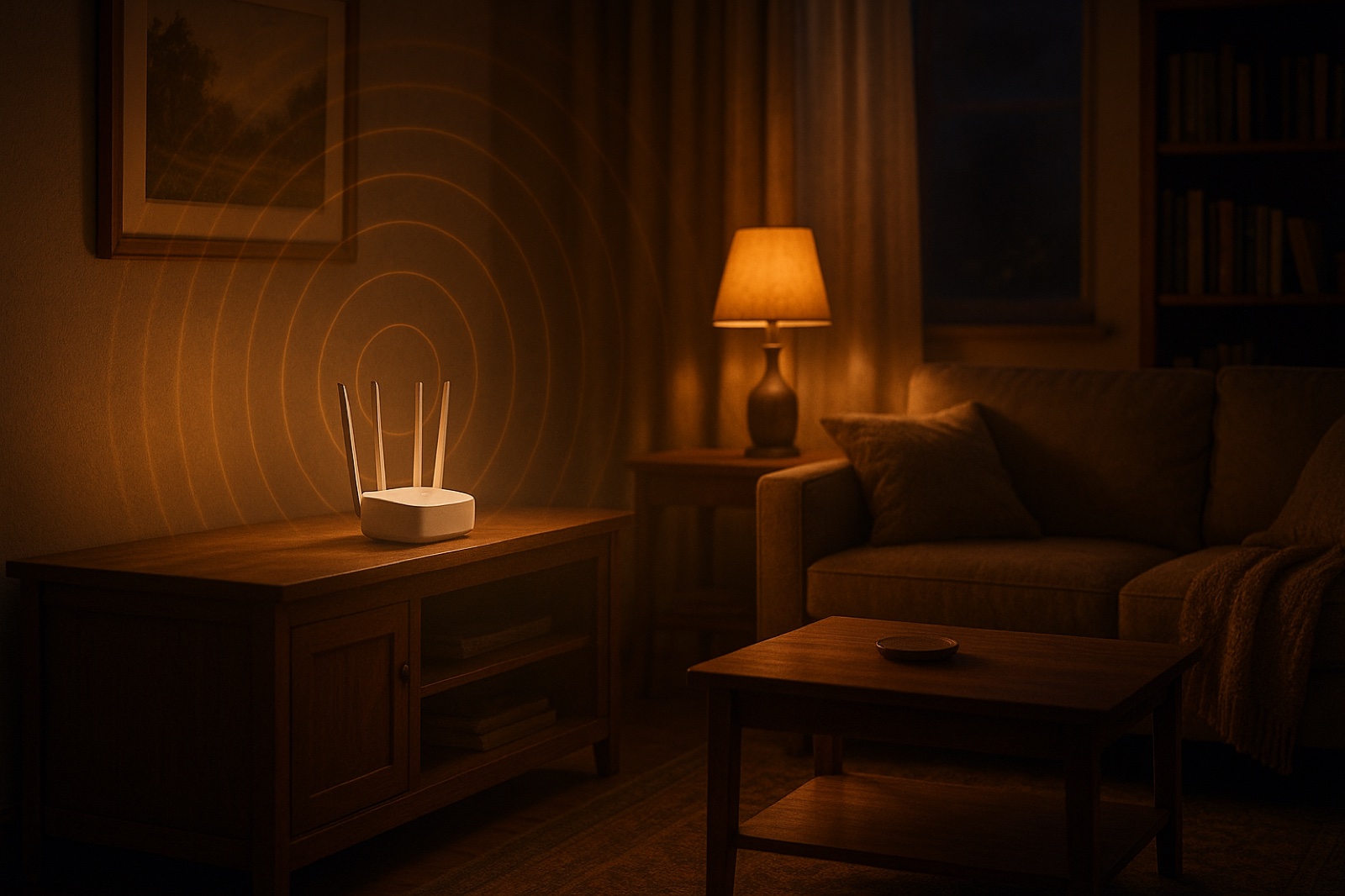
Every WiFi signal that passes through a room gets slightly disturbed by whatever is in its path — walls, furniture, and yes, people. Researchers call this disturbance pattern Channel State Information, or CSI. For years, CSI has been treated mostly as noise — the static a router has to work around to keep your connection stable.
What changed is that scientists figured out how to read the noise instead of ignoring it. A person’s height, build, and the particular rhythm of how they walk all distort the signal in a slightly different way. Feed that distortion into the right model, and you get something close to a radio-wave signature — one that WiFi can identify you with, using nothing but the router already sitting in your living room. Similar work has already shown that patterns hidden in ordinary data — even things as anonymous-seeming as writing style — can be used to unmask a person, as this recent look at AI unmasking anonymous accounts found in a different context entirely.
It’s Already Saving Lives — Which Complicates the Fear
Before this feels like pure dystopia, it’s worth knowing that WiFi sensing isn’t brand new, and it hasn’t only been used for something sinister. Contactless fall-detection systems already use this kind of signal-reading to alert caregivers when an elderly person collapses at home, without needing a camera in their bedroom. Hospitals have tested it to monitor a patient’s breathing and heart rate overnight without a single wire attached to their body. The same invisible sensitivity that can identify you can also watch over someone you love without ever recording an image of them.
That’s the uncomfortable part of stories like this one. The technology itself isn’t good or evil — it’s just newly capable. The question was never really can this be built. It’s who ends up holding it, and what they decide to do with something this quiet and this thorough. People who’ve spent years trying to protect their privacy with things like signal-blocking Faraday bags are about to find out that blocking a phone was never the whole problem — the router in the next room was reading you the entire time.
The Follow-Up Question Nobody’s Answered Yet
The researchers behind the study didn’t shy away from naming the obvious risk: a tool this passive and this hard to detect is also easy to misuse. There’s no red light. No lens pointed at you. No app permission popup asking if this is okay. It just works, quietly, in the background of a signal you were already using for something else. That’s exactly why privacy researchers are pushing for this kind of sensing to be regulated before it becomes standard equipment in more places than nursing homes and hospitals — offices, rental apartments, retail stores that want to know exactly how you move through them.
It’s a real concern, and a reasonable one. But there’s something else worth sitting with underneath the unease.
The Strange Comfort in Being Fully Seen
For most of human history, being fully known by someone — every movement, every unseen moment, every room you thought was private — was not a technical possibility. It took radio waves and a research lab in 2026 to make total, physical knowing something a machine could do to a stranger.
But long before any of that existed, there was already a much older idea floating around, in cultures and traditions going back thousands of years: that a person could be completely known by God — not through a signal or a scan, but simply and entirely — and that being fully known was never actually the threat. It was described as closeness. As care. As the opposite of being alone in a room you thought no one could see into. Being seen used to be presented as the beginning of surveillance. This older idea framed it as the beginning of love. If that kind of complete knowing is on its way one way or another — through routers if not through anything grander — it might be worth asking which version of “fully known” you’d rather it turn out to be. Some people find it helpful to sit with that question directly through something like this short “How Close Am I to God?” reflection.
None of that makes the privacy questions go away, and it shouldn’t. Regulation, transparency, and real consent still matter — a lot. But it’s a strange kind of relief to realize that the fear of being completely known is not new, and that somewhere along the way, someone already made the case that being fully known doesn’t have to end in dread.
Your WiFi router isn’t going anywhere. Neither, it turns out, is that older idea.
What do you think?
If being fully known is coming whether we’re ready or not — through routers, algorithms, or something else entirely — does it change anything to imagine it as care instead of surveillance? Or does that feel like too generous a read on where this technology is actually headed? Tell us what you think in the comments.
Share this
- Scientists just proved ordinary WiFi can identify a person by body shape and movement alone — no camera, no phone needed. We’re already living in the future we used to worry about.
- Turns out you don’t need a camera to be seen anymore. A German study just showed WiFi alone can identify who you are. Wild — and worth thinking about before it’s everywhere.
- Tech just proved something old traditions already assumed: you were never actually hidden. Maybe that’s not as frightening as it sounds.
Frequently Asked Questions
Can WiFi really identify a specific person without a camera or phone?
Yes. A 2026 study out of a German university found that ordinary WiFi signals, read through something called Channel State Information (CSI), can identify a person by their body shape and the specific way they move, with near-perfect accuracy — no camera, phone, or wearable device required.
How does WiFi sensing actually work?
Every WiFi signal in a room gets slightly disturbed as it passes around people and objects. Researchers can read that disturbance pattern — called CSI — and match it to an individual the same way a fingerprint identifies a person, using only the router already installed in most homes and offices.
Is this technology already being used anywhere?
Yes, in limited, largely benign ways. Contactless fall-detection systems for elderly care and hospital monitoring tools that track breathing or heart rate overnight already use similar WiFi-sensing methods, without recording video or images.
Does this mean WiFi can see through walls?
The core finding is about identifying people within the range of a WiFi signal, not full through-wall imaging. Researchers have flagged the broader trajectory of this field — including more advanced sensing — as a reason regulation needs to catch up before the technology spreads further.
Why are researchers concerned about this?
Because WiFi sensing is passive and nearly undetectable — there’s no light, lens, or app permission to alert someone they’re being read. Privacy researchers are calling for oversight before this kind of sensing becomes standard in offices, rentals, and retail spaces.