 0
0
 0
0
Scientific Discovery Illuminates Cosmic Partnerships: A Reflection on Love and Life’s Transience
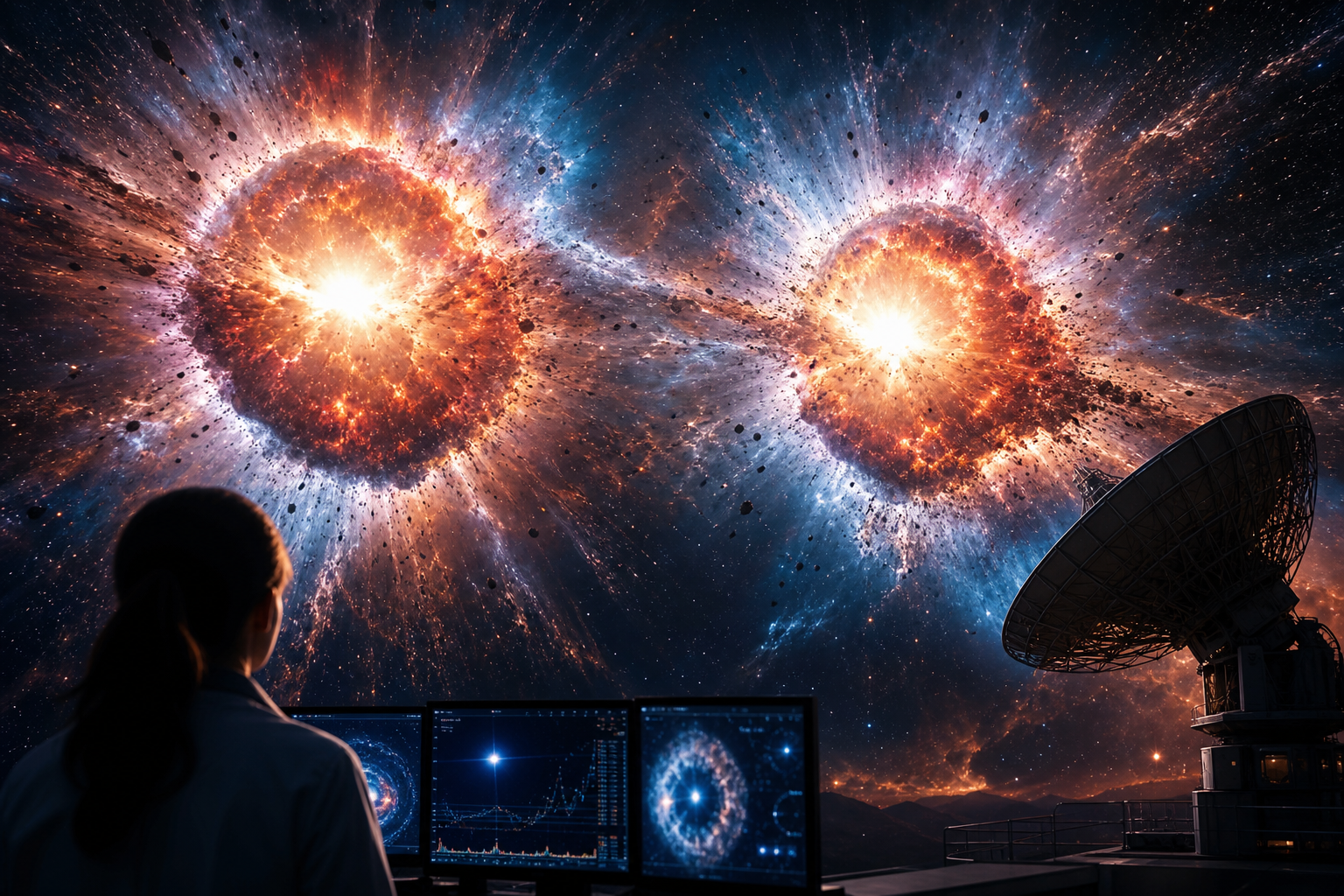
WASHINGTON — In an extraordinary revelation, scientists have unveiled significant evidence of two massive stars residing in a binary system that met their explosive end in quick succession, transforming into nebulae that now shine brightly in our cosmos. This discovery prompts reflection not only on the wonders of the universe but also on profound biblical principles regarding relationships and the natural cycle of life.
Unlike our solitary sun, many of the universe’s grandest stars are born as pairs, bonded in a gravitational embrace. However, just as in human experiences, even the most profound connections can face endings. Researchers have discerned that both stars from this binary system exhausted their nuclear fuel and exploded as supernovas, marking their celestial exit and leaving behind glowing remnants known as nebulas.
Among these, the Jellyfish Nebula, or IC 443, is one of the most celebrated structures in our Milky Way. The evidence gathered over 16 years by NASA’s Fermi Gamma-ray Space Telescope indicates that this nebula originated from a star that was 15 to 25 times more massive than our sun. Its companion, another colossal star, detonated to form the nearby G189.6+3.3 nebula, possibly 20 times the mass of the sun.
For Miltiadis Michailidis, a postdoctoral fellow at Stanford University and lead author of the study published in Nature Communications, this discovery is pivotal. "This system provides a rare opportunity to reconstruct the complete evolutionary history of a massive binary—through both supernova explosions and the remnants they left behind," he states.
This dual calamity—similar yet distinct—reflects the reality of life cycles in all forms, much like the relationships we cultivate on Earth. Even our deepest bonds, while beautiful and illuminating, face inevitable transitions. The Bible encourages us to embrace such change with grace, as expressed in Ecclesiastes 3:1: "To everything, there is a season, and a time for every matter under heaven."
The ongoing exploration of binary systems teaches us about the dynamics of interconnected lives, enhancing our understanding of existence both in the cosmos and our communities. Just as these stars once shared a space, our own lives are enriched by connections with others. They teach us not just about joy but also about resilience, as even after tumultuous endings, new beginnings emerge in unexpected forms.
As we reflect on the brilliance of these massive stars, it can serve as an encouragement to value the relationships we have. Embrace moments of connection, compassion, and even the inevitable farewells that shape our personal journeys.
In conclusion, the study of these supernova remnants invites us to examine our lives in light of biblical wisdom. Each relationship, like each star, has its purpose and its timing. And while our own journeys may encompass both dazzling brilliance and poignant endings, they ultimately reveal the potential for rebirth and renewal, encouraging us always to look up in awe and hope.
Consider how you can cherish the cosmic dance of relationships in your own life. The beauty of connection persists, even beyond what we can see.
If you want to want to know more about this topic, check out BGodInspired.com or check out specific products/content we’ve created to answer the question at BGodInspired Solutions
If positive Biblical wisdom matters to you, I’d love your support of the mission
Q&A about
Did scientists really find evidence of two huge stars that blew up?
Yes, scientists have indeed spotted evidence of two massive companion stars that have exploded in supernova events. This discovery reminds us of the majesty of God’s creation, which is filled with mysteries beyond our understanding. As it says in Romans 1:20, God’s invisible qualities can be clearly seen in what He has made, revealing His glory in even the most distant celestial events.
How do we reconcile scientific discoveries about stars with our Christian faith?
Scientific discoveries, such as those about supernovae, can actually deepen our faith rather than contradict it. They showcase the intricate design and power of God, who spoke the universe into existence. Just as Jesus mentions in Matthew 5:14-16, we are called to let our light shine, recognizing that the wonders of creation can lead others to glorify our Father in heaven.
Are there any biblical lessons we can learn from the life cycle of stars?
The life cycle of stars, including their explosive deaths, can teach us about renewal and transformation. Just like the stars go through cycles of birth, life, and death, we too are called to new life in Christ, as 2 Corinthians 5:17 tells us about becoming a new creation. This process of change can inspire us to embrace our own spiritual growth and the hope of eternal life.
What can the explosion of stars tell us about God’s power?
The explosive nature of supernovae beautifully illustrates God’s immense power and authority over creation. When these stars blow up, they scatter elements necessary for life across the universe, reflecting how God’s plan brings forth abundance even from destruction. This echoes the message in Ephesians 3:20, where we are reminded that God can do immeasurably more than all we ask or imagine, revealing His greatness in every aspect of creation.