 0
0
 0
0
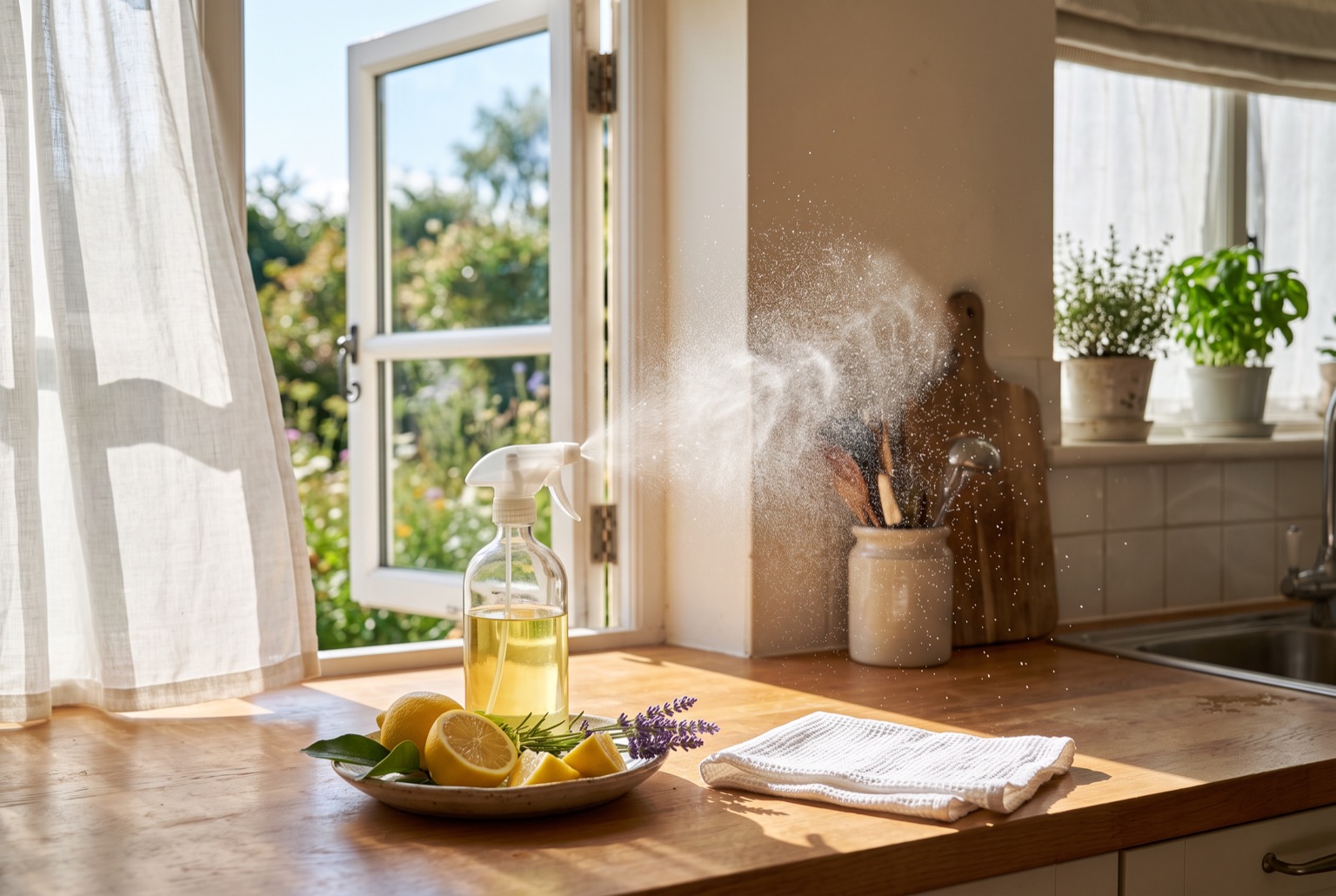
You finish wiping the kitchen counter, and the whole room smells like lemons. It feels like proof. Clean smells clean, right?
A team of air scientists at Purdue University says that smell may be telling you something else. When they measured the air inside a test home while people cleaned, they found that scented cleaners can react with ozone already in the room and form billions, even trillions, of nanoparticles within minutes. These particles are far too small to see, and small enough to travel deep into your lungs.
That sounds alarming. It’s also more interesting, and more fixable, than the headline makes it sound. Here’s what the researchers actually found, what they didn’t find, and a few easy things anyone can do about it.
What the Scented Cleaners Study Actually Found
The work comes from Brandon Boor and Nusrat Jung, engineers at Purdue who study indoor air, working with their colleague Ernest Blatchley. Their lab has a full-size model home on campus, with a working kitchen, a bathroom and wood floors, and it’s packed with instruments that count particles in the air second by second.
They ran ordinary cleaning jobs in that home: mopping floors, spraying counters, wiping surfaces. They used scented liquid cleaners and disinfectant sprays and wipes, including products made with plant oils.
Here’s what they saw:
- The scent chemicals piled up fast. The smells in these products come from compounds called terpenes: pinene (the pine smell), limonene (lemon), thymol (thyme) and linalool (lavender). While people cleaned, indoor levels climbed to somewhere between 10 and 1,000 parts per billion. The researchers say that’s tens to hundreds of times higher than you’d find in a forest, which is where many of these smells come from in the first place.
- Those chemicals met ozone and turned into particles. Most of the new particles measured just 1 to 30 nanometres across. A single human hair is tens of thousands of nanometres wide.
- There were enormous numbers of them. Concentrations reached between a hundred thousand and a hundred million particles in every cubic centimetre of air. That’s about the size of a sugar cube.
- It happened within minutes. As Boor put it: “By the time you finish cleaning up an indoor space, you’ve already formed a lot of nanoparticles and inhaled them.”
The comparison they drew is the one that made headlines. The dose of these tiny particles that reaches your lungs can be “comparable to, or greater than, what you would experience from standing outside along a busy road.”
If you’ve read our piece on why your lungs need a sigh every five minutes, you’ll know how much work those lungs quietly do all day. This study is about what we put in their way without noticing.
Where Does the Ozone Come From?
This is the part most people skip, and it’s the part that matters most. The scent on its own isn’t what makes the particles. It’s the scent meeting ozone.
Ozone is a reactive gas. Most of the ozone inside a home drifts in from outdoors, so levels indoors tend to rise and fall with the air outside. But some devices make more of it indoors. In one part of the study, the team tested far-UV germicidal lamps, a kind of ultraviolet light sold to kill germs in the air. The lamps pushed indoor ozone up to about 20 to 40 parts per billion. With scented cleaners in the room, that meant more ozone for the terpenes to react with.
Think about that for a second. You have a product bought to make a surface clean and a device bought to make the air clean. Put them in the same room and they can make the air worse.
Does “Natural” Make a Difference?
Not much, and this is the finding that surprised a lot of readers. The team tested conventional cleaners and botanical, essential-oil-based ones. Both produced particles, because a lemon terpene reacts with ozone the same way whether it came from a lab or a lemon peel. In the researchers’ words, a natural label “does not necessarily prevent this type of pollution.”
That doesn’t mean essential oils are dangerous or that you’ve been harming your family. It means the chemistry doesn’t read the label.
Boor summed up the whole study in one sentence: “Clean air should not smell like highly concentrated citrus fruit. It should not really smell of anything.”
What the Study Doesn’t Tell You (Yet)
Before you throw out every bottle under the sink, here’s the honest fine print:
- This was a conference presentation, not a finished paper. The findings were shared at the American Chemical Society’s fall 2026 meeting in Chicago. The same lab has published earlier peer-reviewed work on fragrance and indoor particles, but these newest results haven’t been through that process yet.
- It measured particles, not illness. The study shows how many particles form and how many you’d breathe in. It doesn’t show that cleaning with scented products made anyone sick. Tiny airborne particles are linked to lung and heart problems in general, which is why researchers care. But “a dose like standing near traffic” is a comparison of exposure, not a diagnosis.
- One home, specific conditions. Your kitchen, your windows, your climate and the ozone outside your door will all be different.
This is the same careful reading we tried to give the recent kimchi and microplastics study: take the finding seriously, and don’t make it bigger than it is.
Simple Ways to Breathe Easier When You Clean
The good news is that the fixes are cheap, and most of them are free:
- Open a window while you clean. Fresh air moving through the room carries particles out. If you have a kitchen or bathroom fan, switch it on and leave it running for a while afterwards.
- Choose fragrance-free when you can. The researchers’ first recommendation. For many everyday jobs, plain soap and warm water do the work without adding scent to the air.
- Use fewer scented products at once. Spraying, mopping and plugging in an air freshener all in the same session stacks the terpenes up.
- Don’t combine scented cleaning with ozone-making devices. If you own a far-UV lamp or an ozone-type air purifier, keep it off while you clean with fragranced products.
- Step out for a few minutes afterwards. Let the room air out before you settle back in, especially if you have asthma or someone at home has breathing problems.
None of these need money, special equipment or a new routine. They only change the order you do things in.
The Same Scent, a Different Result
What stays with me is how ordinary all of this is. Nobody in that test home did anything wrong. They cleaned. The lemon smell was just a lemon smell. What changed everything was what it met in the air.
There’s a line in a letter written nearly two thousand years ago that says the same fragrance can be the smell of life to one person and the smell of death to another. The writer wasn’t thinking about ozone. He was talking about how a life lived close to God lands differently depending on who and what it meets. But the engineers at Purdue found the same shape in the air of a kitchen. What something becomes depends on what it meets.
It’s worth asking of more than our cleaning cupboards. Our words, our moods and our good intentions all carry a scent into a room. What they turn into depends a lot on what’s already in the air. That’s a good reason to open a window now and then, in more ways than one.
Smell is powerful. It can even change how hard your body works, as another study found when the smell of chocolate added 18 reps to a workout. So the next time the kitchen smells like a lemon grove, you don’t need to panic. Just crack the window, let the air move, and let clean go back to smelling like nothing at all.
Questions People Ask About Scented Cleaners and Nanoparticles
Do scented cleaning products create indoor air pollution?
Yes, they can. Purdue University researchers found that fragrance chemicals in scented cleaners, such as limonene (lemon), pinene (pine) and linalool (lavender), react with ozone in indoor air. That reaction forms billions to trillions of nanoparticles within minutes of cleaning. The findings were presented at the American Chemical Society’s fall 2026 meeting.
Are essential oil cleaners safer than regular scented cleaners for indoor air?
Not necessarily. In the Purdue study, cleaners made with botanical essential oils also formed nanoparticles, because natural fragrance compounds like limonene react with ozone the same way synthetic ones do. The researchers said a “natural” label does not necessarily prevent this kind of indoor air pollution. Fragrance-free products avoid the problem.
How can I reduce nanoparticles when cleaning my home?
Open windows or run an exhaust fan while cleaning and for a while afterwards. Choose fragrance-free products where possible. Avoid using several scented products at the same time. Don’t clean with fragranced products while an ozone-producing device, such as a far-UV germicidal lamp or an ozone air purifier, is running.
Is breathing in scented cleaner nanoparticles as bad as traffic pollution?
Purdue researchers estimated that the dose of nanoparticles reaching the lungs during scented cleaning can be comparable to, or greater than, standing beside a busy road. This compares exposure, not proven health effects. The study measured particle formation in a model home and did not track illness, and the results were a conference presentation rather than a peer-reviewed paper.
What Do You Think?
Here’s a question for you: should cleaning products have to tell you what their scent does to the air, the way food labels list ingredients? Or is that a step too far? Tell us what you think in the comments.
Share This
- “Clean air should not smell like highly concentrated citrus fruit. It should not really smell of anything.” Researchers found scented cleaners can form trillions of nanoparticles indoors. Open a window. https://bgodinspired.com/index.php/bgodinspired-news/bgodinspired-health-news/scented-cleaners-nanoparticles/
- TIL “natural” essential-oil cleaners made nanoparticles too. The lemon smell reacts with ozone in the air, and the chemistry doesn’t read the label. Worth a read before your next deep clean: https://bgodinspired.com/index.php/bgodinspired-news/bgodinspired-health-news/scented-cleaners-nanoparticles/
- The scent isn’t the problem on its own. It’s what it meets in the air. Kind of true about a lot more than cleaning products.