 0
0
 0
0
Greek Word for Worship: What Does “Proskuneo” Really Mean?
Quick answer: The main Greek word translated “worship” in the New Testament is προσκυνέω (proskuneō), pronounced pros-koo-NEH-oh, Strong’s G4352. It is built from pros (“toward”) and kuneō (“to kiss”), so its oldest sense is to kiss toward: to bow, drop to the ground, or kiss the feet or hand of someone greater than you. In Greek, worship is never aimed at nothing. It always faces someone.
Word Study: Where “Proskuneo” Comes From
Pull the word apart and you get a picture, not a concept. Kuneō is an old Greek verb meaning “to kiss.” Pros means “toward.” Put them together and you have a gesture: a kiss sent in someone’s direction, or pressed to their feet, their hand, or the ground in front of them.
The gesture was ancient long before the New Testament. It even shows up in Job, where kissing your own hand toward the sun or the moon is named as a quiet form of idolatry: “If I beheld the sun when it shined, or the moon walking in brightness; And my heart hath been secretly enticed, or my mouth hath kissed my hand” (Job 31:26-27). Blowing a kiss toward something was how you honored it.
For the Greeks themselves, the word carried a sharp edge. The historian Herodotus describes Persian street etiquette: equals kissed each other on the mouth, near-equals on the cheek, and someone of much lower rank fell to the ground before the other. Greeks found that full-body homage to a human being hard to stomach. Herodotus tells of two Spartan envoys who, pushed to fall down before the Persian king Xerxes, refused, saying it was not their custom to do this to a man. And around 327 BC, when Alexander the Great tried to bring the Persian practice into his own court, Greek companions such as the historian Callisthenes openly resisted it. To many Greeks, proskuneō was something you did before a god, not a king.
That is the word the Jewish translators of the Septuagint reached for when they rendered the Hebrew shachah (“to bow down”) into Greek. Hebrew worship was a posture. Greek worship kept the posture and added a direction: toward. You cannot proskuneō in general. There is always someone on the other end of the kiss.
Where This Word Appears in the Bible
Proskuneō appears around 60 times in the New Testament, and more often in Revelation than in any other book. A few places where you can see the physical gesture still inside the word:
| Reference | Text (KJV) | What’s happening |
|---|---|---|
| Matthew 2:11 | “…they saw the young child with Mary his mother, and fell down, and worshipped him” | The wise men’s long journey ends on the floor of an ordinary house |
| Matthew 18:26 | “The servant therefore fell down, and worshipped him, saying, Lord, have patience with me” | In a parable, a debtor does proskuneō to a king. The word itself is not automatically religious |
| Matthew 28:9 | “And they came and held him by the feet, and worshipped him.” | The ancient gesture exactly: at the feet, holding on, before the risen Jesus |
| Acts 10:25-26 | “…Cornelius met him, and fell down at his feet, and worshipped him. But Peter took him up, saying, Stand up; I myself also am a man.” | Worship aimed at the wrong person, and refused |
| Revelation 22:8-9 | “I fell down to worship before the feet of the angel… Then saith he unto me, See thou do it not… worship God.” | Even an angel redirects it. Only one direction is right |
Verse Deep Dive: John 4:19-24 — The Woman Who Asked Which Way to Face
Jesus is sitting at a well in Samaria, talking with a woman who has come to draw water. When the conversation gets uncomfortably personal, she changes the subject to a long-running argument between Jews and Samaritans:
“Our fathers worshipped in this mountain; and ye say, that in Jerusalem is the place where men ought to worship.” — John 4:20
Read that with proskuneō in mind and you can see that her question is really about direction. If worship means bowing toward, then the obvious question is: toward where? Samaritans oriented themselves to Mount Gerizim, the mountain looming over that very well. Jews oriented themselves to Jerusalem. Daniel, centuries earlier, prayed “his windows being open in his chamber toward Jerusalem” (Daniel 6:10). Which way you faced said who you belonged to.
What Jesus does next is remarkable. In the space of five verses (John 4:20-24), the verb proskuneō and its noun form are used ten times. It is one of the densest clusters of the word anywhere in Scripture. Jesus picks up her word and keeps turning it over. And then he takes the geography out of it:
“Woman, believe me, the hour cometh, when ye shall neither in this mountain, nor yet at Jerusalem, worship the Father.” — John 4:21
Notice what survives. The “toward” doesn’t disappear. Worship is still aimed, still facing someone. What disappears is the mountain. The direction is no longer a place on a map. It is the Father, “in spirit and in truth” (John 4:23).
Then comes the line that turns the whole word inside out: “the Father seeketh such” worshippers (John 4:23). In every Persian court where proskuneō was practiced, the king sat still and received. Nobody imagined the one being bowed to going out looking for people to bow. Here, the one at the receiving end of the kiss is the one doing the searching. And the first person Jesus explains this to is not a priest or a scholar, but a Samaritan woman at midday who had asked a question to change the subject.
Not All “Worship” Is the Same: Proskuneo, Latreuo, Sebomai and Threskeia
English uses “worship” and “service” for several Greek words that each describe a different side of the same devotion:
- Proskuneō (προσκυνέω, G4352): to bow, prostrate, kiss toward. The gesture of worship: face, knees, direction.
- Latreuō (λατρεύω, G3000): to serve, originally to work for hire. The labor of worship. It’s the verb in Philippians 3:3 (“which worship God in the spirit”), and its noun latreia is what Paul calls presenting “your bodies a living sacrifice… which is your reasonable service” (Romans 12:1). Matthew 4:10 puts the two side by side: “Thou shalt worship [proskuneō] the Lord thy God,” and serve [latreuō] God alone, echoing how the Hebrew pairs shachah and avad.
- Sebomai (σέβομαι, G4576): to revere, to hold in awe. The inner attitude of worship. It describes Lydia, a woman “which worshipped God” (Acts 16:14) before she had ever heard of Jesus: a God-fearer, reverent from a distance.
- Thrēskeia (θρησκεία, G2356): religion, outward religious practice. The visible form of worship. James uses it pointedly: “Pure religion and undefiled before God and the Father is this, To visit the fatherless and widows in their affliction” (James 1:27).
Put together, they make a full picture: sebomai is the awe, proskuneō is the bow, latreuō is the work that follows, and thrēskeia is what the whole thing looks like from the outside.
Why the Original Word Changes the Meaning
In modern English, “worship” has drifted toward meaning a style of music or a feeling in a room. You can “have worship” without being clear who it’s for. Proskuneō doesn’t allow that. It’s a transitive gesture: there is always an object, always someone on the receiving end. The first question the Greek asks is not “how did it feel?” but “who were you facing?”
That is exactly why the New Testament is so careful about who receives it. When Cornelius does proskuneō to Peter, Peter pulls him up: “Stand up; I myself also am a man.” When John does it to an angel, the angel stops him mid-motion: “See thou do it not… worship God.” Yet when people do the very same thing to Jesus (the disciples in the boat in Matthew 14:33, the healed blind man in John 9:38, the women holding his feet in Matthew 28:9), Jesus never tells anyone to get up. In a Greek-speaking world where proskuneō before a mere human was a scandal, that silence says a great deal.
And there’s a freeing side to this word too. Because proskuneō is about direction rather than performance, it doesn’t require a mountain, a building, a band, or even certainty. Matthew 28:17 says of the disciples meeting the risen Jesus: “they worshipped him: but some doubted.” Worship and doubt sit in the same verse. The Greek asks which way you’re facing, not whether you’ve sorted everything out first.
Living It Out
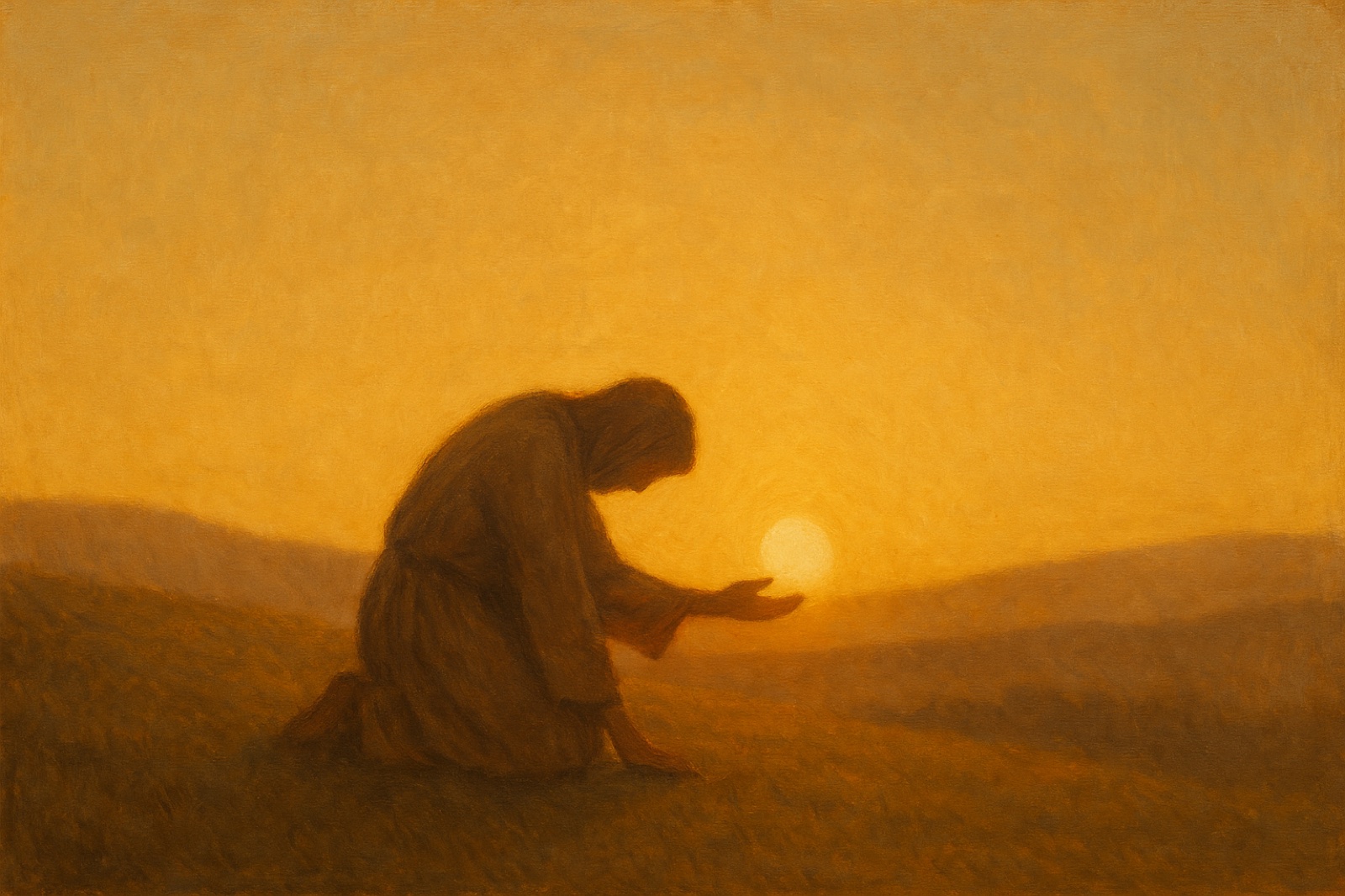
Proskuneō is a question of orientation, so try an orientation check this week. At the end of one day, ask: What did I keep turning toward today? The phone, the approval of one particular person, the bank balance, the next thing to fix? Whatever you kept facing is where your small, daily kisses went.
Then deliberately turn. It doesn’t need a mountain or a service. Wherever you’re sitting, face God on purpose for one minute: bow your head, open your hands, say something true. That’s proskuneō in its simplest form. And remember the other half of John 4: while you’re turning toward God, God has already been out looking for you.
Journal Prompts
- The Samaritan woman’s question was really “which way should I face?” What “mountain” (a place, a church style, a feeling, a routine) have you come to think worship depends on?
- Peter told Cornelius, “Stand up; I myself also am a man.” Which person, achievement, or thing in your life have you been quietly bowing toward, and what would it look like to let it tell you to stand up?
- Matthew 28:17 says the disciples “worshipped him: but some doubted.” Where are you holding back from worship because you’re waiting for your doubts to clear first?
Prayer
Lord, I’ve spent so much of my attention bowing toward things that were never meant to hold it. Turn me around. Teach me proskuneō, the kind of worship that faces You on purpose, whether I’m in a sanctuary or at a kitchen sink, whether I feel certain or I’m full of questions. Thank You that before I ever turned toward You, You came looking for me. Wherever I am today, let this be the direction I face. Amen.
Share This
Found this helpful? Here are two you can copy and post:
“The Greek word for worship, proskuneo, literally means ‘to kiss toward.’ Worship in the New Testament is never aimed at nothing. The real question is always: who are you facing?” [Post URL]
“In John 4, Jesus uses the word for worship ten times in five verses, then takes the mountain out of it. Worship stopped being about where you stand and became about who you face.” [Post URL]
FAQ
What does proskuneo literally mean?
Proskuneō combines pros (“toward”) and kuneō (“to kiss”), so its root picture is “to kiss toward.” In practice it described acts of homage: kneeling, falling face-down, or kissing someone’s feet, hand, or the ground before them. By New Testament times it was the standard Greek word for bowing down in worship, and it’s the word the Septuagint used to translate the Hebrew shachah.
Does proskuneo always mean worshipping God?
No. The word describes the act of homage, and context tells you who receives it. In Matthew 18:26 a servant in a parable does proskuneō to a king. Cornelius does it to Peter in Acts 10:25, and John does it to an angel in Revelation 22:8. Both of those last two are immediately corrected, which shows the New Testament writers knew how easily the gesture could be aimed in the wrong direction.
Is proskuneo used for worshipping Jesus?
Yes, repeatedly. The wise men worship the child Jesus (Matthew 2:11), the disciples worship him in the boat (Matthew 14:33), the healed blind man worships him (John 9:38), the women worship the risen Jesus while holding his feet (Matthew 28:9), and Hebrews 1:6 says “let all the angels of God worship him.” Unlike Peter and the angel, Jesus never refuses it.
What does it mean to worship “in spirit and in truth”?
In John 4:21-24 Jesus contrasts this with worship tied to a particular mountain or city. “In spirit” points away from a physical location toward worship empowered by God’s Spirit and offered from the inner person, and “in truth” points to worship that is genuine and rightly aimed, in line with who God really is. Christians discuss the fine details, but the core of the passage is clear: worship no longer depends on where you stand, but on whom you face.
The same God who spoke to Moses wants to speak with you today.
If proskuneō left you wanting to turn toward God in ordinary moments, not just on Sundays, this free guide is the practical next step: a simple 3-step rhythm for experiencing God’s presence every day, even when life feels chaotic.