 0
0
 0
0
You’re not failing. You’re flooded.
If your days feel like a sprint through wet cement—heavy, sticky, and somehow still not getting you where you want to go—you are not alone. You keep adding more hacks, more lists, more tabs. You answer messages at red lights. You tell yourself “once I get through this week” almost every week. And then you’re lying in bed, scrolling, half-panicked, half-numb, wondering why it never feels like enough.
Here’s the part no one says out loud: being constantly busy can make you feel virtuous. Needed. Safe. It’s a socially acceptable way to hide the fear that if you stopped, even for a minute, the important pieces would scatter. Or worse—you might have to sit with what you’re actually feeling.
Busyness is rarely the root problem. It’s usually the cover story.
Underneath the calendar alerts and emergency emails is something quieter: a struggle to choose. Not because you’re lazy or disorganized, but because caring about many things is costly. You’ve been told everything is important, and your brain believes it. So you juggle it all and judge yourself for dropping anything. “If I were stronger, I could hold more,” you think. But that’s not strength. That’s self-punishment dressed up as productivity.
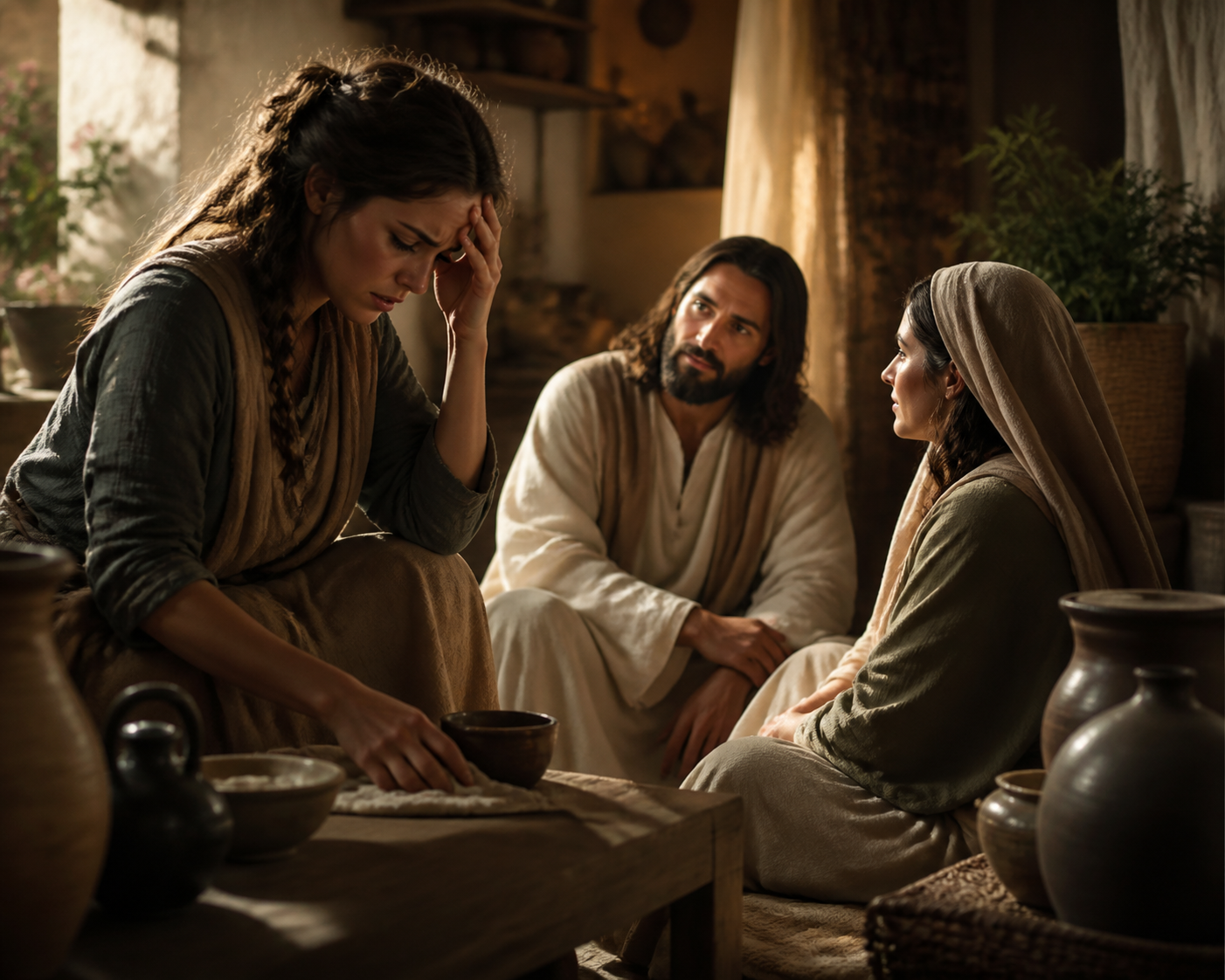
There’s a moment that keeps returning to me. A friend once put it this way: “You’re not behind. You’re just mis-aiming your attention. Only one thing needs you right now.” He told me he first encountered the idea in a line from an old text—Luke 10:41—which basically says, “You’re worried and upset about many things,” and gently suggests that only one thing is truly needed in the moment. It doesn’t require any religious framework to land. It’s just quietly profound wisdom that happens to have ancient roots.
The real shift isn’t getting more done. It’s learning to choose what to do now, and give it your full weight.
We think we’re drowning in tasks. But we’re actually drowning in unmade decisions. We’re in the middle of ten conversations at once, answering none of them fully. We’re trying to be ten selves in one hour. That’s why you feel split. That’s why you can’t unclench.
So let’s choose. Not forever. Not for the year. Just for the next meaningful window of time. And then choose again.
Here’s how to step out of the flood and back into agency—not by abandoning your responsibilities, but by focusing them.
First, pause long enough to see what’s really happening. Overwhelm is often a physiological event, not a character flaw. When your body is operating in threat mode, your brain naturally scans for danger, inflates worst-case scenarios, and fixates on everything at once. That’s not you “failing.” That’s your nervous system trying to keep you alive. No amount of shaming or shoving yourself will fix it. What works is gentler and more practical than that.
Then, reframe the goal. Efficiency is not the prize. Presence is. Getting through everything isn’t a life. Doing the right thing at the right time—with your full attention and a grounded body—is. It’s amazing how often a single well-aimed hour will undo the emotional knot that a week of frantic multitasking cannot touch.
Here are some ways to practice this in real life.
Choose one thing for the next hour, and make it winnable. The question that changes everything is this: “If I could only do one thing in the next hour that would move my life forward, what would it be?” You’re not choosing the most glamorous task. You’re choosing the most consequential one for this moment. Write it down. Then make it concrete: “Draft the first paragraph of the email,” not “work on the email.” “Load the washer,” not “clean the house.” Winnable means your brain can see the finish line before it starts, which lowers resistance and keeps you from numbing out mid-task. Set a 45–60 minute timer. Put your phone in another room. Close everything except what you need. Then, do the one thing. Don’t bargain with it every three minutes. When the timer goes off, step away on purpose, not in defeat.
Create a worry parking lot and return to it on schedule. Overwhelm grows in your head because it has no walls. Give it walls. Keep a sheet of paper titled “Worries I Don’t Have to Solve Right Now.” Every time your brain throws a new flaming baton at you, drop it on the page. That includes things you can’t do anything about at 2 p.m. on a Tuesday: the interview next week, the future of your industry, what someone might be thinking about you. Then carve out a small, contained window daily or every other day—fifteen minutes—to review the list with two highlighter colors: one for “actionable now” and one for “legit but not today.” For anything actionable, use an if-then statement: “If it rains on the day of the event, then we’ll move it indoors. Email the venue by Thursday.” Your brain relaxes when uncertainty has a home and a plan, even if the plan is “not now.”
Renegotiate expectations you never actually agreed to. The heaviest part of overwhelm is often invisible agreements: the ones you made in silence. The expectation that you’ll reply instantly. That you’ll be available late. That you’ll say yes because you always do. You can change those. Try this sentence—it’s simple, honest, and disarming: “I can do A by Friday, or B by Wednesday. Which would you prefer?” You don’t need an apology paragraph. Just a clear option. Another helpful question when someone tosses you a “small ask”: “If this slips to next week, what happens?” Most of the time, the answer is “nothing.” You don’t have to be rude to build boundaries; you just have to stop trying to win at a game with no finish line. Remember the glass-and-rubber rule: some balls are glass (health, a child’s safety, a critical deadline) and some are rubber (most emails, nearly all social expectations). Glass must not be dropped. Rubber can bounce. Let it.
Stabilize your body so your brain can prioritize. You can’t out-think a dysregulated nervous system. Before you attempt to “fix your life,” get your physiology on your side. Do the simplest version available to you: a two-minute “physiological sigh” (two short inhales through the nose, one long exhale through the mouth, repeat 5–10 times). Or splash cold water on your face for 30 seconds. Or walk around the block without your phone, letting your eyes look far into the distance to tell your brain you’re not trapped. Caffeine is gasoline on anxiety; if you’re shaky by 11 a.m., trade one coffee for water or food and see how your day changes. Sleep will fix more overwhelm than any planner. None of this is glamorous. All of it is effective.
Build tiny rituals of presence that don’t depend on willpower. Discipline helps; design saves. Choose two or three “touchpoints” in your day that you’ll treat as sacred, not in a grand sense, but in a small, human one. Maybe it’s the first three bites of every meal with your phone away. The first five minutes after you walk in the door—no chores, no screens, just land in your home. Or the first sip of coffee, taken while looking out a window, naming one thing you’re grateful to have survived. Rituals are anchors. They tell your nervous system: here, in this small moment, is where you get to just be a person. When your brain trusts there will be these pockets of presence, it won’t fight you as hard the rest of the day.
There’s a subtle courage in choosing one thing, especially when your identity has been tangled up in being the person who holds everything. You might worry that letting go of the constant juggling will make you less valuable. Here’s the truth that busy culture keeps hiding from us: doing fewer things with your whole self makes you more trustworthy, not less. People don’t need your constant availability as much as they need your clear attention when it actually matters.
Also, a word for the season you’re in. Sometimes you’re not overwhelmed because you’re doing it wrong. You’re overwhelmed because this moment of life is truly hard—young kids, health issues, grief, a demanding job, a fragile parent, or some combo of all of it. The point isn’t to shame you into better systems. It’s to offer you a sturdy way to move through reality without abandoning yourself. Choosing one thing is mercy, not a hack.
When you practice this—one hour, one thing—you’ll notice something strange. The panic loosens. Tasks still exist, but they stop shouting. You’ll discover that a completed, meaningful action does more for your sense of peace than ten half-started ones. You’ll also find that what you were scared to face (the conversation, the budget, the blank page) is painful, yes, but survivable. Most of all, you’ll taste the relief of being here, with what’s actually in front of you, instead of everywhere else at once.
A small personal confession: I used to measure days by how much I could pile into them. If I went to bed wrung out, I felt like I’d done my job. It took me a long time to see that exhaustion wasn’t proof of worth. It was often proof I’d ignored the one thing that needed me for the ten that didn’t. The first day I tried the “one hour, one thing” approach, I finished a project I’d been dreading for weeks. It didn’t fix my whole life. But it gave me back a kind of quiet I’d been missing. Then I chose again the next hour. And again the next day. This is not a one-time decision. It’s a way of moving through your life that keeps you human.
Today, you will be asked to care about a hundred things. Many of them will matter. Only one will need you in the next hour. Choose that one. Let the rest wait their turn. And when your mind insists it’s all equally urgent, remember that old wisdom: you’re worried about many things—and that’s understandable—but only one thing is needed right now. Not forever. Just now.
So, what’s the one thing you’ll give your full attention to in the next hour—and what will you gently let wait?
If positive Biblical wisdom matters to you, I’d love your support of the mission
Q&A about Luke 10:41
I’m feeling like Martha—constantly busy and stressed. How do I actually slow down and put Jesus first?
In Luke 10:41-42, Jesus tells Martha she’s anxious and that Mary chose the better part by sitting at His feet. Practically, set a daily, protected time with Him in Scripture and prayer; Jesus promises rest for the weary in Matthew 11:28-29. When you start with His words, service flows from abiding, as John 15:5 teaches.
Did Jesus criticize Martha for serving? I’m worried my ministry hustle is wrong.
In Luke 10:41-42, Jesus redirects Martha’s worry and distraction, not the goodness of serving. Serve wholeheartedly unto the Lord (Colossians 3:23), but guard your soul by coming to Him first. If you’re burned out, cast your cares on Him because He cares for you (1 Peter 5:7).
How can I practice choosing the “one thing necessary” when my to-do list is packed?
Follow Jesus’ pattern of withdrawing to pray, like He did early in the morning in Mark 1:35. Start with 10–15 minutes at His feet by reading a Gospel passage and praying it back; seeking God’s kingdom first brings order to everything else (Matthew 6:33). As you abide in His words, you bear fruit without striving (John 15:7-8).
My family or church keeps expecting me to do more, but I feel called to slow down like Mary—how do I handle that without guilt?
Jesus affirmed Mary’s choice even when others expected more from her (Luke 10:41-42), so you can kindly say yes to Him even when you must say no to people. Aim to please God rather than people, as Galatians 1:10 warns against seeking human approval. The early church set wise limits to stay devoted to the word and prayer (Acts 6:2-4), so set boundaries that protect your time with Christ.