 0
0
 0
0
You’ve probably touched a “forever chemical” today without knowing it. It’s in the coating on your nonstick pan, the waterproofing on your jacket, the grease-resistant liner in your fast food wrapper, and — according to biomonitoring studies — very likely in your bloodstream right now. Scientists call them PFAS, short for per- and polyfluoroalkyl substances. Everyone else just calls them “forever chemicals,” because for nearly a century, nothing on Earth could break them down.
Until this year.
A research team just published two separate methods that do something chemists have spent decades saying was basically impossible: they break the bond that makes a forever chemical “forever.” It’s not a fix for the planet’s PFAS problem yet — but it’s the first real crack in a wall that wasn’t supposed to have one.
What Exactly Is a “Forever Chemical”?
PFAS aren’t one chemical — they’re a family of more than 10,000 synthetic compounds, all built around a carbon-fluorine bond, which happens to be one of the strongest bonds in organic chemistry. That strength is exactly why PFAS became so useful starting in the 1940s: they resist heat, water, oil, and stains better than almost anything else humans have ever manufactured. That’s why they ended up in nonstick cookware, waterproof fabric, food packaging, cosmetics, and firefighting foam used at airports and military bases for decades.
But the same bond that makes PFAS so useful is also why they don’t go anywhere once they’re released. They don’t break down in water treatment plants. They don’t break down in soil. They don’t break down in a landfill over decades. Most don’t even break down inside the human body — which is how they’ve ended up detectable in the blood of an estimated 97% of people tested in U.S. biomonitoring studies, according to CDC data. “Forever” isn’t marketing hyperbole here. It’s closer to a literal description of the molecule’s chemistry.
Why “Forever” Turned Into a Real Problem
For a long time, PFAS contamination was treated as a background nuisance — present, but not urgent. That’s changed. Research over the past decade has linked certain PFAS compounds to thyroid disruption, immune suppression, elevated cholesterol, developmental effects in children, and increased risk of specific cancers, including kidney and testicular cancer. The EPA has since set health advisory limits for PFAS in drinking water so low they’re measured in parts per trillion — essentially, “as close to zero as we can currently detect.”
The bigger problem has always been cleanup. Standard water treatment doesn’t touch the carbon-fluorine bond. Filtering PFAS out of water with activated carbon or reverse osmosis just relocates the chemical — it doesn’t destroy it. Somebody still has to deal with the concentrated PFAS waste left behind, and until recently, there wasn’t a reliable, affordable way to actually break the molecule apart rather than just move it somewhere else.
The Breakthrough Nobody Expected This Year
That’s what makes the new research, out of the Helmholtz-Zentrum Dresden-Rossendorf (HZDR) in Germany, worth paying attention to. The team developed and tested two separate methods for actually degrading PFAS in water rather than just filtering it out.
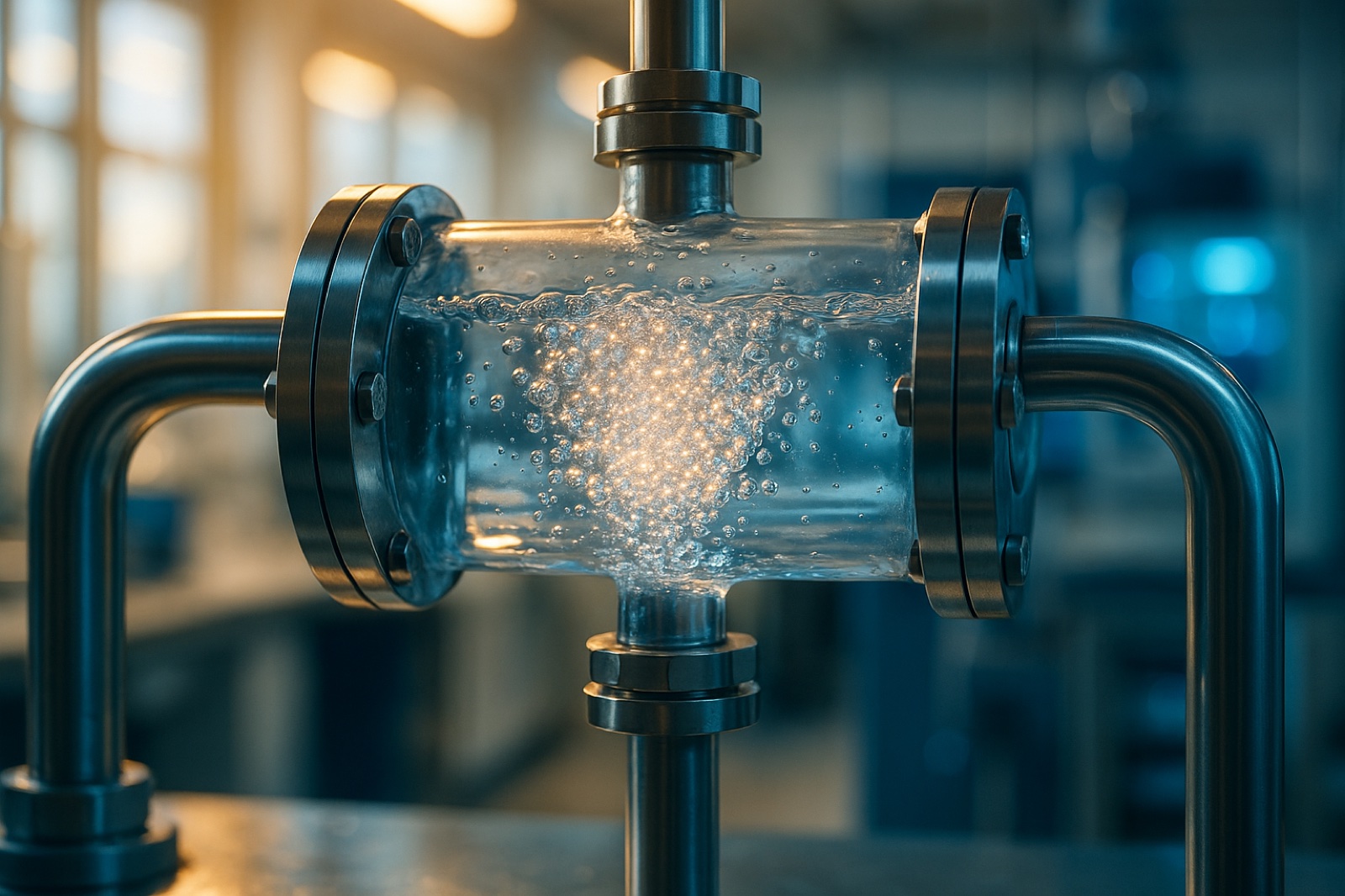
The first uses hydrodynamic cavitation — essentially forcing water through a system that generates and collapses microscopic bubbles at extreme speed. The violent collapse of those bubbles creates localized pockets of intense heat and pressure, and PFAS molecules that concentrate at the bubble’s surface get torn apart by the force. In testing, this method degraded roughly 37% of PFOS (one of the most studied and most persistent PFAS compounds), with confirmed mineralization of the fluorine — meaning the fluorine was actually released from the compound, not just displaced.
The second method uses cold atmospheric plasma combined with gas dispersion, exposing PFAS-contaminated water to a stream of highly reactive plasma. This one performed even better in lab testing — nearly complete degradation of a range of different PFAS compounds, with about 35% of the total bound fluorine released in the process. The findings were published this year in Chemical Engineering Journal Advances and Scientific Reports.
Neither method is ready to scale up to a municipal water plant tomorrow — the researchers themselves describe this as a foundation for future, larger-scale treatment systems, not a finished product. But for a class of chemicals that have been treated as functionally indestructible for eighty years, “nearly complete degradation” in a lab is a genuinely big deal.
What “Permanent” Actually Means
Here’s the part that’s stuck with me since reading about this research: for eight decades, “forever chemical” wasn’t a scare tactic — it was simply accurate. Every test, every treatment plant, every filtration method confirmed the same thing, over and over: this bond does not break. And then a team of scientists found the exact right combination of pressure and energy, and it did.
People carry their own version of “forever chemicals” — the mistake that feels permanently fused to your identity, the family pattern you’re sure you inherited and can’t undo, the shame that’s outlasted every attempt to talk yourself out of it. Most of us have at least one thing we’ve quietly decided is just part of the chemistry now — too bonded-in to ever actually come apart. It’s worth noticing that even actual, literal forever chemicals — built to resist everything — weren’t as permanent as their name promised. Something bigger than a lab has been in the business of taking apart what looks unbreakable a lot longer than we’ve had the equipment to measure it.
If any of that sounds familiar — a pattern in your family you assumed you were stuck repeating, or a version of guilt that’s followed you for years — this honest look at whether the things passed down to us are really as permanent as they feel is worth a few minutes. And if it’s less about what was passed to you and more about something you did, this piece on forgiving yourself gets specific about the difference between guilt that’s doing its job and guilt that’s just overstayed its welcome. There’s also a quick, honest two-minute assessment — Am I Ready to Forgive? — for anyone who’s been carrying something and isn’t sure whether they’re ready to actually set it down.
So, What Happens Next
The realistic version of this story is unglamorous: more testing, more funding, more years before either method shows up in an actual water treatment plant near you. PFAS isn’t leaving your bloodstream or your local water supply this week because of a study published in a chemistry journal.
But the myth that “forever chemical” was a fixed, unbreakable category — that’s already gone. It broke the same week two research teams in Germany proved it could. Whatever you’ve quietly filed away as permanent might be worth a second look too.
Discussion Question
If scientists can prove that even a molecule engineered specifically to never break down eventually can — what’s something in your own life you’d filed away as “just permanent” that might actually be more breakable than you’ve assumed? We’d genuinely like to hear your answer in the comments.
Share This
- Scientists just found two ways to break down “forever chemicals” — the ones that were never supposed to break down at all. Wild how something engineered to be permanent… wasn’t. 🧪
- PFAS got the nickname “forever chemicals” because nothing could touch them. Turns out that was true right up until it wasn’t. New research out of Germany just cracked it.
- Every test for 80 years said this molecule couldn’t be broken down. Then two labs found the exact combination of pressure and energy that could. Makes you wonder what else we’ve quietly decided is “just permanent.”
Frequently Asked Questions
What are “forever chemicals,” exactly?
“Forever chemicals” is the common nickname for PFAS (per- and polyfluoroalkyl substances), a family of more than 10,000 synthetic chemicals built around a carbon-fluorine bond — one of the strongest bonds in organic chemistry. That bond makes them resistant to heat, water, and stains, which is why they’ve been used in nonstick cookware, waterproof fabric, food packaging, and firefighting foam since the 1940s. It also means they don’t naturally break down in water, soil, or the human body.
Can PFAS (forever chemicals) actually be destroyed now?
As of 2026, researchers at the Helmholtz-Zentrum Dresden-Rossendorf (HZDR) in Germany have published two lab-tested methods — hydrodynamic cavitation and cold atmospheric plasma with gas dispersion — that successfully degrade PFAS in water rather than just filtering it out. The plasma method achieved near-complete degradation of a range of PFAS compounds in testing. Neither method is yet deployed at municipal water-treatment scale.
Are forever chemicals dangerous to human health?
Research has linked certain PFAS compounds to thyroid disruption, immune suppression, elevated cholesterol, developmental effects in children, and increased risk of specific cancers, including kidney and testicular cancer. The EPA has set extremely low health advisory limits for PFAS in drinking water as a result. PFAS are detectable in the blood of an estimated 97% of people tested in U.S. biomonitoring studies.
Why couldn’t PFAS be broken down before this research?
The carbon-fluorine bond at the core of every PFAS molecule is exceptionally strong and stable. Standard water treatment methods, like activated carbon filtration or reverse osmosis, can remove PFAS from water but don’t break that bond — they just relocate the chemical, leaving concentrated PFAS waste that still needs to be dealt with.
Where was this new PFAS research published?
The findings were published in 2026 in Chemical Engineering Journal Advances and Scientific Reports, from a research team at the Helmholtz-Zentrum Dresden-Rossendorf (HZDR) in Germany.