 0
0
 0
0
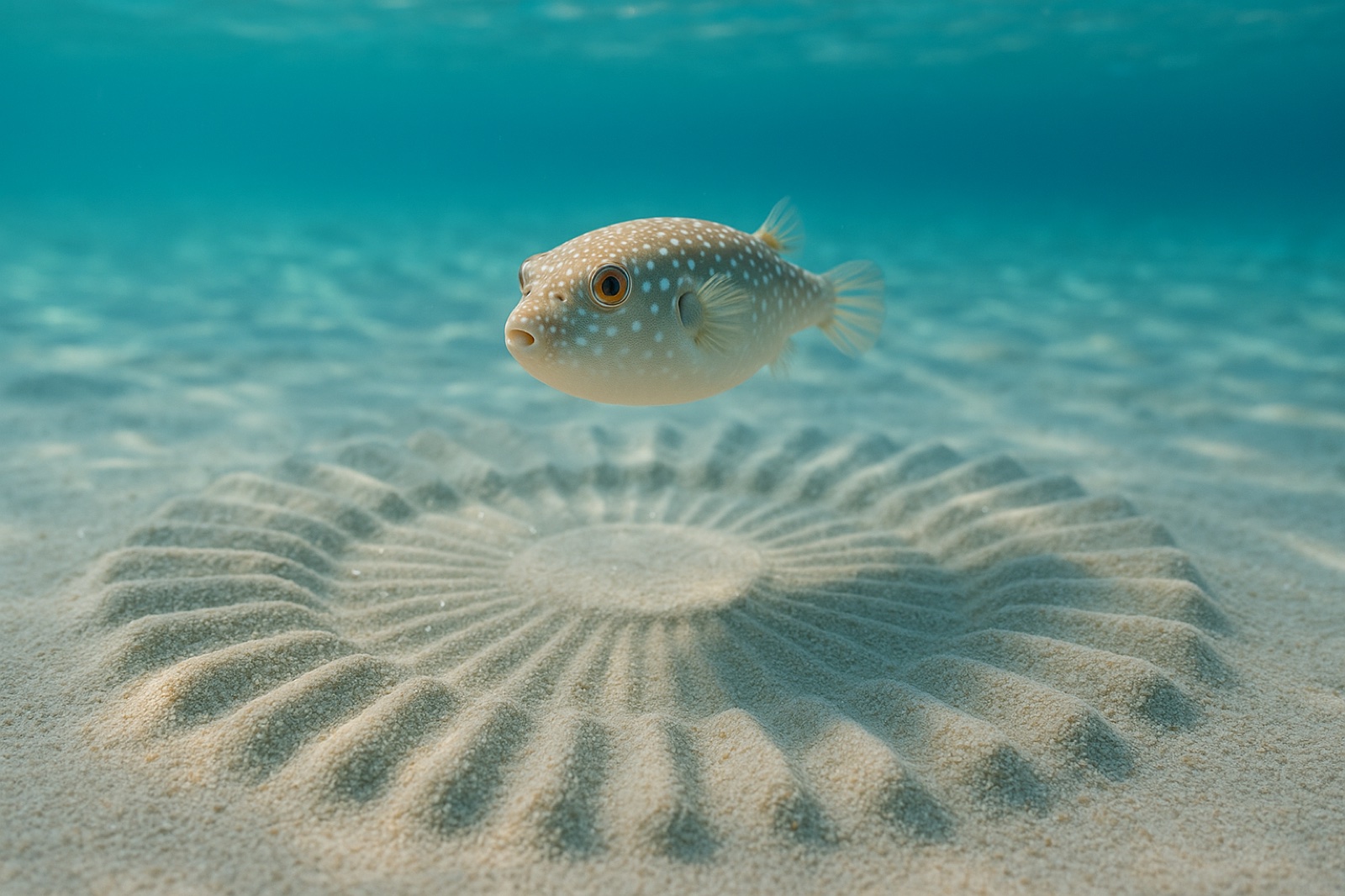
If you dropped a compass, a ruler, and a few days of patience onto the ocean floor, you might eventually draw something like this. A perfect circle, six feet across, made of dozens of ridges radiating out from a smooth center like spokes on a wheel, each one spaced with almost unnerving precision. Now take away the compass. Take away the ruler. Take away the days of patience, too — because the artist responsible for these pufferfish sand circles is a fish about the size of your hand, working alone, with nothing but its fins and its body.
The first time divers found one of these formations off the coast of Japan, some of them assumed it was a hoax — a prop, or maybe an art installation someone had staged on the seafloor for a laugh. It wasn’t. It was a nest. And the fish that built it had never seen another one before in its life.
The Fish Behind the Circle
The builder is a male white-spotted pufferfish, Torquigener albomaculosus — a fish that tops out at around five inches long, roughly the length of a dollar bill. Divers first documented the circles in the shallow waters near Amami-Ōshima, Japan, and for a while, nobody could figure out what — or who — was making them. Some guessed ocean currents. Some guessed a strange coral formation. It took underwater cameras, run continuously for days, to catch the real answer: a lone male pufferfish, plowing furrows into the sand with the edge of his fin, over and over, for roughly a week straight.
He doesn’t sketch it out first. He doesn’t have a model to copy. Nothing about his upbringing involved watching an older pufferfish do this — pufferfish don’t raise their young, and by the time this male is old enough to build, any adult who might have shown him how is long gone. He just starts. And what comes out of that instinct is one of the most mathematically precise structures found anywhere in the animal kingdom.
The Math No One Taught Him
Here’s where it stops being just a pretty pattern and starts being genuinely strange. The ridges in a pufferfish circle aren’t just decorative — they’re functional, and the fish appears to be solving for more than one variable at once.
The spacing between each ridge has to account for the size of the sand grains he’s using; too fine and the ridges collapse, too coarse and they won’t hold a sharp edge. The overall shape has to account for water movement — a circle built to catch light one way in still water would get flattened and blurred by current, so the ridges are angled to diffuse the flow evenly around the whole structure, keeping the finer sediment concentrated in the center where it matters most: that’s where the eggs will eventually go. Even the slight imperfections aren’t sloppiness. Researchers have found the outer ridges are intentionally less uniform than the inner ones, which seems to help break up wave energy before it reaches the nest’s core — a kind of built-in shock absorber that a perfectly rigid circle wouldn’t have.
Put plainly: a fish with no formal training in fluid dynamics, sediment mechanics, or geometry is running what amounts to a live engineering calculation, adjusting for current and grain weight in real time, using a brain a fraction of the size of a pea. And he gets it right. Females inspect the finished circles — the finer, more evenly distributed the sand in the center, the more attractive the nest, and the more likely she is to lay her eggs there. The males whose circles don’t hold up structurally simply don’t get chosen. Precision isn’t a flourish here. It’s survival.
Once mating happens, the eggs are laid in the very center of the pattern. The male guards them for days until they hatch — and then, within a tide cycle or two, the whole intricate structure is gone, smoothed back into ordinary sand, waiting for the next male to start over from nothing.
An Old Kind of Design
It’s tempting to file this under “cool animal fact” and move on. But sit with it for a second longer, because the strangeness doesn’t fully resolve. Instinct usually gets described like it’s the opposite of intelligence — the dumb, automatic stuff a creature does without thinking, as if it’s somehow lesser than a calculated decision. But watch a pufferfish account for water current and sediment weight without a single lesson, and “automatic” starts to sound like the wrong word entirely.
There’s an old idea, older than modern science, that shows up again and again in humanity’s oldest wisdom writing: that the natural world wasn’t just left to figure itself out by trial and error. That the instinct wound into a fish, a bird, or a spider’s web wasn’t invented by the creature at all — it was placed there, complete, before the creature ever needed it. Ancient wisdom traditions have long pointed to exactly this kind of thing — the animals that somehow already know — as evidence that intention runs deeper into creation than we usually give it credit for. Not chaos figuring itself out. Something built with a plan already inside it — the kind of thing a lot of people, across a lot of centuries, have simply pointed to and called God. If you’re curious how much further that thread runs, Bible Answers is a free tool worth a few minutes — it opens in ChatGPT and is built to explore exactly this kind of question.
You don’t have to resolve that question today to notice it’s a genuinely strange thing to be true. A creature with no teacher, no blueprint, and no memory of the last generation’s work — still gets it right, every single time, on the first try. That’s not luck repeating itself. That’s something closer to a plan.
What Stays With You
It’s not the only place in nature where something “just knows” more than it should. Researchers studying giant daisies on the Galápagos Islands found something similar — separate populations arriving at the exact same solution to a problem, using completely different genetic paths to get there, as if the answer existed before the question did. And it’s the same quiet suspicion that shows up when people start asking why their own bodies are built the way they are — that the details weren’t accidental, even the ones that seem too small to matter.
You probably won’t see one of these circles in person. Most people never will — they’re built in shallow water off a handful of Japanese islands, and they only last a few days before the tide erases them. But it’s a strange kind of comfort, knowing they’re down there anyway. A small fish, alone on the ocean floor, quietly doing something it was never taught, getting it exactly right, for no audience at all except the one it’s hoping will notice.
Discussion Question
Do you think instinct like this is just biology running on autopilot, or something closer to a plan built in from the start? What’s changed if it’s the second one?
You Might Also Wonder
Q: Why do pufferfish build circles in the sand?
A: Male white-spotted pufferfish (Torquigener albomaculosus) build large geometric circles on the seafloor to attract a mate. The finer sand grains concentrated at the center of a well-built circle signal to females that the site is a strong place to lay eggs, so the quality of the structure directly affects whether a male gets chosen.
Q: How long does it take a pufferfish to build a sand circle?
A: A single male typically works almost continuously for about seven to nine days to complete one circle, using the edge of his fin to plow the ridges and grooves into the sand.
Q: How big are pufferfish sand circles?
A: Fully finished circles can measure up to roughly six to seven feet across, built entirely by a fish that’s only about five inches long — more than fifteen times its own body length.
Q: Do pufferfish learn to build these circles, or is it instinct?
A: It’s instinct, not learned behavior. Pufferfish don’t raise their young or pass down skills between generations, so each male builds his first circle with no prior example to copy, and still gets the structure and proportions right.
Q: Where can you see pufferfish sand circles?
A: They were first documented in shallow coastal waters near Amami-Ōshima, Japan, and remain the best-known location for observing them, though the structures only last a few days before tides smooth them away.
Worth Sharing
A fish the size of a dollar bill builds a perfect geometric circle in the sand — accounting for water current and grain size — with zero training and no example to copy. Nature keeps outdoing itself. 🐡
Just learned that male pufferfish spend a week straight building these insanely precise circular nests on the ocean floor, ridges, spacing, the whole thing, and nobody ever taught them how. Some things just seem to already know.
The math in a pufferfish’s sand circle is more careful than most human first drafts. No teacher. No blueprint. No mistakes. Just instinct doing exactly what it was built to do.