 0
0
 0
0
Someone at the table says it like it’s obvious: “The Bible’s full of made-up details — whoever wrote it just wanted it to sound convincing.” You nod, because arguing feels like more trouble than it’s worth. But later, alone with your thoughts, the comment doesn’t leave. You start wondering which parts you’d actually be able to defend if someone pushed.
Here’s one worth knowing. It’s a small detail — five words, really — that critics used for over a hundred years as proof a Bible writer had gotten something wrong. Then people with shovels went looking. What they found is still sitting in the ground in Jerusalem today, and it changes what “made up” actually means.
The Detail That Should Have Given Him Away
In John chapter 5, the apostle John tells a story about Jesus in Jerusalem, near a place he describes with unusual precision:
“Now there is at Jerusalem by the sheep market a pool, which is called in the Hebrew tongue Bethesda, having five porches.” (John 5:2, KJV)
Five porches. Not “a pool.” Not “some porches.” Five — a specific number, on a specific structure, with a specific name, in a specific part of the city. That’s the kind of detail an eyewitness includes without thinking twice. It’s also the kind of detail that gets a writer caught if he’s never actually been there.
For a long stretch of the 19th and early 20th centuries, that’s exactly the argument scholars made. No pool called Bethesda had ever been found. The name itself showed up differently across ancient manuscripts — Bethesda, Bethzatha, Bethsaida — which some critics read as confusion, not ordinary copying variance. (If manuscript differences like that make you nervous about trusting what you’re reading, this is worth understanding — the short version is that variance in names and wording across ancient copies is normal and expected, and it doesn’t undermine the text the way it sounds like it should.) A five-sided pool with covered colonnades sounded architecturally strange, almost invented for effect. The conclusion followed easily: whoever wrote John’s gospel was writing decades later, from memory or hearsay, filling in details he couldn’t actually verify.
What They Found Under St. Anne’s Church
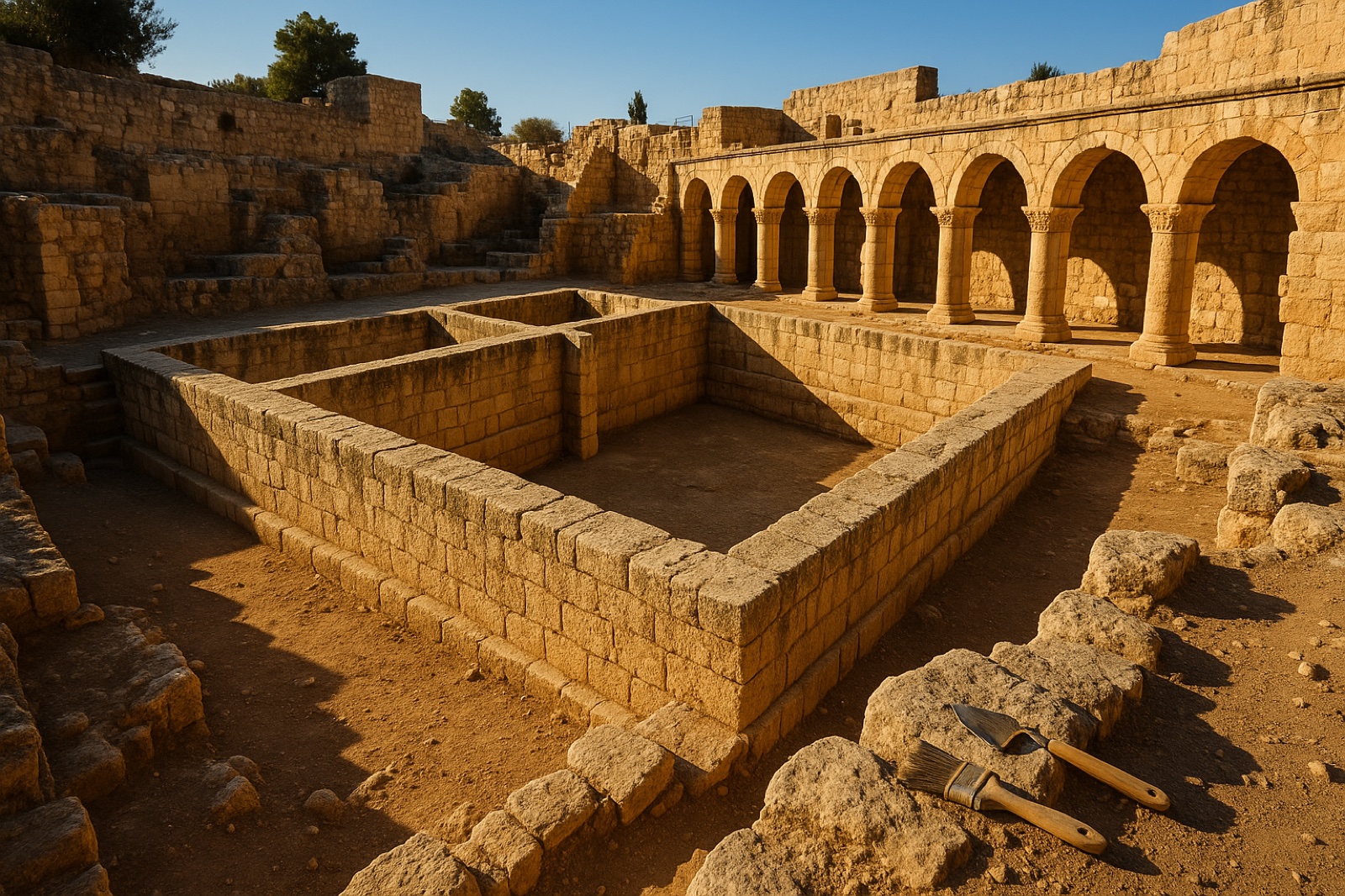
In 1888, archaeologists began digging near the Church of St. Anne in Jerusalem’s Old City, close to where ancient tradition had always placed the pool. What emerged, and kept emerging through excavations across the 20th century, was not one pool but two — a large trapezoidal double pool, divided by a thick central wall running between them.
Now count the porches. One covered colonnade ran along each of the four outer sides of the twin pools. A fifth ran across the top of the dividing wall in the middle, connecting the two. Four sides plus one down the middle. Five porches — on a pool most scholars had confidently said never existed, matching a detail most scholars had confidently said was invented.
It’s not the only time this has happened. The same pattern — a detail dismissed as legend until the ground gave it up — turned King David from a “probably mythical” figure into a name carved on a 2,900-year-old stone. The pool at Bethesda is a smaller story, but the shape of it is identical: the detail that looked like the weak point turned out to be the proof.
The Question Jesus Asked at That Pool
Here’s who John says was actually there, at that very specific, very real pool:
“When Jesus saw him lie, and knew that he had been now a long time in that case, he saith unto him, Wilt thou be made whole? The impotent man answered him, Sir, I have no man, when the water is troubled, to put me into the pool: but while I am coming, another steppeth down before me. Jesus saith unto him, Rise, take up thy bed, and walk. And immediately the man was made whole, and took up his bed, and walked.” (John 5:6-9, KJV)
Thirty-eight years. That’s how long John says this man had been sick — long enough that lying by that pool had become less like hope and more like a habit. Notice what Jesus actually asks him. Not “do you believe I can heal you.” Just: do you want this? It’s a smaller, more honest question than the man is ready for, and he doesn’t even answer it directly. He explains why he can’t — no one to help him into the water, someone else always gets there first. Jesus doesn’t argue with the excuse. He just tells him to get up.
The Detail You Doubt Might Be the One That’s True
Most people don’t lose their faith over the big, dramatic questions. It’s the small, specific claims — a name, a place, a number, a detail that seems too precise to be safe — that quietly convince someone the whole thing might be unreliable. That was the exact reasoning used against Bethesda for over a hundred years, and it turned out to be backward. The specificity wasn’t the weak point. It was the fingerprint of someone who’d actually been there.
You might be carrying a version of that same doubt about something in your own life — not about archaeology, but about whether God’s specific promises to you are as trustworthy as they sound, or whether you’re the exception the details won’t hold up for. And you might also be doing what the man at the pool did: answering a different, safer question than the one you were actually asked. Not “do I believe,” but “here’s why I can’t.” Here’s why this year, this relationship, this diagnosis, this habit is different. Here’s why nobody’s ever gotten there in time for me.
Jesus didn’t need the man’s excuse to be resolved before He healed him. He just needed him to stop explaining and get up.
Something You Can Actually Do Today
- Read it slow, right now. Open your Bible app and read John 5:1-9 — just those nine verses. Notice that Jesus asks a real question before He does anything. Sit with that for a minute before you move to the next thing on your list.
- Write the honest answer, not the safe one. In a notes app, finish this sentence in one line, no editing: “The thing I keep explaining instead of asking for is ___.” Don’t write the polished version. Write the true one.
- Name it out loud to one person. Text someone today — not “pray for me,” but the actual thing. “I’ve been stuck on ___ for a long time and I want to stop explaining why and just ask God for it.” Specific requests tend to get specific answers.
Questions Worth Sitting With
- What’s one detail about your faith you’ve quietly assumed you couldn’t defend if someone pushed on it?
- If Jesus asked you today, “Do you want to be made whole?” — what’s the honest first thing that comes to mind, before the churchy answer does?
- Where in your life have you gotten comfortable explaining a problem instead of asking for it to change?
A Prayer for When You’re Tired of Waiting by the Pool
God, I’ve gotten good at explaining why things haven’t changed. I’m not even sure when I stopped expecting an answer and started just describing the problem instead. I don’t fully understand why some of my doubts hang around as long as they do, but I do believe You’re not shaken by them. Ask me the real question today. Help me stop explaining and just say yes. I want to be made whole. Amen.
Let’s Talk About It
Do you think most people lose their trust in the Bible over the big theological questions, or over small details like this one that just seem too specific to check? Tell us what convinced — or unconvinced — you.
Share This
- “They called it fiction for over a hundred years. Then they found it — five porches and all — exactly where the Bible said it would be.”
- “I used to think the small, specific details in the Bible were the easiest parts to poke holes in. Turns out they’re often the hardest to explain away. #PoolOfBethesda”
- “Jesus didn’t ask the man by the pool if he believed. He asked if he wanted to be made whole. That’s a harder question. I’m still sitting with it.”
Questions People Ask About the Pool of Bethesda
Is the Pool of Bethesda a real archaeological site?
Yes. Excavations beginning in 1888 near the Church of St. Anne in Jerusalem’s Old City uncovered a large twin pool with the remains of covered colonnades, matching the “five porches” John describes in John 5:2. It’s an established, mainstream archaeological find, not a disputed or fringe claim.
Why did scholars doubt the Pool of Bethesda existed?
Before the 1888 excavations, no pool by that name had been located in Jerusalem, and the name itself appeared differently across ancient manuscripts. Combined with the unusual “five porches” detail, many 19th-century scholars concluded the account was invented or inaccurate.
What does “Bethesda” mean?
Bethesda is generally understood to mean “house of mercy” or “house of grace” in Hebrew — a fitting name for the place where John says a man who’d waited 38 years was healed.
What happened to the man Jesus healed at the pool?
According to John 5:6-9, Jesus asked him if he wanted to be healed, told him to rise and carry his mat, and the man was immediately healed after 38 years of illness.
Can you visit the Pool of Bethesda today?
Yes. The excavated site is open to visitors near the Church of St. Anne in Jerusalem’s Old City, and remains one of the more well-preserved biblical archaeological sites in the city.