 0
 0
You Have Been Pushing on the Same Wall for a Long Time
You did not type prayer for breakthrough because you wanted something. You typed it because something will not move. The job search that has gone quiet. The illness that got a little better and then stopped. The same argument in your marriage, on a loop. The habit you have quit eleven times. The money that never quite reaches the end of the month. You have prayed about it so often that the words have gone flat in your mouth, and tonight you went looking for different words.
There is a prayer for breakthrough near the bottom of this page, and you can pray it tonight word for word. But first there is a word underneath the English one, and the Bible uses it in a way almost nobody who types it is expecting. It shows up at a birth, at a battle, at a grave, and then at a gate. By the time you reach the gate, the prayer you came here for will have changed shape.
A Prayer for Breakthrough Has One Hebrew Word Behind It
The Hebrew verb is parats (פָּרַץ, Strong’s H6555). The concordance counts it close to fifty times in the Old Testament, and the root idea is simple: to break through, to burst out, to spread past a boundary. A wall is breached. A flood bursts a bank. A family grows past the edges of its land.
The first time it is attached to a person, that person is a baby. Tamar is in labour with twins, one of them reaches a hand out first, and then the other pushes past him and is born. The midwife says, “How hast thou broken forth? this breach be upon thee: therefore his name was called Pharez” (Genesis 38:29). Pharez, or Perez, means breach. He is named for the breakthrough. The book of Ruth ends with his family line, and it runs straight down to King David.
Then it is David’s turn to use the word. The Philistines have spread out across the valley of Rephaim, David asks God first whether to go up against them, and then he does.
“And David came to Baal-perazim, and David smote them there, and said, The LORD hath broken forth upon mine enemies before me, as the breach of waters. Therefore he called the name of that place Baal-perazim.” (2 Samuel 5:20)
Baal-perazim is parats again, in the plural. Strong’s gives it as “possessor of breaches,” and it is often rendered “the Lord of breakthroughs.” David fought that day, the verse says so plainly. But listen to who gets the verb. David smote. The LORD broke through. And the breaking happened before me, which is the detail to keep in your pocket for later.
The Same Word Named a Grave One Chapter Later
Here is the part that does not make it into most prayers for breakthrough. One chapter after Baal-perazim, David is bringing the ark of God up to Jerusalem on a cart. The oxen stumble, a man named Uzzah reaches out to steady the ark, and he dies on the spot.
“And David was displeased, because the LORD had made a breach upon Uzzah: and he called the name of the place Perez-uzzah to this day.” (2 Samuel 6:8)
Same David. Same habit of naming the ground where something happened. Same root, perez, a breach. One name marks a victory and the other marks a funeral, and the Bible lets one word carry both without apology.
That is not a one-off. At Sinai the priests are warned to prepare themselves “lest the LORD break forth upon them” (Exodus 19:22). Isaiah, centuries after David, reaches back to that same hillside and says the LORD “shall rise up as in mount Perazim” to do “his strange work” (Isaiah 28:21).
So the word you are praying is not a tame one. In Scripture a breakthrough is never a thing a person produces by pushing hard enough or praying the right formula. It is God moving, in power, on God’s own terms, and the people nearby do not get to steer it. If a prayer for breakthrough has ever felt to you like a lever that might work if you pulled it correctly, the Bible’s own use of the word quietly takes the lever out of your hand. That sounds like bad news for about a minute. Then you get to Micah.
Micah 2:13: The Breaker Goes Up Before Them
Micah chapter 2 is angry. It opens on people who lie awake at night planning how to take what is not theirs: “they covet fields, and take them by violence; and houses, and take them away” (Micah 2:2). Then it turns on the preachers who tell those people what they want to hear. For eleven verses it is judgment, and the people hearing it are the ones who have been fenced in, pushed off their land, and told to be quiet.
Then, with no warning at all, the chapter changes key.
“I will surely assemble, O Jacob, all of thee; I will surely gather the remnant of Israel; I will put them together as the sheep of Bozrah, as the flock in the midst of their fold: they shall make great noise by reason of the multitude of men. The breaker is come up before them: they have broken up, and have passed through the gate, and are gone out by it: and their king shall pass before them, and the LORD on the head of them.” (Micah 2:12-13)
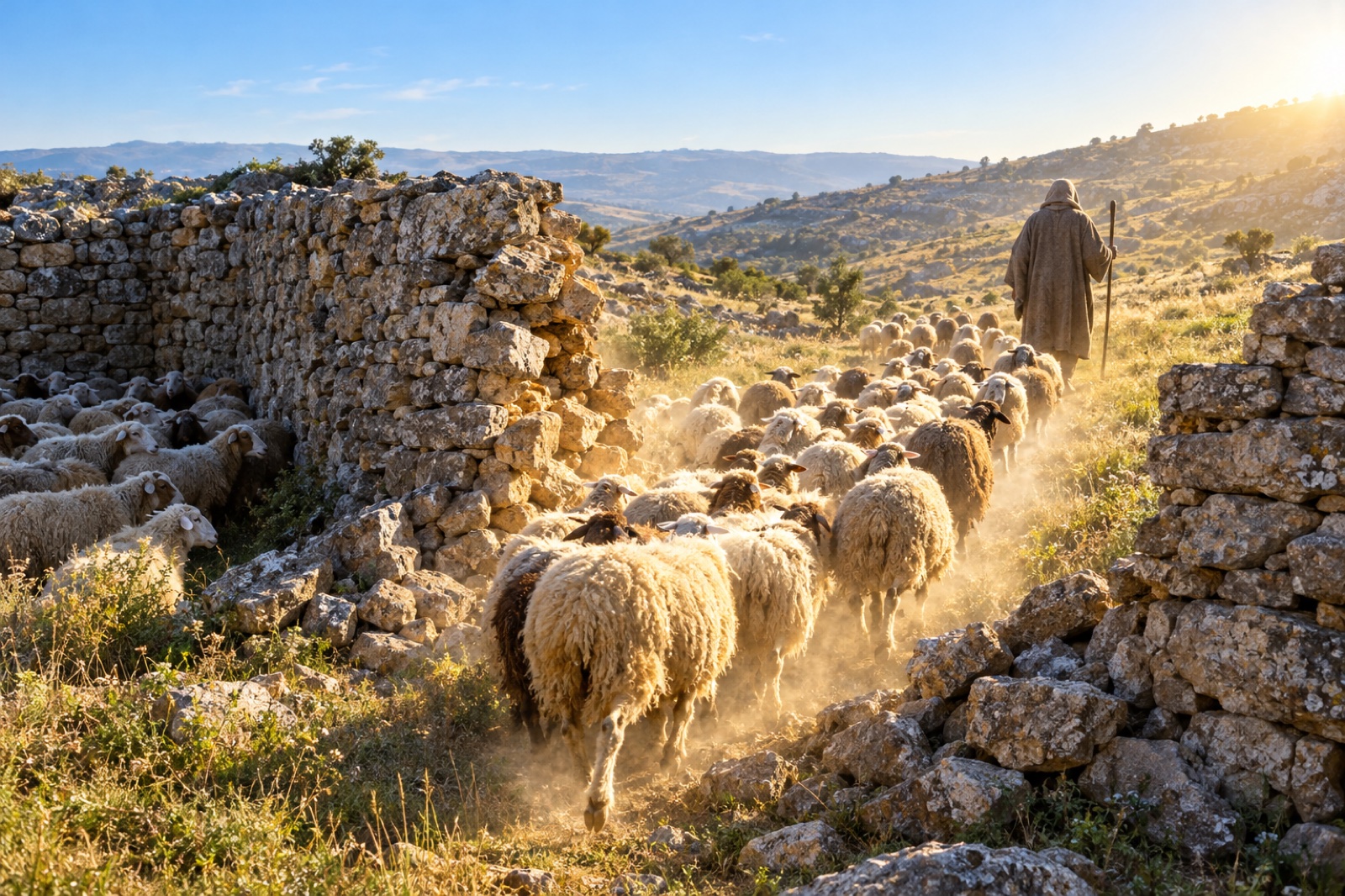
“The breaker” is happoretz, the same verb parats turned into a title: the one who breaks through. The picture is a sheepfold. The flock is penned in, crowded, loud. Someone breaks the wall open. The sheep pour out through the gap. And then the verse tells you, three separate ways, where the leader is standing. The Breaker comes up before them. Their king passes before them. The LORD is on the head of them, at the front of the line.
Readers have argued for centuries about whether the Breaker and the king are two figures or one, and the verse does not settle it in so many words. What it does settle is the direction. Nobody in Micah 2:13 is behind the flock, pushing. Every leading word is out in front.
The Wall Was Never Yours to Break
Now put the two verses side by side, David’s and Micah’s, and notice the small word they share.
David: the LORD hath broken forth before me. Micah: the breaker is come up before them. In Hebrew that is the same word both times, lipne, built on panim, which means face. God’s face is toward the wall. The people’s faces are toward God’s back. In every place where the breakthrough belongs to God, that is the order: God breaks, out in front, and the people walk through what is already open.
Most of us pray for breakthrough the other way round. We are at the wall, shoulder against it, and God is behind us, and the prayer is really a request for more push. Give me the strength to get through this. It is an honest prayer and God hears it. But it is not the shape of a single breakthrough in the Bible. The Bible’s shape is: God goes first, and I follow through the gap.
That changes the words. Not give me strength to break through, but go before me, and show me where you have already broken through.
And here is the second thing Micah does to your prayer. The breakthrough in Micah 2:13 is a gate. Sheep go through a gate one at a time, at a walk. You have probably been watching for a wall to fall, something loud, a flood like Baal-perazim. Micah says it can also look like a line of sheep passing through an opening while the shepherd walks ahead. Which means it is possible to be in the middle of your breakthrough and not know it yet, because you were listening for a crash and it arrived as a gate.
That is not a promise that every wall falls. Paul asked three times for one thing to leave and it stayed, and he wrote the answer down for the rest of us in the thorn in his side. Perez-uzzah is still on the map one chapter after Baal-perazim. But the direction of the Breaker does not change in either case. God is in front. If what you are facing needs more than a wall to move, there is a prayer for a miracle written for that night. And if the gate is open but the walking through it is slow, a prayer for patience asks for a longer fuse instead of a faster answer.
Actions to Take Today
- Name the wall in one sentence. Write it down, plainly, the thing that will not move. Then write one more line underneath: where have you been standing, in front of it pushing, or behind God following? Answer honestly. That line is the whole diagnosis.
- Change one verb. Take the prayer you have been praying for months and swap help me break through for go before me. Say the new version out loud once, tonight. That is the entire change, and it is the one Micah 2:13 makes.
- Find the gate you can already see. Somewhere in this situation there is one small opening you have been walking past: a message you have not sent, a form half filled in, a conversation you keep postponing, an appointment you could book in two minutes. Walk through that gap today. It will not feel like a breakthrough. Sheep go through a gate one at a time.
Journal Prompts
- What wall have you been describing to God for the longest, and what small gate near it have you been walking past?
- When did you decide that your breakthrough would have to be loud? What would it look like if it came at a walk?
- Where in your life is “go before me” a harder prayer to pray than “give me strength”? Why?
A Prayer for Breakthrough
God, I have been pushing on this wall for so long that I forgot you were ever in front of me. You broke through for David before he swung a sword, and you went up before the flock in Micah before a single sheep moved, so go before me now. If there is a gate you have already opened, show me where it is, and give me the courage to walk through it even if it is small and quiet and nothing like the breakthrough I pictured. If the wall stays, keep my face turned toward your back, because I would rather follow you through a gate than break anything on my own. Amen.
Discussion Question
David used the same Hebrew word to name the place of a victory and the place of a death. Why do you think the Bible lets one word carry both? Share your thoughts in the comments.
Share This
The Hebrew word behind “breakthrough” shows up at a birth, then a battle, then a grave, then a gate. God’s breakthroughs are not tame. Praying mine differently tonight.
Micah 2:13: “The breaker is come up before them.” Before. I have spent years shoulder-to-the-wall, asking God for more push, and the whole time the verse had God out in front.
I stopped praying “give me strength to break through.” I started praying “go before me.” Same wall. Completely different prayer.
#PrayerForBreakthrough #Micah213 #BaalPerazim #BreakthroughPrayer
Q&A: Prayer for Breakthrough
What is a short prayer for breakthrough?
A short prayer for breakthrough can be one sentence: “God, go before me, break through what I cannot, and show me the gate you have already opened. Amen.” It follows the order of Micah 2:13, where “the breaker is come up before them” and the people pass through the gate after God has gone first, rather than asking for strength to push through alone.
What does the Bible say about breakthrough?
The Bible’s word for breakthrough is the Hebrew verb parats (Strong’s H6555), meaning to break through or burst out. In 2 Samuel 5:20 David says, “The LORD hath broken forth upon mine enemies before me, as the breach of waters,” and names the place Baal-perazim. In Micah 2:13, “The breaker is come up before them,” and the people pass through the gate behind God. In both passages God does the breaking and does it in front of the people.
Who is the breaker in Micah 2:13?
“The breaker” in Micah 2:13 translates the Hebrew happoretz, “the one who breaks through,” from the verb parats. The verse pictures a penned flock whose wall is broken open so the sheep can pass through the gate, and it ends with “their king shall pass before them, and the LORD on the head of them.” Many readers across the centuries have understood the Breaker as God, or as the promised king, going ahead of the people; the verse itself emphasises that the leader is out in front.
What does Baal-perazim mean?
Baal-perazim (Strong’s H1188) is a place name from 2 Samuel 5:20 and 1 Chronicles 14:11, built from baal, meaning owner or master, and the plural of perets, meaning breach. Strong’s defines it as “possessor of breaches,” and it is often rendered “Lord of breakthroughs.” David gave the valley that name after God broke through the Philistine army “as the breach of waters.” One chapter later, in 2 Samuel 6:8, David used the same root to name Perez-uzzah, where Uzzah died.
Is the word breakthrough in the King James Bible?
The single English word “breakthrough” does not appear in the King James Bible. The KJV translates the Hebrew verb parats with phrases such as “broken forth” (2 Samuel 5:20), “break forth” (Exodus 19:22), and “the breaker” (Micah 2:13), and the related noun perets as “breach” (Genesis 38:29, 2 Samuel 6:8). The idea is there throughout; the one-word form is modern English.
Back to the Wall
The wall is still there tonight. The search is still quiet, the result still says what it says, the loop is still looping. Nothing on this page knocked it down, and the Bible never promised that reading about Baal-perazim would.
But the word changed. You came here asking for strength to get through, and you are leaving with a verse that puts God in front of you instead of behind you, and a gate instead of a crash. The breaker is come up before them. Before. That is where the Breaker stands, and it is the only place the Bible ever puts the One who breaks through.
If you want to, leave one word in the comments naming your wall. No details needed. Other readers will pray that God goes before you through it.