 0
 0
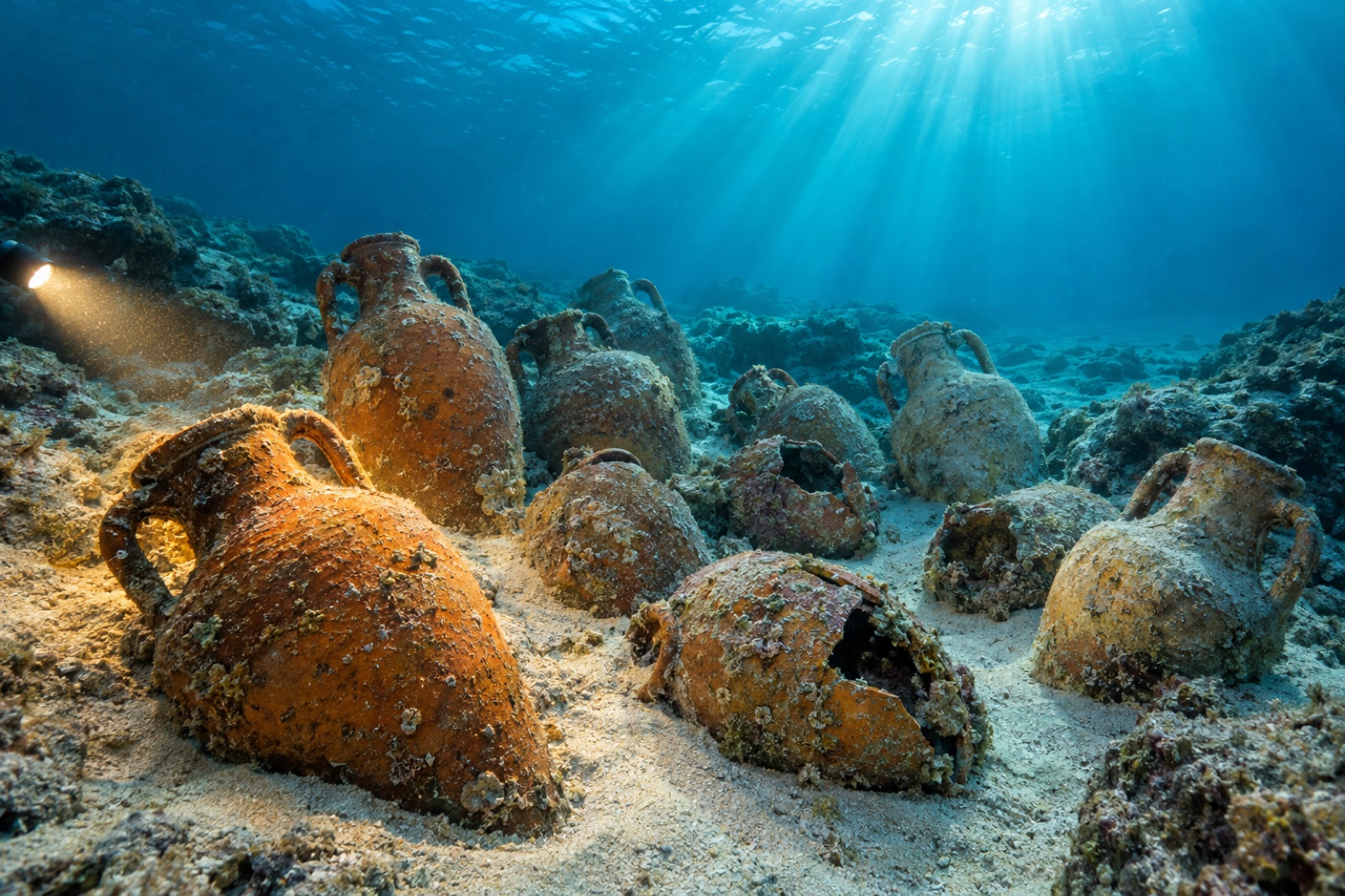
Divers off the south coast of Türkiye went down about 30 metres — roughly 100 feet — and found a cargo lying on the sand. More than 30 large clay jars. Three stone anchors scattered nearby.
What they did not find was a ship.
The wood is not broken. It is not buried. It is gone. Over roughly four and a half thousand years it dissolved so completely that there is nothing left to test. Which creates an odd problem for the people studying it: you cannot carbon-date a ship that is no longer there.
So everything we know about this vessel, we know from its packaging.
World’s Oldest Shipwreck? What the Divers Actually Found
The site sits off the Kekova coast, in the Demre district of Antalya province. A team from Akdeniz University surveyed it in 2024. Full excavation began in 2026, and the find was announced in October 2026.
Here is the inventory, as published by the excavation team in the Journal of Maritime Archaeology:
- More than 30 two-handled ceramic storage jars, some whole, some broken
- Three stone anchors found at varying distances from the cargo — and the team says plainly that it is not confirmed these belonged to the wreck at all
- No hull. No keel. No planking. No timber of any kind
- A best guess at the vessel itself: small, around 10 metres (about 33 feet), sailing east to west
That is the whole ship. A pile of pots and a shape you have to imagine around them.
The Wood Dissolved. The Clay Did Not.
Wood underwater is food. Bacteria, fungi and marine borers work through it until there is nothing structural left. How long that takes depends almost entirely on whether the wood gets buried. Timber sealed in mud or sand can survive for thousands of years. Timber left sitting in open, oxygen-rich water does not.
This wreck landed on a seabed of mixed sand and rock. Nothing sealed it. So the ship went and the cargo stayed.
Fired clay is the opposite kind of material. Nothing eats it. It does not rust or rot. It can crack, and plenty of these jars did — but a broken pot is still a pot. It is still there to be picked up.
That difference is why underwater archaeology is so often the study of containers rather than ships. When a hull does survive, it is usually because something protected it, and the protection itself becomes the story — as with the 2,200-year-old Roman wreck whose tar coating finally explained how ancient shipbuilders waterproofed a hull. Off Demre there was no such luck. There was only clay.
Why Nobody Can Put a Firm Date on It
With no timber, radiocarbon dating is off the table. So the team dated the wreck the only way left to them: by looking at the jars and comparing their shape and decoration to pottery already dated from Egypt and the Middle East.
That comparison puts the wreck in the Early Bronze Age. The published estimate is roughly 2700 to 2400 BC — about 4,400 to 4,700 years ago.
It is worth being precise about what that is. It is a style match, not a measurement. One member of the research team, writing publicly about the find, described the estimate as preliminary and said both earlier and later dates remain possible. The excavation’s lead on the scientific work, Hakan Öniz, has been firm about the era, telling reporters that by comparing the decoration techniques, the team can say the wreck is Early Bronze Age. The era is one claim. The exact century is another.
Is It Really the Oldest Shipwreck in the World?
This is where the headlines ran ahead of the evidence, and the gap is interesting enough to be worth your time.
If the dating holds, the Kekova wreck would be older than the Dokos wreck off Greece, found in 1975, whose cargo dates to about 4,200 years ago. Dokos has held the title for 50 years.
But notice what “oldest shipwreck” has to mean here. There is no ship. The claim rests entirely on the cargo and on a style comparison. And a Greek merchant vessel found standing upright on the floor of the Black Sea — about 2,400 years old, with its mast and rudders still in place — is far younger and yet far more of an actual shipwreck. Depending on which word you lean on, different wrecks win.
Here is the detail almost no coverage mentioned. The team’s own published report is titled as a preliminary report on an Early Bronze Age shipwreck. Its abstract never uses the word “oldest.” Not once. The superlative is in the press releases and the news headlines. It is not in the paper.
Öniz himself has said only that the team is generally confident. That is a researcher being careful. It is a reasonable thing to be, and it reads very differently from a headline.
Contested “oldest” claims are more common than you would think, and they usually come down to definitions rather than discoveries — the same argument runs through the question of what the oldest song in the world actually is, where scholars have the notes and still cannot agree on the tune.
Where the Jars Came From, and a Small Disagreement
Türkiye’s culture minister, Mehmet Nuri Ersoy, announced that clay analyses suggest the jars were probably made in workshops in the Jordan Valley. The working picture that followed was a ship loading up on the Levantine coast and heading west, possibly toward Troy or toward Minoan Crete. Jars of broadly similar type have turned up at all three.
Read the team’s own report, though, and it is more guarded. It says the recovered jars resemble known Levantine types — side handles, flat bases — but differ from them in clay, in construction, and in what they were probably used for.
Both things can be true. A jar can be made in the Jordan Valley and still not match the Levantine types we already have catalogued. But it is a useful reminder: the confident version of a discovery is usually the press version. The paper is almost always the cautious one.
The Residue Nobody Expected
Two jars have been brought up for close study, one in 2024 and one in 2025. Karin Sowada, an archaeologist at Macquarie University who examined them, described looking inside and nearly fainting, and could not believe how much residue was still visible.
A glossy, viscous film is still coating the insides of some of these jars after four and a half thousand years underwater. What it is has not been established. Olive oil, wine and tree resin are all on the table. Ersoy has suggested that sailors on long voyages may have made their own cheese or butter at sea, which would open up another possibility — but that is a suggestion, not a finding.
Sowada raised something else, and it is quietly the most human detail in the whole story. The jars may have been reused for many, many years before the voyage that sank them. These were not display pieces. They were working containers — filled, emptied, hauled, scrubbed, filled again, handled by more hands than anyone could count. Ordinary kit on an ordinary boat.
The artefacts are now being conserved for display at a planned underwater archaeology museum in Antalya.
This Coast Has Been Carrying Food West for 4,500 Years
One more thing about the location, because it is easy to read past.
Demre, the district the wreck lies off, is the modern name for the ancient city of Myra. Its harbour, Andriake, became a transfer point on the grain run — shipments moving from Egypt toward Rome, offloaded and reloaded on their way west. A Roman-era state granary still stands at the site.
So around two thousand years after this little Bronze Age boat went down with its jars of oil or wine, the same stretch of Lycian coast was still a place where food in containers was handed from one ship to the next, heading in the same direction. The vessels changed. The cargo did not change all that much. That is a long time for a coastline to keep doing one job.
Four and a half thousand years is also an almost unusable number. If it helps to make it concrete, it is somewhere north of 1.7 million days — and if you want to feel that scale against your own life, you can work out how many days you have been alive in about ten seconds.
The Cheap Part Is the Part That Survived
Think about how the people who built this boat would have ranked what was on it.
The ship was the serious thing. Expensive, skilled, hard to replace, the whole reason the voyage was possible. The jars were packaging. You could buy more jars.
And the packaging is what is still here. The skilled, expensive, serious part dissolved into the water without leaving enough of itself behind to be dated. The cheap clay is sitting in a laboratory in Antalya with its contents still faintly inside it.
There is a very old line of thinking — ancient itself, and very much at home on this coastline — that a person is something like one of those jars. Ordinary clay. Breakable. Not the impressive part of the arrangement. And that whatever God put inside is the part actually going somewhere. Most people hear that as a line about humility, a gentle instruction to think less of yourself.
The seabed off Demre reads it differently. It is not a line about being small. It is a line about which part lasts.
Nobody who threw those jars on a wheel thought they were making the thing that would outlive the empire that bought them. They were making containers for somebody else’s oil. In a year or two, people will stand in a museum in Antalya and look at them, and there will be nothing to look at where the ship was.
If you are at a point of looking at an ageing body, or a life that has quietly got smaller, and wondering what in it is actually going to outlast you — it is worth knowing that we are usually wrong about which part that is. The impressive part is rarely the durable part. What survives tends to be the thing that was carrying something for somebody else.
Questions and Answers
What is the world’s oldest shipwreck?
A wreck found off the Kekova coast in Demre, Antalya province, Türkiye, is the current contender. Its cargo of more than 30 ceramic storage jars has been dated to roughly 2700–2400 BC — about 4,400 to 4,700 years ago — which would make it older than the Dokos wreck off Greece, dated to around 4,200 years ago. The claim is not settled. The dating comes from comparing the jars’ shape and decoration to already-dated pottery, not from direct testing, and the excavation team’s own published report does not use the word “oldest.”
Why can’t the Kekova shipwreck be carbon-dated?
Radiocarbon dating needs organic material, and the ship’s wood has completely decomposed. The wreck came to rest on a seabed of mixed sand and rock rather than being buried in sediment, so nothing sealed the timber off from the bacteria, fungi and marine borers that consume wood in open water. With no hull left, researchers dated the wreck by comparing its ceramic jars to similar Early Bronze Age pottery from Egypt and the Middle East.
What was inside the jars found in the Kekova shipwreck?
Some of the jars still hold a glossy, viscous residue, which has not yet been identified. Researchers have named olive oil, wine and tree resin as possibilities. Türkiye’s culture minister has also suggested the crew may have made cheese or butter at sea, though that is speculation rather than a laboratory result. Archaeologist Karin Sowada of Macquarie University, who examined two recovered jars, said it was hard to believe how much residue was still visible after thousands of years underwater.
How deep is the Kekova shipwreck and how was it found?
The cargo lies about 30 metres — roughly 100 feet — below the surface, within recreational diving range. A team from Akdeniz University documented the site during a survey of the Kekova region in 2024, and full excavation began in 2026 under the Antalya Museum Directorate. The recovered jars are being conserved for a planned underwater archaeology museum in Antalya.
Where were the shipwreck’s jars made?
Türkiye’s culture ministry has said clay analyses point to workshops in the Jordan Valley, suggesting the ship loaded its cargo on the Levantine coast and sailed west, possibly toward Troy or Minoan Crete. The excavation team’s published report is more cautious: it notes the jars resemble known Levantine types in having side handles and flat bases, but differ from them in clay, construction and probable use. The origin is a working hypothesis, not a confirmed result.
Discussion Question
The ship was the valuable part and the jars were just packaging — and it is the packaging that survived. What is something in your own life, or in your work, that you suspect is being undervalued right now because it looks ordinary? Tell us in the comments. We read every one.
Share This
- They found the world’s oldest shipwreck and there is no ship. The wood dissolved completely — what survived 4,500 years on the seabed was the cheap clay packaging it was carrying. https://bgodinspired.com/index.php/bible-resources/bible-history/worlds-oldest-shipwreck-clay-jars/
- Reading this and can’t stop thinking about it: the expensive, skilled part of this Bronze Age ship is gone without a trace. The disposable jars are in a lab with the residue still inside them. We are usually wrong about which part lasts. https://bgodinspired.com/index.php/bible-resources/bible-history/worlds-oldest-shipwreck-clay-jars/
- Nice detail nobody reported: the headlines all say “world’s oldest shipwreck,” and the research team’s own paper never once uses the word “oldest.” Worth a read. https://bgodinspired.com/index.php/bible-resources/bible-history/worlds-oldest-shipwreck-clay-jars/