 0
 0
A woman takes his hand at the market, and the boy is gone.
It happens like that in Ben Okri’s The Famished Road, again and again, until you stop waiting for a rescue. He wakes in a compound he does not know, or in a forest, or on a mat at the back of a bar. Then he is home.
Most people looking for the Famished Road meaning arrive with a complaint already formed, and it is a fair one. The book does not go anywhere. Five hundred pages, and the family is no better off at the end than at the start. Same single room. Same landlord shouting about rent. Same empty pot.
That is true. It is also the answer.
What an Abiku Actually Is
Azaro, the boy telling the story, is an abiku.
In Yoruba belief an abiku is a spirit-child. He is born, he dies young, and he is born again to the same mother, called back each time by companions in the other world who never agreed to let him go. The Igbo ogbanje is a close relation.
It is worth saying plainly what this is and is not. It is not a punishment for anything. It is not a resurrection. And it is not a metaphor Okri invented for the occasion. It is a form of belonging. The child’s citizenship is somewhere else, and that somewhere keeps sending for him.
Okri published the novel in 1991, and it won the Booker Prize that year. He was thirty-two, the youngest winner the prize had had. It is the first book of a trilogy, followed by Songs of Enchantment and Infinite Riches. The city is never named. Neither is the country, though the streets and the politics are Nigerian and the whole book sits on the edge of independence.
What Azaro does in the opening pages is refuse. His companions come for him with every argument they have, and he will not go, because he has seen his mother’s face. That is the reason. Not a prophecy, not a bargain, not a destiny. A face.
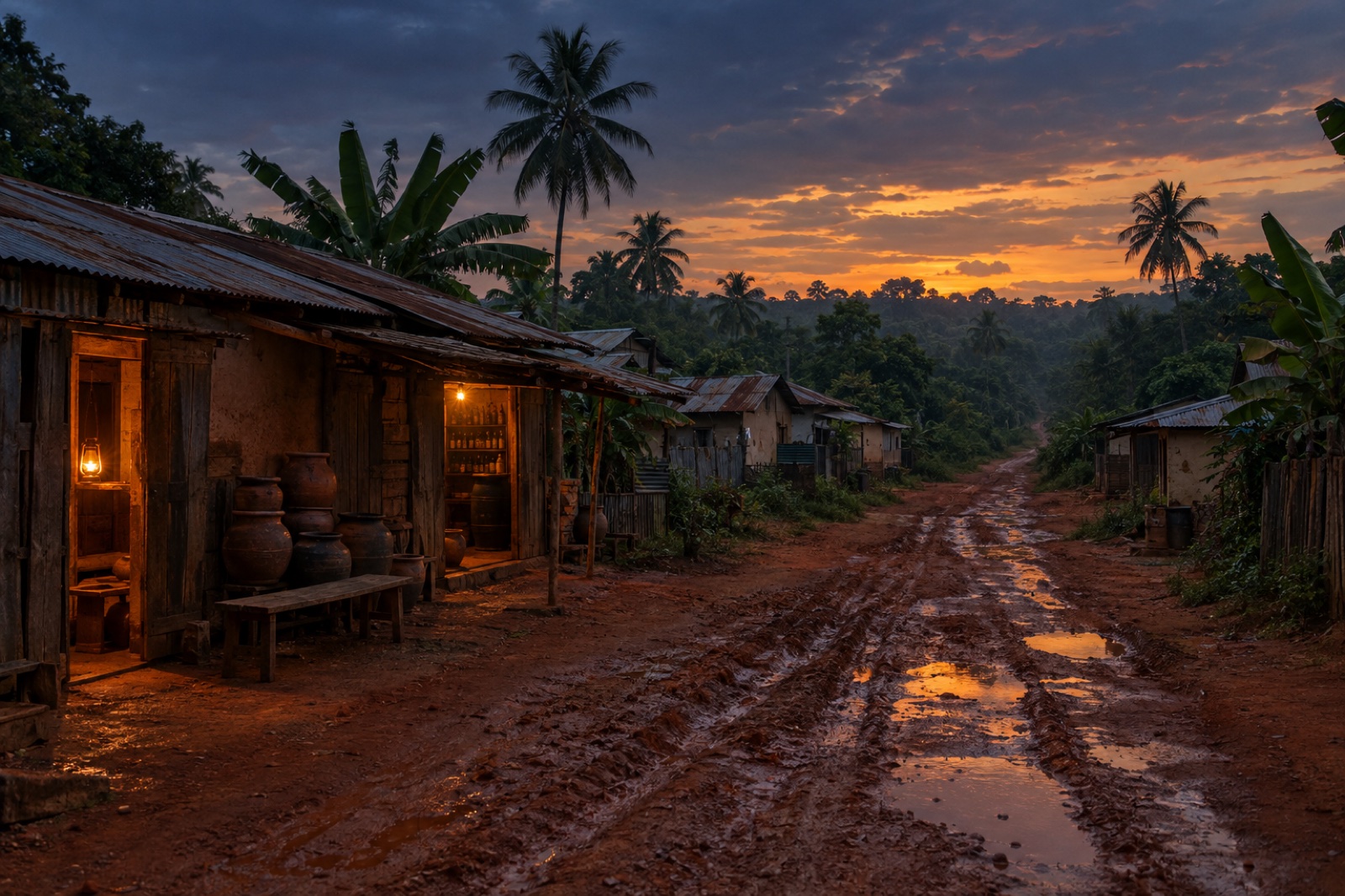
And the novel’s first sentence tells you what he has signed up for: “In the beginning there was a river.” The river became a road, Okri writes, and because the road was once a river it is always hungry. A road made out of a river cannot stop moving and cannot arrive.
The Famished Road Meaning Is in a Pattern, Not a Plot
Here is the thing worth seeing, and I did not see it the first time through.
Azaro’s decision to stay does not end the abiku’s cycle. It relocates it.
An abiku’s existence is leaving and coming back. Azaro quits that on page one, and then spends the entire novel leaving and coming back. Lifted out of a market. Lost in a strange compound. Pulled night after night into Madame Koto’s palm-wine bar, where the spirits make themselves comfortable and wait for him. Carried into the forest by things that want him. Every time, he finds his way home. Every time, home is exactly as he left it.
So the repetition readers complain about is not a writer losing his thread. It is the shape of the life the boy chose. He did not escape the coming and going. He moved it out of death and birth, and into Tuesday.
Once you see it in him, you see it in everyone in the compound. Dad carries loads at the depot, then decides he is a boxer, takes the name Black Tyger, and fights in the open square against opponents the book will not let you file as ordinary: the Green Leopard, and a masked man in a white suit whose uncovered face empties the square. He wins. The family sinks further into debt. He fights again.
Mum hawks goods all day, comes back with almost nothing, and goes out again before light. The Party of the Rich hands out free food that poisons the compound, Jeremiah the photographer takes a picture of what it did, the neighbours turn his photograph into a kind of monument, and he has to go into hiding for it. Madame Koto’s bar climbs the whole book long, new chairs and electric light and finally a car, and the higher it climbs the less of her is recognisably inside it.
Nobody in this novel progresses. Everybody circles. The road was once a river.
Ade Is the Same Creature, Choosing the Other Way
There is a second spirit-child in the book, and he is the reason Azaro’s choice registers as a choice at all.
Ade is Azaro’s friend. Frail, sharp, and finished. He is not frightened of the other world; he is tired of this one, and he means to go back. Near the end he hands Azaro the sentence the whole novel has been circling: that theirs is an abiku country, that like the spirit-child it keeps coming and going, and that one day it will decide to remain.
Two boys, the same nature, opposite verdicts. One goes. One stays.
And here Okri is harder than he usually gets credit for being. The book does not reward the one who stays. No reversal arrives. The ceremony that might have released Azaro from the other world was never affordable, and nothing in the plot is coming to fix the poverty. Achebe gives Okonkwo a flaw and seven years to cure it; Okri does not even offer that structure. Azaro is not on a road to anywhere. He is on a road.
Okri has said he wrote the book “to give myself reasons to live,” and you can feel that in the design. This is not a story about a hard life improving. It is a story about one decision being made again, daily, with no evidence that it is worth making.
The Name His Parents Gave Him First
Which brings up something easy to read straight past in the first chapter.
Before he was Azaro, he was Lazaro. After the first time he died and came back, his parents named him for Lazarus. His mother shortened it later.
That name has no business in this novel, and Okri puts it there anyway. The abiku belongs to its own cosmology and owes nothing to anyone else’s. This is not a Christian allegory and it never once behaves like one. But the parents reach for that name, and the name brings a question in with it.
Because the old account of Lazarus stops exactly where this novel starts.
Jesus stands at the mouth of a tomb and calls a man out by name, in front of a crowd. Then the record goes quiet. Not one word of Lazarus is written down afterward. Nobody asks him what it was like. He walks back into the same village, the same house, the same work, the same body that is going to die again, and the story moves on to other people. The miracle is the end of his chapter. It is the beginning of his life.
Five hundred pages of Okri is the part nobody wrote down. Coming back is not the end of the hardship. It is the start of having to live inside it, in a place that is still hungry, with a mother still hawking and a landlord still shouting.
And both accounts give the same reason for it, which is the strange part. The one thing the old story tells us about Lazarus is that he was loved, and that is the entire reason anyone came for him. Azaro stays because of a face. Not a plan, not a destiny. Somebody in the room.
The Last Thing the Book Does
Okri does not feed the family in the final pages.
The last movement of the novel is a man asleep. Dad lies dreaming for three days after his last fight while Mum and Azaro keep watch, and he surfaces still talking about a better world and about respecting every living thing. Outside, the road is exactly as hungry as it was in the first sentence. Nothing has been settled. A dream is doing the work that money and politics and power all declined to do.
Other novels of the same decade and the same country hand the account of a disaster to whoever is left holding the pen; Adichie gives the war’s record to the houseboy. Okri hands it to a child who will not leave, and the record he keeps is mostly of going out and coming back. Dangarembga’s Nervous Conditions tells you its ending on the first page and then shows you the bill. Okri will not even tell you there is an ending.
Azaro is still there. That is the whole of what he ever promised, and the book treats it as enough, which is the hardest and most ordinary thing in it.
Questions Readers Ask About The Famished Road
What is The Famished Road by Ben Okri about?
The Famished Road is a 1991 novel narrated by Azaro, an abiku or spirit-child living with his parents in the ghetto of an unnamed West African city on the edge of independence. His companions in the spirit world keep trying to call him back, and he keeps refusing. Around that refusal, Ben Okri builds the ordinary life of the compound: his mother hawking goods, his father boxing under the name Black Tyger, Madame Koto’s rising palm-wine bar, a landlord, and two political parties competing for the poor. It won the Booker Prize in 1991 and is the first book of a trilogy with Songs of Enchantment and Infinite Riches.
What does abiku mean in The Famished Road?
Abiku is a Yoruba term for a spirit-child: one who is born, dies in childhood, and is born again to the same mother, drawn back each time by companions in the spirit world. The Igbo equivalent is ogbanje. In The Famished Road Azaro is an abiku who breaks the pattern by deciding to stay among the living, which is why his spirit companions spend the novel trying to retrieve him. Okri treats abiku as a real condition inside the book’s world rather than as a figure of speech, and late in the novel Azaro’s friend Ade extends the idea to the country itself, calling it an abiku nation that keeps coming and going.
Why does Azaro choose to stay in The Famished Road?
Azaro stays because of his mother. In the opening pages of The Famished Road he sees her face, and that is the reason the novel gives, with no prophecy or bargain attached to it. Nothing afterward rewards the decision. The family stays poor, the ceremony that might free him from the spirit world is unaffordable, and his friend Ade, who is also a spirit-child, considers staying a mistake and intends to go back. Ben Okri lets the two boys reach opposite verdicts about the same condition and declines to say which of them is right.
How does The Famished Road end?
The Famished Road ends without relief. After his father’s last fight in the square, Dad lies dreaming for three days while Mum and Azaro keep watch over him, and he wakes still talking about building a better world and respecting all living things. The family’s poverty is unchanged, the road outside is as hungry as it was in the novel’s first sentence, and no explanation is given for the spirit world or for Azaro’s condition. What the ending offers is simply that Azaro is still alive and still there, with two more books of the trilogy ahead of him.
Did Radiohead’s Street Spirit come from The Famished Road?
Yes, by Thom Yorke’s own account. Yorke has said the Radiohead song “Street Spirit (Fade Out)”, from The Bends, came out of reading Ben Okri’s The Famished Road while the band was touring, and he talked about the book in a 1993 interview on the Canadian programme Musique Plus when Radiohead played an early version of the song. Accounts of those early performances give the song’s working title as “Three-Headed Street Spirit”, which points back at the spirit figures in Okri’s novel.
One Question
Ade thinks staying is a mistake, and the novel never tells him he is wrong. So when Dad wakes from his three-day dream talking about a better world, does that land on you as hope, or as the most stubborn thing in the book? I go back and forth on it. Tell me how you read it in the comments.
Share This
Azaro ends the abiku’s cycle of leaving and coming back on page one of The Famished Road. Then he spends five hundred pages being carried off and finding his way home. He did not escape the coming and going. He moved it out of death and birth, and into Tuesday.
People say The Famished Road meanders. It circles, which is not the same thing. Nobody in that compound progresses: Dad wins his fights and the debt grows, Mum hawks all day and comes back with nothing, Madame Koto’s bar rises and she disappears into it. The road was once a river, and a river does not arrive.
Before he was Azaro he was Lazaro, named for Lazarus. The old account of Lazarus ends the moment he walks out of the tomb, and nobody writes down a word he says afterward. Five hundred pages of Ben Okri is the part nobody wrote down: coming back is where the living starts.