 0
0
 0
0
Mano Majra knows what time it is because of the trains.
Before dawn the mail train rushes through on its way to Lahore, and the driver always blows two long blasts at the bridge. The crows start cawing in the keekar trees. The bats come home and quarrel over their perches. The mullah at the mosque hears the whistle and knows it is time, so he has a quick wash and calls. The priest at the Sikh temple stays in bed until the mullah has called. Then he gets up, pours a bucket of water over himself, and prays into the sound of the splashing.
That is the first clock in Khushwant Singh’s 1956 novel Train to Pakistan, and it is the whole village in a few sentences. About seventy families. Three brick buildings: a moneylender’s house, a temple, a mosque. Two religions getting out of bed in a fixed order, and a train setting the order.
Then Singh writes one short line. It had always been so, until the summer of 1947.
If you came looking for the Train to Pakistan ending explained, you already know where the trains end up. What is worth noticing is who stops the last one, and how little the novel is willing to tell you about him.
What Train to Pakistan Is About
Train to Pakistan is a short novel by the Indian writer Khushwant Singh, first published in 1956. It is set in the summer of 1947, in a village on the frontier between what was about to become India and what was about to become Pakistan. Mano Majra sits half a mile from the Sutlej river and a mile from a railway bridge of eighteen spans. The Sikhs own the land. The Muslims are tenants and share the tilling. One Hindu family lives there, the moneylender Lala Ram Lal. There are also a few sweeper families whose religion nobody can quite pin down, and one object every single villager quietly respects: a three-foot slab of sandstone by the pond that they all visit in secret when they badly need a blessing.
The book opens with a robbery. Five armed dacoits kill Lala Ram Lal. Suspicion falls on Juggut Singh, called Jugga, the village badmash, a big man with a record of train robberies and holdups. He is innocent of this one. On the night of the murder he was lying in the fields with Nooran, the daughter of Imam Baksh, the mullah of the mosque. He cannot say where he was without destroying her. So he is taken away in handcuffs.
The same day a stranger is arrested too: Iqbal Singh, a political worker sent from Delhi, educated in England, carrying tinned fish, an air mattress and a silver hip flask.
Then a train comes in from Pakistan carrying dead Sikhs, and the village has to burn one lot of bodies and bury another. Then the river brings down corpses. Then the Muslims of Mano Majra are taken away to a refugee camp for their own safety. Then a group of armed men arrives and decides that the train carrying those Muslims to Pakistan should not reach it.
The Clock Breaks Before the Village Does
Here is the first thing most readers go past. Singh does not start the collapse with a spear. He starts it with a timetable.
Early in September the trains stop being punctual. More of them run at night. Singh describes it as an alarm clock set for the wrong hour, and then as a clock nobody remembered to wind. Children do not know when to be hungry and ask for food all the time. And in one sentence he shows you what that does to the village’s two religions: Imam Baksh waits for Meet Singh to make the first start, and Meet Singh waits for the mullah’s call before getting up.
Both men are waiting for a train that is not coming.
Look at what that costs them. Nobody in Mano Majra decides to stop praying. Nobody argues about doctrine. The prayers simply lose their cue, because the thing both communities were listening to has gone quiet. The opening pages build the village’s religious life on top of a railway timetable, and the September chapter takes the timetable away. Long before anyone picks up a weapon, the mosque and the temple have stopped hearing each other.
Keep an eye on the four parts the novel is built from, as well. They are titled Dacoity, Kalyug, Mano Majra and Karma. A crime, then the age of darkness, then the place itself, then the law of what people have coming to them. That last title matters more than it looks.
Three Men Are Given the Same Night
The last section of the novel sets up a straightforward test. An ambush is coming. Three men know enough to stop it, and each one has something the others do not.
Hukum Chand has the power. He is the district magistrate, and his plan is to release the badmash and the social worker and hope one of them does something. He is not confident. He works Jugga out on paper and gets him wrong: a daredevil, after money or revenge, and his type never risks his neck for a woman. If Nooran is killed, Hukum Chand reckons, he will pick up another girl. Then the magistrate asks himself whether it is really enough to get other people to do his work for him, and he does not answer the question. By the end of the night he has sent his whisky away, left his dinner untouched, had the lamp taken out of the room, and sat down alone in the dark. Then he cries, and then he prays.
Iqbal has the ideas, and he gets the most remarkable passage in the book. He imagines walking out to face the mob and telling them plainly that this is wrong, striding into them without flinching, the way a hero walks into a camera and gets bigger as he comes, and then falling with dignity under a volley of rifle shots. A cold thrill goes down his spine.
And then he thinks it through, and talks himself out of it with real intelligence. Nobody would be there to see it. They would strip the body, find him circumcised, and file him as one more Muslim killed in a massacre. No lesson would be taught, because there would be nobody to receive the lesson. He pours a large whisky, drinks it neat, and reaches his conclusion: for a sacrifice to have a purpose, it is not enough that a thing is good in itself, it must be known to be good. He adds a rule to go with it. The doer must only act when the receiver is ready to receive. Otherwise the act is wasted.
Then the flask keeps going, his thinking gets grander and sloppier, and he falls asleep with the glass still in his hand.
Meet Singh, the temple priest, has the village’s trust. He is a kind man and he will not move. His duty, he says, is to tell people what is right and what is not, and to ask God to forgive them when they do it anyway. He is not a coward about it. When the agitator tells the village that the train should carry as many dead to the other side as Mano Majra has received, it is Meet Singh who says quietly that the train will have Mano Majra’s own Muslims on it, and the young man snaps back that he does not know who is on the train and does not care, it is enough that they are Muslims. That exchange is the novel’s whole position on collective blame, and the priest is on the right side of it.
But then Meet Singh says the most quietly devastating thing in the book. If the ambush succeeds, he says, the men will come to the temple for thanksgiving, and they will make offerings to wash away their sins.
He already knows the accounts will balance. That is why he does not get up.
What the Novel Refuses to Tell You About Jugga
This is the part a first reading tends to miss, and it is the reason the ending hits the way it does.
Jugga is let out on the same order as Iqbal. On the way home in the tonga we get inside his head exactly once. He is not thinking about Malli, the dacoit who framed him. He is thinking about Nooran, hoping she is hiding in the fields or has gone to his mother, and hoping his mother has not turned her out. He has already been told by the subinspector that the Muslims were taken to the camp, and that tonight they go by train to Pakistan.
Then the tonga slows down to turn into the lane by the temple, and Jugga jumps off the moving cart and disappears into the darkness.
That is the last time the novel lets you see what he is thinking. Count up what the other two men get. Iqbal gets thousands of words of interior argument, complete with footnotes about yoga and Indian film music. Hukum Chand gets a whole closing chapter of memory, guilt and self-excuse. Jugga gets a jump off a cart.
He surfaces once more. Late that night he bangs on the temple door with his fists. He wants the Guru’s word, he says. Will Meet Singh read him a verse? The priest grumbles that the scripture has been put to bed for the night, and that Jugga never came to the temple any other time. Jugga is impatient. It does not matter what you read, he says. Just read it.
So Meet Singh takes out a small prayer book, touches it to his forehead, and reads whatever page it happens to fall open at.
And this is the detail worth sitting with. The page is from the morning prayer, and what it describes is a court where deeds are sorted out: the deeds that were done and bore fruit, separated from the deeds that never ripened into action at all.
That is read aloud, at random, in the middle of the night, to the one man in the book who is about to act, in a building where two men who will not act are asleep.
Jugga cannot read, and he does not understand a word of it. He asks if it was good. Meet Singh tells him all the Guru’s word is good. He asks what it means. And Meet Singh, who has spent the whole novel declining to interfere, tells him he has nothing to do with meaning. If he is going to do something good, the Guru will help him. If he is going to do something bad, the Guru will stand in his way.
Yes, Jugga says. What will I do with the meaning. He puts his forehead on the ground, picks up his shoes, and on the way out looks into a side room where Iqbal is asleep with the silver flask lying on his chest. He says goodnight twice to a sleeping man, then asks Meet Singh to pass it on, and goes.
The Last Two Pages, Plainly
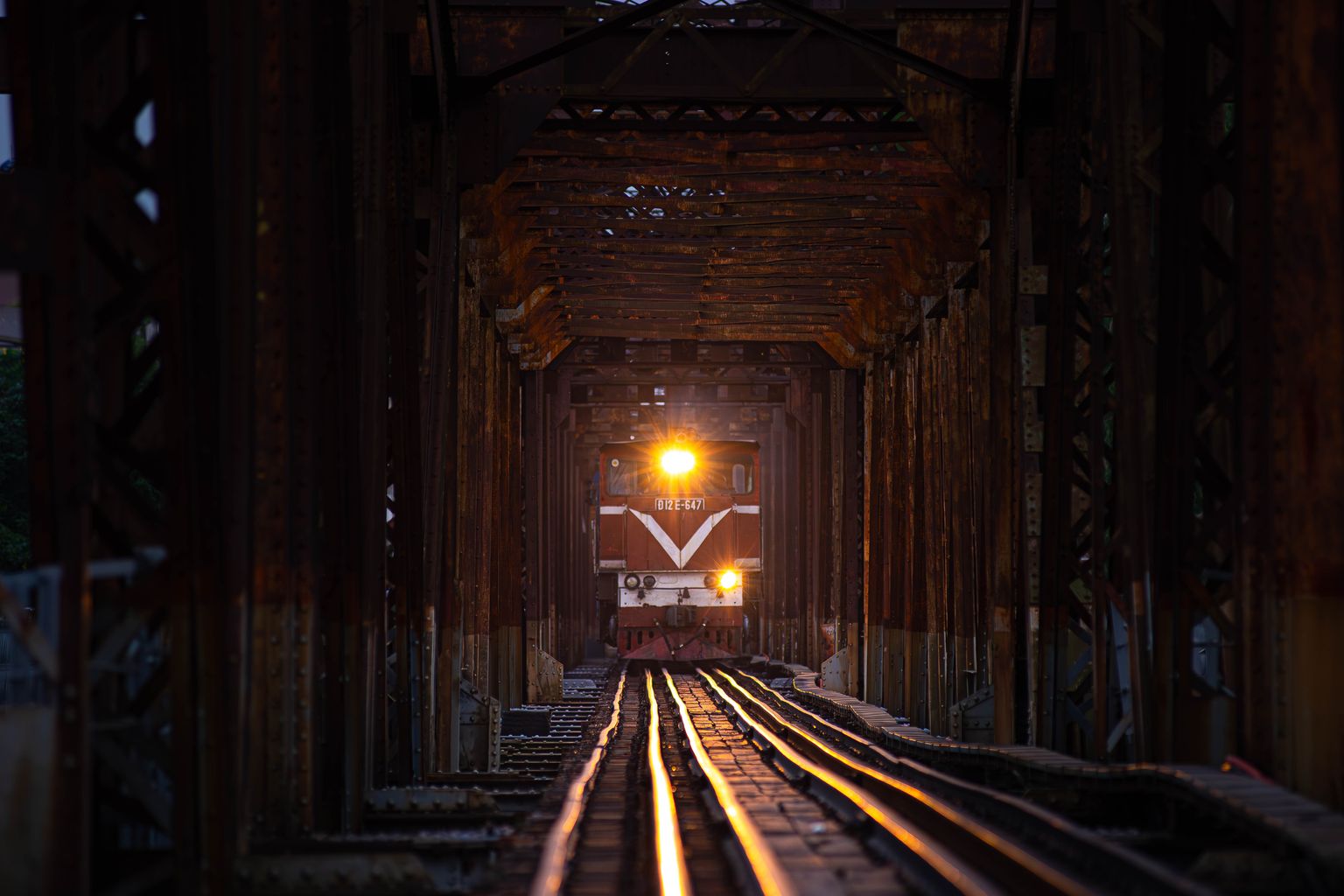
The moon comes up a little after eleven, tired and pale. The men are spread out on both sides of the track with rifles and spears, sitting on their haunches, told to keep quiet so they will hear the train in time. A jeep idles behind the pampas grass. On the first steel span of the bridge a thick rope has been tied horizontally above the line, about twenty feet up. The train will be carrying people on the carriage roofs. The rope is set at the height that will take them off.
A signal drops and turns green. The lights of the train appear, one after another, getting closer. Every man on the bank is watching the lights. Nobody is watching the bridge.
Then a man starts climbing the span. They notice him only when he reaches the top, and they assume he is testing the knot. He stretches himself out along the rope, feet near the knot, hands reaching for the middle. Singh gives him one line of description. He was a big man.
The leader stands up and screams at him to come off, he will be killed. The man turns toward the voice, pulls a small kirpan out of his waist, and starts slashing at the rope.
Nobody on the bank knows who he is. They ask out loud. Who is this? What is he doing? There is no time to answer.
The leader raises his rifle and hits him. One leg comes off the rope and swings in the air. He keeps cutting. Another shot, and his body slides off, and he holds on with his hands and his chin. He pulls himself back up, hooks the rope under his left armpit, and goes at it one-handed. It is down to a single tough strand. He uses the knife, and then his teeth. The engine is almost on him. A volley of shots goes off. He shivers and collapses, and the rope snaps in the middle as he falls.
Then comes the last sentence of the novel, which does not stop to mourn anyone. The train went over him, and went on to Pakistan.
Now notice what the book does not do. It never names him. Juggut Singh’s name does not appear anywhere in that scene. The men who strung the rope never find out who cut it. Nooran, riding that train in her second month with Jugga’s child, never finds out, and his mother’s promise to tell him about the child is never shown happening either. Hukum Chand, praying in the dark, never finds out. Iqbal, asleep with his flask, never finds out. Meet Singh, who read him the verse an hour earlier, never finds out.
The only people who know are the readers.
A Deed Nobody Received
Go back to Iqbal’s rule, because the novel has not forgotten it. A good act has to be seen to count. The doer should only act when the receiver is ready to receive.
It is not a stupid argument. It is the logic of strategy, of campaigns, of anyone who has ever had to decide whether a gesture is worth making. Iqbal is the most educated person in the book and he reasons beautifully.
And then Singh builds the exact experiment that tests it. An act with no audience. No witness who understands it, no record, no name, no receiver anywhere near ready to receive. The thing Iqbal said would be an utter waste of life turns out to be the only thing in the entire novel that saves anybody.
Then look at the title of the section it happens in. Karma. The whole last part of the book is people working out what others have coming to them. The men on the bank are certain the people on the train have it coming. Meet Singh already knows those same men will be in his temple afterwards, settling the bill. Even Hukum Chand’s long night is an audit of what he deserves. And then the section breaks its own title in the last four paragraphs. The man with the most coming to him does the only undeserved thing in the book, and takes the payment himself.
There is a very old passage that describes a figure shaped exactly like that. Someone despised and not thought much of. Someone carrying what belonged to a great many other people. Someone, in the phrase Isaiah 53 uses, numbered with the transgressors, filed in with the criminals. And in the same breath, the people who get saved by it are described as people who looked away and did not recognise him.
Nothing in Train to Pakistan is reaching for that. The novel has no interest in illustrating anything, and it would be a worse book if it did. It simply keeps landing on the same shape, because the shape is true to the way rescue actually tends to arrive. Not on a ledger. Not in front of a crowd. And almost never from the respectable man in the room.
If that kind of reading interests you, two other novels on this site turn on the same question of who gets the credit for a rescue and who actually paid for it: Ngũgĩ wa Thiong’o’s A Grain of Wheat, where a whole village honours the wrong man, and Chimamanda Ngozi Adichie’s Half of a Yellow Sun, which asks who gets to write a war down afterwards.
Back to the Clock
Mano Majra’s clock never comes back. The village keeps its railway station and loses the thing the station used to do, which was tell seventy families when to wake, when to eat, when to pray and when to sleep. That is the loss the novel leaves sitting there, and it does not soften it.
But a trainload of people got a morning out of that night. Somewhere down the line they climbed off the roofs in a new country, and sooner or later they built a life with a whistle in it, and heard a train go past at a particular hour and knew what time it was. Not one of them knew what the hour had cost, or who had bought it, or that the last thing he did was cut a rope with his teeth.
Singh will not even let you call it heroism. He will not give the man a name, a motive, a speech or a thought. He gives him a short flat sentence and a train that does not slow down.
Which is, in the end, the most generous thing the novel could have done for him. A deed that was never known to be good still got everyone across the bridge. Iqbal’s rule was wrong, and it took Singh two pages and no commentary at all to prove it.
Join the Conversation
Singh never names the man on the rope, and never lets you inside Jugga’s head after he jumps off the tonga. Do you think the novel is stronger for that silence, or did you want the last scene from his side? Tell us in the comments. We read every one.
Questions About Train to Pakistan
What happens at the end of Train to Pakistan?
At the end of Khushwant Singh’s Train to Pakistan, a mob ties a thick rope across the first steel span of the railway bridge, about twenty feet above the track, set at the height that will sweep the Muslim refugees off the roofs of the train carrying them to Pakistan. As the train approaches, a big man climbs the span, stretches himself along the rope and hacks at it with his kirpan. The mob’s leader shoots him, and others fire too, but he keeps cutting with the knife and then with his teeth. The rope snaps in the middle as he collapses, and the train passes over his body and goes on to Pakistan. The novel’s final sentence is that plain.
Who is the man on the rope at the end of Train to Pakistan?
It is Juggut Singh, the village badmash, though Train to Pakistan never names him in that scene. Singh calls him only “a big man”. Everything else identifies him: he was released from custody that day, he is repeatedly described as unusually large, he carries a kirpan, his lover Nooran is on that train, and an hour earlier he asked the temple priest Meet Singh to read him a verse without caring what it said. The men on the bank shout “Who is this?” and never find out. The withheld name is what makes the ending land the way it does.
Why is the last part of Train to Pakistan called Karma?
Train to Pakistan is built in four parts: Dacoity, Kalyug, Mano Majra and Karma. The final part is full of people calculating what others have coming to them. The mob is sure the refugees deserve it. Meet Singh predicts the attackers will come to the temple afterwards and make offerings to wash the sin away. The magistrate Hukum Chand spends the night auditing his own life. Then the section ends by breaking its own title: the man the village had written off as a criminal does the one thing nobody had earned, and nobody ever learns it was him.
What does Iqbal decide to do in Train to Pakistan?
Nothing. Iqbal Singh, the England-educated political worker in Train to Pakistan, imagines confronting the mob and dying in front of them like a hero walking into a camera. Then he reasons his way out of it over several whiskies: there would be no audience, his body would be mistaken for one more Muslim victim, and so the act would teach nobody anything. He concludes that for a sacrifice to have a purpose it is not enough for a thing to be good, it must be known to be good, and that one should only act when the receiver is ready to receive. He falls asleep with the glass in his hand, and the novel then quietly proves him wrong.
Is Train to Pakistan based on a true story?
The village and its people are invented; the situation around them is not. Train to Pakistan is a work of fiction set during the 1947 Partition of British India, and Khushwant Singh’s own opening pages give the scale: around ten million Muslims, Hindus and Sikhs in flight, and close to a million of them dead by the time the monsoon broke. Mano Majra, Juggut Singh, Nooran, Iqbal and Hukum Chand are the novelist’s creations. The trains arriving full of bodies, the refugee camps and the ambushes on the railway lines were not.
Share This
In Train to Pakistan, Iqbal spends pages proving that a sacrifice nobody sees is a waste of a life. Twenty pages later Khushwant Singh stages exactly that, and it saves a whole train. https://bgodinspired.com/index.php/entertainment/train-to-pakistan-ending-explained/
The thing I never noticed about Train to Pakistan: the man on the rope is never named. Not once in the final scene. The mob asks “Who is this?” and nobody in the book ever finds out. https://bgodinspired.com/index.php/entertainment/train-to-pakistan-ending-explained/
Mano Majra tells the time by trains. The mullah waits for the whistle, the Sikh priest waits for the mullah. So when the timetable collapses, both prayers lose their cue — and that happens long before anyone picks up a spear. Still the sharpest thing in Train to Pakistan. https://bgodinspired.com/index.php/entertainment/train-to-pakistan-ending-explained/