 0
0
 0
0
Maybe you know this walk. You are on your way to something you cannot fix. A hospital room. A hard talk. A letter you have to open. A person who may not want to see you.
You are going anyway. And somewhere on the road, the real question shows up: When I get there, what am I actually going to do?
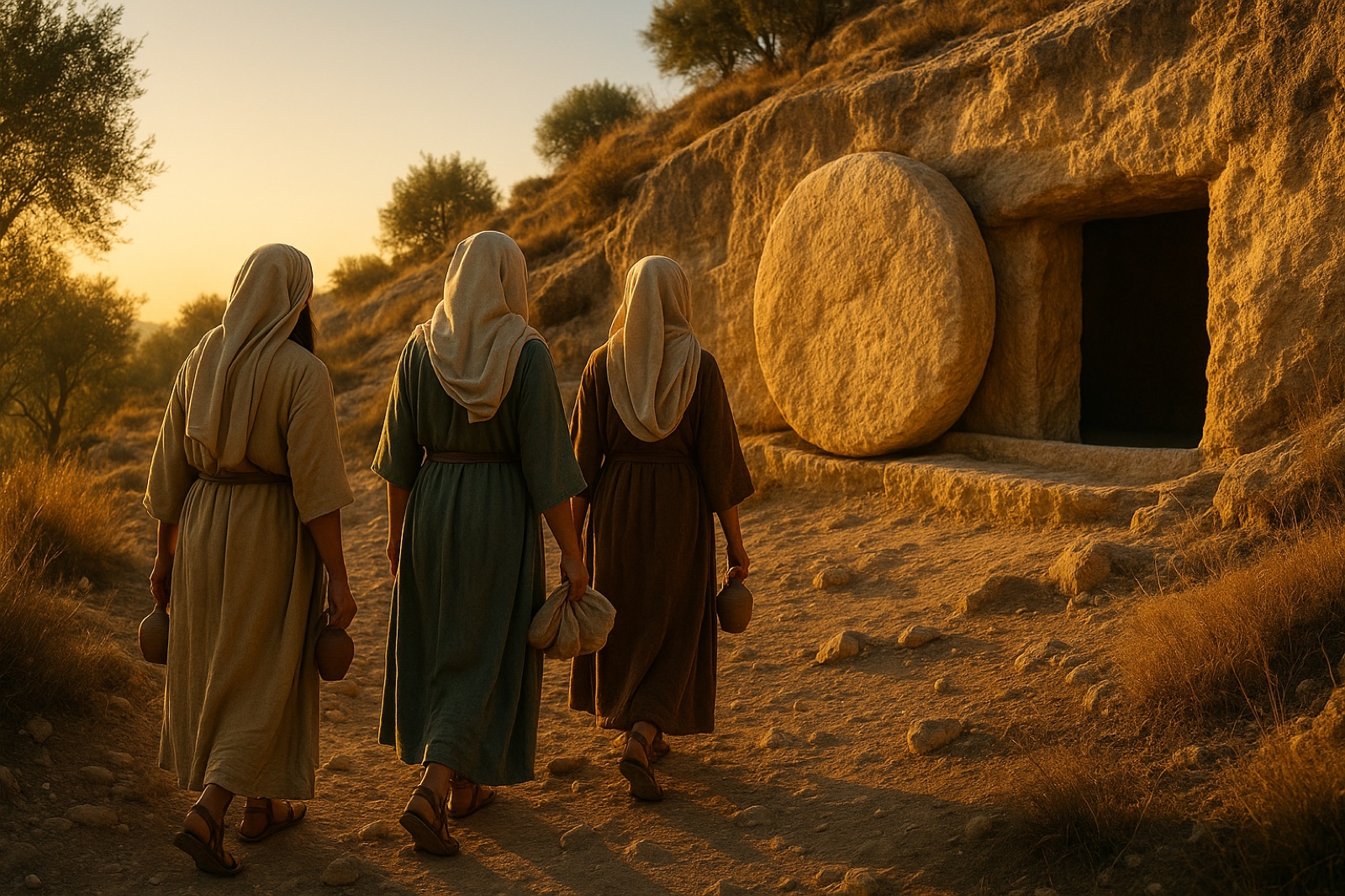
Three women once asked that question on a dark road outside Jerusalem. Their version was: who will roll away the stone? The surprising part is not the question. It is when they asked it.
Who Will Roll Away the Stone? What Mark Actually Says
Mark tells it in four short verses. Read them slowly, and watch the order things happen in:
“And when the sabbath was past, Mary Magdalene, and Mary the mother of James, and Salome, had bought sweet spices, that they might come and anoint him. And very early in the morning the first day of the week, they came unto the sepulchre at the rising of the sun. And they said among themselves, Who shall roll us away the stone from the door of the sepulchre? And when they looked, they saw that the stone was rolled away: for it was very great.”
– Mark 16:1-4 (KJV)
First they buy the spices. Then they set out. Then they ask about the stone.
They did not solve the problem and then go. They went, and the problem came along with them.
They Had Watched the Stone Go In
It is easy to read this as if the women forgot about the stone. Like someone who leaves the house and then remembers they don’t have the key.
But go back one chapter. When Jesus was buried on Friday, Mark says Joseph of Arimathea “rolled a stone unto the door of the sepulchre.” The very next verse says: “And Mary Magdalene and Mary the mother of Joses beheld where he was laid” (Mark 15:46-47).
They were there. They saw the stone roll into place. They knew how big it was better than anyone.
So this was not a plan with a hole they missed. They knew about the hole. They walked toward it anyway.
(If you only know Mary Magdalene from movies, the real story is worth a look. Here is who Mary Magdalene actually was in the Bible, and it is not what most people think.)
They Kept Saying It
There is a small detail in the Greek that English hides. The word Mark uses for “they said” is in a tense that describes something ongoing. It reads more like “they were saying” or “they kept saying.”
That sounds about right, doesn’t it? This was not one calm question. It was the kind of thing you say again and again on a walk, because you have no answer and it will not leave you alone.
Who’s going to move it? Did anyone think about this? What are we going to do when we get there?
And still, their feet kept moving.
Four Accounts, Told Honestly
Most devotionals blend the four Gospels into one smooth story. But they are not the same, and the differences are worth seeing:
- Mark names three women, who buy spices after the sabbath and find the stone already moved.
- Luke says the women prepared spices and ointments before the sabbath and then rested (Luke 23:56). He later names Mary Magdalene, Joanna, Mary the mother of James, “and other women” (Luke 24:10).
- Matthew names two women and mentions no spices at all. They came “to see the sepulchre.” In Matthew, there is a great earthquake, and an angel rolls back the stone and sits on it (Matthew 28:1-2).
- John only names Mary Magdalene, who comes “when it was yet dark.” Yet when she runs to Peter, she says, “we know not where they have laid him” (John 20:2). That little “we” hints she was not alone.
One more thing. Many retellings talk about the women heading to a sealed tomb with soldiers on guard. That detail is real, but it is only in Matthew, where the stone is sealed and a watch is set (Matthew 27:66). Mark’s women never mention a seal or guards. Their only worry is the weight.
These differences do not weaken the story. They sound like several people remembering one confusing, early, frightening morning. Every account agrees on what matters: the women went, and none of them moved the stone.
The Job They Went to Do Was Already Done
Here is the part almost nobody mentions.
The women were going to anoint the body. But John tells us that on Friday, Nicodemus “brought a mixture of myrrh and aloes, about an hundred pound weight,” and they wrapped the body “with the spices, as the manner of the Jews is to bury” (John 19:39-40). That is a huge amount, the kind of burial fit for a king. (You can read more about who Nicodemus was and why he showed up at the tomb.)
And days before that, when a woman poured costly ointment on Jesus, He said: “she did it for my burial” (Matthew 26:12).
So in a practical sense, the body had already been prepared, twice. The women were carrying spices to a job that was finished. And by the time they got there, there was no body to anoint at all.
Put plainly, their trip was a small, useless-looking act of love for someone they thought was dead. That is the whole thing they did. They did not move the stone. They did not get to finish their task. They just showed up.
And they were the first people told that Jesus was alive.
“For It Was Very Great”
Look again at verse 4: “they saw that the stone was rolled away: for it was very great.”
That is a strange spot for that detail. Mark tells us how big the stone was only after it has been moved. The size of the problem gets named at the moment it stops being their problem.
The stone was never theirs to move. It was too big for them, and Mark wants you to know that. But it was also never the point. The young man in white tells them, “behold the place where they laid him” (Mark 16:6). The stone was not moved so Jesus could get out. It was moved so they could look in.
“The stone was never theirs to move. Showing up was.”
Now, a careful word. This is not a promise that if you step out in faith, God will clear every obstacle in your way. Mark does not tell it like that. In fact, Mark ends the scene with the women running away, shaking and afraid: “neither said they any thing to any man; for they were afraid” (Mark 16:8). In the two oldest complete copies of Mark we have, the book stops right there.
Going did not make them brave. The stone was not a prize for their courage. They were scared on the way there and scared on the way back. And God met them anyway.
A good place to start:
The Book of Matthew – Immersive Storytelling Format
Hear Matthew’s whole account of Jesus, all the way to the earthquake and the angel sitting on the stone, as an audiobook and PDF you can take anywhere.
Get the free guide – Free.
When You Are Walking Toward Your Own Stone
Maybe your stone is a diagnosis. A debt. A broken friendship. A child who won’t call back. A grief that sits in your chest like rock.
You have probably been told to fix it first. Make a plan. Find the strength. Then go.
The women at the tomb did it the other way around. They did the small thing they could do: buy spices, get up early, walk. They brought the big question along with them, out loud, the whole way. And the big thing was handled by Someone else before they ever arrived.
You do not have to know who will roll away your stone before you take the next step. You just have to carry your small, ordinary act of love toward it. Make the visit. Send the message. Sit with the person. Bring the soup.
If you are not sure how to even pray about it, try our free Bible Verse for How I Feel tool. Pick what you are feeling right now, and it will give you a verse for this exact road.
Actions to Take Today
- Name your stone out loud. Like the women did, say it to someone, even just one sentence: “I don’t know how I’m going to handle this.” Saying it on the road is allowed.
- Find your “spices.” Write down one small, doable act of love connected to the thing you can’t fix. A text. A meal. Five minutes of sitting with someone. Not the whole solution, just your part.
- Take one step before you have the answer. Do that small thing today, while the big question is still open. Let the question walk with you instead of keeping you home.
Journaling Prompts
- What is the “stone” you keep talking about on the road, and how long have you been carrying that question?
- Where have you been waiting to solve something before you would let yourself show up?
- Think back to a time something you dreaded was already handled when you arrived. What did you learn about God in that moment?
A Prayer for the Road
God, I’m walking toward something I can’t move, and I keep asking who’s going to fix it. I don’t have a plan, only the small thing I can carry. Help me bring it anyway, and help me trust that the stone was never mine to roll. Meet me when I get there, even if I’m still afraid. Amen.
Let’s Talk About It
Why do you think the women set out before they had figured out the stone? Was that faith, love, or just grief that needed somewhere to go? Share your thoughts in the comments below. We’d love to hear from you.
Share This
- The women at the tomb asked “who will roll away the stone?” AFTER they had already set out. They went before they had the answer. That’s my reminder today.
- I always thought the women forgot about the stone. Mark 15:47 says they watched it go in. They knew exactly how big it was, and they went anyway.
- “For it was very great.” Mark only tells us how big the stone was after it had already been moved. Some problems were never ours to move.
Questions People Ask About the Stone
Who asked “who will roll away the stone” in the Bible?
In Mark 16:3, Mary Magdalene, Mary the mother of James, and Salome asked “Who shall roll us away the stone from the door of the sepulchre?” (KJV). They were walking to Jesus’ tomb early on the first day of the week, carrying spices they had bought to anoint His body. They asked the question on the way, after they had already set out.
Did the women know how big the stone at Jesus’ tomb was?
Yes. Mark 15:46-47 says Joseph of Arimathea rolled a stone to the door of the tomb, and that Mary Magdalene and Mary the mother of Joses watched where Jesus was laid. Mark 16:4 adds that the stone “was very great.” The women knew the stone was too heavy for them and went to the tomb anyway.
Who rolled the stone away from Jesus’ tomb?
Matthew 28:2 says there was a great earthquake and “the angel of the Lord descended from heaven, and came and rolled back the stone from the door, and sat upon it.” Mark, Luke and John do not describe the stone being moved. In those Gospels, the women simply arrive and find the stone already rolled away.
Why did the women bring spices to Jesus’ tomb?
The women brought spices to anoint Jesus’ body, a common act of love and respect for the dead in that time. According to John 19:39-40, Nicodemus had already wrapped the body with about a hundred pounds of myrrh and aloes on the day of burial. When the women arrived on the first day of the week, the body was gone, because Jesus had risen.
Why do the Gospel accounts of the empty tomb differ?
The four Gospels name different women and different details. Mark names three women, Matthew names two, Luke names several including Joanna, and John focuses on Mary Magdalene. Luke says the spices were prepared before the sabbath, and Mark says they were bought after it. Those differences read like several witnesses remembering the same early, frightening morning. All four agree that women came to the tomb first and found it empty.