 0
0
 0
0
You know the chapter. Maybe someone read it at a wedding, or on Mother’s Day, or a friend posted a verse from it with a photo of a spotless kitchen. She rises before dawn. She buys a field. She makes her own clothes and sells the extra. Her children stand up and call her blessed. And somewhere around verse 20 you quietly closed the Bible and thought: I am not her. I will never be her.
If that is you, you are not alone. Keyword tools estimate that around forty thousand people a month, in the United States alone, type the words “Proverbs 31 woman” into a search box. Many of them are women who already feel behind. They are not looking for a higher bar. They are looking for a way to stop feeling crushed by the one they think the Bible set.
So let’s look at what the chapter actually is. Not what it has been turned into. What it is.
What the Proverbs 31 Woman Really Is
Start at the top of the chapter, where almost nobody starts. Proverbs 31:1 in the King James Version reads: “The words of king Lemuel, the prophecy that his mother taught him.”
Read that again. This chapter is a mother’s words to her son. We do not know much about King Lemuel. He is not named anywhere else in the Bible, and some Jewish teachers have long suggested the name is another name for Solomon. But the Bible is clear about who did the teaching. A mother taught this to her boy. The famous poem about the “virtuous woman” was not handed to a woman as a to-do list. It was handed to a young man as a way to see.
Then look at the shape of the poem. In Hebrew, verses 10 to 31 are an acrostic. There are twenty-two lines, and each one begins with the next letter of the Hebrew alphabet, from the first letter to the last. That is a poet’s way of saying “A to Z.” It is the form you use for praise, not for a job description. Nobody writes an alphabet poem to tell someone what to do. You write one to say: here is everything good I can think of, in order, and I still have not run out.
And in many Jewish homes, that is exactly how it is still used. The poem, known by its Hebrew title “Eshet Chayil,” is sung at the table on Friday night as the Sabbath begins, often by a husband to his wife. It is not read to her as a standard she failed to meet that week. It is sung over her as thanks.
So the first thing to let go of is the idea that this chapter is a checklist. It never was one. It is a mother’s blessing and a song of praise that somebody, somewhere along the way, turned into a measuring stick.
The Word Hiding Under “Virtuous”
Proverbs 31:10 in the King James reads: “Who can find a virtuous woman? for her price is far above rubies.”
The Hebrew behind “virtuous woman” is “eshet chayil.” The word “chayil” does not mean tidy, or soft-spoken, or good at crafts. It is a strength word. In most of the Bible it is used for armies and soldiers. When the angel greets Gideon in Judges 6:12, the King James has him say, “The LORD is with thee, thou mighty man of valour.” That word “valour” is chayil. Gideon, hiding in a winepress, is called a man of chayil.
And here is a detail worth sitting with. In Ruth 2:1, the King James introduces Boaz as “a mighty man of wealth.” The Hebrew there is also chayil. The same word. Boaz is a man of chayil before Ruth is ever called a woman of chayil. The translators chose “wealth” for him and “virtuous” for her, but the Hebrew did not change. It is the same quality in both of them: strength, courage, substance, the kind of person who holds when things get hard.
So a closer reading of Proverbs 31:10 is not “Who can find a woman who does everything?” It is closer to “Who can find a woman of valour?” A brave woman. A strong one. That is a very different question, and it has a very different answer.
The Only Woman the Bible Actually Calls This
Here is the part that changes everything. The phrase “eshet chayil” appears only three times in the whole Hebrew Bible. Twice it is in Proverbs, in 12:4 and 31:10, where it describes a kind of woman in general. Only once is it said about a real, named, living woman.
That woman is Ruth.
Ruth 3:11 in the King James reads: “And now, my daughter, fear not; I will do to thee all that thou requirest: for all the city of my people doth know that thou art a virtuous woman.” That phrase “virtuous woman” is eshet chayil, exactly the words from Proverbs 31:10.
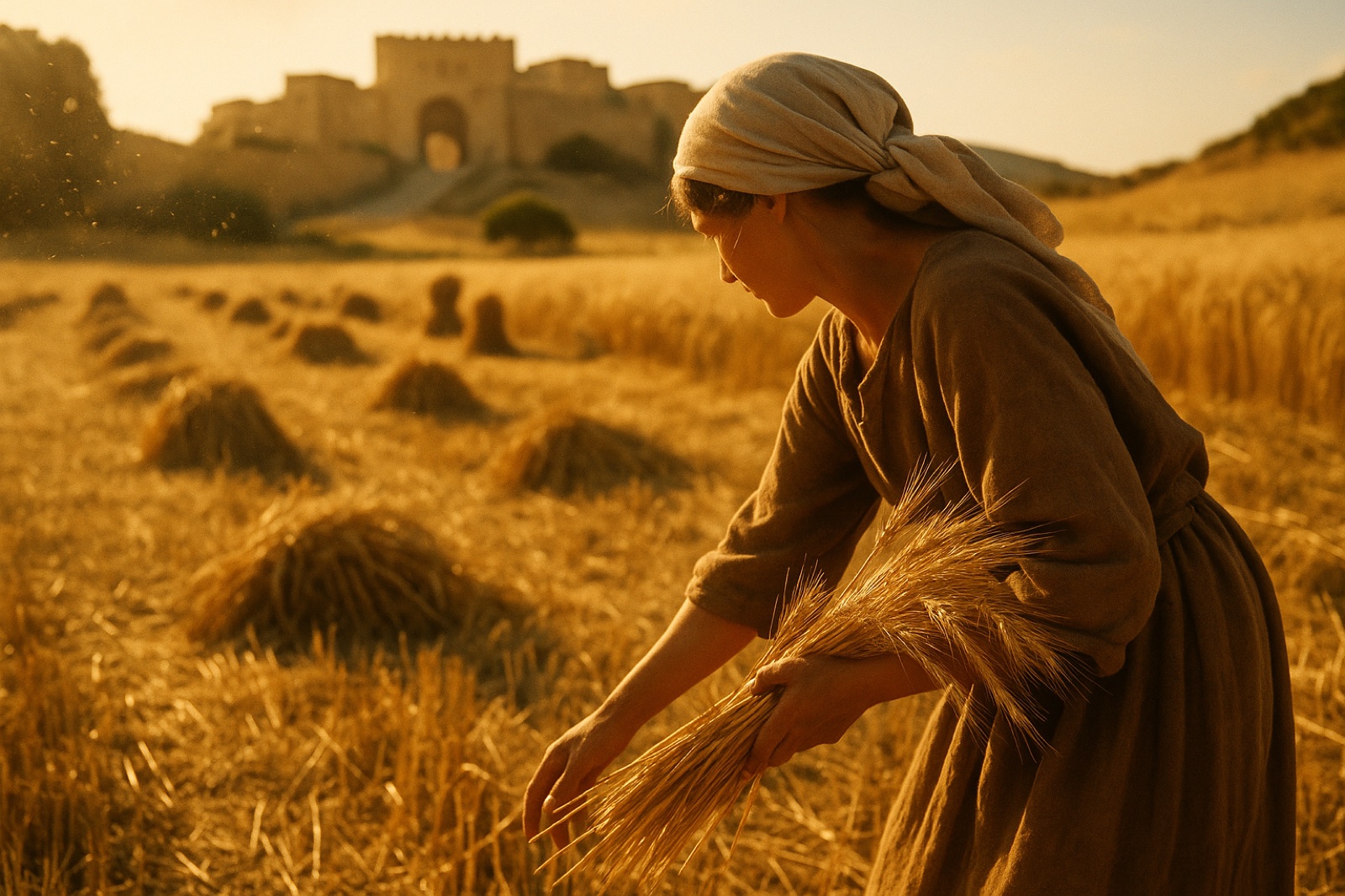
Now think about who Ruth was when Boaz said that. She was a foreigner from Moab, a people Israel did not trust. She was a widow. She was so poor that she fed herself and her mother-in-law by walking behind the harvesters and picking up what they dropped. Ruth 2:2 has her ask Naomi, “Let me now go to the field, and glean ears of corn after him in whose sight I shall find grace.” If you have never heard of gleaning, it was the Bible’s safety net for the poor, and we have written about what gleaning was and why God commanded it. It was hard, hot, humbling work. It is what you did when you had nothing.
Ruth did not rise before dawn to run a household full of servants. She had no household. She did not buy a field. She stooped in someone else’s. She did not clothe her family in scarlet. She owned what she was wearing. Measured against the “checklist” reading of Proverbs 31, Ruth fails almost every line.
And she is the one the Bible calls eshet chayil.
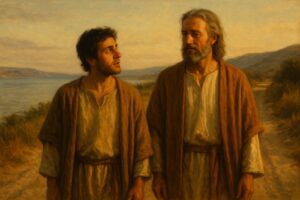
Boaz tells her why. In Ruth 2:11 he says he has heard “all that thou hast done unto thy mother in law since the death of thine husband,” and how she left her father, her mother and her homeland “and art come unto a people which thou knewest not.” Her valour was loyalty. It was courage. It was staying with a grieving, bitter woman who had told everyone to call her Mara when it would have been easier to go home. It was walking into a foreign field with her head up. None of that shows up on a chore chart. All of it is chayil.
The Last Line of the Poem Comes True in Ruth’s Life
There is one more thread, and it is the kind of thing you only see once you lay the two books side by side.
Proverbs 31 ends with this, in verse 31: “Give her of the fruit of her hands; and let her own works praise her in the gates.” The gates were the public square of an ancient town. It is where business was done and where the elders sat. To be praised “in the gates” is to be honoured out loud, in front of everyone.
Now turn to Ruth 4:11. Boaz has gone to the town gate to settle the matter of marrying Ruth. And the King James says: “And all the people that were in the gate, and the elders, said, We are witnesses. The LORD make the woman that is come into thine house like Rachel and like Leah, which two did build the house of Israel.” The whole town, in the gate, blesses a penniless foreign widow and compares her to the mothers of the nation.
The poem says the woman of valour will be praised in the gates. Ruth is praised in the gates. Boaz had already said that “all the city” knew what she was. It is hard to read that as an accident.
It may not be an accident in another way, too. In some of the oldest complete Hebrew manuscripts of the Bible, the book that comes right after Proverbs is not Ecclesiastes. It is Ruth. Which means a reader would close Proverbs on the question “Who can find a woman of valour?” and turn the page straight into the story of one.
So Who Is the Proverbs 31 Woman?
Here is the Turn, and it is simpler than the chapter has been made to feel.
If the only woman God’s Word ever hands this title to was a widow gleaning scraps, then the title was never about output. It was never about the kitchen, the field, the scarlet, or the schedule. Those lines are a mother painting a picture for her son of what strength looks like when it is at work in a life. They are examples. They are not entrance requirements.
The poem tells you what the real test is, and it says it plainly near the end. Proverbs 31:30: “Favour is deceitful, and beauty is vain: but a woman that feareth the LORD, she shall be praised.” Not the woman who gets everything done. The woman who trusts God. And that is exactly what Ruth did, back in chapter one, with nothing in her hands, when she said to Naomi, “thy people shall be my people, and thy God my God.”
That means the question you have been asking the chapter, “Am I enough?”, is a question the chapter was never trying to make you ask. You read it as comparison. It was written as blessing. And the woman it points to did not earn the name by measuring up. She was given it, by a man who had watched her be faithful in a field, long before the ending was clear. God’s love for you works the same way. It is not waiting at the end of a finished list. It is already there, in the field, while you are still bent over picking up what you can.
If you find that you read most things in your life the way you have been reading this chapter, as a grade you are failing, it may help to take our free “Am I a Perfectionist?” check. It takes a few minutes and it may name something you have carried for years.
And if you want to see where Ruth’s story went next, Matthew put her name in the family tree of Jesus and refused to cut it. The gleaning widow became a great-grandmother of King David. Nobody saw that coming either.
A good place to start:
The Beginner’s Guide to Feeling God’s Presence Every Day
A simple guide to noticing God in ordinary moments, on the days you feel behind as much as the days you feel strong.
Get the free guide
Free.
What You Can Do Today
- Read Proverbs 31:1 out loud. Just that one verse. Say the words “his mother taught him.” Let the chapter be what it is, a mother blessing her son, before you read another line of it.
- Write down one thing you did this week that took courage, not polish. Showing up to a hard conversation. Staying when leaving was easier. Walking into a room where you did not belong yet. That is chayil. Name it.
- Send a message to one woman you know and tell her the Ruth part. Something like: “The only woman the Bible ever calls a Proverbs 31 woman was a widow picking up leftover grain. Thought you should know.” You may be lifting a weight she never told anyone she was carrying.
Journaling Prompts
- When you picture “the Proverbs 31 woman,” whose face do you actually see, and where did that picture come from?
- Ruth’s valour was staying loyal to someone in grief. Where in your life right now are you being faithful with no applause and no guarantee of a good ending?
- What would change if you believed God was already praising your work “in the gates” today, not waiting to see whether you finish the list?
A Prayer
God, I have been reading this chapter as a test, and I have been failing it in my own head for years. Thank You that the only woman You ever gave this name to was poor, foreign, and standing in a field with nothing. Help me believe that You see courage and faithfulness the way You saw hers. Take the measuring stick out of my hands today. Let me hear this as a blessing, because that is what it was.
Discussion Question
Do you think the “Proverbs 31 woman” has done more good or more harm as a phrase in church life? Share your view in the comments; we would love to hear how the chapter has landed for you.
Share This
- The only woman the Bible ever calls a “Proverbs 31 woman” was a widow gleaning leftover grain in someone else’s field. That changes how I read the whole chapter.
- Proverbs 31 was written by a mother for her son. It is an A-to-Z poem of praise. It was never a checklist for me. Letting that sink in today.
- “Virtuous woman” in Hebrew is “woman of valour,” the same word used for Gideon the soldier and Boaz the landowner. Strength, not perfection. I needed that.
Questions and Answers
Who is the Proverbs 31 woman?
The Proverbs 31 woman is the woman described in Proverbs 31:10-31, a Hebrew acrostic poem that King Lemuel’s mother taught him. The passage praises a “virtuous woman,” in Hebrew “eshet chayil,” meaning a woman of valour or strength. It is a poem of praise about character, not a checklist of tasks.
What does “eshet chayil” mean?
“Eshet chayil” is the Hebrew phrase translated “virtuous woman” in the King James Version of Proverbs 31:10. “Eshet” means “woman” or “wife,” and “chayil” means strength, valour, or might. The same word “chayil” describes soldiers and warriors in the Bible, including Gideon in Judges 6:12, and describes Boaz in Ruth 2:1.
Is Ruth the Proverbs 31 woman?
Ruth is the only named woman in the Bible who is called an “eshet chayil,” the same Hebrew title used in Proverbs 31:10. Boaz says it of her in Ruth 3:11, translated “virtuous woman” in the King James Version. At the time, Ruth was a widow from Moab who fed herself and her mother-in-law by gleaning leftover grain.
Who wrote Proverbs 31?
Proverbs 31:1 says the chapter contains “the words of king Lemuel, the prophecy that his mother taught him.” King Lemuel is not mentioned anywhere else in the Bible, and some Jewish teachers have suggested the name refers to Solomon. The Bible presents the chapter as teaching a mother gave to her son.
Is Proverbs 31 a checklist for Christian women?
No. Proverbs 31:10-31 is a Hebrew acrostic poem, with each verse beginning with the next letter of the alphabet, which is a form used for praise. It was taught by a mother to her son, and in Jewish tradition it is sung to wives on Friday night as thanks. The poem’s own summary in verse 30 says the woman “that feareth the LORD” is the one to be praised.