 0
0
 0
0
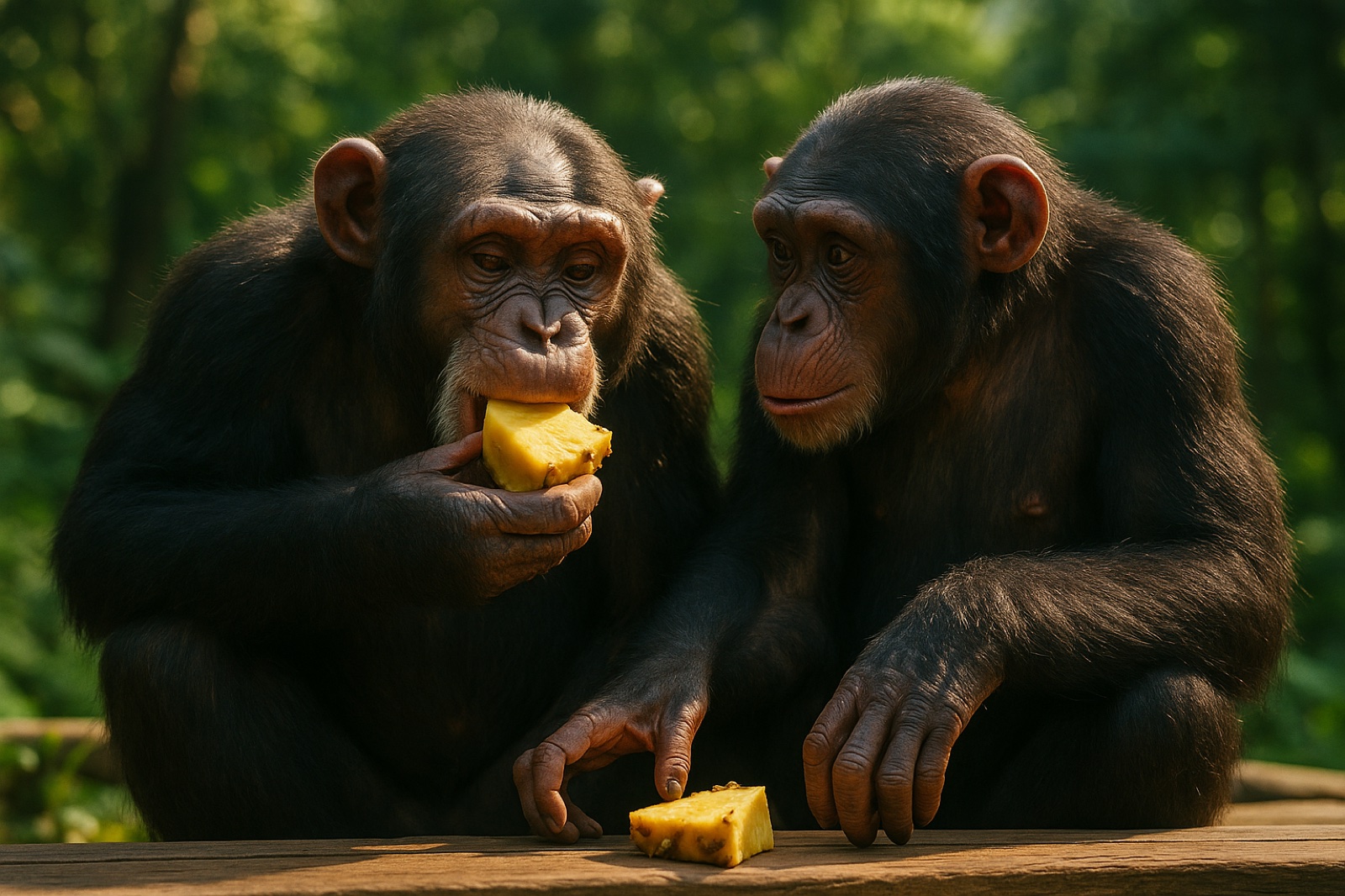
Put a chimpanzee in a room with a rope. Tie the other end of the rope to a tray of fresh pineapple. If no one else is around, the chimp pulls the rope. Every single time.
Now put a second chimp on the far side of that tray, already eating. Does the first chimp still pull?
A new study tested exactly that with 26 chimpanzees in Uganda. The short answer: chimpanzees steal less from friends than from other chimps. The longer answer is more interesting, and a little uncomfortable, because it sounds a lot like us.
What the chimpanzee stealing study actually did
The chimps live at Ngamba Island Chimpanzee Sanctuary, a forested island on Lake Victoria. Before any test began, a research assistant watched the group for 800 hours, at feeding times, four times a day.
They wrote down who groomed whom. Who touched. Who sat within arm’s reach. Who ate side by side. From all of that, the team worked out how close every pair of chimps was.
Then each chimp was given two partners. One was its friend: the chimp it was closest to. The other was a non-friend: a chimp it had an ordinary, middle-of-the-road bond with. The two partners were matched on sex and on rank in the group, so the main difference between them was the friendship itself.
Then came the test. One chimp, the “victim,” sat in a room eating pineapple off a tray through the bars. It could only pull one piece through at a time. Across a corridor, a second chimp, the “thief,” walked in and found the end of a rope tied to that same tray. One pull, and the tray, with two pieces of pineapple still on it, slid across to the thief.
No climbing. No fight. No way for the victim to reach over and hit back. Just a rope, some fruit, and a choice.
The study was led by Oded Ritov at the University of California, Berkeley, with researchers in Vienna, Leipzig, Jerusalem and Portsmouth. It is published in the journal Evolution and Human Behavior.
Chimpanzees steal less from friends. Now look at the numbers
Across 138 trials, the thieves pulled the rope 65% of the time. Split by partner, it looked like this:
- With a non-friend: the thief took the tray on 70% of trials.
- With a friend: the thief took the tray on 61% of trials.
That gap was big enough that the researchers are confident it is real and not luck. Friendship held some chimps back from an easy, sweet reward.
But read the friend number again. Six times out of ten, a chimp still took food from the chimp it was closest to in the whole group. Friendship made theft less likely. It did not make it rare.
And here is the detail that gives the small gap its weight. In the practice runs, when no other chimp was in the room, every thief pulled the rope every time. So whenever a chimp left the tray alone for its friend, it was turning down something it plainly wanted. The researchers write that holding back like this “requires a high degree of self-control,” especially in an animal that loves food as much as a chimpanzee does.
One more thing mattered: rank. The higher the victim stood in the group, the less likely it was to be robbed. So some of the restraint in this study was friendship. Some of it was probably plain caution about who might be upset later.
The part nobody predicted: how the victims reacted
The team also filmed every trial and counted signs of upset: screams, whimpers, barks, banging on the walls, and rough scratching, which in chimps is a sign of stress.
When a friend stole, the victims at first tended to be more upset than when a non-friend stole. That fits ordinary life. We expect more from friends, so when a friend takes from us, it stings more.
Then something changed. Trial after trial, the victims’ upset at their friend faded. With the non-friend, it stayed about the same the whole way through.
The researchers are careful here. They did not expect this, and they say it needs to be repeated before anyone leans on it. They offer two possible reasons. Maybe the victims calmed themselves down to protect the friendship. Or maybe, after the first theft, they simply expected less from that friend. Both are very human-sounding explanations.
The thieves told a story too. They made more noise, mostly screaming, when stealing from a non-friend. The authors suggest the thieves treated a non-friend as more of a fight. With a friend, the same act seemed to feel like something else.
What this says about friendship, for chimps and for us
Put it all together and the picture is simple. Friends get a softer hand. Non-friends get the rope pulled, often with shouting.
Most of us know this pattern from the inside. We forgive a friend who is late again. We are patient with a sister who borrows things and forgets. A stranger who pushes in at the market or the bus stop gets no such patience. If you have ever wondered how many people can really sit in that “friend” circle, the answer is smaller than you might think, as we found when we looked at what Dunbar’s number really means.
Chimps share a surprising amount of this social wiring with us. Young chimps even pick up local accents that show up in their laughter first, and humans, it turns out, laugh mostly because of who we are with, not because of jokes.
But this study also says something humbling. Going easier on the people we love is not some rare moral victory. It is old. A chimp on an island in Lake Victoria does it, imperfectly, with no rulebook at all.
The side of the tray a chimp won’t choose
Long before anyone tied a rope to a tray, Jesus made the same point in plain words. He said there is nothing remarkable about loving people who love you back. Everybody does that. Then He asked for the part that does not come naturally: be good to the stranger, even the one against you, and give without keeping score.
Seen next to this study, that request lands differently. The friend side of the tray is where instinct already gets us, most of the time. The stranger side, the 70% side, is where Jesus asked people to stand. Nature does not hand anyone that. It has to come from somewhere bigger.
A good place to start: The Beginner’s Guide to Feeling God’s Presence Every Day. A short video guide and companion PDF for noticing something bigger in ordinary days, at work, at home, and in line next to a stranger. Get the free guide. Free.
So what do you do with a chimp study?
Maybe just notice the rope next time. It shows up in small ways: the last seat, the last portion, the shortcut that costs someone you will never see again.
Being a good friend is a real gift, and this study shows it matters even in the forest. Being kind to someone who can never pay you back is the rarer one. In a sanctuary in Uganda, friendship pulled the number down by a few points. It is worth wondering what could pull it down further.
Discussion Question
Which do you think is harder: staying calm when a friend takes from you, or going easy on a stranger who would never even know you held back? Tell us what you think in the comments.
Share This
“Chimps stole from friends 61% of the time and from non-friends 70%. Friendship helps. It just doesn’t do as much as we’d like to think. https://bgodinspired.com/index.php/nature-and-creation/chimpanzees-steal-less-from-friends/”
“Every chimp grabbed the pineapple when it was alone. With a friend nearby, some held back. Turns out being decent to our own people is the easy part. https://bgodinspired.com/index.php/nature-and-creation/chimpanzees-steal-less-from-friends/”
“This chimp study made me think about how differently I treat friends and strangers. Worth a read: https://bgodinspired.com/index.php/nature-and-creation/chimpanzees-steal-less-from-friends/”
Questions People Ask About the Chimpanzee Stealing Study
Do chimpanzees steal less from their friends?
Yes. In a 2026 study of 26 chimpanzees at Ngamba Island Chimpanzee Sanctuary in Uganda, published in Evolution and Human Behavior, a chimp could pull a rope to take a tray of pineapple from another chimp. Chimps took the tray on 61% of trials when the other chimp was a close friend and on 70% of trials when it was not. Friendship lowered theft, but most chimps still stole from friends more often than not.
How did scientists decide which chimpanzees were friends?
Researchers watched the Ngamba Island chimpanzee group for 800 hours and recorded how often each pair groomed, touched, sat within arm’s reach, and fed side by side. Each chimp’s friend was the partner it was most closely bonded with. Its non-friend was an ordinary acquaintance of the same sex and similar rank as the friend, so friendship was the main difference.
Do chimpanzees get upset when a friend steals their food?
Yes, at first. In the 2026 Ngamba Island study, chimpanzees tended to show more upset, such as screaming, whimpering, and banging, when a friend stole their food than when a non-friend did. Over repeated trials, their upset at the friend faded, while their reaction to non-friends stayed about the same. The researchers did not predict this and say it needs to be repeated.
Why do chimpanzees steal less from friends?
The researchers behind the 2026 chimpanzee stealing study suggest chimps may expect more from friends and avoid stealing because it would break that expectation and damage the relationship. Holding back takes real self-control: every chimp pulled the food tray toward itself when no other chimp was present. Rank also mattered, since higher-ranking chimps were robbed less often.
What does the chimpanzee friendship study mean for people?
The 2026 chimpanzee study suggests that treating friends more gently than strangers is a very old pattern, shared with our closest animal relatives. It also shows that friendship reduces harm without removing it: chimps still stole from friends on most trials. For people, it is a reminder that kindness toward friends comes fairly naturally, while kindness toward strangers takes something more.