 0
0
 0
0
“Yesterday you were divorced. Today I am a widow.”
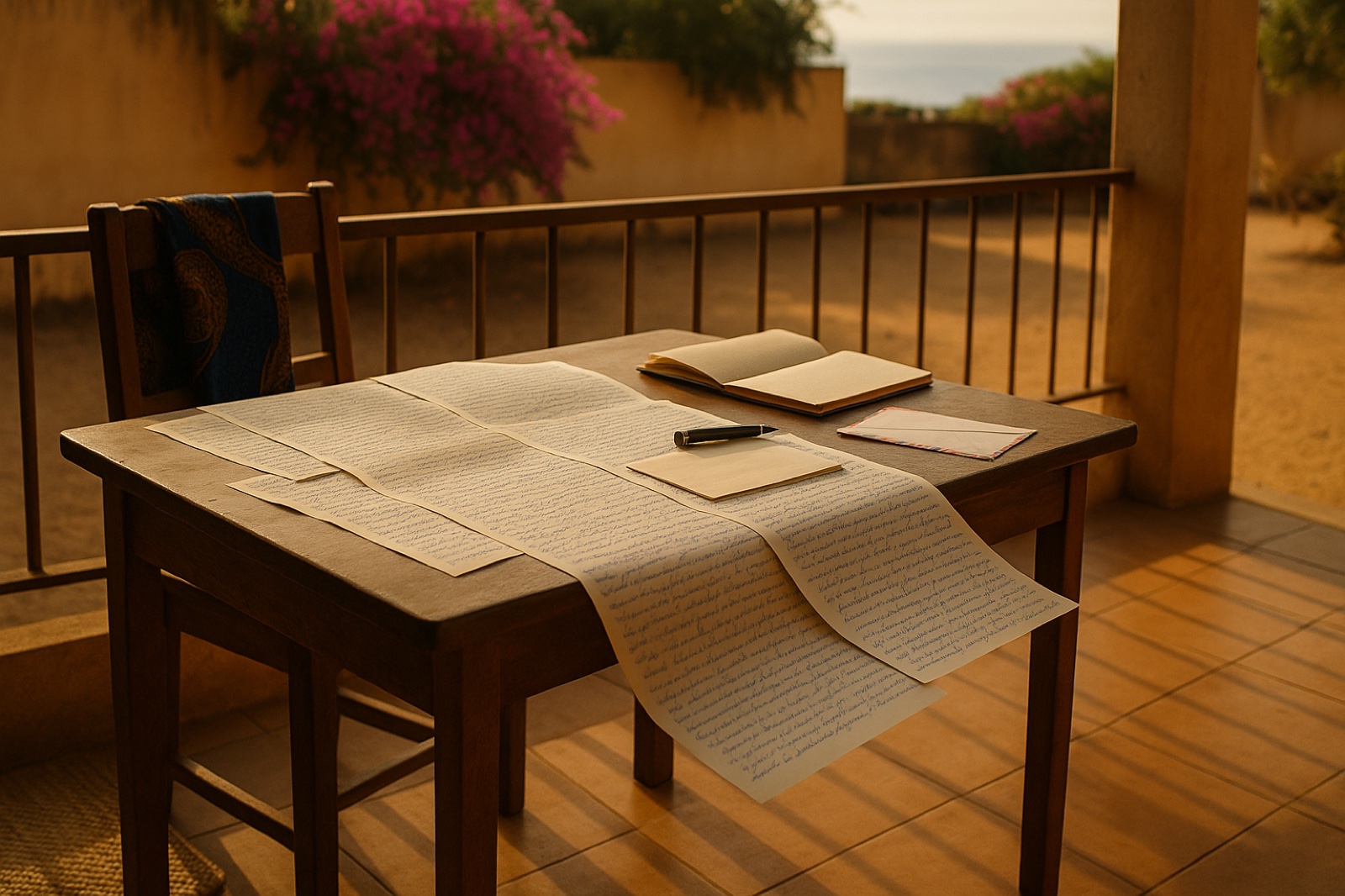
A woman in Dakar writes that line in the first pages of a notebook. Her husband has just died of a heart attack. Her faith asks her to stay indoors and mourn him for four months and ten days. So she sits down and starts writing to her oldest friend.
That is the whole frame of the book. One woman, one notebook, one reader. But the So Long a Letter meaning most summaries miss is hiding in that frame. A widow’s mourning is time set apart for a husband. This widow spends every day of it with her friend.
So Long a Letter summary: two wives, two answers
So Long a Letter is a short novel by the Senegalese writer Mariama Bâ. It was first published in French in 1979, in Dakar, as Une si longue lettre. In 1980 it won the first Noma Award for Publishing in Africa. The English translation is by Modupé Bodé-Thomas. Like Things Fall Apart, it is one of the African novels that students all over the world meet first. Readers who know Half of a Yellow Sun will find a much smaller canvas here: one house and one notebook.
The woman writing is Ramatoulaye, a teacher and a mother of twelve. The friend is Aissatou. Their friendship is older than they are. Their grandmothers passed messages across the fence between their two compounds. As girls they walked the same road to Koranic school. They buried their milk teeth in the same holes.
Both women married for love, and both marriages cost them something. Aissatou, a goldsmith’s daughter, married Mawdo Bâ, a doctor from a royal family. His mother never forgave the match. Ramatoulaye married Modou Fall, a law graduate her own family did not trust.
Then the same thing happened to each of them.
It came to Aissatou first. Mawdo’s mother, known as Aunty Nabou, raised her young niece to be a second wife for her son. Mawdo married the girl. He said he did it for his old mother’s sake, and that his heart had not moved. Aissatou did not argue. She wrote him a letter, took her four sons, and left. “Clothed in my dignity, the only worthy garment, I go my way.” She went back to her books, trained as an interpreter, and was posted to the Senegalese embassy in the United States.
Then it came to Ramatoulaye. After twenty-five years of marriage, Modou married Binetou, a school friend of their daughter Daba. He did not tell his wife himself. Three men came to her door that same day to tell her it was already done: his brother Tamsir, his friend Mawdo, and the Imam. Ramatoulaye smiled and thanked them.
Daba begged her mother to walk out, the way Aissatou had. Ramatoulaye stayed. She was ready to share her husband in the way her faith sets out. But Modou did not share. He moved in with his new wife and never came home again.
The book will not tell you who was right
It is easy to turn this story into a debate. Leave or stay. Modern or traditional. Brave or weak. A lot of essays on the themes of So Long a Letter do just that.
The book does not. Ramatoulaye tells Aissatou that leaving took courage, and she means it. But she never calls her own choice a mistake. She stayed because she still loved him, because of twelve children, and because of what she believed.
And she is not weak. On the fortieth day of mourning, Tamsir announces that he will marry her now, as if she came with his brother’s house. Thirty years of silence break at once. She tells him she is “not an object to be passed from hand to hand.”
Then a better man asks. Daouda Dieng is kind and well off, and he first asked for her hand when she was young. She turns him down too, in a letter. She does not love him. And he already has a wife. Ramatoulaye will not do to another woman what was done to her.
The book is just as fair to the people who hurt her. Binetou is a schoolgirl whose mother pushed her out of class and into a rich man’s house. Ramatoulaye sees her as a victim, not a thief. The girl Mawdo married was raised for that role from childhood. Much of the damage here is done by mothers.
Near the end, Ramatoulaye says she still believes a man and a woman need each other. So this is not a book against marriage. It is not a book against men, or against her faith, which she holds on to through every page.
So what is it for?
The mourning belongs to the husband. The pages belong to the friend.
Go back to the frame. The four months and ten days are for Modou. The visitors come for Modou. Custom even calls for the dead man’s affairs to be laid open, a practice the book calls mirasse, and that is how Ramatoulaye learns the last of it. He had mortgaged the house they paid for together, to buy a villa for the new wife.
Everything in those months points at him. Everything except the notebook.
Every page faces Aissatou. She is the “you” of the whole novel. And here is the strange part. A good share of what Ramatoulaye writes, Aissatou already knows.
She tells Aissatou the story of Aissatou’s own marriage. She recalls the gossip it caused, and the plans of Aissatou’s own mother-in-law. She even copies out, in full, the letter Aissatou wrote to Mawdo when she left. She hands a woman her own words back.
Nobody does that to pass on news. You do it to say: I was there. I saw what it cost you. I have kept it.
And the keeping runs both ways. When Modou left, Ramatoulaye and her children had to fight for places on public transport, while his money bought cars for the new household. She mentioned it to Aissatou in passing. Aissatou’s answer was to buy her a car. She ordered a Fiat and paid for it. Ramatoulaye was scared of driving, and learned anyway.
That is where she writes the line the book is best known for: “Friendship has splendours that love knows not.”
There is one more thing, and it is easy to miss. The long letter is a reply. Ramatoulaye says so in her first sentence: she has received Aissatou’s letter. Much later we find out what was in it. Aissatou is coming home on a visit.
So from the first page, Ramatoulaye knows she will soon be able to say all of this out loud. She writes it anyway. The letter is not there to carry news across an ocean. It is how she thinks. And she can only think this clearly because there is someone to say “you” to.
So Long a Letter ending explained
The last pages are written the day before Aissatou arrives.
First there is one more test. Ramatoulaye’s daughter, also named Aissatou after the friend, is pregnant by a law student, Ibrahima Sall. A neighbour expects shouting and shame. Ramatoulaye is angry for a moment. Then she holds her daughter. The woman who stayed turns out to be nobody’s frightened wife.
Then she turns to tomorrow. She has made a bet with Daba. Aissatou will turn up in a tailored suit, and after her years abroad she will want a table, a chair and a fork. Ramatoulaye will not give in. She will spread a mat on the floor and set out one big steaming bowl, and Aissatou will have to share it.
It is a joke between old friends. It is also the book’s answer to the debate. The one who left and the one who stayed will eat from the same bowl. Neither has to become the other.
Then come the last lines. Hope is still alive in her, she says. The word “happiness” does mean something, and she is going out to look for it. And if she fails, too bad for her. She will just have to write another letter this long.
The novel never shows the notebook being posted. It does not need to be. Its reader is almost at the door.
The promise nobody said out loud
Count the promises in this novel. Two marriages, made in love and in front of witnesses. Both men went on to make the same promise to someone else.
Then look for the promise that holds for a whole lifetime. Nobody ever spoke it. It started with two girls burying their milk teeth in the same hole.
There is a very old story with the same shape. Two women stand on a road. Both have buried their husbands. The older one, Naomi, tells the younger one to turn back, because there is nothing left to gain by staying. The younger one, Ruth, will not go. Where you go, she says, I will go.
Those words, from Ruth 1:16, are read at weddings all over the world. But they were not said at a wedding. One widow said them to another, after the marriages were over. The best-known promise of loyalty in the Bible is not a marriage vow at all.
Bâ’s novel does not point to that story, and nothing suggests it was on her mind. Ramatoulaye’s faith is Islam. She prays all through the book, and the book is told from inside that faith. The two stories do not need each other.
But they noticed the same thing. A promise is not proven on the day it is made. It is proven on the road afterwards, when leaving would be easy. Ruth does not make a second speech. She goes out into the fields and finds food for two. Aissatou does not make a speech either. She pays for a car.
Tomorrow, on the mat
So picture the day after the last page. A woman in a tailored suit, probably, sits down on a mat in Dakar and dips her hand into the shared bowl. Across from her is the friend who stayed.
The notebook is closed by then. It has done its work. For four months and ten days it kept a place open for a friend, in a house that was meant to be thinking only of a husband.
So Long a Letter is usually taught as a novel about a marriage that failed. Read it again and ask a different question. Who is the “you”? By that measure, it is a love story after all. The love that lasts in it is the friendship.
Questions Readers Ask About So Long a Letter
What is So Long a Letter about?
So Long a Letter is a 1979 novel by the Senegalese writer Mariama Bâ. It takes the form of one long letter from Ramatoulaye, a newly widowed teacher in Dakar, to her lifelong friend Aissatou. During her mourning period, Ramatoulaye looks back on thirty years of marriage to Modou Fall, who took a second, much younger wife and abandoned her and their twelve children. She also retells how Aissatou left her own husband, Mawdo, when he took a second wife.
What is the main message of So Long a Letter?
So Long a Letter by Mariama Bâ does not give one simple message. It shows two women, Ramatoulaye and Aissatou, who face the same betrayal and make opposite choices, and it refuses to say that either one was wrong. The clearest thing the novel says is about friendship. The marriages in the book break, but the bond between the two women lasts from childhood to the final page. Ramatoulaye puts it in one line: “Friendship has splendours that love knows not.”
Why does Ramatoulaye stay with Modou when Aissatou leaves Mawdo?
In So Long a Letter, Aissatou leaves Mawdo as soon as he takes a second wife, because she will not accept a divided marriage. Ramatoulaye stays married to Modou after he marries Binetou. Her reasons are her love for him, her twelve children, and her faith. She expects the equal sharing her faith lays down for such a marriage. Modou does not share. He abandons her. The novel treats her choice to stay as a real choice, not as weakness, and she later refuses two marriage proposals on her own terms.
How does So Long a Letter end?
So Long a Letter ends on the evening before Aissatou arrives in Dakar for a visit. Ramatoulaye has turned down proposals from Tamsir and Daouda Dieng and has stood by her pregnant daughter. In the final lines she says that hope is still alive in her and that she will go out in search of happiness. She jokes that if it goes badly, she will have to write another letter just as long. The novel closes with her signature.
Who are Ramatoulaye and Aissatou in So Long a Letter?
Ramatoulaye and Aissatou are the two friends at the centre of So Long a Letter by Mariama Bâ. Ramatoulaye is the narrator, a teacher and mother of twelve in Dakar, Senegal. Aissatou is a goldsmith’s daughter who married a doctor, Mawdo Bâ, left him when he took a second wife, and built a new life as an interpreter at the Senegalese embassy in the United States. They grew up together, and Ramatoulaye’s whole letter is written to Aissatou.
Over to You
Aissatou left. Ramatoulaye stayed. Which choice do you think took more courage? Or is the book right not to choose between them? Tell us what you think in the comments.
Share This
“In So Long a Letter, the mourning is for the husband. But every single page is written to the friend. That is the whole book.”
“Ramatoulaye spends half of So Long a Letter telling Aissatou things Aissatou already knows. It is not news. It is her way of saying: I was there, and I kept it.”
“So Long a Letter has two broken marriage vows and one promise nobody ever said out loud. Guess which one lasts to the final page.”