 0
0
 0
0
Some sentences stay with you for years. A teacher once said, “You’re good at this.” A parent said, “I’m proud of you,” once, on an ordinary afternoon. Someone at a hospital bed said, “It’s going to be all right.” You probably can’t remember what you had for lunch that day, but you remember the exact words, and sometimes the voice that said them.
That kind of word, the spoken kind that lands on a real day and stays, is close to the rhema meaning in the Bible. Rhema is one of the two main Greek words the New Testament uses for “word.” You may have heard it set against its better-known partner, logos, or seen it on the sign of a church or Bible college. This is what the word itself actually says, and the place in Luke where it shows up three times around one manger.
Rhema Meaning: A Word That Was Spoken
Rhema (ῥῆμα, Strong’s G4487) means something that has been said: a word, a saying, a statement, an utterance. It comes from an old Greek verb for speaking, so at its root it describes a word with a voice behind it. Not an idea floating in the air, but a sentence that somebody actually said out loud.
Here’s the part that surprises most readers. Rhema can also mean a thing, an event, a matter that happened. That second meaning makes more sense once you know the Greek Old Testament often uses rhema where the Hebrew has dabar, and dabar means both “word” and “thing.” In the Hebrew way of seeing it, what God says and what then happens are not two separate categories. The word is the event on its way.
You can see that in one of the best-known promises in Luke. When the angel tells Mary she will carry a child, he finishes like this:
“For with God nothing shall be impossible. And Mary said, Behold the handmaid of the Lord; be it unto me according to thy word.”
Luke 1:37-38 (KJV)
Read in Greek, verse 37 is built around rhema. A very literal rendering is something like “no word from God will be without power.” The “nothing” is a rhema. Then Mary answers, “be it unto me according to thy word,” and that “word” is rhema too. The angel says no spoken word from God is powerless, and Mary says, in effect, then let that spoken word happen to me.
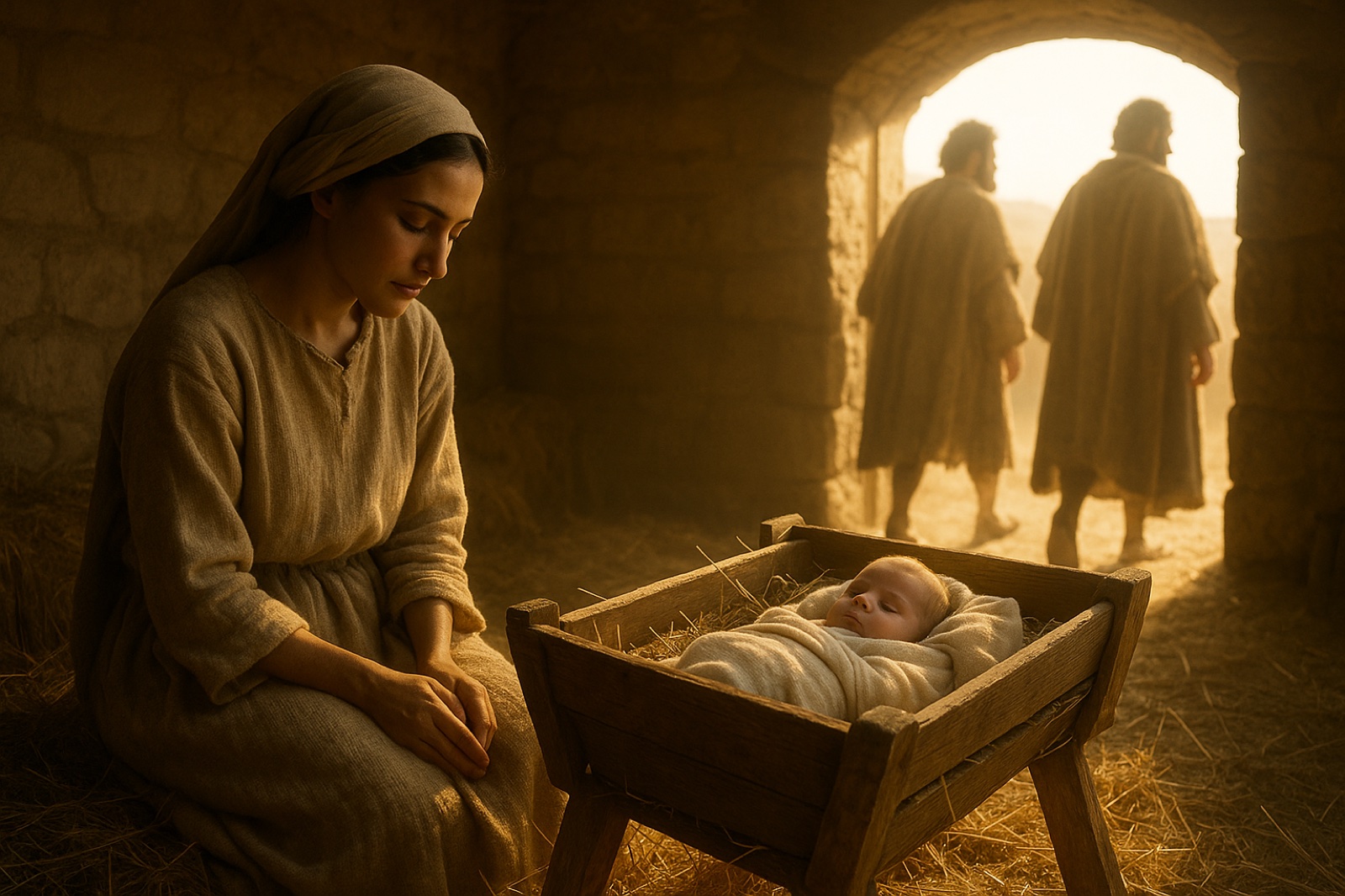
Three Rhemas Around One Manger
A chapter later, the word comes back three times in five verses, and the King James translators gave it three different English words. Each one is a fair translation, but together they hide a thread a Greek reader would hear right away.
- The shepherds say, “Let us now go even unto Bethlehem, and see this thing which is come to pass” (Luke 2:15). That “thing” is rhema. They go to see a word that has happened.
- After they find the baby, “they made known abroad the saying which was told them concerning this child” (Luke 2:17). That “saying” is rhema again.
- Then: “But Mary kept all these things, and pondered them in her heart” (Luke 2:19). “These things” is the plural, rhemata.
So what Mary kept wasn’t a general set of memories. She kept the spoken words: what the angel said, what the shepherds reported, what she’d heard said about her son. The word for “kept” here means to guard something carefully and hold onto it, and “pondered” pictures putting things side by side and turning them over to see how they fit.
Luke uses the word one more time at the end of the chapter, after a twelve-year-old Jesus says something in the temple that nobody understands: “his mother kept all these sayings in her heart” (Luke 2:51). Rhemata again. Mary didn’t understand that one either. She kept it anyway.
Rhema vs Logos: Is There a Real Difference?
Some popular teaching draws a sharp line between the two words: logos, it says, is the written word of Scripture in general, and rhema is a personal word God speaks to you for a particular moment. There’s something real underneath that, but it’s worth being exact about how much.
The real part is that rhema leans toward the spoken, particular word, the actual thing said. Logos is the broader word. It can mean a message, a reason, an account, even the whole meaning behind things, which is why John chose it for “In the beginning was the Word.”
What the New Testament doesn’t do is keep the two in separate boxes. Look at how Peter writes in a single paragraph:
“Being born again, not of corruptible seed, but of incorruptible, by the word of God, which liveth and abideth for ever… But the word of the Lord endureth for ever. And this is the word which by the gospel is preached unto you.”
1 Peter 1:23, 25 (KJV)
The first “word” is logos. The second and third are rhema. All three point to the same thing, the good news that was preached to Peter’s readers. So the honest summary is that the two words overlap a great deal, rhema tends to stress the word as spoken and heard, and a hard wall between “the Bible” and “a word for me” is more than the Greek alone can carry.
That doesn’t make rhema less personal. It makes it more grounded. When Jesus answered temptation in the desert, He said, “Man shall not live by bread alone, but by every word that proceedeth out of the mouth of God” (Matthew 4:4). That “word” is rhema, and Jesus was quoting Scripture that had been written down for centuries. The written word became a spoken word in His mouth, at the exact moment He needed it. The same pairing of bread and daily need shows up again in the prayer He taught.
Paul uses rhema the same way when he calls “the word of God” the sword of the Spirit in Ephesians 6:17. A sword is only useful in a hand, at a moment. The rest of that armor has its own surprising history.
At Thy Word
There’s one more rhema worth knowing, because it shows what you can do with one. Simon Peter had fished all night and caught nothing. He was a professional, and a carpenter’s son was telling him to push out into deep water and try again. Peter said:
“Master, we have toiled all the night, and have taken nothing: nevertheless at thy word I will let down the net.”
Luke 5:5 (KJV)
“At thy word” is rhema. Peter didn’t feel hopeful, and he said so first. He just let one spoken sentence from Jesus outweigh a whole night of evidence. Later, when many followers walked away, the same Peter said, “Lord, to whom shall we go? thou hast the words of eternal life” (John 6:68). Rhemata again. Peter kept coming back to things Jesus had actually said.
Keeping a Word You Don’t Understand Yet
Most of us treat the Bible like a library: true, valuable, and somewhere on a shelf. Rhema invites a different relationship. It’s the word that was spoken, so it’s meant to be heard, carried, and turned over, the way you carry the one sentence someone said to you on a hard day.
Mary is the clearest picture of what that looks like. She didn’t explain the angel’s words, and she didn’t understand what her twelve-year-old said in the temple. She kept them. She put them side by side and kept turning them over, and years later the pieces started to fit. Keeping a word doesn’t require you to understand it first. It only asks you to hold on to it long enough for it to happen.
And Peter shows the other half. Sometimes a word you’re keeping asks you to do one small thing before you feel ready. “At thy word” is enough of a reason to let the net down one more time.
A good place to start: The Beginner’s Guide to Feeling God’s Presence Every Day. A simple rhythm for noticing God in ordinary moments, even when life feels loud. Get the free guide. Free.
Actions to Take
- Circle the three rhemas in Luke 2. In your Bible or app, mark “thing” in verse 15, “saying” in verse 17, and “things” in verse 19. Write “same word: spoken” in the margin. It takes two minutes.
- Pick one sentence Jesus actually said. Choose one short line from the Gospels, like “Come unto me, all ye that labour and are heavy laden, and I will give you rest” (Matthew 11:28). Write it on a scrap of paper or set it as your phone’s lock screen for today.
- Say it out loud once at a hard moment. Rhema is a spoken word. The next time today feels heavy, say your sentence out loud, even quietly, the way Peter said “at thy word” before he moved.
Journaling Prompts
- What is one sentence someone spoke to you years ago that you still carry? Why do you think it stayed?
- Is there a word from Scripture you’ve held onto without fully understanding it? What would it look like to keep it like Mary did, instead of solving it?
- Where in your life are you being asked to let the net down one more time, at a word rather than at a feeling?
A Prayer
God, I have a lot of words about you on my shelf, and not many I’m actually carrying. Give me one word for today, and help me keep it the way Mary did, even when I don’t understand it yet. When I’m tired and the evidence says nothing will change, help me say “at thy word” and try one more time. Thank you that no word you speak is without power. Amen.
Discussion Question
Do you think English Bibles should translate rhema the same way every time, so readers can see the thread in Luke 2? Or is it better to choose “thing,” “saying,” and “word” so each verse reads naturally? Tell us what you think in the comments.
Social Share Posts
Post 1:
Just learned that “thing,” “saying,” and “things” in Luke 2:15-19 are the same Greek word, rhema. Mary didn’t keep vague memories. She kept the spoken words.
Post 2:
“Nevertheless at thy word I will let down the net.” Peter didn’t feel hopeful. One sentence from Jesus outweighed a whole empty night. That’s rhema.
Post 3:
Keeping a word doesn’t mean understanding it first. Mary kept sayings she didn’t understand, and years later they made sense. I’m trying to carry one word this week instead of solving it.
Q&A
What is the meaning of rhema in the Bible?
Rhema (ῥῆμα, Strong’s G4487) is a Greek New Testament word meaning something that has been spoken: a word, a saying, or an utterance. It can also mean a thing or event, because the Greek Old Testament often uses rhema for the Hebrew word dabar, which means both “word” and “thing.” The King James Version translates rhema as “word,” “saying,” or “thing” depending on the verse.
What is the difference between rhema and logos?
Rhema and logos both mean “word” in the Greek New Testament. Rhema tends to stress a word as actually spoken or said, while logos is broader and can mean a message, a reason, or an account. The two overlap heavily: in 1 Peter 1:23-25, the apostle Peter uses logos and rhema for the same “word of God” within three verses. A strict split where logos means Scripture and rhema means a private personal word is a later teaching, not something the Greek requires.
Where does the word rhema appear in the Bible?
Rhema appears many times in the Greek New Testament. Well-known examples include Matthew 4:4 (“every word that proceedeth out of the mouth of God”), Luke 1:38 (“be it unto me according to thy word”), Luke 2:19 (“Mary kept all these things”), Luke 5:5 (“at thy word I will let down the net”), Romans 10:17 (“faith cometh by hearing, and hearing by the word of God”), and Ephesians 6:17 (“the sword of the Spirit, which is the word of God”).
What did Mary keep and ponder in her heart in Luke 2:19?
In Luke 2:19, “Mary kept all these things, and pondered them in her heart,” the Greek word for “things” is rhemata, the plural of rhema, meaning spoken words or sayings. Mary was holding onto the words spoken about her son, including the shepherds’ report of what the angels told them. Luke 2:51 uses the same word again: “his mother kept all these sayings in her heart.”
How do you pronounce rhema?
Rhema is usually pronounced “RAY-muh” in English, with the stress on the first syllable. The “h” after the “r” is silent in English pronunciation. Pronunciation of ancient Greek varies between teaching traditions, so small differences are normal.