 0
0
 0
0
Anyone who has grown strawberries knows the race. You are not the only one who wants them. Birds want them. Slugs want them. Aphids settle in under the leaves and never leave. So you reach for a cover. And then the cover brings its own problem: whatever keeps the bugs out tends to keep the sun and rain out too.
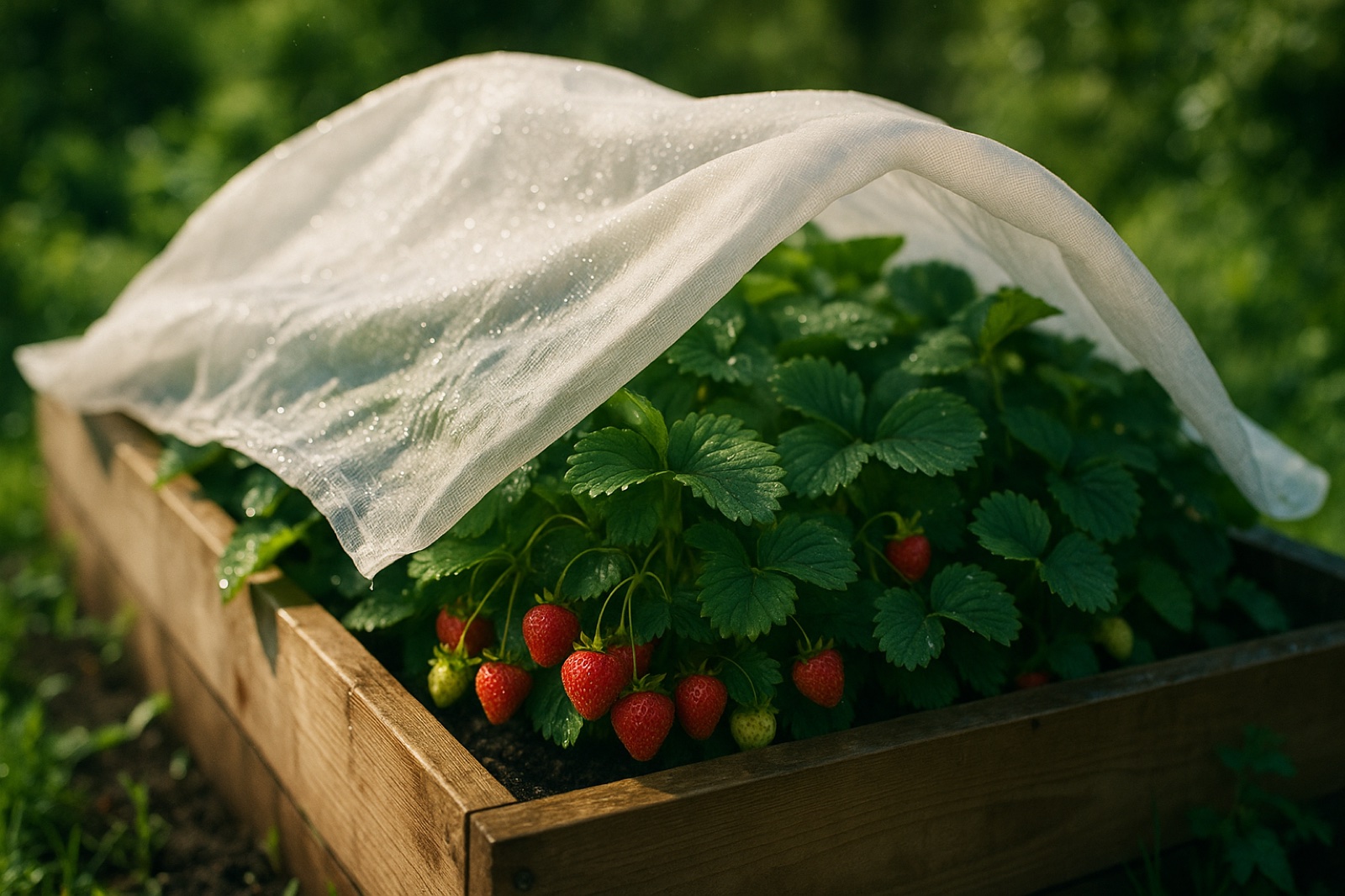
A small trial at North Carolina State University tried a different kind of strawberry plant cover. It is a knitted fabric, not a sheet or a screen. Under it, the plants grew more than three times as many berries as the plants left open beside them. The berries were bigger. They ripened a week earlier.
That is the headline. The details are better than the headline, and one of them is not what you would expect.
What the strawberry plant cover trial found
The team planted 24 strawberry plants of a variety called Sweet Charlie in three raised beds in Raleigh, North Carolina. In each bed, four plants sat under the cover and four sat in the open. They grew through autumn and winter and were picked over seven weeks in April and May of 2025.
The numbers from the paper, which was published in the journal Agriculture:
- Covered plants produced about 3.56 times as many berries as uncovered plants.
- The average covered berry weighed about 12.2 grams. The average uncovered berry weighed about 6.6 grams. That is close to double.
- The first ripe berries under the cover came about one week earlier.
Those are big differences. They also come from a small trial: one variety, one place, one season, 24 plants. The researchers say so themselves. A result like this is a reason to run a bigger trial, not proof that every garden will get the same thing.
How the knitted fabric works
The material is called Plant Armor Generation 2. It has two outer layers of polyester, joined by an inner layer of very fine polyester threads. Together they make a thick, three-dimensional fabric with a winding path through the middle.
Air passes through. Water passes through. Light passes through. But an insect trying to reach the plant cannot just squeeze through a hole, the way it might with an ordinary screen. It has to find its way through the maze.
That maze idea is not new to this team. An earlier version was tested on cabbage, and NC State reported that tobacco thrips took roughly three hours to get through it, against about twelve minutes through a standard single-layer cover. The cabbage plants under it also grew noticeably larger. (That earlier work is described in NC State’s 2022 release.)
For the strawberry study, the lab test was done with young aphids. They could not cross the fabric.
If you have spent money on other ways to beat garden pests, you may also like our look at what pesticides quietly do to queen bees. The cover approach is interesting partly because it uses no chemicals at all.
The part the headlines skip: aphids got in anyway
Here is the detail that most write-ups mention once and move past.
Out in the beds, yellow rose aphids showed up in both groups. Under the cover and in the open. The team treated both groups once with insecticidal soap. The paper does not pin down exactly how the aphids got into the covered plots. The most likely answer is the obvious one: a cover has edges, and edges have gaps. Aphids are also often carried in on the plants themselves.
So the cover did not seal the plants off from the world. It could not. The fabric was built on purpose to let things through. That is why the plants thrived. The same openness that let in sun and rain left room for a few aphids to find a way in too.
The researchers are plain about what they do not yet know. They have not measured the cost, how long the fabric lasts, whether it saves water, or whether it pays for itself on a real farm. They also do not claim to fully explain why the covered plants did so much better. More sun and rain got through than a typical cover would allow, and the plants were shielded from some feeding, but the exact mix is still an open question.
What this means if you grow strawberries at home
You probably cannot buy this exact fabric yet. But the lesson travels to any cover you already use, from a net to a hoop of row fabric.
- Do not seal the bed. A cover that blocks sun and rain costs you fruit. The whole point of the knitted cover was that it let the good things in.
- Check the edges. Pests come in where the cover meets the soil, the frame, or itself. Tuck, weigh down, and look under the cover often.
- Check the plants before you cover them. A cover can trap a pest inside just as easily as it keeps one out.
- Expect to tend it. Even in a university trial, the covered plants still needed one treatment. A cover changes the work. It does not end it.
It is worth noticing what the best protection in this trial actually looked like. It was not a box. It was a hedge. It kept out most of what would eat the fruit and let in everything the fruit needed to grow. Light, water, and air passed through. Trouble found the maze slow going.
That picture is older than this study. One of the oldest songs about a vineyard describes its owner building a hedge around it, not a wall. Hedges are a strange way to describe being kept safe, because a hedge is not a sealed thing. Wind goes through it. Rain goes through it. Sun goes through it. The idea is that being protected by God was never meant to mean being shut away from life. It means something stands between you and what would strip you bare, while everything you need to grow still reaches you. And, as the trial quietly shows, a few aphids still get in. The hedge is not the same as nothing ever going wrong. It is the difference between a hard season and a stripped field.
An old harvest law from the same world even asked farmers to leave the edges of their fields unpicked for people who had nothing, which we wrote about in what gleaning in the Bible really meant. Edges, it turns out, have always mattered in a field. They are where things get in, and where things get given away.
Back in Raleigh, the trial is over and the plants have been pulled. The next step is a bigger one, with more varieties, more places, and a real look at cost. If that holds up, growers could get more fruit with fewer chemicals, which would be a good outcome for a lot of people who will never know a knitted fabric had anything to do with their breakfast.
For now, if you have a strawberry bed and a cover, lift the corner this week and look under it. The berries will tell you how well your hedge is working.
A good place to start:
The Beginner’s Guide to Feeling God’s Presence Every Day
A simple guide to noticing God in ordinary moments, even in a garden bed on a Tuesday.
Get the free guide
Free.
Discussion question
Would you rather have a cover that keeps every pest out but blocks some sun, or one that lets more light and rain through and accepts a few pests? Which trade would you make in your own garden? Tell us in the comments.
Share this
- A knitted cover grew 3.5x more strawberries in an NC State trial, and the reason is not what I expected. The best protection was not a sealed box. https://bgodinspired.com/index.php/nature-and-creation/strawberry-plant-cover-trial/
- Growers, read this before you buy another row cover. The plants that did best were the ones whose cover let sun and rain in. https://bgodinspired.com/index.php/nature-and-creation/strawberry-plant-cover-trial/
- Small trial, big result: strawberries under a 3-D knitted fabric produced more than three times the fruit. The catch is in the edges. https://bgodinspired.com/index.php/nature-and-creation/strawberry-plant-cover-trial/
Questions and answers
What is the knitted strawberry plant cover from NC State?
It is a fabric called Plant Armor Generation 2, developed at North Carolina State University. It has two outer polyester layers joined by a layer of fine polyester threads, forming a thick three-dimensional material with a winding path through it. Air, water, and light pass through, but insects must find their way through the maze rather than through a simple hole.
How much more fruit did the covered strawberry plants produce?
In a small trial published in the journal Agriculture, strawberry plants under the knitted cover produced about 3.56 times as many berries as uncovered plants grown beside them. The covered berries were also heavier, averaging about 12.2 grams against about 6.6 grams, and the first ripe berries came about a week earlier. The trial used 24 Sweet Charlie plants in Raleigh, North Carolina, harvested over seven weeks in April and May 2025.
Did the strawberry plant cover keep aphids out?
Partly. In laboratory tests, young aphids could not cross the fabric. In the outdoor trial, however, yellow rose aphids appeared in both the covered and uncovered plots, and both groups were treated once with insecticidal soap. The researchers did not determine exactly how the aphids got into the covered plots, but openings around the edges of a cover are the usual route.
Can I buy Plant Armor for my garden?
The strawberry study does not report a price, a retail product, or an availability date. The researchers state that cost, durability, water savings, and profitability still need to be assessed. For a home garden, the practical lessons apply to any cover you already own: let sun and rain through, seal the edges carefully, and check the plants both before and after covering them.
Is a knitted crop cover better than a regular row cover?
The trial suggests it may be, but it was a single small study using one strawberry variety at one site over one season, so it is not yet proof. Earlier NC State work on cabbage found that tobacco thrips took roughly three hours to pass through the knitted material compared with about twelve minutes through a standard single-layer cover. Larger trials with more varieties and locations are needed before growers can count on the same results.